Disturbing Question — How on Earth Can a Public Defender Program Rely on Court Imposed Fees for its Budget?

I am not sure I can stand this.

According to its own communication director, the New Orleans public defender relies on fines and fees imposed by the court for 41% of its budget (NOLA CityLab here).

New Orleans’ Office of Public Defenders’ communications director Lindsey Hortenstine tells CityLab that court fines constituted 41 percent of the office’s budget in 2014. But public defender services, which assist defendants who can’t afford a private attorney, are otherwise starved of the capital needed to fulfill their obligations, as is much of the city’s court system. So the costs are absorbed by poor defendants who are basically “paying to be prosecuted,” says Adrienne Wheeler, executive director of the New Orleans-based Justice and Accountability Center of Louisiana.

Indeed, as  reported by the New York Times here, this is part of a broader problem in which these fines and fees also support the courts and the prosecutors.

On Thursday, [six] plaintiffs in a class-action lawsuit against the criminal district court here, among others, alleging that judges and court officials have been running an “illegal scheme” in which poor people are indefinitely jailed if they fall behind on payments of court fines, fees and assessments. The suit describes how fees are imposed with no hearing about a person’s ability to pay, and how nearly all components of the local criminal justice system — the judges, the prosecutors, the public defenders — benefit financially to some degree.

“The extent to which every actor in the local New Orleans legal system depends on this money for their own survival is shocking,” said Alec Karakatsanis, a founder of Equal Justice Under Law, a civil rights group, and one of the lawyers who filed the suit. The funding arrangements at the court have been particularly controversial here in recent years, in the wake of allegations of abuses in the way money raised from defendants has been spent.

But in general, said Mr. Karakatsanis, who filed a similar suit in Ferguson, Mo., in February and helped force changes to jailing policies in Montgomery, Ala., last year, “the effort to fund local court systems on the backs of the very poor is not an aberration.”

The article goes into detail about abuse of the fees fund by judges for things like premium health insurance.  But the one that goes beyond shocking for me is the inclusion of public defenders.

Unless I get this wrong, the person who is meant to defend you against these charges, and, at least in theory, address whether you can pay them, depends for those fees for 41% of this salary.

Does the word “conflict” not come into mind?  See e.g. Tumey v. Ohio
273 U.S. 510 (1927)(reversal; “The question in this case is whether certain statutes of Ohio, in providing for the trial by the mayor of a village of one accused of violating the Prohibition Act of the State, deprive the accused of due process of law and violate the Fourteenth Amendment to the Federal Constitution, because of the pecuniary and other interest which those statutes give the mayor in the result of the trial.”).

Sounds like all convictions should be voided from when this started to happen, and the contemporaneous objection rules are of no help in saving the conviction when the person who was meant to make the objection had a financial incentive not to do so.

Kudos again to Alec Karakatsanis, and also to the Brennan Center, that has done a lot on this issue. But, shame to the rest of us for somehow not being enough on this.

Posted in Access to Counsel, Attorney-Client, Bail, Court Fees and Costs, Defender Programs, Poverty | 3 Comments

We Need a National Campaign for Access to Justice — Why the CCJ/COSCA Resolution Makes it So Much Easier and What Might It Start to Look Like?

There are lots of reasons why we really do not have in place anything like a national campaign for 100% access     (Although we have certainly become much better at talking about the need).  One of the reasons for the lack of a clear campaign is that we have not had focused agreement, beyond the very general term, on what achieving such access would actually require, what it would look like, or how the process might be led and managed.

That all changed a few weeks ago.  Look at this from the Conference of Chiefs/Conference of State Court Administrators Resolution.

WHEREAS, significant advances in creating a continuum of meaningful and appropriate services to secure effective assistance for essential civil legal needs have been made by state courts, national organizations, state Access to Justice Commissions and other similar bodies, and state bar associations during the last decade; and

WHEREAS, these advances include, but are not limited to, expanded self-help services to litigants, new or modified court rules and processes that facilitate access, discrete task representation by counsel, increased pro bono assistance, effective use of technology, increased availability of legal aid services, enhanced language access services, and triage models to match specific needs to the appropriate level of services;

NOW, THEREFORE, BE IT RESOLVED that the Conference of Chief Justices and the Conference of State Court Administrators support the aspirational goal of 100 percent access to effective assistance for essential civil legal needs.  .   .

You pretty much have it there.  This is what we need, and this is the service continuum that will get it there.

So with that, and with the endorsement in the Resolution, for each state of a “strategic plan with realistic and measurable outcomes,”  and with the endorsement of both judicial leadership and the planning role of access to justice commissions or equivalent,  you have the goal, the method, and the leadership basically outlined, and you have something we can all rally around, contribute to, and organize in support of.  While there is lots to fill in, we are so much more in unison now.

The campaign to achieve what the Chiefs and COSCA have laid out will include many elements, including pilots and innovation, strategic planning, research, public communication, legislative campaigns, coalition outreach beyond the legal system, and above all creating a narrative of feasibility.  Above all, we must always hammer home that this is not a hopeless dream, rather it is something that requires change and commitment, but is far cheaper, far more practical, and far more achievable than we thought a few years ago, when we focused on the cost of counsel for all, rather than that as one element in a much larger continuum of services.  Some, but far from all, of these elements are in place, but they can now be so much more effective when they are seen as part of the campaign to achieve the overall goal of the CCJ/COSCA resolution.

And, while I do not know what phrase we want, let alone if  “100% access to justice” is the right one, I do know that we need a phrase that describes this campaign that resonates for everyone, of every party, and every stakeholder interest.  Finding a phrase will much easier now that we have near consensus that no one service solution will realistically be best for everyone who suffers an access barrier.  See,for example, the comment by John Pollock of the National Coalition for a Civil Right to Counsel to this post, a comment that, as a general matter, takes this tack (It is the bottom comment to the post.)

Every organization and constituency should be thinking how they can be part of that campaign, and indeed what phrase will make their participation easiest and most effective.


Posted in Access to Justice Boards, Access to Justice Generally, Bar Associations, Budget Issues, Communications Strategy, Legal Aid, LEP, LSC, Self-Help Services, Simplification, Triage, Unbundling | 1 Comment

The Risks of a Narrow Definition of Access to Justice

There is up at the ABA.com “Rebel Lawyers” an article titled “Lawyers need to move beyond ‘access to justice’ to close the legal services gap.”  It is by Dan Lear, currently director of industry relations for Avvo.

What it actually argues is really that the single lawyer full representation or assistance model is not working, and that many people do not seek “justice” but rather services such as wills.

He highlights how bad the actual statistics are, and argues that working only on “access to justice is a mistake because the problems of those other than the poor or disadvantaged are different from those of the rest of us, and the solutions they need are different.

What he seems to be doing is defining the access to justice movement as being focused only on what he describes as the “poorest and most disadvantaged.”

Modest-means clients are also different than the access-to-justice clients. For one, while they may not be able to afford traditional full representation legal services but they can pay something. Further, many modest means clients are middle-income individuals, so they’re more likely better educated with better access to technology or other resources that would help them self-educate, receive unbundled legal services delivered partially or fully though technology or online, or navigate the legal system with only limited guidance from an attorney.

Under the traditional “access to justice” model, access-to-services clients would receive extensive one-on-one attention from an attorney to address their legal need. And at no cost.

While I agree with the substance of many of his observations, I find the definition of “access to justice” that he uses confuses the matter, has too narrow a definition of the services provide to even the narrow poor constituency, and makes it look like there is more division than there is.  While I am sure you can find examples of people and plans that define “access to justice” narrowly, I think that these days most of us think of the term in broad terms, and focus on the needs of all who experience barriers such as cost, regardless of actual income.  We see that it is only by understanding these barriers as part of the same underlying problem, that we will get the agreement on solutions.

While there will be differences in the specifics of solutions, and certainly in how they are funded, we need to think of this as one integrated problem.  Maybe, if people do think of the term “access to justice” so narrowly, maybe we need another one.  By the way, the research suggests that the phrase is meaningless to the general public.  Actually, while they are more likely to recognize it, they do not even necessarily think of the phrase “legal aid” as limited to low income people, although for the professional elite it has a long history.  I have suggested alternatives.

So lets see this as part of a big picture, and talk about it that way.


Posted in Access to Justice Generally, Document Assembly, Forms, Legal Aid, Middle Income, Mixed Model, Systematic Change, Technology, Unbundling | 1 Comment

The Pope Joins the Simplification Movement

In the slow-moving Vatican bureaucracy, it’s big news, as reported in the Washington Post, when the annulment procedures are made easier.  Or, as Katherine Alteneder put it:  “The Pope joins the simplification movement.”

Specifically:

The changes will eliminate a requirement that all annulment decisions get a second judgment and will allow local bishops to expedite the annulment process for some cases. The annulment process will be free of charge, though many dioceses had already eliminated the administrative fees for marriage annulments, according to a Vatican spokesman. The revisions also expand the role of local bishops in judging nullification proceedings. .  .  .

Another change announced  Tuesday will allow bishops the ability to further expedite the annulment process for some particularly straightforward cases — a process that [a theologian at Catholic University] Pecknold said would allow the bishop to essentially “write a note.”  .  .  .

Another change announced  Tuesday will allow bishops the ability to further expedite the annulment process for some particularly straightforward cases — a process that Pecknold said would allow the bishop to essentially “write a note.”

So, this is a classic example of making no formal change in governing law, but effecting a massive real-world change by changing procedure.  Its just like making banks attorneys certify that the records exist as part of a collection process commencement.

And it is also a recognition that for most folks the procedure is the real barrier — starting with the fees.  Moreover, sometimes the solution is to move at least uncontested cases, and maybe others, out of the courts.

So the lesson is clear.  Look to why people are not using a process, to why they are getting bogged down or defaulting out, and change the process to reflect the reality of who has the information, who can move easily, and what they need to do what is needed.

So, who will be first to offer document assembly for annulment petitions?  (List of requirements for marriage and by implication of possible reasons for annulment from the US Conference of Catholic Bishops here.)  It is broader than one might expect.  For example in terms of broad implications of possible reasons, from the Diocese of Gary Indiana here is a pdf annulment petition packet with a two page list of possible reasons.

Posted in Document Assembly, Simplification, Systematic Change | Comments Off on The Pope Joins the Simplification Movement

LSC’s Jim Sandman Interview Shows Pace of Change in Access to Justice

A recent interview that LSC’s Jim Sandman gave to Bloomberg/BDA underlines how fast things are changing in access to justice.  Among the nuggets:

  • Among the reasons Jim gives for the access crisis is  “A regulatory system that stultifies innovation and constricts the ability of competent, qualified non-lawyers to provide assistance to clients in the way that nurses and physicians’ assistants provide medical care to patients.
  • On the mismatch between the system and the reealities of who is represented and who not: “We have legal system that was largely created by lawyers for lawyers and built on the assumption that you have a lawyer. It’s a system that works pretty well if you have a lawyer and not well at all if you don’t. Litigants forced to represent themselves often experience poor outcomes even if they have meritorious claims or defenses. Can you imagine a system less user-friendly to people without lawyers?”
  • On simplification, pricing, and regulatory barriers:  “We need more and better do-it-yourself resources, particularly online. We need to relax regulatory barriers that impede competent paraprofessionals in assisting people who can’t afford counsel. We need to simplify the legal system to make it more user-friendly for people who don’t have counsel. The system is far more complicated than it needs to be, especially in areas of law affecting the necessities of life for people who can’t afford a lawyer. We need to develop pricing models and service-delivery systems that permit lawyers to earn a decent living without charging rates that only the wealthy can afford.”
  • A brilliant summary of the potential of technology:  “Technology allows us to push out information to the public that was previously accessible only to lawyers. It can provide user-friendly form-preparation assistance for the unrepresented, much like TurboTax helps people prepare tax forms. It can stretch limited resources for legal aid providers, allowing them to automate processes that lawyers used to handle. It can enable legal aid offices to offer some assistance to people they otherwise would have to turn away with nothing. It can assist pro bono lawyers taking on matters in areas of practice that may be new to them. It can help increase the efficiency of routine business processes. LSC’s “Report of The Summit on the Use of Technology to Expand Access to Justice” provides a blueprint.”
  • On the high tech legal businesses:  “The do-it-yourself movement is pervasive across all segments of the economy today. It’s not going away, and anyone who thinks law is immune to it is delusional. These players are making legal information much more accessible. They are simplifying and routinizing processes for dealing with the most commonly occurring legal problems. And they are reducing costs to consumers.”

That Jim understands the potential of the transformations taking place today makes me much more optimistic about the potential impact of the 100% Access to Justice Resolution passed by CCJ and COSCA.

To get to 100% we will need to make every use we can of these new approaches, and the leverage and legitimacy of LSC and its Board will be critical in ensuring that this happens.  LSC, through its grantees, has impact on every civil court in the country, just as the Chiefs and COSCA do.

The strategic question is how to use that leverage in ways that facilitate speedy change rather than stimulating anxiety and therefore less progress.  I believe that the creation of self-reinforcing momentum among institutions at all levels is the key.  The Resolution provides a trigger, a spur, and at least the beginning of an organizational structure through its encouragement of the use of ATJ Commissions or alternatives.

This exciting and rewarding conversation should be starting in every group.


Posted in Access to Justice Boards, Access to Justice Generally, Legal Aid, LSC, Non-Lawyer Practice, Simplification, Systematic Change, Technology | Comments Off on LSC’s Jim Sandman Interview Shows Pace of Change in Access to Justice

Reflections on Two Comments on 100% Access to Justice Definition

The proposed definition of 100% access to justice has received near record comments — and hopefully there will be more.  I want to comment on two here, although all are worth consideration and debate.

Jim Greiner points out that the proposed definition assumes that the person with a claim will usually, if provided sufficient information about an actual available remedial path, will take the needed steps.  But, as he points out:

But a large, and growing, mountain of research going under various names (such as “behavioralism”) is suggesting that the majority of folks will not take action in areas in which they perceive action-taking to be difficult (law, health habits) even when action-taking is OVERWHELMINGLY in their own best interest. If that’s right, then a focus on maximizing individual autonomy and decision-making may simple recreate the world we live in now.

He suggests that we need to change the underlying processes so that they are structured so that they do not act unless it is appropriate, and that silence of one potentially acted against should not be used as a full measure of appropriateness.  Rather:

 .  .  . [T] he problem may be the default rule. (. . . “default” means what happens if nothing happens.) To stay with the []debt] example: In the debt collection context, the “default” rule is . . . default (by the defendant). What if the default rule were different? What if the rule were that the plaintiff had to make a serious evidentiary showing of entitlement to relief before a judgment could be entered? A rule like that would not fit within your definition because it does not focus on maximizing individual/defendant empowerment and choice. But it may be (again, we need more research here) to allow effective access.

I agree that 100% access to justice ultimately means changing court processes so that they reflect the realities of access to information and of litigant capacity and determination, include significant simplification.  Indeed, experiments in places like NY that place greater evidentiary burdens on creditors in the foreclosure context have been very effective — see especially last bullet point, descried here.

The problem is how to come up with a definition that does not go from mission creep to mission explosion, thus undercutting the liklihood of broad incremental strategic change that is needed.

Maybe it might meet all goals if the following were added after the first sentence:

Such a true 100% access state will be more easily and cost-effectively achieved and more genuine if the underlying decision-making processes are designed to minimize the complexity of the underlying  proceedings, so that choices about whether to participate are based to  the greatest extent possible on the person’s view of the merits, and their desire to resolve the matter, rather than on any deterrent effect caused by the complexity or burdens that might be reduced or transferred, even at the initial stage.

The second comment I want to discuss comes from Cathy Carr.  She ulimately proposes that all procedures should be denominated “lawyer-free” or “lawyer for all.”

I think for us to suggest that people with lots of resources get lawyers, and others get something short of that, is not an equitable system. Lets stop talking about what is enough assistance for poor people to get, and instead talk about how the whole system should run. If we are going to now design a system where lawyers are not needed, then no one should have one. If the system is still designed where lawyers come in with people who can afford it, then everyone should have that same benefit. I agree that of course its unrealistic that we provide lawyers for everything. So then lets make systems that don’t require or allow the use of lawyers in certain areas. But we shouldn’t be talking about making poor people use a system without a lawyer, where everyone with money uses a lawyer.

It certainly has the appeal of symmetry, and a certain kind of formalist fairness.  On the other hand, as a practical matter, unless it was defined as “lawyer for almost all”, it would come up against Fifth and Sixth Amendment concerns that it was depriving people of the right to counsel — not to mention the political interests of the bar.  To the extent that there is currently some sympathy in the bar for simplification, moving in this direction would surely reverse that instantly.

Similarly, our work on triage has shown that whether a person needs a lawyer, an unbundled service, a nonlawyer advocate, or another means of help is a highly complicated matter, involving many factors beyond the case type or the presence or absence of a lawyer on the other side — major contributors though those are.  So, we would end up having to start many cases with a pre-procedure to decide if this is a lawyer or a non-lawyer procedure, and surely we could only make that decision after participation by lawyers — so we would be off again to the same expensive and unfair races.

On the other hand, I do think that it could be useful to have a careful and focused consideration of whether the current small claims prohibitiion on the participation of lawyers in some states might be expanded.   (Although it has to be recognized that this approach has had mixed success, mainly because the frequent flier landlords, banks and merchants are often more effective than lawyers.

Moreover, Cathy’s point emphasizes that there is huge value in trying to change procedures so that it does not matter if a lawyer is there or not.  It is certainly possible to design a procedure so arcane and inhpitable that the self-represented will always lose.  We know that it is possible to create, at least in some contexts, situaitons in which this is not the case.  So that means that we can move judges, procedures and outcomes along that continuum.

So, thanks again to all of our Commentators.

Please note that I have changed the design of the blog slightly so you can now see a list of the five most recent comments on all posts, and go straight to one of them.  Of couse, you can get to comments by going to the post itself, and then clicking the link near the bottom of the post.


Posted in Access to Justice Boards, Access to Justice Generally, Administative Proecdure, Bar Associations, Budget Issues, Commentators, Consumer Rights, Court Management, Guest Bloggers, Research and Evalation, Simplification, Systematic Change, Triage | Comments Off on Reflections on Two Comments on 100% Access to Justice Definition

Towards a Definition of “One Hundred Percent Access to Civil Justice”

With the setting by the Conference of Chief Justices (CCJ), and the Conference of State Court Administrators  (COSCA) by Resolution of 100% access to justice as an “aspirational goal,” the question of just what that term means becomes more and more important.

With the Resolution also calling for each state to develop access to civil justice strategic plans with “realistic and measurable outcomes,” agreement on what 100% would mean, as well as what “access” would require, are a key part of the process.  It should also be noted that the endorsement of a “continuum of meaningful and appropriate services,” makes both achieving the goal easier, and defining success more difficult and more important.  If you believe that everyone should have a lawyer for everything, and that is all that you need (special link for Jane Austen lovers), then you have your measure right there — what percentage actually get a lawyer.

Before offering a definition, let me urge, in the spirit of “real[ism]” in the linked to Resolution that we not engage in “goal creep,” and try not to load up the definition with everything.  That might well doom the whole effort.  So here is one starting tentative  suggestion:

A state is providing 100% access to justice in its courts and dispute resolution institutions when available justice services are such that any individual who either might gain by seeking the assistance of an institution to protect their significant interests, or who might gain from assistance in preventing another to use the institution to impinge on their interests, is sufficiently informed about such services to be able decide whether they wish to seek such services, to be able to take the steps required to obtain them if they choose, and can in fact obtain such services if sought.  Such services must be available without excessive burden, regardless of the individual’s  financial resources or other barriers such as language or capacity.  Such available and accessible services must be sufficient to ensure that the facts and the law are sufficiently placed before the decision-maker so that a neutral decision-maker can make the decision on the facts and the law, unless an individual decides, upon appropriate information, that they do not want to pursue their case.

Note that this draft does not require that everyone actually seek and get those services, only that they are “sufficiently informed” about them, and that they can get them if they decide to seek them.

Note also that while a decision on the facts and the law is critical in many cases, this definition allows a party to opt out of the process where appropriate.  (Often, for example, default is the optimum legal strategy.)

This version does include administrative agencies, although in a general sense only.  It some states it might not be appropriate for a Commission, depending on the Commission’s mandate.

This version does not include the federal courts.

Obviously it does not require that services be free, only that they not impose an excessive burden, and that they are not barred by resources or other barriers.

This definition does not include transactional services, such as will writing, contracts, leases, complaints, etc.

Nor does it directly deal with the merits of cases or the “justice” of underlying substantive law.  While it requires proper presentation of facts and law, it does not explicitly require that the decision maker be neutral, since that is taken care of in Codes of Judicial Conduct.

Maybe the way to deal with omissions is to think about what organizations should be asked to consider adopting a similar goal for their areas of responsibility.  Judicial leadership in promoting such initiatives would certainly be highly appropriate.  Interestingly, the hardest area then becomes the transactional one.

Another approach would be to draft a comprehensive definition, but then make clear the limited affirmative responsibility of each player.

I am totally open to proposed changes in this tentative definition, and would welcome such proposals and arguments in support of such changes.

Posted in Access to Justice Boards, Administative Proecdure, Bar Associations, Court Management, Judicial Ethics, Legal Aid, Planning, Research and Evalation, Systematic Change, Triage | 8 Comments

Celebrating 50 Incubators, and Raising A Research and Evaluation Challenge

There are now 50 law school incubators, as listed by the ABA.  Individual programs are listed and profiled here.  This news makes the movement a highly significant one, and the time has some to talk intellectual infrastructure.  In particular, it seems to me that the issues of research and evaluation now becomes critical.

I want to know what happens to the law graduates who go through these programs, and what kinds of practice they find sustainable.  I want to know whether the kinds of services and resources make a difference.  I am interested in who the clients are, both when the lawyers are in the incubators and afterwards.  I want to know what the clients think of the lawyers and of the programs.

I also think it is critical to assess the broader impact on access to justice.  Are the graduates making any significant dent in meeting unmet need?  How much would these programs need to scale before they did that, and how much would that change over time?  How do incubator innovations integrate with other innovations such as unbundled, online forms, navigators, technology and expanded non-lawyer options?  Do they have the effect of expanding pro bono?

In addition, it would be helpful to know what kinds of supervision are most effective, and in what contexts, as well as impacts on law school recruiting, loan repayment and reputations. In other words, the research agenda is enormous.

Now, law schools are research as well as educational institutions, so the question is how to leverage the research resources and opportunities, and to do so in a way that maximizes credibility and effectiveness.

How about the incubator schools developing a research and evaluation consortium that would work on the following:

  • Establishing a research agenda
  • Developing typologies, terms, and definitions that would facilitate joint and comparable research
  • Assist in raising money to conduct research derived from the research agenda
  • Bring stakeholders into a process to ensure that the research would be practically useful.
  • Communicating with groups that focus on research in education (beyond legal education), on access to justice and on the profession, and on the people needing services (such as SRLN)
  • Developing evaluation tools and common comparable outcome measures.

Relatively small contributions from the schools should be enough to launch such a consortium.  Indeed, $10K contributions each from the 50 schools would provide half a million dollars.

Posted in Incubators, Law Schools, Research and Evalation, Unbundling | Comments Off on Celebrating 50 Incubators, and Raising A Research and Evaluation Challenge

Comments to FCC Could Help Support Broadband Access fund

On July 17, the FCC proposed a rule change that would modernize and expand its lifeline program.  The current comment period (following extension) closes on Sept 30, 2015.

While there are massive technical changes in the proposal, the bottom line for our constituencies is that poor people would be eligible for a subsidy of almost $10 a month that could be applied to wired and wireless internet fees, as well as  landline and cell service for which they are currently available (NYTimes article).

Obviously this has huge potential to improve access to justice, and it is important that the FCC hear from our community on this topic.

A very short comment is enough.  Courts, Commissions, or access to justice programs would all be appropriate commentators (provided, of course, consistent with any governing legal limitations).  Comments might include ways in which technology — and thus broadband access, are critical to access to justice, given the huge unfilled need.

Comments can be filed online at http://apps.fcc.gov/ecfs/upload/display.  The Docket numbers are: WC Docket No. 11,-42, WC Docket No. 09-197, and WC Docket No. 10-90.

P.S. Added on Sept 28.  Here are the Comments of the Washington State Access to Justice Board.

Posted in Funding, Poverty, Technology | Comments Off on Comments to FCC Could Help Support Broadband Access fund

A Digest of The Last Month’s Comments

Just over a month ago, we launched our “Board of Commentators,” with the hope that we could stimulate broad and open discussion about the future of access to justice.  So this Digest is intended to draw some attention to the helpful ideas offered — I am only pulling a small part of what was said in each comment, so please go and look at the full comments by clicking on the post link. Continue reading

Posted in Commentators | Comments Off on A Digest of The Last Month’s Comments

Legislative Funding Best Practices For Legal Aid Endorsed by CCJ and COSCA Apply to Broad Definition of Legal Aid

As I recently blogged, the Conference of Chiefs and the Conference of State Court Administrators passed three important and inter-related Resolutions recently.  The first was about 100% access to justice, and the second about Best Practices for Supreme Court support for legislative funding for legal aid.  The text of the second Resolution is here.  (There was a third Resolution affirming support for LSC funding.)

As you will see from the texts below, the endorsement of the Best Practices in the legislative funding Resolution should go a long way to encouraging the already powerful and effective leadership from state Supreme Courts in moving the access agenda forward.  This resolution helps remove any lingering anxiety that such leadership might be inappropriate for a court.

What is fascinating is that the ideas endorsed in the document itself apply with equal force to a broad definition of legal aid — in fact to any service that contributes to meeting the 100% access aspirational goal in the first of the Resolutions.  This makes all the sense in the world because the polling and focus group branding recommendations (especially slides 7, 17 and 18) tell us of the great value of such a broad definition of legal aid.

So, these best practices can be used by, and urged upon Supreme Courts, and those who work with them, in the full context of support for 100% access innovation, not just what some of us call “community based” or “advocacy” legal aid — unbelievably valuable and critical though those are.  (And, indeed, many community based legal aid programs provide a broad range of services)

Here are the Best Practices prepared by the ABA Resource Center for ATJ Initiatives. (Link here.)

Provide leadership. In many states, the active and visible support of the state’s highest court and its individual members has determined the success or failure of initiating and increasing this very important funding source.

Build the leadership and support into the court’s culture. Success at the state legislature requires long‐ term, consistent support. In the most successful states, supportive justices have worked to ensure that the court as a whole sees access to justice and state funding for legal aid as a priority.

Create a high‐powered ATJ commission. Access to justice commissions are blue‐ribbon entities comprised of leaders representing, at minimum, the state courts, the organized bar, and legal aid providers, but often including legislators and representatives of corporations, foundations, the medical community, and human services organizations. ATJ commissions have been instrumental in obtaining or increasing state funding.

Speak and write publicly on behalf of the funding. Justices have testified on behalf of state funding for legal aid and chief justices have included a message of support in their annual state of the judiciary speeches to their legislatures. Justices have authored op‐ed pieces on the importance of state funding for legal aid.

Call for and/or host hearings or other public meetings and gatherings around the state to give representatives of the courts; the legal, business and faith based communities; human services organizations; and low income people the opportunity to share information about the value of legal aid and problems created by the lack of services.

Visit with legislators. A personal visit is almost always a good strategy for educating a legislator about how important an issue is. When a supreme court justice makes the effort to do this, it can have a powerful impact.

Find funding sources. Helping campaign leadership and legislators identify the most appropriate sources of state funding for legal aid.

Resolve conflicts. When concerns are raised about a funding mechanism or other issues, initiate discussions that might resolve conflicts and/or negotiate solutions.

Administer the funds. Where appropriate, agreeing that the administrative office of the court or other court entity will serve as administrator of the funds and/or include them in the courts’ budget.

Full text of the Resolution is here.

Conference of Chief Justices Conference of State Court Administrators

In Support of the Statement of Best Practices for State Funding of Civil Legal Aid

Prepared by the ABA Resource Center for Access to Justice Initiatives

WHEREAS, the Conference of Chief Justices and the Conference of State Court Administrators have consistently advocated for adequate resources to fund civil legal aid programs; and

 WHEREAS, Census Bureau data show that nearly one in five Americans—61.8 million people—are eligible for legal aid services, a 21% increase since 2007; and

 WHEREAS, the civil legal problems of low-income people involve essential human needs, such as protection from domestic abuse, safe and habitable housing, access to necessary health care, and parental rights; and

WHEREAS, the Conference of Chief Justices and the Conference of State Court Administrators in 2012 published a comprehensive policy paper[1] making clear that millions of people in America face legal crises without the benefit of legal counsel, thereby either giving up their legal rights or seeking judicial relief without assistance of counsel; and

WHEREAS, in 2002, 2009, 2011, and 2012, the Conference of Chief Justices and the Conference of State Court Administrators, by resolution, reaffirmed the importance of the federal Legal Services Corporation and, as recently as 2012, called upon all members of Congress “to fulfill our nation’s promise of ‘Equal Justice Under Law’, by restoring funding for the federal Legal Services Corporation to the level necessary to provide critically needed services to low-income and vulnerable Americans”; and

WHEREAS, federal funding of the Legal Services Corporation has declined from $420 million in FY 2010 to $375 million for the current fiscal year—a reduction of more than 10 percent; and

WHEREAS, it is advisable to pursue strategies to improve state and federal government funding of civil legal aid; and

WHEREAS, the American Bar Association’s Resource Center for Access to Justice Initiatives, a project of the Standing Committee on Legal Aid and Indigent Defendants, has carefully studied successful legal aid funding efforts in the states; and

WHEREAS, the ABA Resource Center has gathered a series of best practices to guide bench and bar leaders in their pursuit of increased funding of civil legal aid;

NOW, THEREFORE, BE IT RESOLVED that the Conference of Chief Justices and the Conference of State Court Administrators encourage their members to consider the ABA Resource Center for Access to Justice Initiatives’ “Supreme Court Leadership on State Legislative Funding for Civil Legal Aid” (Updated July 15, 2015) as a worthy guide for their own endeavors to obtain increased funding for civil legal services to disadvantaged populations.

 Adopted as proposed by the CCJ/COSCA Government Affairs Committee and the CCJ/COSCA Access, Fairness, and Public Trust Committee at the 2015 Annual Meeting.

[1] “The Importance of Funding for the Legal Services Corporation from the Perspective of the Conference of Chief Justices and the Conference of State Court Administrators.”

Together the Resolutions are a great step.

Posted in Access to Justice Boards, Funding, Judicial Ethics, Legal Aid | 1 Comment

New CCJ/COSCA Resolution on 100% Access, and How to Get There, Is a Tipping Point

The week before last, the Conference of (state) Chief Justices, and the Conference of State Court Administrators jointly passed two Resolutions that together predict a tipping pint forward in moving to justice.  One sets an aspirational goal of 100% access to justice services, and the other promotes best practices for funding legal aid.

This blog post focuses on the 100% Resolution, and a subsequent post will focus on the  one dealing with best practices in funding for Legal Aid Services, and on how the two Resolutions support each other.  In short, the 100% resolution assumes a robust legal aid system, and funding is critical to it. Moreover, optimum use of that funded system depends on the broader multi-component continuum envisioned in the 100% resolution

My reasons for declaring the 100% resolution a tipping point are outlined below the Resolution.

CONFERENCE OF CHIEF JUSTICES

CONFERENCE OF STATE COURT ADMINISTRATORS

RESOLUTION 5

 Reaffirming the Commitment to Meaningful Access to Justice for All

 WHEREAS, the Conference of Chief Justices acknowledged in 2001 in Resolution 23 that the promise of equal justice is not realized for individuals and families who have no meaningful access to the justice system and that the Judicial Branch has the primary leadership responsibility to ensure access for those who face impediments they cannot surmount on their own; and

WHEREAS, the Conference of Chief Justices and the Conference of State Court Administrators passed Resolution 2 in 2008 recognizing that ensuring access to justice in adversarial proceedings involving basic human needs, such as shelter, sustenance, safety, health, and child custody is one of the Conferences’ highest priorities and encouraged their members to take steps to ensure that no citizen is denied access to the justice system due to the lack of resources, or any other such barrier; and

WHEREAS, significant advances in creating a continuum of meaningful and appropriate services to secure effective assistance for essential civil legal needs have been made by state courts, national organizations, state Access to Justice Commissions and other similar bodies, and state bar associations during the last decade; and

WHEREAS, these advances include, but are not limited to, expanded self-help services to litigants, new or modified court rules and processes that facilitate access, discrete task representation by counsel, increased pro bono assistance, effective use of technology, increased availability of legal aid services, enhanced language access services, and triage models to match specific needs to the appropriate level of services;

NOW, THEREFORE, BE IT RESOLVED that the Conference of Chief Justices and the Conference of State Court Administrators support the aspirational goal of 100 percent access to effective assistance for essential civil legal needs and urge their members to provide leadership in achieving that goal and to work with their Access to Justice Commission or other such entities to develop a strategic plan with realistic and measurable outcomes; and

BE IT FURTHER RESOLVED that the Conferences urge the National Center for State Courts and other national organizations to develop tools and provide assistance to states in achieving the goal of 100 percent access through a continuum of meaningful and appropriate services.

 Adopted as proposed by the CCJ/COSCA Access, Fairness and Public Trust Committee at the 2015 Annual Meeting.

 At the risk of repetition, I list below 12 ways in which this single Resolution moves the access agenda very significantly forward.

1.  By “support[ing] the aspirational goal of 100 percent access to effective assistance for essential civil legal needs,” the Resolution can be said to make that goal the aspirational policy of the entire state court system.  Since this really is first and foremost a court issue, this can also be said to make it the aspirational policy of the country, at least at the state level.  This obviously has and with very significant implications for all the players, including other state branches of government and federal partners.  (Indeed one of  “wheras” paragraph states that “the Judicial Branch has the primary leadership responsibility to ensure access for those who face impediments they cannot surmount on their own.”)

2.  By using the quantifiable “100 percent,” rather that more general phrases like “for all” or “equal” the Conferences have concretized and made much more specific the goal.

3.   By “urge[ing] their members to provide leadership in achieving that [100%] goal and to work with their Access to Justice Commission or other such entities,” the Conferences recognize that courts and  judges (indeed most specifically but not, only Chef Justices) are the critical leaders in moving toward the goal.

4.  In so doing, they also recognize not only the essential role of Commissions, or equivalents, in moving to 100% access, but also that that role requires more than just a focus on fundraising for traditional community based legal aid and on pro bono (a step that all Commissions have made, at least at the conceptual and planning stage.)

5.  By urging that the courts to “work with,” the Commissions or equivalents to develop a strategic plan to meet the 100% access goal, the Conferences create a path for the states to move forward on this policy — while recognizing the enormous flexibility that states will need to do so most effectively.

6.  By recognizing the value of “expanded self-help services to litigants, new or modified court rules and processes that facilitate access, discrete task representation by counsel, increased pro bono assistance, effective use of technology, increased availability of legal aid services, enhanced language access services,” the Resolution explicitly endorses those approaches, making their broad adoption much easier.

7.  By urging that tools and assistance for “achieving the goal of 100 percent access [should include support for] a continuum of meaningful and appropriate services,” the Conferences endorse the critical concept that the solution to 100% requires this continuum, and can not be be achieved by adopting only ad hoc innovations.

8. By similarly recognizing the importance of “triage models to match specific needs to the appropriate level of services,” the Resolution provides support for adoption of this difficult but critical concept.

9.  By urging that the state 100% access strategic plans should include “realistic and measurable outcomes,” the Conferences build on the quantification of the “100%” in “100 percent access to effective assistance for essential civil legal needs” to help ensure that the states monitor and assess their achievements moving forward, while again allowing for the needed flexibility and innovation relevant to each state’s needs. As the social scientists tell us: “if it’s not measured, it’s not valued.”

10.  To achieve such “realistic and measurable outcomes” justice, partners will need to buy into those outcomes and reporting needs, promising major impact system-wide.

11.  By “urg[ing] the National Center for State Courts and other national organizations to develop tools and provide assistance to states,” the Resolution should catalyze those organizations to develop a wide variety of planning, implementation, research and, measurement and assessment tools and to assist in actual deployment of the many innovations that are to be supported.

12.  Implicit in this urging is the assumption that all involved organizations need to create their own plans for “realistic and measurable outcomes” just as the states are being called upon to do.  This is underlined by the recognition in one of the “wheras” paragraphs of how much a broad range of organizations have created the innovations that have made adoption of this goal possible:  “significant advances in creating a continuum of meaningful and appropriate services .  .  .  have been made by state courts, national organizations, state Access to Justice Commissions and other similar bodies, and state bar associations during the last decade.”

This really is a courageous and transformative step, and I look forward to seeing state and local organizations rise to the challenge.  Of course, many of the ideas in the Resolution have been discussed in other places, and by other groups, but they have never been articulated together in one place, in such a coherent way, and by such a hugely important and influential group.  That is a tipping point, that’s leadership, and that what brings real change.

Posted in 100% Access Strategy and Campaign, Access to Counsel, Access to Justice Boards, Access to Justice Generally, Bar Associations, Communications Strategy, Court Management, Forms, Legal Aid, Mobile Technology, Outcome Measures, Political Support, Research and Evalation, Rules Reform, Self-Help Services, Simplification, Systematic Change, Technology, Triage, Unbundling | 3 Comments

A Challenge on Civil Advocacy Legal Aid Outcome Meaures

While there is now general agreement that outcome measures for civil advocacy legal aid are a good idea, and that measures need to be different in different areas of substantive advocacy, it is apparently hard to get agreement on common measures that can be used in different jurisdictions.

So, I offer a challenge to those working on this and to the advocacy legal aid community:

Either show why the measures in the Massachusetts eviction studies are so bad that they should not be used, offer better ones, or try these as a national outcome measure in eviction cases, so we can learn how they might be improved for this purpose.

The measures were developed by Harvard’s Jim Greiner and a variety of stakeholders for this paper.  They have been the subject of extensive debate and analysis.  The paper abstract gives both the general methodology and the conclusion.

At least for the clientele involved in this District Court Study – a clientele recruited and chosen by the legal aid provider’s proactive, timely, specific, and selective outreach and intake system – an offer of full representation mattered. Approximately two-thirds of occupants in the treated group, versus about one-third of occupants in the control group, retained possession of their units at the end of litigation. Using a conservative proxy for financial consequences, and based on a subset of cases in which financial issues were at the forefront, treated-group occupants received payments or rent waivers worth on average a net of 9.4 months of rent per case, versus 1.9 months of rent per case in the control group. Both results were statistically significant.
(outcome related to burden on court omitted)

In simple terms the two measures are retention of possession and value of payments or rent waivers.  The methodology for these two outcome measures is described in much more detail it the full paper here.

I do not think that anyone would seriously argue against the proposition that these are valid and valuable measures of the impact of legal aid advocacy — which is not to say that they are the only ones, or that they can not be improved.

Now, obviously, if one applied these measures across the country, one would discover that there are huge differences, certainly between states, almost definitely within states, and very possibly between programs within units and kinds of locations within states.  Equally obviously, the first question will be to seek explanations for those differences, particularly which of the differences can be attributed to differences in the law, differences in court culture, differences in legal aid programs advocacy, and difference in intake policies.

Surely that is a critical debate, one that should have huge implications for access to justice commissions as they look at the whole system, to courts as they consider their structures, to advocacy legal aid boards and management as they work to improve their quality, and challenge courts to improve their structures.  Depriving ourselves of the data to have this debate is, simply put, crippling for access to justice.

Perhaps the unwillingness, so far, to accept such common studies comes from the force of the argument that every defect in a measure has to be perfect before it is safe to use them.  That’s the wrong test.  The right question is whether a proposed measure is so bad that it can not be used.  (For some history of the discussion of outcomes measures in legal aid, see here.)

I think that the medical analogy is useful.  For many years the 5 year survival rate was used as the measure of success of cancer treatment.  More specifically, mean survival after treatment began was often used.  Now the strong trend is to report both actual survival and an “is is worth it to the patient” test, called generally “health-related quality of life.”  As one paper put it as far back as 2001,

Over the last decade, clinicians have accepted that while survival and disease-free survival are critical factors for cancer patients, overall quality-of-life is fundamental. This review considers recent developments in the field of quality of life, oncological challenges and future directions.

For a more recent (2011) study of such outcome measures, see here.  Here is the report of the development of a disease specific quality of life measure (analogous to a substantive area specific outcome) that might be methodologically helpful to us, since the patients helped develop the measures (hmm).

The point being that over time we can improve the measures, but only if we get started and see what happens with imperfect or incomplete ones.

So, I repeat the challenge, tell us why the Greiner measures are too bad to use, give us a better set, or try these and see.


Posted in Legal Aid, Medical System Comparision, Metrics, Outcome Measures, Research and Evalation | 1 Comment

ATJ Commissions Planning Survey Shows Energy, Common Directions and Interest in Multi-State Networking

After the Access to Justice Commissions meeting this spring in Austin, the Commissions were invited to respond to a brief survey as to their interest in following up on the areas for possible initiatives that had been the focus of the meeting.

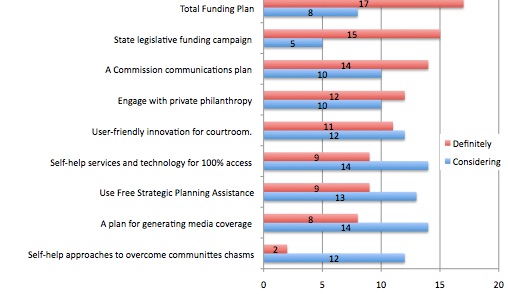
I am very pleased that I can now share the results of that survey, and that they show a broad level of interest in moving forward.   The results also give a strong sense that the Commissions are moving in a common and broad general direction.  This chart tells much of the story.  The possible areas of activity are shown in order of definitively planned activity, with 25 states providing significant data.

com-plans

Firstly, there is a significant level of interest in having such areas of activity.  In fact, the average responding state has 3.9 areas of project or definite planning, and 3.9 under consideration.  That’s a total of 7.8, a major change from the relatively narrow focus of a few years back.

Secondly, with one exception, the totals (not shown on the graph) are very close together.  For each of the areas, between 22 and 25 states are either definitely planning or are considering them.  The exception is the one dealing with community legal system chasm, which has only 2 definitely planning, but 12 considering, for a total of 14.  From this pattern, we can conclude that there is general agreement about the general possible focuses of the movement.  (It should be admitted, however, there might be other options not offered that are in fact receiving significant interest.)

Thirdly, it is noted that while funding are as usual the most two common areas that is definitely planned, it is also the fact that one communication strategy and one court system improvement strategy find themselves in the top four, and not so far behind, confirming that Commissions now have a broader view of their role as innovators as well as funders.

Please note that the names of activities used here are very abbreviated.  The full survey questions, and slightly fuller data presentation are shown in the Report here.

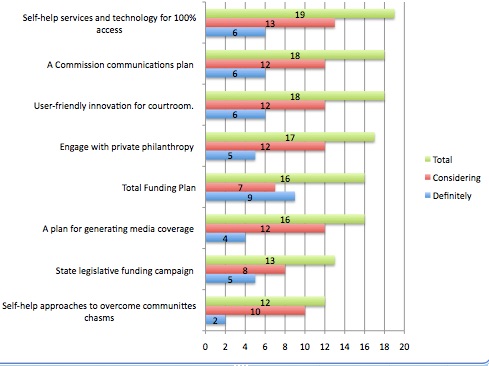
The second series of questions gauged interest in networking among Commissions to support each others’ activities in these areas.  Here the average state was definitely interested in 1.7 areas (out of a lower maximum) and possibly in 3.4, for a total of 5.1.  These are lower numbers than plans for in-state activity, and significantly more tentative.  Here is the chart, sorted this time by the total, given that that seems to be a more useful number here both for analysis and planning purposes.

Network-planThere is, I think, a greater spread in the totals, a different ordering, and, of course, the much greater occurrence of networking between states being considered, rather than definitely desired.  With the exception of those definitely wanting such networking on a total funding plan, there is less interest relatively in funding issues.

Of course, many strategic and planning considerations will go into any decisions about priorities and next steps.  But Public Welfare Foundation funded support for the meeting planning and this follow-up are to be congratulated on the much more focused meeting and the gathering this data, which gives a much more comprehensive view of what the state-level Commissions believe they want.


Posted in Access to Justice Boards, Chasm with Communities, Communications Strategy, Court Fees and Costs, Funding, Legal Aid, Metrics, Planning, Self-Help Services, Simplification, Technology | 1 Comment

An Urgent Call for Action on Moving Potential Clemency Cases Forward

This blog urges the legal profession, both institutionally and individually, to step up now and play its role to help free thousands of nonviolent drug offenders given draconian federal sentences, and now potentially eligible for Presidential clemency.  First the background.

As recently reported by the New York Times under the headline Obama Plans Broader Use of Clemency to Free Nonviolent Drug Offenders, the President is taking unprecedented steps to reverse at least some of these injustices.  As you will recall, back in April 2014, DOJ announced a priority process for certain non-violent drug cases, and the profession formed a group to rise to te challenge.

In addition, the newly-formed Clemency Project 2014 (a non-government affiliated organization composed of the American Bar Association, the National Association of Criminal Defense Lawyers, the Federal Defenders, the American Civil Liberties Union, and Families Against Mandatory Minimums, as well as individuals active within those organizations and other lawyers wishing to participate in this volunteer effort) is helping to quickly and effectively identify appropriate candidates for this initiative. Inmates who appear to meet the six criteria will be offered the assistance of an experienced pro bono attorney through Clemency Project 2014 in preparing his or her application for clemency.

As of now, according to the Times,

The consortium, called Clemency Project 2014, now has more than 50 law firms, more than 20 law schools and more than 1,500 lawyers participating. But the process is burdensome as the volunteer lawyers try to dig out documents from more than a decade ago to satisfy the criteria. So far, they have screened out 13,000 inmates who did not meet the guidelines and sent just over 50 applications to the Justice Department. (I understand this number is now 15,000)

Obviously, the project is doing all it can to move this huge number of cases.  Indeed, and this is cause for great celebration, the project has recruited more than any prior single pro bono project ever — over 1,500 attorneys.  A touchstone for the future of pro bono in moments of opportunity and crisis.

But while I am full of praise and admiration for the individual 1,500, and for the participating organizations in the Project, I am a bit worried about whether the profession as a whole is doing enough.

Deborah Leff, the department’s pardon attorney, has likewise pressed lawyers representing candidates for clemency to hurry up and send more cases her way. “If there is one message I want you to take away today, it’s this: Sooner is better,” she told lawyers in a video seminar obtained by USA Today. “Delaying is not helpful.”

Moreover, in the  Times, we hear of the 46 commutations, but:

[These] reflect just a small fraction of the more than 6,600 petitions submitted to the Justice Department since the administration announced its initiative last year. Some lawyers representing prisoners have complained that the review process has been overwhelmed. The administration has asked Congress for more money for lawyers, and said it was committed to issuing more commutations over the next 18 months.

Cynthia W. Roseberry, the project manager of Clemency Project 2014, a coalition of lawyers, law firms and law schools formed to answer the Justice Department’s call, said that she was heartened by Mr. Obama’s action, but that the government and the consortium “have quite a bit of work ahead.”

Indeed. Given the time DOJ inevitably takes to process cases, and the time it will take a president who has other responsibilities to make decisions, as a practical matter the is somewhere between 7 and 12 months to get all these cases to DOJ (perhaps less than 12).  We do get a new president in nineteen months, so who knows what, if anything, will happen then.  And this is a signature project for this administration.

The good news is that the project obtained the agreement of the Administrative Office of the Courts and the Bureau of Prisons to establish a process by which it will provide the pre-sentence report once the inmate has signed the consent.  A court order is no longer required, although the judge is given a period of time to object prior to the release of the report.  This is reasonable because of the possibility of inclusion of information about incrimination of others.  This means that the process of data gathering has now been hugely streamlined, since often, but not always, the report also includes the needed information on any state convictions.  (When it does not, getting the old usually non-digital state records is a major source of delay.)

There is also good news (good for the inmates, but meaning more work for the Project) that the recent 46 commutations have signaled that the President will be at least somewhat flexible on some of the eligibility criteria.  One person who had served less than ten years was included, as was another with a firearms record which might otherwise have been deemed “violent.”

So, right now it is simple.  The legal community must get the tens of thousands of cases reviewed and the eligible ones sent to DOJ.  If we do not do so, after having promised to do so, the profession will in a certain sense be responsible for those still sitting in Federal prison who would otherwise be free.

So what is to be done?

Firstly, every attorney who possibly can should volunteer.  I am told that it may take only an hour to do the initial screening, and that for many of the cases the record is very clear that the inmate falls well within the program, in that under current law the sentence would simply not have been imposed.  So the process of writing up the petition is easy and short.

Moreover, there is back-up assistance for all attorneys who volunteer, and much time can be saved by those who have access to the services of paralegals.

The institutional question is more difficult.  I suspect that the large legal professional organizations can and need to do more to affirmatively recruit the huge numbers that will be needed.  I understand that the Criminal Justice Division of the ABA has been a stalwart supporter, but I am not sure that the larger organization has yet done as much as it might beyond exhortation.  We all know that recruiting pro bono volunteers needs more than urging, it requires a structure of one-on-one follow up before people can be expected to respond, and this should be a high priority for an organization-wide initiative, and an organization with significant capacity in this area.

More is at stake than maybe 15,000 lives.  A public failure will impact the credibility of the pro bono movement as a whole.  What should be a triumph of the profession would become instead a collective fail and shame.  As a general matter, some resist attempts to increase resources for access to justice with the claim that the bar should do more though pro bono.  The answer, basically, is that we are doing all that we can.  How will that claim look if the profession can not rise to this challenge and this commitment.  Our credibility to urge steps towards access to justice will surely be weakened.  (Something that state ATJ Commissions might think about when they consider if they can play a recruiting role.)

The profession and the organizations have put themselves on the line, which pro bono groups all too rarely do.  For this, they are to be lauded.  But that does not mean that they should not be held accountable.  Similarly, the legal profession as a whole has put itself on the line.  If we fail, the argument that lawyers inefficiencies are making us irrelevant will be hard to refute.

A couple of other thoughts:  I hope that the project has a good system for tracking whether the assigned attorneys are in fact moving on their cases, an internal schedule of targets so it knows when there is a crisis, and a plan for getting the additional resources it may need

I very much hope that follow up blogs will have good news to report on process, numbers and outcomes.  I very much hope that the final report, in late Jan 2017, will be that every case was appropriately and expeditiously considered, and that thousands of lives have been saved.

p.s.   Here is an article by National Association of Criminal Defense Lawyers President Norman Reimer, that might be useful in spreading the word.  Lets get to it.


Posted in Criminal Law, Defender Programs, Dept. of Justice, Legal Ethics, Reentry, Technology, White House | Comments Off on An Urgent Call for Action on Moving Potential Clemency Cases Forward