How State-Wide Groups Might Help Deal With The “Ferguson Chasm”

Here are some suggestions for how ATJ Commissions and other statewide groups (or those just advocating) might move forward on addressing the “Ferguson Chasm” — the gap between communities and the entire legal system, epitomized by Ferguson using the court system as an ATM on the backs of the people.

These ideas were developed for a session held at the recent ATJ Chairs meeting held in association with the Equal Justice Conference, so the ideas may be familiar to some of Commission leadership.  Thanks to Bonnie Hough, Califoarnia Courts, and Kelli Evans, the California State Ba, who co-led the workshop and helped with the list.

  • Develop a pilot community-based court self-help/navigator center. Ideally this should be done in a way that it can be scaled easily. One such approach would be to use community organization volunteers supervised (perhaps remotely by video) by court staff or contracted community-based legal aid. (Such a center could also help people confidentially check their warrant and case status.)
  • Develop network of community liaisons for state self-help resources (Alaska model), potentially including health centers, schools, libraries, faith-based organizations.
  • Do survey on attitudes about legal system by class, ethnicity and neighborhood, and what might change such attitudes.
  • Obtain state and county-wide statistics on numbers of civil case warrants issued, people incarcerated, or losing driving licenses or other licenses, for non-payment of fines, court costs, for nonpayment of child support, etc.
  • Audit availability and effectiveness of protections – and where needed enhance such protections — to ensure that such people are not being penalized despite inability to pay (Turner v. Rogers). Examples would be rule clarification, individualized outreach to litigants, additional information for litigants at multiple steps in the process, setting up an informational hotline, educating judges, training court staff, and/or establishing online tools. (Note: much of this activity could be 2/3 compensated under non-caped IV-D Child Support Enforcement Funds.)
  • Partner w/ researchers and courts to conduct impact analysis of existing and proposed fees, and require ATJ impact analysis
  • Partner with legal aid to educate legislators and other stakeholders about the impact on individuals, families, communities, and access to justice from drivers’ license suspension and other practices and sanctions
  • Simplify fee waiver processes and make sure they are very accessible; encourage a “blanket” waiver policy for means-tested benefit recipients and those assisted by programs that income qualify clients;
  • Support record clearance projects (opportunity to engage law schools and pro bono counsel and also increase civic engagement to the extent record clearance helps restore voting rights), including making self-help resources on the topic available.
  • Advocate for the end of license suspension as a debt collection tool
  • Support programs that allow people to have court fees and fines waived or reduced; similarly, support income-based repayment plans and partial payment options.
  • Partner with legal aid to educate legislators and other stakeholders about the impact on individuals, families, communities, and access to justice from drivers’ license suspension and other practices and sanctions

Any and all of these would be helpful, and seem like good starting places.  For a prior blog on this general topic, see this.

Please add other ideas in the Comments.

Posted in Access to Justice Boards, Chasm with Communities, Child Support, Court Fees and Costs, Policing, Self-Help Services, Simplification | Comments Off on How State-Wide Groups Might Help Deal With The “Ferguson Chasm”

The Needed Components for National ATJ Initiative Taking

A couple of years ago, I blogged about what a state capacity for access to justice might look like.  Folks might find this post useful to start to talk about evaluation of the progress of their state’s ATJ Commission (or justification for lack of one).

I thought it might now be time to think about what the capacities for national Access to Justice focusing and initiating of activities are needed, particularly when new areas of opportunity arise.

I am not here suggesting how these functions might be fulfilled, or whether or how they should be integrated or divided, rather I suggest them as a way of assessing whether our community is doing all it should in focusing and opportunity-taking terms.

Before the list I would also point out that filling in the gaps in this list, and making sure there is some form of linkage between the elements, would provide many opportunities to emphasize and leverage the bipartisan nature of support for legal aid, broadly defined, and access to justice generally.

So here is my initial list, with some explanations:

Communication Capacity to public and policy folks.  This we have in Voices for Civil Justice thanks to Public Welfare and Kressge funding

Strategic Planning Component.  The idea that some group is really doing long term strategic planning for access to justice.  Not sure this is happening.

Idea Factory.  I like to think that SRLN does this is most areas, but surely we need more.

Operating Foundation.  A group that has the resources to move in quickly to fill gaps and exploit opportunity without a long term fund-raising lag.  Right now, the Public Welfare Foundation plays an amazing role doing this, but perhaps we need more

Lobbying capacity (presumably non-tax-exempt).  Various groups lobby for specific issues such as LSC funding, but the approach is inevitably fragmented, particularly for innovations initiatives.

Research Capacity or Agenda.  Similarly, there is as yet no integrated access research agenda or body — although work by the Department of Justice and NSF, about which I hope to be blogging soon, may fill, or show the way to fulfilling, this role.

Pilot project capacity.  Where is the non-ad-hoc capacity for pilot projects — particlarly if they can not be considered as technology projects eligible for LSC TIG funding?

Communication Capacity for Innovation Within Legal Aid and its Components (community-based legal aid, courts, bar, etc).  By this I mean the ability to get the word out within the network and build internal enthusiasm and momentum. While Voices is fulfilling some of this function as a byproduct of the innovation component of its public communications strategy, this is still only a partial overlap.  An example would be what is being done through the evaluation of “roles beyond lawyers” that Public Welfare is funding and encouraging.

Educational capacity for long term professionals.  While many organizations provide training for their own specific constituency, there is no LLM on access to integrated access to justice, or judicial education on access generally (beyond the SRLN curricula)

Crisis Intervention Capacity. When the VA crisis erupted a few months ago, and when Ferguson/Baltimore re-focused us on the complex role of courts, there was no infrastructure for for an integrated leadership response for the role of legal aid, broadly defined.

Support for Integrated data capacity.  Who is making the argument for integrated data across components of legal aid, broadly defined.  The DOJ/NSF process described above might help with this.

Nationally Developed Software Platforms and Sustaining Strategy. Compliments are due LSC for their Technology Summit Report and integrated portal plans.   SJI (with LSC) has played a role in the past in supporting a national document assembly platform used by both court-based forms legal aid and community based legal aid.

Supporting Local Capacity. The ABAs work in this area has been greatly strengthened by the support of the Public Welfare Foundation.  NCSC has been particularly helpful in supporting the creation of new ATJ commissions.

I am sure I have forgotten many important contributions to meeting these needs.  But I think they illustrate rather than undercut the argument of the need for more analysis of these focusing and initiative taking needs.


Posted in Access to Justice Boards, Bar Associations, Communications Strategy, Dept. of Justice, Funding | Comments Off on The Needed Components for National ATJ Initiative Taking

The Broader Lessons of Ferguson and Baltimore Are Much More Challenging — Opportunities to Be Part of the Solution

Some of us have begun calling it the Chasm — it’s the chasm between the legal system and the poor.  When the cops yell “stop”, young men do not make subtle legal distinctions between the civil and criminal justice systems.  If they fear a warrant — and what might happen to them if they are arrested, and are given a “rough ride” Baltimore style, they do not ask if it is a criminal or civil system warrant.

In the past, our critique of the court system, from within and without, has been that it fails to provide access to a system that should and could provide access.   What we are now starting to have to think about is how much the court system keeps people in poverty, or even drives them into it — and does so including through cases that are denominated “civil.”

Look at this reminder from a document prepared by an Michigan court Ability to Pay Workgroup.

In the three decades since the United States Supreme Court issued its decision in Bearden v Georgia, 461 US 660 (1983), judges have been required to address the issue of ability to pay before incarcerating a person for failure to pay court-ordered financial obligations.

Contrast it, please, with everything we are hearing from all over the country about the systems of fines, fine escalation, driving license loss, incarceration, failure to reduce child support obligation, etc, (Brennan Report),  NYT article. DOJ Report.   We should be ashamed that we are part of the problem not just because we are not part of the solution, but because we are actually making it much worse, with terrible implications for individuals and, as we now know, communities.

Here are some starting points:

The Michigan Workgroup document includes a variety of best practices, including when ability to pay should be assessed, how it should be assessed, possible rules and statutory changes, and payment plan calculators.  Here is the list of appendices:

  • Ability to Pay Checklists
  • Statutory Requirements
  • Court Rule Requirements
  • Case Law Summary
  • Ability to Pay Language
  • Payment Plan Calculators
  • Federal Poverty Guidelines Charts
  • Means Test
  • Payment Alternatives
  • Incentives/Waivers
  • Model Debt Inactivation Policy
  • Possible Statutory Amendments
  • Possible Court Rule Amendments

It is a wonderful document with which a state can start to develop their own policies — although I should emphasize that I am not specifically endorsing any specific content, only the thoroughness of the general approach, and the philosophy described in the quote above and below, which is the conclusion of the document.

The “ability to pay” must be determined and applied on an individual basis. Each judge, for each obligor brought before the court for failure to pay a court-ordered financial obligation, must review the required facts and circumstances and make an individual determination of the obligor’s ability and resources to pay the ordered monetary assessments and whether the obligor has made a good-faith effort to pay. Judges may have differing philosophies regarding ability to pay and may weigh facts in a given case differently. A judge’s discretion is tempered by the confines of the law and should be exercised with fairness and restraint. Ultimately, each decision is up to the individual judge.

While I suspect that the final sentence was added by way of compromise — and while I would add that for a judge to refuse to exercise discretion is an abuse of discretion — the fact is that final sentence does end up emphasizing that the judge will be held responsible for that decision, both legally and morally.

The Brennan Center has developed a Toolkit for one subset of this problem, the criminalization of debt.  It includes five core recommendations for reform;

  1. conduct impact Analysis of Proposed and Existing fees

    Such studies can show lawmakers that the imposition and enforcement of fees and fines has both financial and social costs, and that these laws fail to generate revenue.

  2. create and Enforce Exemptions for indigence

    The most effective way to break the cycle of debt and poverty that criminal justice debt perpetuates is to create exemptions for indigent people and effectively enforce them.

  3. Eliminate Unnecessary interest, late fees, and collateral consequences

    Where exemptions are not possible, other policies can reduce the onerous burden of debt. Eliminating interest and late fees makes debt more manageable. Collateral punishments, such as suspending driver’s licenses, only make it more difficult for people to obtain the employment necessary to make payments.

  4. End incarceration and Supervision for non-Willful failure to Pay

    Criminal justice debt ensures that people who are no threat to public safety remain enmeshed in the system. Often people facing the possibility of re-incarceration or further supervision have no right to counsel. Such practices raise constitutional questions, are costly to states, and decrease public safety as court and criminal justice resources are diverted.

  5. focus on rehabilitation through Meaningful Workforce Development

    Offering optional community service as a means for paying criminal justice debt has the potential to improve the long-term job prospects for those who enroll, improving rentry prospects and providing states with an alternative means to collect debt.

In a separate post, I will soon be discussing steps that state leaders can take to start this process, particularly using the access to justice commissions, or equivalent, and what resources can be created at the national level to make this happen.

Posted in Bankruptcy, Child Support, Court Fees and Costs, Court Management, Dept. of Justice, expungement | 2 Comments

Interdisciplinary Education Comes to Medicine — What About Law?

A recent NYT blog highlights how medical education trains its varied professionals, doctors, nurses, physicians assistants, in totally isolated silos, even though today they almost always actually practice in integrated teams.

But, there are now some changes described in the article extract pasted below:

The push toward more collaborative care has been underway for years. In 2001, the Institute of Medicine issued a report recommending that all health professionals receive training in interdisciplinary teams. .  .

.  .   . [t]he Robert Wood Johnson Foundation and three other leading foundations recently helped start the National Center for Interprofessional Practice and Education to improve teamwork and break down siloed training approaches. Another initiative, Retooling for Quality and Safety, led by the Josiah Macy Jr. Foundation and Institute for Healthcare Improvement, awarded grants to six universities to support interprofessional activities aimed at integrating patient safety into medical and nursing school curricula. Participating schools designed a variety of creative learning models to bring students together, such as interprofessional Grand Rounds conferences and web-based learning modules; small-group exercises to develop care plans or break bad news; quality improvement projects to improve hand hygiene or prevent falls; and clinical simulations with debriefing sessions during which all team members had the opportunity to describe what went well and what could have been improved.

Data evaluating whether interprofessional training improves teamwork, communication and leadership is still preliminary, but promising. A study of over 600 medical, nursing, physiotherapy and occupational therapy students enrolled in an interprofessional training course found that all student groups gained knowledge of other professions’ work, but also developed a deeper understanding of their own professional role. Other research suggests that joint clinical simulation and facilitated debriefing sessions can improve confidence by providing collaborative care for a rapidly deteriorating patient and enhance communication by increasing providers’ ability to identify various professional roles, “close the loop on patient care,” and correct others in a constructive manner. Similar results have been found for medical and nurse anesthetist students in operating room simulations. At the resident level, the use of multidisciplinary rounds — in which doctors-in-training discuss diagnoses and patient care issues with case managers, nursing coordinators and others — has been shown to improve hospital performance on quality metrics for heart failure and pneumonia and decrease how long patients stay in the hospital.

While it is certainly true that the range of other professionals who are thought to work regularly with lawyers is smaller than those who work with physicians, surely that is a restatement of the problem, rather than an excuse for our failure to consider equivalent approaches.

More and more lawyers are working regularly and closely with social workers, yet how many law school clinical programs are teaching this skill?  In the defense world, investigators are critically important, but how many have the experience of learning with lawyers?  Similarly, I doubt that many incubators are yet including the integration of other professionals into the curriculum.

Indeed, what about the idea of co-training for lawyers and doctors?  Given the spread of medical legal partnerships, how many law schools include a class on working with doctors and other medical professionals, and how many medical schools expose their students to partnering with (rather than fearing) lawyers.

Similarly, I would hope that the trend to exploring expansion of “beyond lawyers” roles will speed and be sped by approaches such as these.  Indeed, one of the strengths of the Washington State Limited License Legal Technician model is the participation of the state’s law schools in the educational component.


Posted in Law Schools, Medical System Comparision, Public Defender, Systematic Change | 1 Comment

While Study On Greater Happiness of Nonprofit Lawyers Raises Methodological Questions, It Still Has Useful Lessons

Its hard for some of us not to feel smug and self-satisfied when we see the following blog headline in the New York Times: Lawyers With Lowest Pay Report More Happiness.

And its hard not to come to the conclusion that the article implies that making the choice to be a nonprofit lawyer will lead to greater happiness.

Of the many rewards associated with becoming a lawyer — wealth, status, stimulating work — day-to-day happiness has never been high on the list. Perhaps, a new study suggests, that is because lawyers and law students are focusing on the wrong rewards.

Researchers who surveyed 6,200 lawyers about their jobs and health found that the factors most frequently associated with success in the legal field, such as high income or a partner-track job at a prestigious firm, had almost zero correlation with happiness and well-being. However, lawyers in public-service jobs who made the least money, like public defenders or Legal Aid attorneys, were most likely to report being happy.

Lawyers in public-service jobs also drank less alcohol than their higher-income peers. And, despite the large gap in affluence, the two groups reported about equal overall satisfaction with their lives.

Making partner, the ultimate gold ring at many firms, does not appear to pay off in greater happiness, either. Junior partners reported well-being that was identical to that of senior associates, who were paid 62 percent less, according to the study, which was published this week in the George Washington Law Review.

There are numerous theories to explain the phenomenon, like the kind of work people have to do, the hours, the fear, etc.  This is a new one for me:

And then there is the public hostility. “People just seem to hate lawyers,” Ms. Spataro said. “There are thousands of prominent websites for lawyer jokes. That’s just horrific.” Case in point: Many of the more than 3,000 comments on the CNN article about lawyer suicides applauded the trend. The comments are no longer visible in the link to the online article.

I assume that the final line of that paste is meant to discourage NYT readers from adding to the comments!

I think it is important to point out the methodological issue.  It may be that happier people go into lower income legal jobs because they have less to prove.– and they stay happier  Indeed, it would be interesting to do a happiness assessement before law school, during law school, and during career, although even that has methodological weaknesses.

More valid might be a randomized study in which students at a law school were offered counseling on how to align personal goals and values with career direction, and then do the follow up for all who were offered it (it is invalid to compare those who accepted the offer with those who rejected it.)  Even with the offer comparison study, you still run the risk of “contamination,” if the law students talk to each other.  To avoid this, I think, you would have to compare some schools at which all were offered the help, with similar others at which none were.

In the end, however, I think the study can be of help with career direction choice.  If the lower income lawyers are happier, you are more likely to be happy if you join them, if only because the main choice you make is life is who to be with.  You might as well choose happy people to make you happy.

So there are sometimes solutions without randomized studies.


Posted in Law Schools, Legal Aid, Research and Evalation, Vocation | Comments Off on While Study On Greater Happiness of Nonprofit Lawyers Raises Methodological Questions, It Still Has Useful Lessons

DOJ ATJ Initiative Director Lisa Foster Keynotes at Equal Justice Conference

As Department of Justice Access to to Justice Director Foster pointed out at her keynote at the Equal Justice Conference, yesterday (see below for full text), there have been sixteen of these Conferences.  What she did not point out was that this is the first time that the Conference has been addressed by someone in her position.  So this alone represents an important step, and she rose to the challenge of saying something very different and helpful that lays the groundwork for different access world.

Frankly, we have become used to many such speeches at these kind of conferences, they start with a statement about how terrible things are, they recite the numbers, they tell us what wonderful work we do what heroes we are.

But this was a fundamentally different speech.  The pivot point was these words:

One could argue, based on those statistics that the movement for equal justice in America has not made much progress.  But those statistics are only half the story.

And then she went on to highlight the achievements — the Commissions, and,

In 1999, the internet was new, self-help centers were rare, and we still used Latin to refer to self-represented litigants.  Today, we have HotDocs, ProBono Net, Stateside Legal, the Self-Represented Litigants Network, Limited License Legal Technicians in Washington, Navigators in New York, and the Justice Corps in California.
 
And in 1999, although there was a Department of Justice, there was no sign on the door anywhere in the building that said this.

And she showed the office door sign slide.

She also spoke about the trends that we creating opportunities for change, starting specifically about the new and critical focus on inequality:

What’s different today is that everyone – and I mean everyone – is talking about it.  The President has called income inequality, “the defining challenge of our time.” In January, at a forum sponsored by Freedom Partners, an organization that describes itself as a chamber of commerce that promotes the benefits of free markets and a free society, Ted Cruz, Rand Paul and Marco Rubio all spoke about the problem of income inequality. Jeb Bush said that Americans are frustrated because they see only a few people riding “the economy’s up escalator.”
 
It’s not just the chattering classes that are worried about income inequality and the collateral damage it can cause.  Last year, the Pew Research Center conducted a survey in 54 countries about which of five dangers people considered to be the “greatest threat to the world.”  Many of the countries polled listed religious and ethnic hatred first.  Americans chose income inequality.

She is right that is a critical change, and while it presents many challenges to our community, they can be overcome.  Our polling data, and our political experience, particularly in Washington, tell us that an inequality message risks fragmenting the very carefully built up bi-partisan consensus about access to justice funding.  Yet, when the discussion about surely we can find a way to leverage this to greater rather then lesser bi-partisan support for this funding.  The key, at least initially, I suspect is in the next poin Lisa Foster made:

The second dynamic can be summarized in a word — and in pictures: Ferguson.  Ferguson – a city whose fiscal and judicial policies have trapped too many of its largely African-American residents in a cycle of poverty and despair.
 
The light that was shined on Ferguson – a light made a little brighter by the Report issued by the Justice Department’s Civil Rights Division – that light has illuminated many other dark corners of our country where the practice of incarcerating people simply because they can’t pay geometrically mounting fines and fees is rampant.  In California, and in many other states, the Legislature has permitted and in many instances required judges to suspend or revoke a person’s driver’s license if they have not paid fees, fines or child support, leading – because one has to drive to get to work to earn the money to pay off those fines and fees – to additional citations and ultimately arrest.

I think our message has to be — being poor is not a crime, and neither is being middle income.  Its not so much about lessening inequality, but about lessening both the causes of, and consequences of inequality — and it turns out that the legal system — even the accessibility of the legal system, are contributors to inequality, and exacerbators of the consequences.  Maybe that is a broader message that can drive change.  Indeed, Lisa’s third major point, the importance of criminal justice reform, highlighted this, with its implications for exclusion from the job market, and thus permanent exclusion from the main legal path out of poverty:

At a speech at the National Press Club last week, Senate Judiciary Committee Chairman Grassley said: “We’re seeing studies that show 32 percent of American adults have criminal records if arrest records are included.  If an employer uses the database for hiring purposes, the records can be inaccurate and old.  It’s unfair that an arrest – not resulting in a conviction – is included in a criminal background check.  And while there is a process by which people can contest their records being in the database, there are flaws in that process that need to be looked at and changed.”  In the same speech, Senator Grassley also called for counsel to be provided in civil asset forfeiture proceedings, the need to ensure that the states are truly meeting their constitutional obligations under Gideon, and the need to reform the juvenile justice system.  Bipartisanship can happen.

Indeed, a national expungement strategy should be a key part of our new law and anti-inequality agenda.

The speech also included detailed and inspiring examples of partnerships, and just as important, a very strong message about the importance of overcoming fragmentation with strategy at the national and local levels.

To make progress, we need a coordinated strategy.  The movement for equal justice is larger than our individual offices or programs.  We need to be aware of and work in concert with all of the many organizations that try to secure justice for, and improve the lives of our clients, including the courts, community health centers, social service agencies, and state and local government.
 
And that’s hard, because we are, truly by definition, fragmented.  We are often geographically fragmented – we are legal aid of mid-Florida and Western Michigan, and southeast Louisiana.
 
We are fragmented by issues – protection and advocacy services, housing, domestic violence and immigration.  We are fragmented by affiliation – we are LSC and non-LSC programs, we are law school clinics, pro bono programs, and court self-help centers.  It’s also hard because, let’s face it, we are for the most part overworked  – we have too much to do without trying to figure out what everyone else is doing and try to work together.
 
But we must.  An effective strategy can’t just be at the national level – although rest assured, we at ATJ, together with national organizations like NLADA, the ABA, Voices for Civil Justice and many others, are working on it.  Coordination – and critical thinking – has to start at the local and state level. We need to assess our community’s strengths and weaknesses and then coordinate and integrate services.  We can’t afford to be duplicative or competitive.

That is a very major challenge, and a critical one, building on the research work, in which DOJ has played such a critical role.  Hopefully the LAIR work, in which DOJ helps get other federal agencies interested in the access community, and integrating them into grant eligibility, and which Lisa also highlighted, can be a critical lever for this.

Equally important was the highlighting of the importance of research and evaluation, with frankly, Lisa issuing an implied warning:

This year, the White House Office of Management and Budget – or OMB – launched the budgeting process by telling every department that their budgets should advance “evidence-based policymaking by increasing access to administrative data, utilizing low-cost randomized trials, embedding evidence and evaluation into grant programs, and strengthening agencies’ capacity to build and use evidence.”

She followed up with examples of research into successful projects, and examples of how DOJ embeds the approach into its work.  This is unavoidable, and it is only a matter of time before we will be help accountable if we do not get with this program.

So, far more than most keynotes, this was a speech of optimism and challenge — optimism about how much we have done, and why this is such a moment of great opportunity, but also challenge because she implicitly reminded us of how much we have to stretch and change in order to take advantage of the moment and fulfill our obligations to our clients and the future.

When a speech covers so much, it takes time to fully sink in.  Hopefully by the end of the Conference we will have a sense of what more might need to be done to ensure that the lessons that Director Foster sought to teach are fully internalized into our work and our movement.

What more can I say, but “Congratulations on a true keynote.”

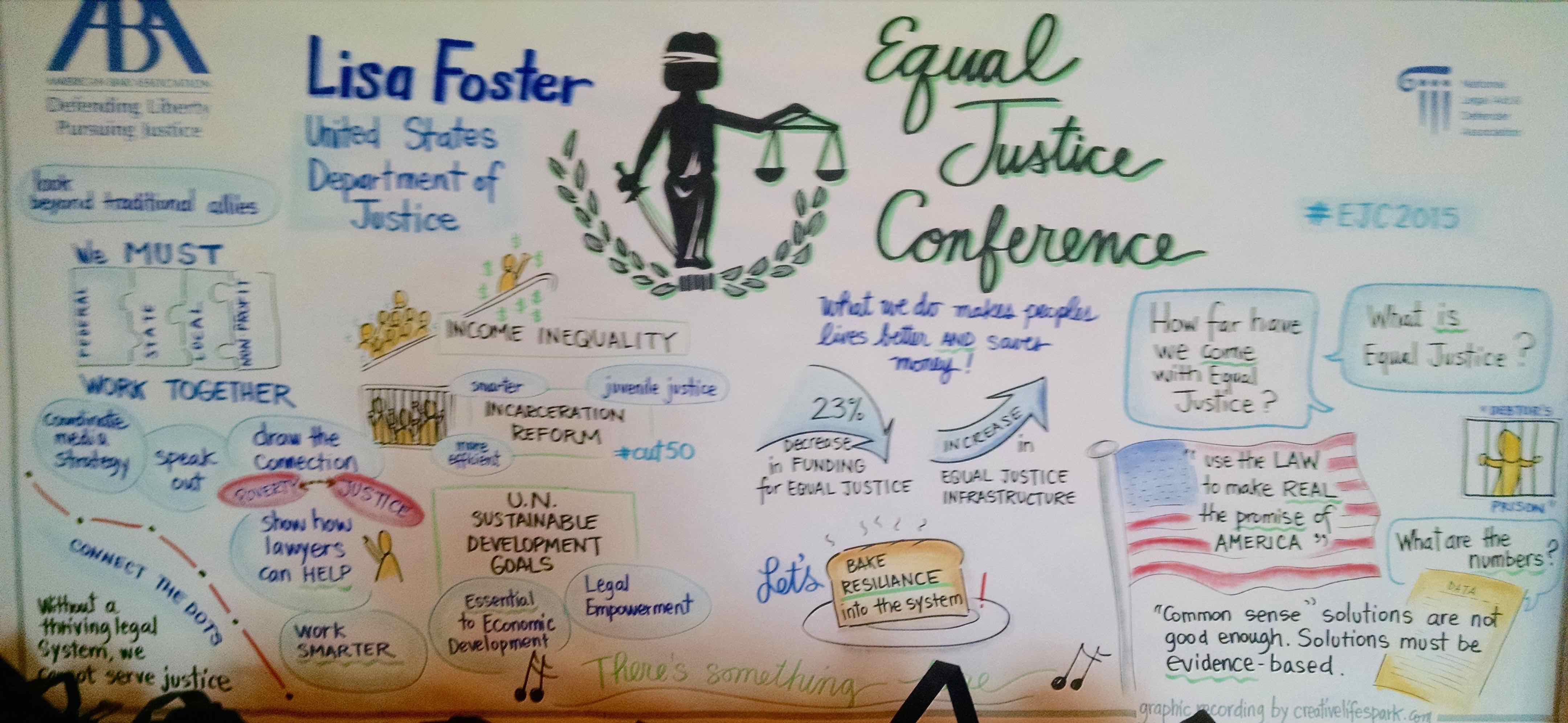
Well, I can paste in the photo of the summary written up in front of us during the speech.
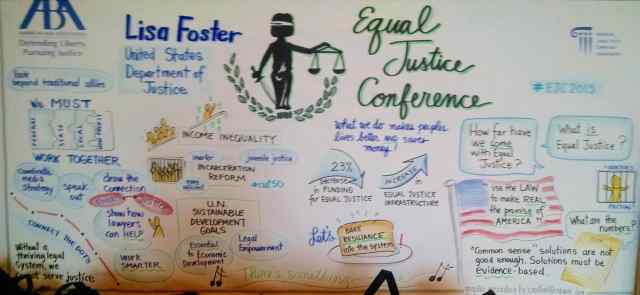
EJC-Keynote-2

Click below for full text.

Continue reading

Posted in Court Fees and Costs, Criminal Law, Dept. of Justice, Funding, Research and Evalation, Self-Help Services, Systematic Change | Comments Off on DOJ ATJ Initiative Director Lisa Foster Keynotes at Equal Justice Conference

Ohio Supreme Court Task Force Recommends “Access to Justice Impact Statement” Requirement

The Ohio Supreme Court Task Force on Access to Justice has included among other great proposals, a new and exciting idea in its Recommendations, which would be to require an “Access to Justice Impact Statement” before any changes in the Ohio Rules of Court.

5. DEVELOPMENT OF AN ACCESS TO JUSTICE IMPACT STATEMENT RECOMMENDATION

The Task Force recommends that the Supreme Court require that an “access to justice impact statement” be filed with any proposed amendment to the Ohio Rules of Court.

Discussion

Ohio law currently provides that a fiscal analysis be submitted to the General Assembly for every proposed bill or resolution.34 This is because fiscal impact statements are critical to ensure that any legislator voting on a particular bill has sufficient information to evaluate the bill’s full impact; for example, whether adopting a bill might require defunding a competing program. Similarly, the Revised Code provides that the Ohio Judicial Conference may prepare a “judicial impact statement” for the General Assembly when a bill or resolution “appears to affect the revenues or expenditures of the courts of Ohio, to increase or decrease the workload or caseload of judges or members of their staffs, or to affect case disposition.” R.C. 105.911. Through these measures, the General Assembly ensures that its members have the fullest information available on the full impact of a bill before they vote on its passage.

Similarly, the Supreme Court should require that the Access to Justice Director prepare an “access to justice” impact statement for any proposed change to the Ohio Rules of Courts. In the same manner that the legislative budget office may seek information from any department, institution, board, commission, authority or other instrumentality or officer of the state, county or other governmental entity,so too may the Access to Justice Director request information from any state or local governmental entity, court, nonprofit entity, for-profit entity or any proponent of a change to the Ohio Rules of Courts. The “access to justice” impact statement shall address the likely number of Ohioans impacted by the proposed change; whether the change will increase or decrease access to Ohio’s courts for low-income Ohioans; what impact, if any, the proposed change will have on Ohio’s minority populations’ access to the courts; and, what impact, if any, the proposed change will have on the ability of Ohioans with limited English proficiency to access justice. In this way, the Court and its boards and commissions will have the fullest information possible as to the effect of a proposed rule change prior to adopting or rejecting it.
(Bold added)

This is truely an excellent idea.  Every state should do this.

I would add the suggestion that all Court Committees should have a member assigned to carry the access perspective into the deliberations of the Committee.

I would also hope that Ohio would develop, and other states would adopt, a template for such an impact statement and for the process that would guide the preparation of the statement. I would offer that national folks would be very happy to help with the brainstorming of that template.

Many of us wold love to see the Federal government adopt a similar process for changes in Federal agency processes, and for changes in state agency processes funded by the Feds. This has been suggested in a prior blog about the power of the phone and the pen.

There have been prior similar suggestions in Canada (at p 28), and Australia (at p. 6).


Posted in Access to Justice Boards, Court Management, LEP | Comments Off on Ohio Supreme Court Task Force Recommends “Access to Justice Impact Statement” Requirement

Univ of DC Law School Encourages Student Engagement with Baltimore Protests and “Legal Observer and Other Assistance” / “Legal Support”

Here, as reported by the Washington Post, is the letter from the Dean to the student body.  For those who worry about how this is organized, I bold the relevant paragraph and some other text, which includes the carefully limited description of the role.

Dear Students,

We have been watching the news from Baltimore and know that it is having a profound effect on many in the Law School community.   As John Lewis said earlier this week, community/police relations is the civil rights issue of this time.  Across this Nation, for nearly a year, the concerns of communities of color about persistent and long standing police abuse, have been reflected in demonstrations and public debate.   The energy and commitment of those involved in the movement is inspiring and we want the Law School to be part of it.

The situation in Baltimore is of particular concern.  Not only is Baltimore just 30 miles up the road, but many members of our community have roots in the City.  It is important that we not ignore what is happening to our neighbors.   Several students have come to the Deans with a request that they be permitted to defer an exam so that they can provide legal observer and other assistance to those who have taken to the streets to exercise their First Amendment rights and to address these serious issues.

We would like to support this activism.   To that end, if any student wishes to participate in legal support for the demonstrations, we will defer one exam until May 11.   To do so, you need to connect with one of the legal assistance organizations, develop a plan for the assistance you intend to provide and get this information to Dean Steward before your exam.   If you are having difficulty in identifying a group to work with, please let me know and we can assist you.  In addition, because these issues affect everyone at the Law School, we would be pleased to support a student organized teach-in.   A community event that brings us together around these issues and promotes mutual support is important during these challenging times.

The police accountability movement needs and will continue to need the best lawyers that we can train.   It is our aspiration that you become the future of the legal support for the most important cases of the next generation.  It is critical that, while we pay attention to what is going on today, that we not lose sight of the essential role you will play once you pass the bar.  We need to invest in you to be prepared to play that role.   That is our shared commitment.

Wonderful.

Posted in Criminal Law, Law Schools | Comments Off on Univ of DC Law School Encourages Student Engagement with Baltimore Protests and “Legal Observer and Other Assistance” / “Legal Support”

Broader Lessons From NYT Highlighted Brennan Center Book Featuring Presidential Candidates (and others) on Criminal Justice Reform

The Times rightly highlights the astonishing fact of how many of the presidential candidates, regardless of party, agree on the need for often similar reforms of the criminal justice system, in this new book released today by the Brennan Center.  As the Times puts it:

 The last time a Clinton and a Bush ran for president, the country was awash in crime and the two parties were competing to show who could be tougher on murderers, rapists and drug dealers. Sentences were lengthened and new prisons sprouted up across the country.

But more than two decades later, declared and presumed candidates for president are competing over how to reverse what they see as the policy excesses of the 1990s and the mass incarceration that has followed. Democrats and Republicans alike are putting forth ideas to reduce the prison population and rethink a system that has locked up a generation of young men, particularly African-Americans.

Former Secretary of State Hillary Rodham Clinton, Senator Ted Cruz and Senator Rand Paul want to ease mandatory minimum sentences. Gov. Chris Christie wants to release nonviolent offenders pending trial without bail. Gov. Scott Walker, former Gov. Rick Perry and former Senator James Webb want to expand drug treatment as an alternative to prison. Senator Marco Rubio wants to make it harder to convict federal defendants without proving intent.

Online, here, the Times also summarizes the policy suggestions.

Some thoughts.  First, this really is an astonishing transformation.  Since the Watts riots, fear of crime has been a driving political force, particularly exploited by one party.  Until very recently, the response to Ferguson, others, and now Baltimore, would be to subtly suggest that all who fail to support “our” police are themselves a threat.  While there are many reasons, from the fall in crime, to the massive cost of incarceration, to the use of video cameras, to having a black President, to right wing donors interest in change (thank you Citizens United!), the old songs do just not play anymore.

Secondly, I found it hard not to feel that the news is not in the suggestions, but rather in who is making them. For those involved in the justice system, there are unlikely to be many new ideas in the book (and why, please, do politicians spend all their time bragging about what they have achieved, rather than trying to make suggestions for the future?)

Thirdly, that there is almost general consensus about general approaches means that this might be a time for broader debate about a new generation of changes that go beyond the tried but not fully replicated ones.  Could we find better ways to support neighborhoods and neighborhood networks that try to help when kids get into trouble?  What can we do to make the justice system (all of it) less of an enemy?

Fourthly, why do we not have any book like this on the civil justice system.  If anything is sure, it is the chasm that often divides communities and the legal system is not just about cops and criminal courts, but also about all the quasi-criminal civil enforcement systems, about which most citizens do not make complex jurisdictional distinctions.  Obviously, we do not yet have the attention from politicians to the civil justice system, but to say that is just to restate the problem.  It may be that we have been reluctant to engage the political class for fear of politicizing the issue.  But what has happened in the criminal justice area would suggest that engagement does not necessarily lead to politicization, rather it may transcend it.


Posted in Access to Justice Generally, Criminal Law, Funding | Comments Off on Broader Lessons From NYT Highlighted Brennan Center Book Featuring Presidential Candidates (and others) on Criminal Justice Reform

Illinois “Safe Habor” Policy for SRL assistance Moves the Ball Foward

There has long been debate about whether listing what self-represented litigant assistance policies are permitted when performed by court staff is useful or harmful.  The argument for listing them is that it makes it much easier for staff to perform them without worry.  The argument against is that a listing may be interpreted as exclusive, and be used as an excuse to turn down experimentation and innovation.

I think  the argument in favor of the full listing approach is enhanced by the just released Illinois Supreme Court Order ( Letter here, Illinois Order here) which attempts a comprehensive approach including such a list, as well as one of prohibited activities and a discussion of confidentiality and ethical obligations.  Congratulations to the Court and the ATJ Commission.

The listing of Illinois permitted activities is here:

(d) Permitted Services. To assist court patrons, circuit clerks, court staff, law librarians, and court volunteers—acting in a non-lawyer capacity on behalf of the court—may, as resources and expertise permit:

(1)  Provide legal information about court rules, court terminology andcourt procedures, but not limited to providing information regarding; requirements for service, filing, scheduling hearings and compliance with local procedure;

(2)  Inform court patrons of legal resources and referrals if available,, including but not limited to:

Pro bono legal services;

Low-cost legal services;

Limited scope legal services;

Legal aid programs and hotlines;

Law and public libraries;

Non-profit alternative dispute resolution services;

Lawyer referral services;

Internet-based resources;

Court-sponsored or -affiliated educational classes, including, but not

limited to, parenting education and traffic safety classes and alternative

dispute resolution services;

Units or departments of government; or

Domestic violence resources.

(3)  Encourage self-represented litigants to obtain legal advice from a lawyer;

(4)  Provide information about security protocols at the courthouse and directions

around the courthouse, including, but not limited to, photocopier and telephone

locations, children’s waiting room locations and other courthouse offices;

(5)  Offer educational classes and informational materials;

(6)  Assist court patrons in identifying approved forms and related instructions based

on the court patron’s description of what he or she wants to request from the court, including but not limited to, providing approved forms for the waiver of filing fees. When necessary, explain the nature of the information required to fill out the approved forms. Where no approved form exists to accomplish the court patron’s request, inform the litigant of that fact and direct him or her to other legal resources;

(7)  Record verbatim information provided by the self-represented litigant on approved forms if that person is unable to complete the forms due to disability or literacy barriers;

(8)  Review finished forms to determine whether forms are complete, including checking for signature, notarization, correct county name and case number;

(9)  Provide assistance to litigants pursuing self-guided research;

(10)  Provide docket information, including but not limited to:

Stating whether an order has been issued

Explaining how to get a copy if one was not provided

Reading the order to the individual if requested

Providing instructions about how to access such information;

(11)  Inform court patrons of the process for requesting a foreign language or sign language interpreter;

(12)  At the direction of the court, review documents for completeness prior to hearing;

(13)  Provide a court patron with access to a case file that has not been restricted by statute, rule or order, or instructions about how to obtain such access;

(14)  Provide the same services and information to all parties to an action, as requested;

(15)  Provide services based on the assumption that the information provided by the court patron is accurate and complete;

(16)  Provide other services consistent with the intent of this policy.

While I suspect that I would expand this list, to include, for example, assisting to litigant to obtain information about related cases from other courts, and reviewing the completeness of the form even without “direction of the court,” and providing information and explanation about how to comply with, an obtain compliance with, a court’s order, overall I like it.  I think  I would also like an expanded list of how people can provide additional assistance in explaining what information a form actually seeks, without taking over from the litigant.  Often instructions are inadequate, and an explanation could be completely neutral.

It is reassuring that items 14, and 15 underline how to make sure that information is neutrally provided, and that item 16 includes a broad expansion of the “safe harbor” to “other services consistent with the intent of this policy,” which I would interpret as to provide as much assistance with access, provided that it is neither non-neutral, or runs the risk of being perceived as non neutral.  Indeed, the purposes section of the order says that:

The purpose of this policy is to provide guidance to circuit clerks, court staff, law librarians, and court volunteers acting in a non-lawyer capacity as to what services may and may not be offered to assist court patrons to achieve fair and efficient resolution of their cases. (Bold added.)

I would love for anyone to use the comments section to add more suggestions for additions to the permitted list.

I would conclude that the one thing we know for sure is that with experience we are learning more and more about how broader assistance can be given in a neutral manner, and that often services are initially perceived as non-neutral only because they have not previously been provided.  Perhaps the way to test whether a service is neutral is not to ask if it is, but rather to ask how it might be provided in a neutral manner, and then see if that is practical.

Posted in Court Management, Self-Help Services | 1 Comment

Joking About Clients — Understandable and Maybe Helpful — But There’s a Test About When It’s OK

There is a provocative, but also disturbing article in the Washington Post that all who serve others, including lawyers and court and self-help staff, might want to think about.  It is titled, Nurses make fun of their dying patients. That’s okay.

As the article puts it:

.  .  . [W]hile people may readily excuse gallows humor among, say, soldiers at war, they may have a lower tolerance for it among health-care professionals. “Derogatory and cynical humour as displayed by medical personnel are forms of verbal abuse, disrespect and the dehumanisation of their patients and themselves,” Johns Hopkins University professor emeritus Ronald Berk contended in the journal Medical Education. “Those individuals who are the most vulnerable and powerless in the clinical environment … have become the targets of the abuse.”

I strongly disagree. The primary objections to gallows and derogatory humor in hospitals are that it indicates a lack of caring, represents an abuse of power and trust, and may compromise medical care. But in my reporting, I found that nurses who use this humor care deeply about their patients and aren’t interested in abusing their power. Their humor serves to rejuvenate them and bond them to their teams, while helping to produce high-quality work. In other words, the benefits to the staff — and to the patients they heal — outweigh occasional wounded feelings.

To be fair to the writer, she does draw limits:

That’s not to excuse all humor by health-care professionals. For example, mocking disabilities and using racial, ethnic or other cruel epithets go too far.

Consider the case of a Virginia colonoscopy patient who says he set his cellphone to record post-procedure instructions and ended up recording his doctors making fun of him while he was under anesthesia. The patient claims that his doctors called him a “retard” and joked that he might have syphilis or “tuberculosis in the penis.” He is suing for defamation and seeking more than $1 million in damages.

“Tuberculosis in the penis” is funny because it makes no sense. But “retard” is an unacceptable word under any circumstances. If the patient’s claims are true, his doctors crossed a line.

But, as a frequent flier at the wonderful Johns Hopkins, I found myself disturbed by the thought that people who need to go the hospital might defer because of fear of being laughed at.  Consider the following from the article:

The nurses I interviewed maintained that situations and symptoms, more often than patients, are the targets of jokes. I learned that some units have a dedicated “butt box” for items retrieved from patients’ rectums — glass perfume bottles, an entire apple, etc. — though after Indiana nurses pulled out a G.I. Joe, the real unfortunate hero assumed pride of place in the nurses’ station.

Hard not to see this as funny, but shyness and anxiety already prevent too many from getting needed care.

This is what I think.  If you could share the joke with the patient, then it is probably OK, regardless of whether they actually hear the joke.  If you could not, then the joke is creating “us versus them.”  And, that is not to mention the fact that some patients under anesthesia may be hearing or remembering more than we realize.

Humor, as the article says, helps patient care teams bond, but it should also help patients and caregivers bond too.  I often find myself joking with doctors and nurses. (I am particularly proud of one joke I developed about the string that is used to retrieve a urinary tract stent, and its possible relationship to an IUD string — “gives new meaning to the phrase “tying the knot.”)  It a way of making my clinicians’ day go better, thanking them for the help, seeing them as human beings, and, frankly, of reminding them that I am human too.

All the same goes for lawyers, self-help, and court staff.

I still remember with pain visiting a self-help center in which one of the staffers had an ugly doll on her desk, labeled “self-represented litigant.”  Some customers of the center might well have seen it.  That it was there was obviously a management as well as a staff attitude problem.  I am still embarrassed that I said nothing.

There is an extra problem in that humor can be a way of saying “I am on your side,” and while that is totally appropriate in a medical staffer, or a legal advocate, if we are in a neutral role, we need to be a bit cautious.

Again the solution is a simple test, the same one for anything someone in a neutral role says to a litigant: “Would you say the same thing if the opposing party were there?”

So, in the end, both tests are the same.  Transparent humor is OK.  But “us against him, her, or them,” is not.  (But disease and unwanted death are acceptable enemies, by my lights at least.)

P.S. I strongly urge that the linked article in Medical Education be read.  It includes suggestions for how medical education could be changed to ensure greater patient respect. We should think similarly about our own educational processes.  This would be particularly relevant to clinical programs, with their high level of client contact.

Posted in Legal Ethics, Medical System Comparision, Self-Help Services | Comments Off on Joking About Clients — Understandable and Maybe Helpful — But There’s a Test About When It’s OK

Hearing Lisa’ Foster’s Keynote at the Equal Justice Conference Should Be An Important Moment

We have just heard that Lisa Foster, the head of the DOJ Access to Justice Initiative, will be keynoting the Equal Justice Conference next month.

The chance to hear what she has to say from her perch as one of the very few people with an overview perspective of all the elements of the access to justice system should be quite something.

That this conference will be hearing for the very first time from someone in this role underlines what a very different time this is, with change happening on so many fronts — sometimes even integrated.

For so long the “Department of Justice” was really a “Department of Prosecution.”  Now, since the access position was created by President, we have had an advocate within DOJ for the critical and necessary access perspective.  That’s a different world.

I look forward to the keynote.


Posted in Access to Justice Generally, Dept. of Justice | Comments Off on Hearing Lisa’ Foster’s Keynote at the Equal Justice Conference Should Be An Important Moment

The Risks Bars Face Unless They Approach Strategic Planning From a Public Interest Perspective

After recently being part of a focus group for a Bar, part of a strategic planning process, I have some thoughts that might be helpful for bars entering into this process.

Since the US Supreme Court case of North Carolina Board of Dental Examiners v. Federal Trade Commission, it is clear that exemption from anti-trust challenge only applies for a bar if a self-regulating profession is actively supervised by a true state agency.  This is necessary to ensure that protection of the public interest.

In my view, for unitary bars, in which all admitted lawyers must be members, and in which the bar regulates and disciplines, this means that if they fail to structure their strategic planning process around the needs of the public, they may be subjecting themselves to anti-trust scrutiny and to losing the state action exemption on which many such groups have relied.

So, to the extent that a bar makes it clear that its decision-making is driven by other than the public interest, that may be viewed as evidence of lack of active supervision by a public-interest driven true state entity, and cause the anti-trust exemption to fall — something that should be terrifying in this age of challenges to the lawyer monopoly as currently structured.

While non-unitary, non-self-regulating bars do not face exactly this set of risks, they do nonetheless need to make sure that their strategic planning is seen by the public as being driven by an analysis of the public interest.  If they fail to do so, they risk challenges to the structures of regulation and monopoly, and with good reason.

How might a bar structure strategic planning to meet these goals:

  • Finding out what the public actually wants from the profession — look here for some work on public attitudes to the system, with a focus on legal aid, broadly defined.
  • Looking at the actual public interest problems with the legal system
  • Looking at the potential role of the organized bar in overcoming these problems
  • Studying whether the current definitions of limitations upon practice are appropriate in an era of far greater client knowledge and availability of information and tools, including over the Internet. (See New York State Bar flexibility here.)
  • Looking at alterantive structures of ownership, and how to combine the advantages of flexibility with the need to protect the public interest against certain of the pernicious impacts of commercialism.

Other suggestions please?

Many others will surely come from the broad inquiry being entered into by the ABA Commission on the Future of Legal Services.


Posted in Anti-Trust, Bar Associations, Non-Lawyer Practice | 1 Comment

Steps in New York Underline Speed of Acceptance of “Roles Beyond Lawyers”

Two very exciting steps forward in the movement to allow non-lawywers to do more to help with access to justice.  First, I can now post the promised OCA proposal which is in the process of being formally submitted to the legislature.  I understand that the number OCA 2015-21, is the best way to refer to the bill until is formally introduced and gets the right kind of number.

Second, I can report that the House of Delegates of the New York State Bar Association has voted to support the bill.  Obviously, one can not overstate the importance of these steps for access to justice, or praise enough the NYSBA and NY Chief Judge Lippman.  (Disclosure and disclaimer: I am on the group that initially proposed the bill, but any opinions here are strictly my own.  The language speaks for itself.)

As to the bill, in one sense it is very carefully limited.  While authorizing a significantly expanded list of activities that may be performed by nonlawyers, it does so only in a small range of contexts, which should enable us to learn more in a low risk context.

Specifically, the key part of the statute would read:

. . . [T]he judiciary shall implement and oversee a program for the free provision of certain services to unrepresented persons living at or below two hundred percent of the federal poverty level who must appear in the proceedings specified in this article in the civil court of the city of New York and in the housing part thereof (“program”). Under this program, these services shall be provided by specially trained non-lawyers (certified as housing court advocates or consumer court advocates as provided herein) under the supervision of attorneys-at- law admitted to the practice of law in this state in the employ of not-for-profit service providers, including but not limited to legal services provider organizations, approved by the chief administrator of the courts.

The not for profit organizations have to have plans and programs specifically approved by,and those who wish to play such roles also have to be individually certified by, the chief administrator, provided the individuals meet the educational, training and other standards to be established by the chief administrator.

The authorizations, even within the limited listed courts, are also constrained to certain actions.

(i) for a housing court advocate, the provision of such services may not be authorized other than in (A) summary proceedings brought pursuant to 22 NYCRR 208.42(d), and (B) actions described in subdivision (n) of section two hundred three of the New York city civil court act, and (ii) for a consumer court advocate, the provision of such services may not be authorized other than in actions and proceedings in relation to a consumer credit transaction as defined in subdivision (g) of section two thousand one hundred one of the New York city civil court act.

However, and this is the good part, while the advocates are not broadly authorized to practice law, they will be able to do enough to make a big difference.  (Compare the much more limited roles in the already functioning Navigator program which did not require a change in law.) Specifically, the advocates will be able to provide:

(a) advice, counsel or other assistance in the preparation of pleadings;

 (b) advice, counsel or other assistance in the preparation of an order to show cause to vacate a default judgment, prevent an eviction or restore an action or proceeding to the calendar to amend or enforce provisions of a stipulation or order previously entered into; provided this shall include authority to sign an answer or order to show cause;

(c) negotiate with a party or his or her counsel or representative the terms of any stipulation or order to be entered into; and

(d) address the court on behalf of any such person.

 There will be a fourteen person advisory board.  Finally, four years after the start of the authorization, the courts are to submit an evaluation which might include recommendations as to expansion as to courts and areas of practice.

It is also important that the Fact Sheet that goes with the bill (and which lays out the case for the innovation with great if restrained force)  says:

Except as expressly authorized by this measure, HCAs and CCAs would be prohibited from performing any other acts or providing any other services that would constitute the practice of law or from holding themselves out as being entitled to practice law in any way, and would remain subject to all the restrictions and civil and criminal penalties prescribed by law for the unauthorized practice of law. As all advice, counsel and other services provided by HCAs and CCAs will be rendered under the supervision of an attorney, the requirements of confidentiality and evidentiary privileges, including the attorney-client privilege, shall continue in effect.

Of course, with the support of the NYSBA, I am highly optimistic that this will pass and will be a great model for the country, particularly in its demonstration of the role that consultation and collaboration can play in moving forward.  These are turning points on which we will look back.

Posted in Non-Lawyer Practice | 1 Comment

Guest Post From Sherna Deamer on Making Justice Truly Blind — Where it Should Be

This blog loves to share provocative “out of the box” ideas that can get conversation going.  Here is one on how to remove some of the unconscious cultural and ethnic bias in our legal system.  It comes from Sherna Deamer, retired director of the Contra Costa Virtual Self Help Center (obviously speaking only for herself).

BACKGROUND:

Until the 1960s, there were virtually no women in any of the major orchestras in the United States. The sad truth, we were told, was that women just couldn’t play any orchestral instruments as well as men could. That was just a fact of life. Then, musicians in the women’s liberation movement suggested (fought for) the holding of auditions behind curtains, so the judges couldn’t see whether the applicant was a man or a woman. Well! All of a sudden there were women in all sorts of orchestras, and now it is common place to see a woman even in the position of first violin.

SUGGESTION:

What if, for criminal cases, the case would be given a temporary name for use until adjudication: “State vs. 02/12/15 #6” for example – the date the case was filed, plus an identifying number.   That way, the actual name of the defendant would not be generally known. Is it McGee? Or is it Sanchez? Does that matter, if the goal is to try the case on the merits of the facts?   Would “Defendant 02/12/15 #6” work just as well in the interest of justice?

The judge who would do the arraignment would meet the defendant, presumably, but none of the other judicial offices would. Further, the records would be redacted so that none of the judicial officers involved in the case would know whether either of the parties was male or female, black or white, young or old, rich or poor.   All of the pretrial hearings on motions, evidentiary hearings, and so on, would be done by judges who could not be the trial judge. They would just be deciding the legal issues being raised by the lawyers.

During the trial itself, both the victim and the accused would sit behind curtains. Again, neither the judge nor jury would know whether either of the parties was male or female, black or white, young or old, rich or poor.   Both the victim and the defendant would testify, and submit to cross-examination, but they would speak to a “translator” – someone with a BBC-trained neutral voice – who would then repeat what they said into a microphone for all to hear. And both “translators” would be of the same sex: two female “translators”, or two male “translators” so as not to prejudice the judge and jury.

The lawyers for each side would have to know who they were representing. But they there would have to be very strict rules about what they could say in court. “Just the facts,” as they say.   “The victim claims that this is what happened to him or her, and here is the evidence that that is true.” “The defendant claims that he or she did not commit the crime, and here is the evidence that that is true.” Then let the judge and jury decide based on fact, not on prejudice.

WORTH SOME EXPERIMENTS

This would be a super-simple system to cheat. I can think of dozens of ways the court staff, judicial officers, lawyers and others could all “slip” and move the case from the factual to the emotional. However, if there were a judicial system somewhere that was willing to try doing what it could to eliminate known prejudices, perhaps a lot could be learned.

Posted in Court Management, Judicial Ethics, LEP, Research and Evalation | 2 Comments