Pending Supreme Court Case Could Put Limits on Integrated Bar’s Ability to Limit NonLawyer Activities

David Udell points out this fascinating pending Supreme Court case, that had passed me by.

On October 14, 2014, the Supreme Court is scheduled to hear North Carolina Board of Dental Examiners v. Federal Trade Commissionwhich raises the issue whether a professional association authorized by the state to enforce the law governing the practice and unauthorized practice of, in this case dentistry, enjoys the state actor exemption from anti-trust law when the organization is run by members of the profession, particularly when those are elected by the profession.  (In this case the dentists had passed a regulation defining teeth whitening services as the practice of dentistry — sounds vaguely familiar?)

The 4th Circuit agreed withe the FTC that the answer to the exemption question was no, and that therefore the North Carolina Board of Dental examiners was subject to the Sherman Anti-Trust Act, and that indeed, in this case, the issuance of cease and desist orders to non-dentists offering teeth-whitening services was not legal.

While the issue would not apply to bar associations that do not have regulatory authority, at least some are clearly worried and have filed an amicus in support of the dentists, concluding:

The decision will intrude upon the regimes that states have created to enforce laws governing regulated professionals, such as lawyers, doctors, dentists, physical therapists, pharmacists, engineers, and architects. The decision ignores federalism, frustrating the sovereign and commonsense choice of states (i) to entrust regulation of professionals to entities composed primarily of officials who are also “market participants,” (and who thus have the requisite expertise), and (ii) not to seek somehow to “actively supervise” those expert bodies with another level of bureaucracy. By disrupting state regulatory regimes and by facilitating antitrust claims by persons subject to regulation, the decision below will impair the ability of the State Bar and other professional regulatory entities to protect the public.

As the 4th Circuit clarified, however:

At the end of the day, this case is about a state board run by private actors in the marketplace taking action outside of the procedures mandated by state law to expel a competitor from the market. Despite these actions, if the [**13] Board was actively supervised by the State, it would be entitled to the Parker exemption. Today’s opinion simply reinforces the Court’s admonition that federalism “serves to assign political responsibility, not to obscure it.” Ticor, 504 U.S. at 636, 112 S.Ct. 2169. As the FTC summarized:  allowing the antitrust laws to apply to the unsupervised decisions of self-interested regulators acts as a check to prevent conduct that is not in the public interest; absent antitrust to police their actions, unsupervised self-interested boards would be subject to neither political nor market discipline to serve consumers’ best interests.   Interlocutory Order, 151 F.T.C. at 622-23.

While there are a number of ways that states might be able to avoid the consequences of an affirmance of the 4th Circuit’s decision, such as by having much tighter supervision by the state supreme court of the state bar, or by moving the enforcement process directly into the Court or another “non-market” entity, and while the Supreme Court’s grant of cert might in any event signal a likely reversal, none the less, any decision is likely to put into stark relief the arguably monopolistic consequences of the regulatory system, in a time of great technological and market change.
Posted in Anti-Trust, Legal Ethics, Non-Lawyer Practice | Comments Off on Pending Supreme Court Case Could Put Limits on Integrated Bar’s Ability to Limit NonLawyer Activities

Highlights and Thoughts on the LSC 40th Anniversary

Earlier this week, LSC had its 40th anniversary shebang in DC.

As I understand it, the primary goal was to establish LSC and federal funding of community-based legal aid as a permanent bi-partisan commitment.  It certainly moved us a long way toward this goal, with, for example, speeches by Bush counsel and Supreme Court putative nominee Harriet Miers, and actual Republican Supreme Court Associate Justice Scalia.

More surprising, and very encouraging, was a slowly building focus on innovation.  Moreover, this focus was not just on technology and “efficiency” but also on ideas such as system change, and non-lawyer practice.  Among the highlights for me:

  • Professor Deborah Rhode, after analyzing the excessive lawyer market regulation, and the need for big change, summarizing it with something like: “We need less protection of lawyers and more protection of consumers,” a mantra I suggest we should all internalize
  • Massachusetts Chief Justice Ralph Gants, in response to Scalia’s statements about the importance of equality of access to justice, urging that the US Supreme Court should become much more active in promoting access to justice.  (I would add what a model for such a role Canada offers).
  • Three of the law school deans (Georgetown, Yale and Chicago) who spoke acknowledging interest in helping in proving training for non-lawyer practice.
  • Solicitor General Donald Verrilli talking about the corrosive effect on the bar of its integration with the countries economic inequality.

In the long term, I hope that LSC will be able to follow up with building a bipartisan agenda for access to justice innovation.  There is nothing in the emerging consensus that is not bipartisan.

A final note of disappointment about the media.  What a comment on the media, after such an important event, that the main media coverage seems to be entirely about VP Biden’s use of the word “shylock.”  (This is what happens when you Google “Legal Services Corporation 40th).

But this will be forgotten, and an integrated consensus approach to access, for which this celebration laid the groundwork, will not, because it will touch millions of lives.


Posted in Access to Justice Generally, LSC | 1 Comment

Briefly I Really Was the National Poster Child for Aging!

Yes, really, for a short time, if you went to the National Institute on Aging website, you got so see a photo of me in front of a laptop and holding a phone. (Here is a link to the photo alone, which still sits on their server somewhere.)

The backstory is that my wife Joan and I live in a wonderful continuing care retirement community outside Washington called Collington, and NIA came with a photographer to get some stock photos of seniors, with a focus on activity and engagement.  Hence the computer and phone.

Really this post is an opportunity to sing the praises of Collington, a part of the Kendal network of Quaker value retirement communities.  While people at Collington come from a wide variety of backgrounds, from the military to the academic world, from the private sector to what is often vaguely referred to as “the government,”  and from nonprofits to medicine, there is a strongly shared “culture of contribution,” in which people sought, and continue to seek, to contribute to the world.

More generally, I would also like to take this opportunity to urge people not to delay too long making the decision to move to a community such as this.  Collington is a nonprofit Continuing Care Retirement Community, which means that the facilities here go all the way from independent living to the euphemistically named “memory care.”  Provided you are healthy enough when you first come here, you can contract to pay a fixed rate, regardless of the level of care you will need in the future.  So earlier is better to decide.  Moreover, the earlier you move, the easier it is to build a network of friends.  We have been astonished at how easy we found this to do.

I never thought I would be a poster child for anything.

Posted in Uncategorized | 4 Comments

Interesting Expansion of Access to Justice Interest in the Political Sphere

This blog has long urged greater engagement with the political sphere to expand access to justice.  So it is good news that the New York City Council has established a Committee on Courts and Legal Services.  To quote the press release:

“Every New Yorker is entitled to equal justice under the law, and the Committee on Courts and Legal Services and the City Council will work with community partners and city agencies to identify ways to meet that fundamental goal,” said Speaker Melissa Mark-Viverito. “Under the leadership of Chair Rory Lancman, the Committee will examine the demand for legal services and the resources and support needed for the courts to serve our city with integrity. Now more than ever, this is an important step forward and I look forward to commencing hearings in the weeks ahead.”

I hope that the title does not mean that this is going to be just a process for getting more money for community based legal aid, but rather a broader look at access to justice initiatives and the relationship of various levels of government to access.

The reference to the “support needed for the courts to serve or city with integrity” is encouraging. It will be interesting to see the scope of the hearings.


Posted in Access to Justice Generally, Political Support | 3 Comments

Good News on Electric Shock Judge

Judge Nalley is now history.  I have just received the following from the Office of Communications and Public Affairs of the Maryland Courts.

Good afternoon, Richard. I know you’ve been writing about Judge Nalley on your Access to Justice blog. To ensure that you have the most accurate and current information, I have attached an order from the Maryland Court of Appeals, which has rescinded Judge Nalley’s status as a recalled judge, effective September 5, 2014.  He is no longer eligible to preside over any cases in the state.

The Order is here.

If I had known of the Order at the time of my blog post, I would obviously have written the prior post differently.

Congratulations are due to the Court for their speedy response, and for their tracking and responding to the news about this incident.

Obviously, questions remain about the recall process.

p.s. Perhaps my use of the phrase “speedy response” was over-hasty.  The incident occurred on July 23, and was reported in the media at least as early as August 18.  The removal of the judge is dated Sept 5.


Posted in Legal Ethics | 3 Comments

Judge Orders Self-Represented Litigant To Be Given Electric Shock

This blog tries to avoid sensational horror stories about the courts, but this one is sui generis.  From the Washington Post.

Delvon L. King was acting as his own attorney in a gun-possession case when Charles County Circuit Court Judge Robert Nalley ran out of patience. The judge said that King was being “non-responsive” and “rude” and “citing case law that did not apply to his case.”

So Nalley ordered a deputy sheriff to administer a shock to King via a remote-controlled black box strapped to the defendant’s ankle. “Do it. . . . Use it,” Nalley said, according to a transcript of the July 23 proceeding.

The device is called a Stun-Cuff, and when the deputy pushed a button on a handheld transmitter, 50,000 pulsating volts shot into King’s Achilles’ tendon for five seconds. The defendant screamed, fell to the floor and writhed in pain.

That will surely teach more rigorous citation of cases.

The text below was written before I was infokrmed that the judge had been removed, effective Sept 5.

The Maryland judiciary has, with exceptions, a good reputation.  On can only hope that the call by the state’s chief Public Defender for the judge’s removal will meet with an appropriate response, and perhaps some soul searching about who are becoming judges.  But:

The Charles County Sheriff’s Department has since released the findings of an internal investigation, which is required after every “use of force” incident. The investigation concluded that Nalley and Deputy Sheriff Charles P. Deehan, who administered the shock, had not acted improperly.

The Milgram experiment lives, and the Nuremberg Principles do not. As Wikipedia puts it:

Principle IV states: “The fact that a person acted pursuant to order of his Government or of a superior does not relieve him from responsibility under international law, provided a moral choice was in fact possible to him”.

This principle could be paraphrased as follows: “It is not an acceptable excuse to say ‘I was just following my superior’s orders'”.

Posted in Judicial Ethics | 3 Comments

LSC Announces Pro Bono Innovation Grants

LSC has just announced its first pro bono innovation awards, funded by a special line in the LSC appropriation.  These grants follow the TIG model, they are discretionary and competitive, and intended to be innovative.

This years grants cover the following:

  • Integration of pro bono into follow-up and brief services (Atlanta Legal Aid.)
  • Cooperate with bar to develop rural versions of metro clinics (Colorado Legal Services
  • Training institute to provide on-demand training relevant to low income practice (Legal Aid Foundation of Los Angeles and others)
  • Create a new pro bono practice group across organizations and coordinate pro bono opportunities, including with atty emeritus program (Legal Assistance of Western New York)
  • Pro bono staffed veterans hotline (Maryland Legal Aid)
  • Statewide technology platform targeting barriers to legal service delivery for solo practitioners, small firms, government attorneys, law students, and paralegals (Montana Legal Services Association)
  • Set of resources for services beyond brief services (Northwest Justice Project)
  • Pro bono, law- student-driven Medical-Legal Community Partnership with exiting programs (Philadelphia Legal Assistance)
  • Recruit pro bono attys with Illinois LegalAidOnline to provide family services in suburban areas (Prairie State Legal Services)
  • Partnering with the Self-Help Center of the State Courts, local State Bar Pro Bono committees,  a Legal Center, and volunteer law students and attorneys to provide a continuum of service for clients representing themselves in family law matters in rural areas (Utah Legal Services)
  • Test and prototype “pop-up” clinics, a customized virtual law firm platform, and cost-effective videoconferencing so bankruptcy experts can train and mentor pro bono attorneys. (Volunteer Lawyers Project of Boston Bar)

There is indeed a lot of potential here.  There is heavy use of technology — underlining how much the future of access is to be tied in with technology innovation.  There is at least some court cooperation, and themes of making better use of experts and resources.

Some tests for this high potential initiative are how quickly these innovations can be tested and spread throughout the pro bono world, how much they actually improve quality and volume, and whether they bring in new partners and lawyers.

Hopefully next year there will be a similar program, and even more ideas.  I am pasting in a list I previously offered on this blog:

  • Replicating successful pro bono innovations such as self-help center based pro bono clinics, attorney of the day programs, and programs that focus pro bono resources on cases that are almost ready for resolution.
  • Development of replication kits and technical support for such proven innovations.  It might be that LSC would be particularly interested in grants that would provide results quickly, helping to make the case for additional ongoing innovation funding.
  • Systems to promote corporate or other partner pro bono such as that highlighted recently at the White House.
  • Better data collection on the extent and impact of pro bono.
  • Systems to compare the effectiveness of different systems of pro bono administration, and identification of related best practices.
  • Programs to gather data on, and analyze the impact of, changes in bar rules that encourage pro bono.
  • Tools to measure attorney satisfaction with pro bono, and identify ways to improve matching clients with attorneys.
  • Experiments in use of attorneys and others in online chat and phone systems that provide information and advice.

Congrats to LSC for pursuing this initiative.


Posted in Funding, LSC, Pro Bono, Technology | Comments Off on LSC Announces Pro Bono Innovation Grants

Guest Blogger Dave Pantzer on “What can a surgeon, a jet pilot, and a construction foreman teach us about the legal profession?”

This post from guest blogger Dave Pantzer discusses Atul Gawande’s 2009 book The Checklist Manifesto: How to Get Things Right, and suggests that the legal profession take seriously the challenges and opportunities set forth in the book.

Anthony DeFilippo almost died in intensive care after one of the lines a doctor had inserted into his blood stream apparently became infected. The data on line infections are grim: “ICUs put five million lines into patients each year, and national statistics show that after ten days 4 percent of those lines become infected. Line infections occur in eighty thousand people a year in the United States and are fatal between 5 and 28 percent of the time.” There are countless other risks as well, but just eliminating line infections would make a huge difference to the safety of intensive care.

One doctor at Johns Hopkins, Peter Pronovost, set out to eliminate that one source of risk, using the following five-step checklist: Doctors must:

  1. Wash their hands with soap;
  2. Clean the patient’s skin with antiseptic;
  3. Put sterile drapes over the entire patient;
  4. Wear a mask, hat, sterile gown, and gloves; and
  5. Put a sterile dressing over the insertion site once the line is in.

It sounded simple, even silly, but they found that in one third of cases, at least one of these obvious steps was skipped. To ensure compliance with the checklist, the hospital administration empowered nurses to stop doctors if they saw a missed step. Nurses were also directed to check with doctors daily about which patient lines could be removed.

The results? After a year of trying the plan, the data was almost unbelievable: “the ten-day line-infection rate went from 11 percent to zero. So they followed patients for fifteen more months. Only two line infections occurred during the entire period. They calculated that, in this one hospital, the checklist had prevented forty-three infections and eight deaths and saved two million dollars in costs.”

This startling account appears early in the pages of Dr. Atul Gawande’s thought-provoking book The Checklist Manifesto: How to Get Things Right. This book, written by a surgeon, is not just about the medical profession. Dr. Gawande investigates how different kinds of checklists can prevent errors in disciplines as varied as investing, building skyscrapers, and flying airplanes.

Of course, not all tasks can be performed by a single expert with a five-step checklist. Constructing a new building, for instance, involves the interaction of specialists and experts from sixteen different trades. Each trade may have its own checklists to ensure their individual responsibilities are met, but what happens when the experts from the different trades have different ideas? How are decisions made in the face of major, unexpected developments? Can checklists help prevent errors in situations of such complexity?

For this situation, the construction industry uses a different type of checklist – a communications checklist: “the way project managers dealt with the unexpected and the uncertain was by making sure the experts spoke to one another – on X date regarding Y process. The experts could make their individual judgments, but they had to do so as part of a team that took one another’s concerns into account, discussed unplanned developments, and agreed on the way forward.”

The book is about very simple processes (task verification checklists and communication checklists) and how they can, and have, incredibly reduced error rates in high-impact disciplines like surgery, flying airplanes, building high-rises, and even investing (despite the fact that many of these tend to be high-intuition, expert-driven, even lone-ranger types of professions.)

The Checklist Manifesto concludes with a challenge to, among others, the legal profession – a challenge to search out the patterns of mistakes that plague our profession and to identify and develop solutions. And the good news is that many of those solutions are cheaper, simpler, and more elegant than we might think.

“We are all plagued by failures – by missed subtleties, overlooked knowledge, and outright errors. For the most part we have imagined that little can be done beyond working harder and harder to catch the problems and clean up after them. We are not in the habit of thinking the way the army pilots did as they looked upon their shiny new Model 299 bomber – a machine so complex no one was sure human beings could fly it. They too could have decided just to ‘try harder’ or to dismiss a crash as the failings of a ‘weak’ pilot. Instead they chose to accept their fallibilities. The recognized the simplicity and power of using a checklist.”

Which balls do we see being repeatedly dropped in the legal profession?

For the bench: Which entirely preventable procedural errors cause otherwise good decisions to be overturned on appeal? What players in the system need to be empowered, like the nurses at Johns Hopkins, to throw a flag and stop the play?

For the bar: What steps are lawyers missing, not because they are uninformed or unprofessional, but just because the situation is unusual, or because too many voices are clamoring for their attention?

For all the players in any one of a thousand situations that affect the lives and livelihoods of litigants: Where do we need to stop and make sure concerns are raised and voices heard? And what systems can we formalize to make sure we all learn about the solution to a problem that one of us just solved?

These aren’t rhetorical questions. I don’t know the answers. I suspect that if we regularly pause to discuss and assess the patterns of our mistakes (and our successes) we will find that many problems can be solved, and much pain can be avoided, with this free technology: the checklist.


Dave Pantzer manages the Maryland People’s Law Library (www.peoples-law.org) for the Maryland State Law Library. Dave teaches undergraduate law at Towson University and gives seminars on clear writing. He can be reached at dave.pantzer@mdcourts.gov.

Posted in Systematic Change | 2 Comments

Guest Blogger Katherine Alteneder of SRLN Suggests Strategies for Getting to 100% Self-Help Services Coverage Nationally

I invited Katherine Alteneder, my replacement as coordinator of the Self-Represented Litigation Network, to bring us up to date on the potential impact of the very important recent ABA survey on Self-Help Centers. This is her guest post. I hope the first of many.

____________________________________________________________________________

We have reached an important milestone in access to justice for the self-represented. According to a recently released The Self-Help Center Census: A National Survey (the Census) by the American Bar Association’s Standing Committee on the Delivery of Legal Services, the majority of states offer court-based self-help centers that collectively serve an estimated 3.7 million people annually. As the Census illustrates, the approximately 500 self-help centers currently in existence are a vibrant and effective resource deploying a wide array of delivery mechanisms offering consumer centric services that meet the needs of low-moderate income people throughout America in both urban and rural settings. In addition to these 500 court based self-help centers, according to the April 2014 Law Library Survey issued by the Self-Represented Litigation Libraries Working Group, we also know that there are at least 150 libraries providing a range of services to self-represented litigants throughout the country. The types of services provided to self-represented litigants include:

[S]ome type of in-person services, document assistance and web-based information. Less commonly provided services include in-person workshops, interactive web-based forms, web or videoconferencing workshops, video or online tutorials, email or online responses, and referrals to pro bono attorneys and attorneys providing unbundled services.

The momentum, innovation and determination of courts, libraries, legal aid and the bar to join together to fulfill the affirmative obligation of ensuring all litigants have meaningful access to the courts, regardless of representation status, has been truly remarkable and in significant part made possible through the leadership of the Conference of Chief Justices / Conference of State Court Administrators who in 2002 passed a resolution In Support of a Leadership Role for CCJ and COSCA in the Development, Implementation and Coordination of Assistance Programs for the Self-Represented. Their blueprint for action as articulated in the supporting white papers from 2002 and 2000 continues to be as relevant today as when written.

However, as the Census also reports, there remain a significant number of states that do not yet have self-help centers, and few provide statewide services. The issuance of this census represents a galvanizing moment for the creation of a movement to get to 100% access to such services.

Moreover, only 15% of the respondents indicate that their community has a limited scope lawyer referral panel.

We know from years of experience, supported by available research in jurisdictions with well developed self-help centers that these centers work. The vast majority of legal issues presenting are simple and litigants can get adequate and appropriate assistance through a lawyer supervised self-help center. We know from our research that clerk’s offices and court rooms become more efficient when litigants have access to self-help. We know that public trust and confidence in the courts increases with access to self-help centers.

But, while self-help centers are very effective for that vast majority of problems, they don’t get us to 100% access. A remarkable 81% of the self-help centers turned people away because the matter was too complex or the center did not handle the case type presented. So what’s the solution for helping those with complex problems but who cannot afford full representation? When probed further, the overwhelming majority of respondents indicated that customers would benefit from limited scope services as the litigants often face very specific obstacles in preparing their case on their own, such as, “what exhibits should I bring and how do I get them admitted,” or “what are the consequences of my decisions now.” These are some of the many moments when legal advice is critical. Unfortunately, only 18% of responding self-help centers reported having access to an unbundled attorney referral list. Given the sophistication in the range of services now offered in many self-help centers, it is frankly surprising that the linkage to private counsel has not yet been made effectively in more jurisdictions.

Ten years ago many states might have said that, under attorney ethics rules, it was impossible for a client to buy legal services on an a la carte basis. This is not the case today, as most states have changed their rules or recognized that existing rules posed no barrier to providing unbundled or limited scope representation, and many have adopted special rules to encourage and facilitate unbundled practice. The challenge we face today is one of systems design and relationship building. Bar Associations and Courts must work together to help lawyers realize a new and viable business model and to give the self-represented litigant access to unbundled lawyers via a referral mechanism that can be used by the court based self-help center.

The Self-Represented Litigation Network, leading advocates for an accessible and integrated justice system, has made a commitment to help facilitate the development of self-help centers in every state by 2020, and to ignite local and regional dialogues on how to connect self-represented litigants with attorneys providing limited scope services. This is a moment of great opportunity and we look forward to the community action and dialogue. We urge that every state begin a discussion about how to introduce or expand self-help services, and to identify the national assistance that would help them do so.

______________________________________________________________________________

Richard adds:

Thanks, Katherine. All I would add is that national access organizations should also rise to this challenge and think about what commitments and contributions they can make to the same goal.


Posted in Self-Help Services, SRLN, Systematic Change | 1 Comment

BOA Settlement To Include Money for IOLTA Programs

I suspect that all the readers of this blog cheered todays story that the Bank of America has been forced to agree to a $16.5 billion settlement with DOJ for its mortgage shenanigans (NYT). (DOJ Press Release)

Some might might have cheered even more loudly if you had known that the settlement includes at least $30 million for IOLTA programs.  A minimum of $200,000 is to go to each program, with the rest distributed based on poverty population. In addition, should BOA fail to lie up to its obligations under the agreement, an additional liquidated damages provision would kick in.  (I understand that there was something generally similar in the recent Citi settlement.)

While this is peanuts compared to the loss of interest income to IOLTA caused by the crash triggered in part by these mortgage issues, its both a concrete and symbolic start. For IOLTA programs, its a real boost.  I hope those with discretion will use it imaginatively.

At a minimum, the inclusion reflects DOJ’s emerging recognition of the relationship of community based legal aid with the enforcement of the law.  What a difference having an Access to Justice Office makes.

Posted in Dept. of Justice, Funding, IOLTA | 1 Comment

HiL Comparision of Nine European Countries Legal Aid Systems Should Get Everyone Thinking About Costs, Quality, and System Change

Netherlands-based HiL has released an absolutely fascinating study of nine European legal aid systems.  This not only compares costs (based on hard numbers)  , but also hypothesizes which organizational, structural, and legal system aspects seem to be driving higher or lower costs.  These are obviously of very high relevance as we try to think about the most effective way to 100% access to justice in the US, and as middle and low income countries explore building systems.  The study attempts to put the results in a quality context, but there appears to be no hard data on this.

Here are extracts of the offered hypotheses of the nine driving factors (I have removed most state-level detail from the ends of the paragraphs below, and not put in “. . . .” there):

1. Reducing complexity of procedural routings for problem categories

All else being equal, the costs of legal aid are likely to be higher if court procedures are more complex. The same will be true if two or more procedures are needed in order to resolve a conflict in a certain relationship instead of one. In these situations, more people will need legal assistance, and legal assistance will be more costly, because more effort has to be spent to navigate the procedure. We found some indications of a rather strong relationship between legal aid spending and complexity of procedures in Chapter 4.

2. Further developing specialised procedures for frequent and urgent problems

Specialised procedures before courts or tribunals may exist for employment matters, social security, family matters, consumer cases, refugee and immigration and housing. These procedures are often less complex, more straightforward and more easy to use for citizens. Although the number of cases before these tribunals can be quite substantial, Chapter 4 offers no example of a specialised procedure leading to high costs of legal aid. To the contrary, such procedures seem to lead to lower spending per case than procedures for civil or administrative cases in general.

3. Services integrating legal analysis with other disciplines

In fields such as debt restructuring and family disputes, legal assistance is being integrated into more holistic services based on interdisciplinary approaches. These are likely to improve quality of the outcomes for clients. The effect on costs is uncertain. If integration means involving more professionals per case, then it is likely to increase costs. If one person combines the necessary skills and fields of knowledge, costs will be lower (Sections 4.4, 4.8).

4. Reducing the services that are a monopoly of the legal profession

A monopoly for the legal profession on representation in procedures at courts is likely to increase the costs of legal aid. States are then obliged to provide legal aid under ECHR case law for citizens with limited means and justiciable problems of sufficient importance. Moreover, such a monopoly is a restraint on innovation of legal services. In Finland, no monopoly for the legal profession exists, whereas Finland seems to achieve a high level of quality at low costs.

5. Improving legal information/advice which is a low cost service and facilitates negotiation and representation

Legal information and advice is available from a range of different sources. It is needed by many people and rather easy to standardise. Once produced in the forms of manuals, guidelines or web text, it can be delivered at low marginal cost to each additional user. So models of delivery include websites, telephone helplines, advice by paralegals, lawyers, social workers, trade unions, consumer organisations or state officials, as well as over the counter services at community justice centres. Costs per client served with information or advice are low, that is in the range of €30 up to €300, and spending on this primary form of legal aid tends to be 10% of the overall legal aid budget (Section 3.1). There is reason to believe that availability of trustworthy legal information and advice makes it easier to settle and adjudicate cases in a fair way as well. It is difficult to find good business models for information and advice, however, so government subsidies may be needed here (Sections 2.3.1-2 and 5.1).

6. Fixed fees instead of hourly fees for legal aid lawyers

Most state legal aid systems pay fixed fees to lawyers for each legal aid product they deliver. England & Wales and the Netherlands (for cases requiring more than three times the number of predetermined number of hours) have important exceptions to this and then pay a fee per hour spent by the lawyer. . . . Spending under such schemes has a tendency to spin out of control quickly and is indeed substantial in both countries. This suggests states should consider to change these schemes. One option is to design additional fixed fee categories for homicide, major fraud and other rather frequent complex cases. Another option is to let an appropriate fixed fee in complex cases be established beforehand by (independent) legal aid authorities (Section 3.6).

7. Fixed fees on market for legal services

In Germany, there is a tradition of lawyers charging fixed fees related to value at stake. So clients with limited means and a value at stake in the range of €500 to €10,000 can obtain legal assistance up to representation in court for fees in the range of €100 to €2,000. Many cases will settle before this fee level is reached. This may be one of the explanations why Germany (although it has a strong monopoly for lawyers which drives up the costs of legal assistance) has low spending on legal aid whereas there are no indications of poor quality procedures and outcomes. This German system is difficult to implement elsewhere because it requires extensive fee regulation. But the effects can replicated if suppliers of legal services start offering fixed fee services, as they now do in many countries, and governments stimulate this (Sections 3.6, 3.9 and 5.2).

8. Closed budget

Belgium and France both have a closed budget and also low costs of legal aid as a percentage of GDP. In practice, Belgium has an open budget, because the fees of lawyers are retrofitted to make sure they receive a minimum fee. Under a closed budget, additional demand for legal services subsidised by the state is met by lowering the price per product paid to lawyers. There are some reasons to believe that this system may eventually lead to quality problems.

9. Compensation levels

The amount of compensation lawyers receive per legal aid product is very different per country. Based on the available data, it hard to establish which proportion of this difference can be attributed to the amount of work that has to be done and which proportion can be attributed to the level of compensation paid to lawyers. There are indications, however, that effective remuneration per hour worked is substantially lower in France and Belgium than in the UK and the Netherlands (see section 3.6). This being said, the compensation levels can have an influence on the quality of those lawyers that provide legal aid services. In Belgium and France for example, there are more signals that legal aid is supplied by inexperienced lawyers.

The study offers hypotheses that the following factors have “little impact on costs, and varying impacts on quality.

1. Availability of legal expenses insurance

 2. Preventing justiciable problems

3. Mediation

4. Raising own contributions and income level for eligibility

5. Recovering legal aid money from applicants, defendants or other funding sources

The study suggests that the impact of the following is uncertain, and should be studied further.

1. Products and incentives for negotiation and settlement

2. Reducing the types of problems for which legal aid is available

But:  “.  . . this strategy should be considered in combination with a thorough analysis of how this particular category of problems can be resolved without legal assistance sponsored by the state and, if necessary. be combined with creating simplified and specialised procedures for this category of problems.

This is very powerful stuff, as indeed is the rest of the report.

Obviously the main area of questioning of the results is likely to be the need for proper measures of quality.


Posted in International Models, Metrics | 2 Comments

Newly Released “Community Needs and Services Study” Should Trigger Some Rethinking About Barriers and Needs

Rebecca Sandefur and the American Bar Foundation have just (today) released Accessing Justice in the Contemporary USA: Findings from the Community Needs and Services Study (CNSS).

This very important study went into a Midwestern city and asked people whether they had had problems that in fact (but not in the description in the survey) involved civil legal aspects.  In other words, it aimed not only at problems that people thought of as legal, but at anything that might have a legal aspect.  It surveyed individuals at all income levels.

Headline:  Over an 18 month survey, 66% reported at least one such problem, with an average of 2.1 problems from the whole population.  This is much higher than the ABA 1992 study (1 per person in 12 months).

But:

Americans respond to their civil justice situations in a wide variety of ways, but this variety masks a powerful consistency: rarely do they turn to lawyers or courts for assistance. In the CNSS, the most common source of assistance for people facing civil justice situations is actually themselves. That is, the most common way in which people reported handling civil justice situations is by taking some action on their own without any assistance from a third party. .  .  . People employed [such] self-help for 46% of civil justice situations.

And:

The second most common way in which people responded to civil justice situations involved turning to their immediate social network: 23% of situations were handled with the help of family or friends, either as the sole source of assistance (16%) or in conjunction with a third party advisor or representative of some kind (an additional 7%).  Just over a fifth (22%) of situations were handled with the assistance of a third party who was not a member of people’s social network.

Moreover, the percentage who sought assistance from lawyers was remarkably low.

When third parties other than family and friends became involved, these seldom included lawyers or courts. Situations that were selected for detailed follow up in the life histories provide rich information about how people handle these kinds of events. In these life histories, very few situations involved courts or tribunals of any kind: 8% of the total situations selected for in-depth follow-up.  Of the small number of situations with some kind of court involvement (n=36), people sought advice or other assistance from attorneys in just over two fifths (42%) of cases. In situations with no court involvement, they sought the assistance of attorneys in 5% of cases. (Bolding added)

The biggest shocker, however, is the reasons people gave for not seeking more help:

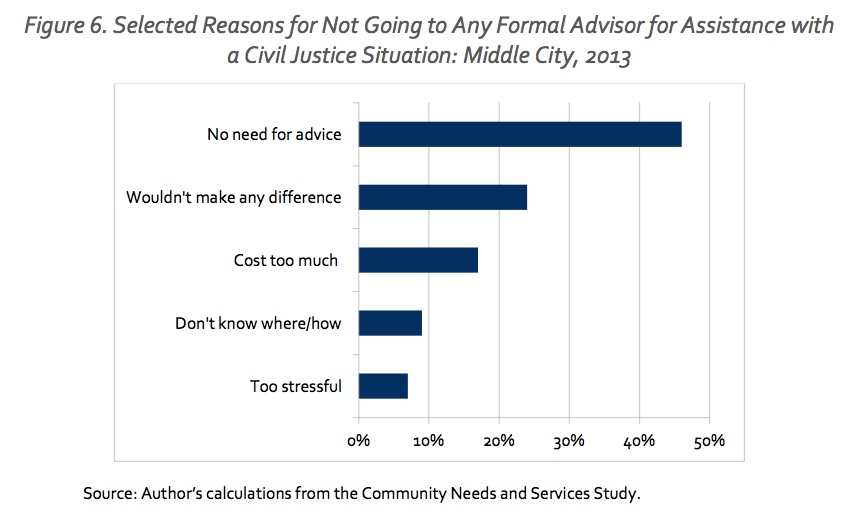
Why didn’t people reach out further for assistance in handling civil justice situations? Interestingly, cost plays a modest role in people’s accounts of why they did not do more to respond to the situations they faced. Among people who had not gone to any kind of advisor outside of their own social network, the most common reason given was that they did not see the need (46% of the instances in which no advice was sought): either the problem had resolved or they expected it to resolve without getting advice, or they simply felt that they did not need advice. Another important reason for not seeking advice was believing that it would make no difference (offered as a reason 24% of the time). In 9% of instances where people did not or were not planning to seek advice, they explained that they did not know where to go or how to do so. Concerns about cost played a role in 17% of cases in which people did not or were not planning to turn to third parties, including lawyers, for assistance in handling civil justice situations.

Here is the chart.

NohelpreasonWhat to make of these results?

Firstly, as suspected from Canadian and British studies, the extent of legal problems that the public does not identify as such is great.  This may mean that there are many more problems needing legal intervention than we know, or it may be that lawyers tend to think that they are needed far more than the public, applying common sense, simply does not see as practical legal problems. Additional analysis and research would be helpful

Secondly, and much more controversially, the above chart might well suggest that cost is not the primary barrier to access to justice, rather it is perceptions and assumptions.  This is in a sense good news, because it means that the problem may, from a cost point of view, be more soluble than we think — which means that it is much easier to make the argument for whatever resources are really needed.

Third, and this is what really excites me, it may be that the family and social networks of most individuals, as well as they themselves, are much better problem solving resource than we realize.  If this is the case, then it may be our job to develop the resources that will make these helpers more powerful and more accurate than they now are. (You can’t help but think of McKenzie Friends, allowed in most Commonwealth countries, to provide help in the courtroom, as well as web-based information and tools.)

There’s a lot more in here worthy of study.

The study was partially funded by NSF.  Its great to see the fruits of NSF’s interest in access to justice.  Kudos to the DOJ Access Initiative for helping move forward the idea of more research in this area.

Note: a footnote in the Report says that “These initial findings exclude situations involving consumer purchases, health care, and neighborhood and community issues,which will be presented in future reports.”  These will up the prevalence rates, but not massively, I understand.

Posted in Research and Evalation, SRL Statistics | 2 Comments

Canadian Group Offers Guide to Settlement for the Self-Represented

The Canadian Group, the National Self-Represented Litigants Project, has released a very interesting resource: Settlement Smarts for SRLs.

It goes through the process step by step, very much from the self-represented litigant’s point of view.  All too often such documents are legal summaries, rather than this kind of material which really puts the reader in the litigant’s shoes.

Here, for example, is the section on being strategic.

It is important to show the judge that you are serious about exploring settlement. Even if you feel skeptical – for example, if you have approached the other party before and they have dismissed the idea – the judge will be much more supportive and helpful towards you if you state your commitment to trying to find a fair settlement.

Your opening statement to the judge is a good opportunity to describe your commitment to a fair settlement, to explain your settlement goals, and why these are important to you. Try to acknowledge in a respectful way the other side’s goals as well. Try to frame what you want to accomplish as goals – which you can express clearly and firmly – rather than as demands or entitlements.

For example, rather than saying “I am entitled to more access to my kids and there must be no last minute changes” say instead “I want to reach agreement on an access schedule that can enable me to plan ahead and avoid the anxiety of last minute changes”. Or, rather than “I demand payment before I complete work on the deck”, instead try “I need to be paid for my time and materials in order to be able to move forward with my commitment to finish the job.”

You should also mention any previous efforts you have made to reach an agreement – for example making an offer, producing documents, offering to compromise on something – even if the other side did not respond or dismissed your efforts.

It is also constructive for the other side to hear you say that if a fair settlement can be reached, you are committed to following these terms e.g. committing to following an agreed access schedule for co-parenting, or agreeing to completing a job for a customer.

You want to show the judge and the other side that you are “settlement smart.”

I thought this section, which integrated lessons from the group’s 2013 self-represented litigant survey particularly interesting and persuasive to the self-represented engaged in the settlement process.

2.5.1 Many litigants believe that their caseis“different”–because of course it is unique and personal to them – and that a judge will “obviously” side with them. Unfortunately, legal outcomes are never certain, which is why so many cases settle before trial when the risks and costs of proceeding become more real and immediate. This primer encourages you to think about settling earlier, even if you are convinced a judge would rule in your favor.

2.5.2 Bear in mind that a settlement agreement will rarely give you – or the other side – everything you want. This may sound obvious, but it is worth repeating that there is no incentive for anyone to settle by agreeing to everything the other side wants – they might as well go to trial and let the judge decide.

2.5.3 Many litigants adopt a strategy of “waiting it out”.They hope that if they persevere, the other side will eventually give up. This may work out – or it may not. In the meantime, you will be stuck in a process that will cost you time and money and sap your patience.

2.5.4 Getting angry, however understandable,is usually counter- productive. You will achieve more if you can express yourself in a calm and reasoned manner that suggests confidence and competence.

It would be nice to think of a range of tools that would help in settlement.  These might include predictor tools, tools to marshal arguments, model talking points, advice on how to read the mediator, etc.


Posted in Mediation, Self-Help Services | 3 Comments

Wonderful Graphic Triage Model

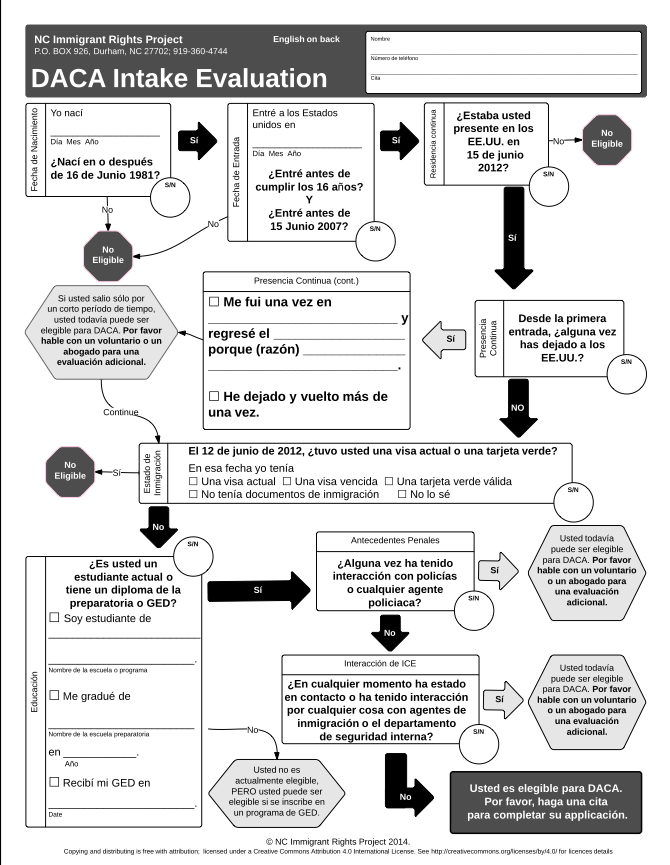
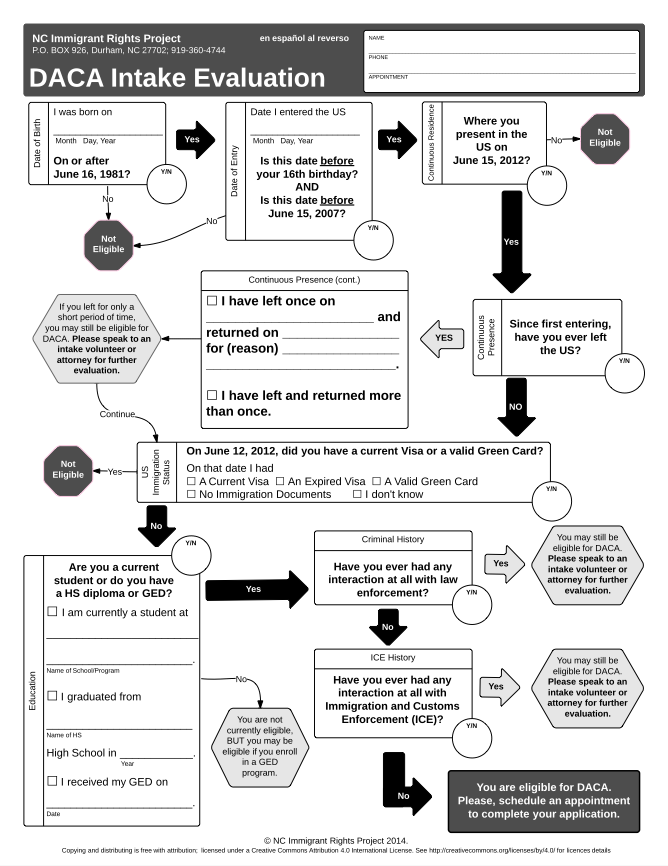
The wonderful OpenLawLab blog recently shared a triage chart designed by the NC Immigrant Rights Project to help intake workers work with clients to decide if the client is eligible for the Deferred Action (DREAM) program.  It is here, and below, under the Creative Commons license.

Open-Law-Lab-DACA-Screener-part-1Open-Law-Lab-DACA-Screener-part-2I love how clean and logical this is.  And it tells people what to do and where to go even if they may not be eligible.

Just think how much training and talking time this saves.

Why don’t we have this for every triage situation.


Posted in Immigration, Triage | Comments Off on Wonderful Graphic Triage Model

DC Court Offers Chat Informational Serices — Thoughts on Expansion

As reported in the Washington Post, the SC Superior Court is now offering chat informational services.

D.C. Superior Court officials on Tuesday announced a new online Web chat feature where court users can ask questions of court employees about their cases within the civil division.

Individuals with cases in small claims court (involving disputes of $5,000 or less), landlord and tenant, and civil actions ( involving disputes of more than $5,000) can access the various Web chats through the court’s main Web site.

 Of course, every court should be offering this service — there are several advantages of chat, two of the biggest are that the litigants get a full text record of the interaction that they can review later, and that supervisors can review the chats for quality.  The use of the stored answers can make chats much more efficient that traditional phone info services, and produces higher quality from volunteer information providers.

In terms of expansion, it should not be forgotten that chat — and indeed phone hotline services — may well be more efficiently be provided that locally based services.


Posted in Self-Help Services, Technology | Comments Off on DC Court Offers Chat Informational Serices — Thoughts on Expansion