A New Way of Thinking About Triage, 100% Access, and the Analysis Process

Traditionally, those who have pushed triage as a key component of 100% access have not always been fully clear about how the triage analysis actually fits in practice into the service modalities analysis.  Here is one way of thinking that has occurred to me.

Step One:  Design the basic accessible system, by putting in place all the things that we know work and can be done at low per litigant cost:  simpler procedure, broad informational services such as forms, help choosing the path, and compliance information, training for staff and judges, caseflow management.

Step Two:  Identify the specific tasks that need to be performed by the self-represented under this system.  For example, litigants need to fill in their own forms, and answer questions posed by judges.

Step Three:  Develop protocols to identify when certain tasks can not be performed by certain groups without additional assistance, what those tasks are, and who those people are.  The main factors will be litigant capacity, opposition power, and complexity of task  and case.  For example, some might be so intimidated that they can not answer questions, or the case might be so complex that forms will not be sufficient to get a judge in the right position to explore what needs to be explored.

Step Four:  Develop protocols to identify/design what kinds of additional assistance roles will be sufficient to get those tasks tasks done and when.  Examples of such assistance roles might be navigators (courtroom or courthouse), nonlawyer services, unbundled lawyer services, and full representation.  For example, it might be that appropriate navigators can get over most of the intimidation problem, but that unbunlded lawyers are needed for certain kinds of complexity.

Then you actually have the design of a 100% access system for that case type.

Step Five:  Analyze whether you could save money by providing more at step one for everyone, so that the more expensive step four services would be needed by less people.  Alternatively, it might be that money could be saved by increasing step four services, so that the level of step one services, provided to all, could be reduced.  For example, if one expected judges to be responsible for less of the exploration through questioning, one might save so much time, that it would be worth paying for lawyers in the subset of cases in which such more limited questioning would not be sufficient.

This overall analysis would thus maximize cost effectiveness as well as access.

Thoughts?

Posted in 100% Access Strategy and Campaign, Simplification, Triage, Unbundling | 2 Comments

Justice for All Project “Fast Facts” Underlines Potential of this Moment

More information is now available about the new “Justice For All” project which will support the access to justice services strategic planning process urged upon the states by the Conference of Chief Justices Resolution.  (Disclosure; I am involved with the Project.)

As explained about goals:

The project aims to encourage state efforts that include all relevant stakeholders in the civil justice community—courts, access to justice commissions, legal aid, the private bar—in a partnership to implement CCJ/COSCA Resolution 5 (Meaningful Access to Justice for All). The Resolution envisions state systems in which everyone has access to meaningful and effective assistance for their civil legal needs through a comprehensive approach that provides a continuum of meaningful and appropriate services.

The latest document also provides a lot more information about the tools and materials that will be developed to assist this process.

An expert working group will develop guidance materials outlining and providing information about the key components of services and capabilities that states should have in place to achieve access to justice for all. The materials will contemplate a mix of services, as highlighted in the Resolution, for states to consider in their particular contexts (e.g., self-help services to litigants, new or modified court rules and processes that facilitate access, discrete task representation by counsel, pro bono assistance, effective use of technology, increased availability of legal aid services, enhanced language access services, enhanced coordination with the human services sector, and triage models to match specific needs to the appropriate level of services).

The working group will provide a template for a strategic action plan, including the basic outline for the possible plan, along with the menu of options and service alternatives for states to consider to fill the identified gaps in services in their states. The expert group will also provide a template for a state assessment/inventory to help states identify the services and capability components they do and do not have, and consider how to address gaps in services to better meet the legal aid needs of all. Related guidance materials will be provided. Templates and guidance materials will be available for all states.

As to the time schedule for grants and technical assistance:

o Late May: Justice for All RFP release
o Early September: RFP return deadline
o Mid-October: Grant awarded
o Early-mid 2017: Technical assistance funding finalized and processed

This is something that all players in all access to justice communities should be following very closely.  Resolutions are often criticized for being nothing more than words.  This kind of concrete action has every potential to be make the Resolution a tipping point.

Posted in 100% Access Strategy and Campaign, Access to Justice Boards, Access to Justice Generally, Funding | Comments Off on Justice for All Project “Fast Facts” Underlines Potential of this Moment

Very Hopeful Poll on Views of Age 18-26 Cohort Has Major Justice Implications

Frank Luntz, a broadly respected Republican Pollster, has just issued a fascinating poll on attitudes of people aged 8 to 26, which he calls the “Snapchat generation,” for whatever reason.

Bottom line, leaving the partisan stuff out, this generation are collectivist, internationalist, see corruption as the biggest problem, and highly optimistic about the future, both for themselves and the country.  Here are some highlights, but I recommend that people go read the whole poll (which includes the partisan and candidate alignment data).  It is an eye-opener, and suggests a huge shift for a more hopeful world.

My view of the whole things would be that this poll suggests that, a least in terms of the 18-26 generation, the access to justice community should be developing an agenda for fairness and justice, while attacking inequality and corruption, particularly when it comes from corporate or Washington failure, while also supporting those who provide help to individuals, and while not being afraid to draw on precedents and ideas from other countries, almost regardless of the labeling of their political systems.

Here is why.

Optimism.  88% say that they are at least somewhat optimistic about their own future and 61% say that America’s best days are ahead.  A massive change from prior groups, and suggests the possibility of hopeful engagement.  Indeed 87% say they will likely vote in the coming election.

Valuing Caring Professions.  The most respected professions are doctor/nursing and teachers, at 49% and 48% listing in the top three.  Lawyers, not so good at 8%.  Perhaps the explanation for the lawyer number can be found in the fact that elected leaders clock in at 6%, business leaders at 4%, and bankers at 4%.  By their clients you shall know (and judge) them.

“Corruption,” “Greed” and “Inequality” are seen as the Words that Best Describe America’s Problems.  This comes in at 38% for Corruption, 29% for Greed, and Inequality at 26% (the same number as Government, perhaps picking up a different political demograph, or more likely overlapping.)  Capitalism and Poverty tie at 13% and interestingly Partisanship gets only 8% suggesting that the Beltway’s evenhanded allocation of blame does not resonate with this group.

The Biggest Political Challenge is Seen as Inequality. 28% identify Inequality as the biggest problem, choosing as the top challenge: “Income inequality: I’m worried about the widening gap between the rich and poor. The rich aren’t paying their fair share and the poor are suffering.”  It is particularly that this is seen as a political challenge, that is to say one that must be solved in the political area, and is explicitly linked to inequity of financial burden.  An important potential message for issues of legal aid and court funding.  Again, the idea that this is not going to be solved by further empowering capitalism is supported by the fact that when asked which political system is more compassionate ,58% said Socialism 9% said Communism, for a combined non-capitalist 67%, and only 33% said Capitalism.  Moreover, 66% said Corporate America “embodies everything that is wrong with America,” and only 34% said that it is what is “right” with America.  “Washington” scores nearly as badly at 60% in embodying the problem.

A Full Third Now See Themselves First as Citizens of the World, More Than of America.  It is 35 to 65, but still a huge change.  It suggests that courts need to start thinking more about our interests as world citizens, rather than just US.  Not to mention perhaps citing opinions and legislation from other countries.  It also means that people may be interested in leanring from innovation in other countries such as the role of the legal profession.

Not American Exceptionalists.  On the contrary, 58% agreed that “America isn’t any better or worse than most other countries,” and, in strong contrast to prior generations, only 42% agreed that “America is exceptional. It’s better than every other
country in the world.”  Same conclusion.

“Fairness” (5%) and “Justice” (11%) Rarely Cited as Things that Make America Special.  Opportunity, Freedom, Diversity and Democracy all scored high.  Given the low scores for fairness and justice, and the low excptionalism score, this may be because this generation simply does not see America as fair or just, and presumably would like to do so.

This is consistent with the recommended messaging from Voices for Civil Justice:

.  .  .  helps ensure fairness for all in the justice system, regardless of how much money you have. It provides access to legal help for people to protect their livelihoods, their health, and their families. Civil legal aid makes it easier to access information— whether through easy-to-understand forms, including online forms; legal assistance or representation; and legal self-help centers—so people know their rights. Civil legal aid also helps streamline the court system and cuts down on court costs. When we say the Pledge of Allegiance we close with “justice for all.” We need civil legal aid to ensure that the principle our founding fathers envisioned remains alive: justice for all, not the few who can afford it.

Note however, that this messaging is much less aggressive on inequality and corruption than would appear to be appropriate for the 18-26 group.  It is more individualistic a.  It is non-internationalistic, and makes no use of skepticism about corporate America or “Washington.”  Perhaps most importantly, it fails to share the optimism this group seems to feel.

The real question is how can we get this generation to communicate with and persuade their elders to adopt their world view and analysis.

(Methodological note:  Most of the percentages above allowed several answers, but I am not certain how many.  In some cases it is clear that they were allowed three.)


Posted in Access to Justice Generally, Communications Strategy, Funding | Comments Off on Very Hopeful Poll on Views of Age 18-26 Cohort Has Major Justice Implications

An Approach to Customer/Litigant/User Input Into the Courts

I have been thinking recently if there is any good way to get decent customer/litigant/user input into the functioning of the courts. The fact is that most court systems do very little in this regard.  There is certainly no “Consumer Union” for courts

Part of the problem is that most court users see their having to deal with the court as a single event, unlikely to be repeated.  Another part of the problem comes from court fears that litigants will attempt to engage in ex parte communications if they are part of any formalized input process.  It is worth noting that those with representation get regular opportunities for general input through “bench-bar” gatherings, and is assumed that such input will not be case-specific.

Many hospitals have various forms of patient councils, and indeed, I am just joining the Johns Hopkins Cancer Center Patient and Caregiver Advisory Council. (“Our Vision: To integrate the patient and their caregiver’s perspective into all aspects of cancer treatment from diagnosis thru survivorship. Our goal is to instill hope and humanity in the evolving world of cancer care.“) I very much look forward to learning about how this kind of input can work.

Let me suggest that there is one category of case that seems often to be in and out of the court system for a long time, on and off, and that is cases dealing with children.  The problem here may be that those most willing to spend time engaged with the system at a general level will have the strongest feelings, and may indeed not always be open to the views of their opponents.

It may be therefore, that would be appropriate to have have three such Councils, one of prime custodial parents, one of non-custodial parents, and one of children, probably teens.  It would also probably be safest to make sure that the court staff who ran and attended the meetings would be those who were not engaged in case decision-making, or even dealt with the public.

We might learn enough from these experiments to move to other areas of input and to use other mechanisms, such as social media.  The bottom line is that you want a system that encourages reflective, focus-group type input,without the heavy costs of such a formal process.

Please share thoughts and ideas on this in the comments.

Posted in Court Management, Medical System Comparision | Comments Off on An Approach to Customer/Litigant/User Input Into the Courts

A Different Take on The Supreme Court Vacancy — A Bipartisan Access to Justice Opportunity

The apparently inevitable partisan political wresting on the open Supreme Court seat has already started.  But maybe there’s a different way of thinking about this.  Although, after McConnel threw down the gauntlet about letting the people decide, I am not sure anyone could blame the President from taking him at his word, one way or another.

First Fragments from a Justice Story

Scene One: Oval Office — President and Chief of Staff.

President:  With the preliminaries out of the way, is there some way we can turn this into opportunity.

Chief of Staff:  Mark (former deputy chief of staff Mark Childress) called in from Tanzania with an idea.  He reminds us that when he was director of the Access to Justice Office, following Larry (Prof Laurence Tribe), he got some bipartisan support around issues of access to justice.  He says maybe we could make this an access appointment, rather than a traditional left-right appointment.  Makes it harder to block when it’s an issue that all political groups identify with.

President:  Ya, but what’s the politics, optics, alignment.  More data, and names?  And keep moving with the vetting of the old list.

Scene Two: Next Day with Joe Biden, AG Lynch, and Counsel.

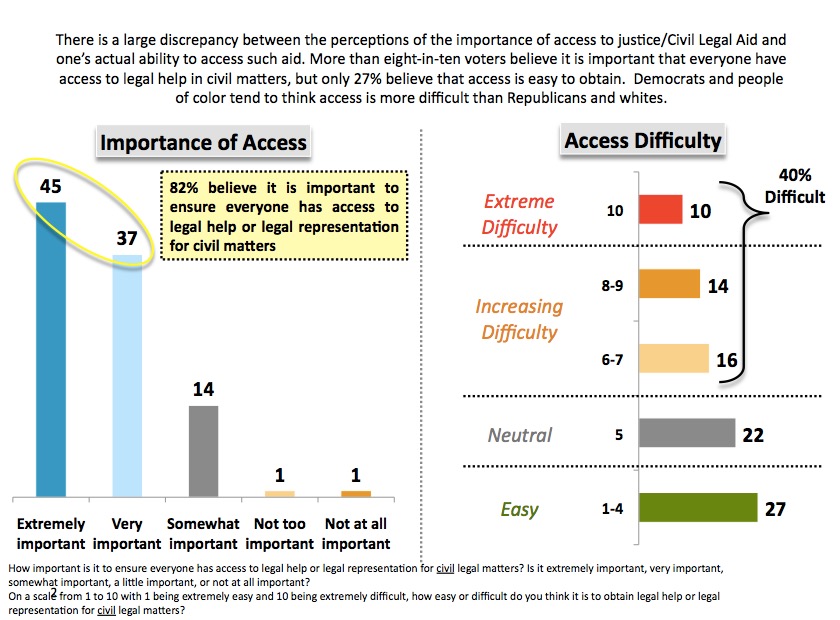
Chief of Staff:  Here’s the general polling on access to the legal system from Voices for Civil Justice. (And, Mr President, click here for another slide and credit.)

pollBottom line.  Broad support, even for more money after messaging, with little vulnerability to attacks.  Key message is fairness.

Vice President Biden:  Remember, when I spoke at the LSC 40th anniversary, Scalia spoke too.

President:  What’s the evidence it is bipartisan?

Chief of Staff:  Simple, the state Chief Justices last summer passed a 100% access to justice resolution.

To quote:  “advances include, but are not limited to, expanded self-help services to litigants, new or modified court rules and processes that facilitate access, discrete task representation by counsel, increased pro bono assistance, effective use of technology, increased availability of legal aid services, enhanced language access services, and triage models to match specific needs to the appropriate level of services.”

President:  You are kidding!

Chief of Staff:  Unanimously (of those present)!  Red and Blue states and named by both red and blue governors.  “Aspirational Goal.”

AG Lynch:  And the House Access to Justice Caucus has a Rep was well as a Dem member.

But for the Court it’s not about LSC.  Jut like the Legal Aid Inter-agency Roundtable, it’s everything that gets people heard in the legal and administrative system.  Changes in courts, court rules, services, technology, nonlawyers, advocates.

President; (Astonished expletive deleted).  Can your sound out McConnel’s people.  Would the Chiefs get behind an access candidate?

Counsel:  They have to be careful politically.

Scene Three :Later that day, phone  call between McConnel Chief of Staff and WH Chief of Staff.

(After preliminaries)

WH Chief: So, I got a way for your to dig yourselves out of your hole on this.

McConnel Chief:  What hole?

WH Chief: Look, so you block, saying the people must speak first.  Then you lose the Senate and the White House.  Who does Hilary or Bernie nominate — Obama?  They spoke twice on him!  And you can not filibuster, because the people have spoken.  We get that you are trying to damp down your own candidates on this, but it just makes it worse for you.

McConnel Chief: (longer string of denying expletives deleted.)  And what if we win?

WH Chief:  You sure you want that!  OK, here’s the idea.  We turn away from the culture wars, find someone who beleives in making the legal system work for all, that defangs Sanders and Trump.  Did you know Scalia spoke at the 40th anniversary of LSC?

McConnel Chief:  Are you trying to bait me?

WH Chief.  Yes!  But seriously, its about much more than funding LSC, which is not the Court’s business.  Its about opening the system. Its even about de-lawyering — making alternatives to lawyers possible.  Newt would once have liked that.

McConnel Chief:  Get me names from super red states.

Scene Four: Next Day with WH team

President:  Names?

WH Counsel:  Just some so far.  Christine Durham, former Utah Chief Justice, Mormon, appointed by a D., tried to allow some gun regulation, tried to enforce Roe.

Wallace Jefferson, former Texas Chief, not yet 50, African American, appointed by Ric Perry, won two cases in the Supreme Court limiting municipal liability.  Rick Casey of the San Antonio Express-News last year suggested him as an Obama nominee.  Jefferson’s great grandparents were slaves owned by a judge.  By the way, irony alert, that’s the paper that broke the Scalia story over the weekend.)

Both have played major roles in the Conference of Chief Justices, Jefferson helped get Larry to address them, and that’s when his endorsement of Access to Justice Commissions really got the idea to take off.  Jefferson starred down the Texas bar on the need for court forms.  Let me read: “The Constitution requires the Court to administer justice.  This occurs not only by deciding cases but by establishing a judicial climate in which people who lack money to hire a lawyer have a reasonable chance to vindicate their rights in a court of law.”

AG LynchLisa Foster at our ATJ office tells me that Larry’s Chiefs’ speech was the turning point in lots of things.

President:  Dig more.  Get more names.  I’ll call Mitch.

A final thought from this blog:  Even, as most likely, this approach goes nowhere, let try to make sure that attitudes of potential nominees on this urgent perspective are explored, and those of the nominee made clear and considered.  It might help make access to justice an election issue, which it should be.

Posted in Access to Justice Generally, Supreme Court, White House | 3 Comments

Good News From the ABA — Regulatory Objectives Adopted

Today on what the American Lawyer (limited-free link here) reports was ultimately a voice vote, the ABA House of Delegates approved the Model Regulatory Objectives proposed in Resolution 105, previously discussed and listed here and here.

The full Resolution, as amended and adopted, is here.  The Objectives survive intact, and the only amendment, pasted below, seems to be more about protecting lawyer-only ownership of law firms than any limitation of the concept of non-lawyer practice.

FURTHER RESOLVED, that nothing contained in this Resolution abrogates in any manner existing ABA policy prohibiting non lawyer ownership of law firms or the core values adopted by the House of Delegates in Resolution 10F, adopted on July 11, 2000.

It would seem to me that this additional language would not require ownership by lawyers of the “non-traditional legal service providers” envisioned by the Resolution, given the differences in the phrases “law firms” and “non-traditional legal service providers,” and traditional rules of statutory construction.

So, given this action, and that by the Conference of Chief Justices on the Objectives last week, this seems to be where we are:

  1.     The ABA has adopted, and the Chiefs have encouraged their members to use, the same set of Model Regulatory Objectives and to do so for both lawyers and non-lawyers.
  2.      While neither group formally urges the adoption of forms of non-lawyer practice, both organizations have effectively acknowledged both the existence of such forms of practice, and the likelihood that additional states beyond those already deploying or considering it, will find the general approach of value.
  3.      So now the issues become much more practical, such as what are the specific regulatory structures, what tasks are to be authorized to be performed by these new professionals, what specific rules will govern their authorization and practice, and  what kinds of groups will offer these services. (More on all this in the future.)

While there are likely to be many skirmishes to come, this has been an important few days, and surely one in which the contribution of nonlawyers to getting us to 100% access has moved from being a fringe possibility to a likely major ultimate component.

Congratulations to those involved.  This is a important achievement.

Posted in 100% Access Strategy and Campaign, ABA, Attorney-Client, Bar Associations, Non-Lawyer Practice, Systematic Change | 1 Comment

Conference of Chief Justices Recommending its Members Consider “Regulatory Objectives” for Regulation of Lawyers and Nonlawyers Could Help Move the ABA Process Forward

When I blogged yesterday on “Is The ABA Really Willing for the Headline to be ‘Bar to Public: Drop Dead?‘”, I had not known that the Conference of Chief Justices (CCJ) had, on Wednesday, passed a resolution on the same general subject, titled Recommending Consideration of the ABA Model Regulatory Objectives for the Provision of Legal Services.

Indeed, the CCJ Resolution notes the prior passage of its own Access Resolution, references the establishment of the ABA Commission on the Future of its Legal Services, and the Commission’s conclusion of the value of the establishment of regulatory objectives,and itself (CCJ) observes that doing so “clarifies the purpose of regulating lawyers and, where a state chooses to do so, other legal service providers; ensures transparency to the public regarding the regulatory framework for lawyers and other legal service providers; and defines the parameters of regulations.

It then proceeds to list the Regulatory Objectives developed by the Commission (see the bottom of this post), and concludes:

NOW, THEREFORE, BE IT RESOLVED that the Conference of Chief Justices recommends consideration of the model regulatory objectives by its members as a means to help assess the state’s existing regulatory framework and to help identify and implement regulations related to legal services beyond the traditional regulation of the legal profession.

While this is not a formal endorsement of ABA Resolution 105, while it does not even mention the Resolution rather than the Commission’s substantive conclusions, and while it is addressed to CCJ’s own Chief Justice members rather than other organizations, the parallels are hard to escape.

I would hope therefore that ABA House of Delegates would now find it easier to come to the conclusion that the approach, and perhaps even the specifics of the proposal before them, far from being a crazy radical change, is very much in line with our Nation’s broad access to justice agenda.

I am particularly encouraged that the Chief”s chose to reference the Access Resolution, with its “recognit[ion of] “‘significant advances in creating a continuum of meaningful and appropriate services to secure effective assistance for essential civil legal needs” and support[ing] ‘the aspirational goal of 100 percent access to effective assistance for essential civil legal needs.’”

If the ABA House of Delegates acts positively tomorrow, this will surely be evidence that our national justice leadership organizations are moving into congruence, not only about the urgency of moving to 100% access, but about the strategy for doing so.

P.S.  The Regulatory Objectives discussed above are as follows:

Protection of the public

Advancement of the administration of justice and the rule of law

Meaningful access to justice and information about the law, legal issues, and the civil and criminal justice systems

Transparency regarding the nature and scope of legal services to be provided, the credentials of those who provide them, and the availability of regulatory protections

Delivery of affordable and accessible legal services

Efficient, competent, and ethical delivery of legal services

Protection of privileged and confidential information

Independence of professional judgment

Accessible civil remedies for negligence and breach of other duties owed, and disciplinary sanctions for misconduct

Diversity and inclusion among legal services providers and freedom from discrimination for those receiving legal services and in the justice system.

Posted in 100% Access Strategy and Campaign, ABA, Access to Justice Generally, Attorney-Client, Legal Ethics, Non-Lawyer Practice | 1 Comment

Is The ABA Really Willing for the Headline to be “Bar to Public: Drop Dead?”

The American Lawyer is reporting (limited free link here) very significant opposition within the ABA to the work of the ABA Commission on the Future of Legal Services.  As the article explains:

[The Commission’s Resolution 105 merely] asks the ABA to adopt “Model Regulatory Objectives for the Provision of Legal Services” that are guided by such benign principles as protection of the public and meaningful access to justice. It also urges each state’s highest court to be guided by these objectives if it is considering new rules to allow activity by “nontraditional legal service providers.”

While the resolution doesn’t advocate for such changes, the mere mention of “nontraditional legal service providers” raises hackles for some in the ABA. The Texas state bar board, for example, has asked Texas delegates to withhold their support for Resolution 105. State bar president-elect Frank Stevenson II of Locke Lord said the board opposes the proposal because it seems to presume there’s a place for nonlawyers to provide legal services.  He added that Texas’ chief justice has already set up a commission to study how lawyers can reach more of the public, and his group wants to wait for that group to finish its work.

“Our position shouldn’t be interpreted as rigidly opposed to innovation in the provision of legal services,” Stevenson said. But he added, “We feel lawyers are not fungible with nonlawyers.”

I am not sure what that last quote means, or is meant to mean.  Does it merely mean that nonlawyers can not do all that lawyers can do, which would in no way justify or support opposition to the proposal, or does it mean that nonlawyers can not do anything that lawyers do, which is surely absurd.

Remember that the proposal merely acknowledges the possibility of authorization for some form of nonlawyer practice and proposes the goals that should drive regulation of lawyers and nonlawyers, if authorized.

Here are the proposed Regulatory Objectives:

Protection of the public

Advancement of the administration of justice and the rule of law

Meaningful access to justice and information about the law, legal issues, and the civil and criminal justice systems

Transparency regarding the nature and scope of legal services to be provided, the credentials of those who provide them, and the availability of regulatory protections

Delivery of affordable and accessible legal services

Efficient, competent, and ethical delivery of legal services

Protection of privileged and confidential information

Independence of professional judgment

Accessible civil remedies for negligence and breach of other duties owed, and disciplinary sanctions for misconduct

Diversity and inclusion among legal services providers and freedom from discrimination for those receiving legal services and in the justice system

Nothing very controversial there, surely.  The kicker comes in the “resolved” section (bold added).

FURTHER RESOLVED, That the American Bar Association urges that each state’s highest court, and those of each territory and tribe, be guided by the ABA Model Regulatory Objective for the Provision of Legal Services when they assess the court’s existing regulatory framework and any other regulations they may choose to develop concerning non-traditional legal service providers.

So if good old Texas, and others, gets their way, the message is simple.  There are to be no “non-traditional legal service providers.”  Period.  (Texas used what might be called the “not-yet approach” to justify its lack of support.)

That’s pretty bold, given that, as the Report accompanying the Resolution points out with respect to regulatory goals:

Nearly two dozen jurisdictions outside the U.S. have adopted them in the past decade or have proposals pending. Australia, Denmark, England, India, Ireland, New Zealand, Scotland, Wales, and several Canadian provinces are examples.

Whatever face-saving formula might be used to avoid a formal rejection of the approach, I think the media, and indeed the public and legislatures, would be justified in viewing any refusal to adopt the Objectives as an act of contempt towards the public’s interests in comparison to those of the profession. (This is particularity the case given the breadth of wisdom and input that led to and guided their development.)

A “Drop Dead” approach indeed.  And a risky one.  Remember which big state’s votes helped Ford lose the election in 1976.  The House of Delegates considers the issue on Monday.

P.S.  Sorry, my age is showing.  Many will not get the “Drop Dead” reference. The reference is to the New York Daily News Headline “Ford to City: Drop Dead,” when Ford came out in opposition to financial help for the City.  The opposition, and the headline itself, are considered by many to have had a significant impact on the 1976 election result, in which the margin was close. (From the NYT: “Gerald R. Ford and Marie Antoinette did not have much in common, but being misquoted cost both of them their jobs. .  .  .  Mr. Ford never explicitly said “drop dead.” Yet those two words, arguably the essence of his remarks as encapsulated in the immortal headline, would, as he later acknowledged, cost him the presidency the following year, after Jimmy Carter, nominated by the Democrats in New York, narrowly carried the state.”

Posted in ABA, Access to Counsel, Access to Justice Generally, Bar Associations, Legal Ethics, Non-Lawyer Practice | 3 Comments

Another Important Piece of the Justice for All Strategy Falls Into Place — Resources and Funding for Strategic Planning

As every reader of this blog knows, the Access Resolution passed by the Conference of Chief Justices and the Conference of State Court Administrators is important not only because of its endorsement of the “aspirational goal” of 100% access to justice services, but because of its explicit call for each state Access to Justice Commission (or equivalent) to develop a strategic plan with “realistic and measurable outcomes.

Now, in an announcement from Massachusetts Chief Justice Ralph Gants and California Court of Appeal Associate Justice Laurie Zelon, the National Center for Stare Courts tells us of the launch, with funding from the Public Welfare Foundation, of the Justice For All Project.  To quote the (reformatted by me) key paragraph from the announcement:

.  .  . The project will develop a state assessment/inventory and strategic action plan template and guidance materials to assist states in their planning;

[A]ward grants to targeted states using an RFP process, for assistance with state assessment/strategic action planning; and

Provide funding for technical assistance to address specific state access needs.

The Project will be in the care of an Advisory Group, representing a broad range of leaders committed to access innovation and implementation, an Expert Working Group reflecting very broad knowledge and experience in the field, committed liaisons to CCJ and COSCA, and a skilled and expert staff consisting of Tom Clarke and Shelly Spacec Miller (NCSC) and Katherine Alteneder (SRLN).  The members of these groups are listed in full in the announcement.   (Disclosure: I was involved in discussions about the conceptualizing of this project, and am honored to serve on the Expert Working Group.)

The announcement promises more details and a “likely RFP target date of May 2016.

Indeed, “[a]ll states are encouraged to mobilize their partners in the access to justice community to begin the journey to implement the Resolution.”  With the RFP for funding states to work on their assessment/strategic action plans coming so soon, preliminary work would surely make sense.

To my mind, this is a very important step.  It is one thing to announce a goal, but very different to develop the tools needed to move forward, and to provide the resources that will help states fulfill that goal.  I think the process of developing the template and guide  for assessment and strategic planning will show us how much we have learned in the last 15 years, and also help focus us on the issues that will need further attention.  I would very much hope that as we learn from this planning and subsequent deployment, we will be able to use that experience to further improve the tools.

Special thanks, of course, to funder Public Welfare Foundation, and law firm DLA Piper, which will be providing pro bono research and technical assistance.

Posted in 100% Access Strategy and Campaign, Access to Justice Boards, Access to Justice Generally, Funding, Systematic Change | Comments Off on Another Important Piece of the Justice for All Strategy Falls Into Place — Resources and Funding for Strategic Planning

Moving to 100% Access Strategic Plans – The LSC TIG Program as Opportunity and Harbinger

The 2016 Legal Services Corporation Technology grant solicitation,due Feb 29, suggests one of the ways that the Chefs 100% Resolution can move towards true implementation.

It creates as its first listed specific area of interest, “Achieving 100% Access,” which it describes as “use[ing] technology to further the goal of 100 percent access to effective assistance for essential civil legal needs, particularly through projects that advance related objectives developed by the Access to Justice Commission in the applicant’s state.

The full text of that portion of the request for letters of intent, which appears below, relies heavily on the Chief’s Resolution and quotes from it, including specifically the urging that courts and ATJ Commissions, or other relevant bodies, should develop “strategic plan[s] with realistic and measurable outcomes.

Achieving “100 Percent Access.” LSC’s 2013 Technology Summit Report  proposed  an integrated service-delivery system that would “move the United States toward providing some form of effective assistance to 100 percent of persons otherwise unable to afford an attorney for dealing with essential civil legal needs.” Recently, the Conference of Chief Justices and the Conference of State Court Administrators adopted a resolution advocating a similar access goal:

NOW, THEREFORE, BE IT RESOLVED that the Conference of Chief Justices and the Conference of State Court Administrators support the aspirational goal of 100 percent access to effective assistance for essential civil legal needs and urge their members to provide leadership in achieving that goal and to work with their Access to Justice Commission or other such entities to develop a strategic plan with realistic and measurable outcomes;

and BE IT FURTHER RESOLVED that the Conferences urge the National Center for State Courts and other national organizations to develop tools and provide assistance to states in achieving the goal of 100 percent access through a continuum of meaningful and appropriate services.

With this area of interest, LSC seeks proposals that use technology to further the goal of 100 percent access to effective assistance for essential civil legal needs, particularly through projects that advance related objectives developed by the Access to Justice Commission in the applicant’s state.

LSC’s Technology Summit Report provides examples of strategies for achieving 100 percent access, but proposals should not be limited to approaches discussed in the report. Applicants should work with their local commissions (where they exist) and/or other stakeholders to determine the best ways to use technology to move toward achieving this goal.

This has several obvious implications.  In the short term, to the extent that states already have developed even interim access strategies, it would make sense for the legal aid community in a state to work with the other stakeholders to identify the ways that technology could most effectively move forward those strategies and to develop TIG proposls that are integrated with these approaches.  It would similarly make sense to pay particular attention to ways that the technology could be deployed statewide with ease, either initially, or following a local pilot. (It would be hard to imagine a technology serving a state strategic plan if the technology was not designed to be deployed statewide.

In the longer term, it would make sense to make sure that the state access strategic plans include a strong technology component, particularly since LSC is so open to the use of its TIG funding for partnerships, and indeed to cover partners’ costs.  (I remain surprised that this fact is still not yet appreciated by all decision-makers in the access community.)

As a general matter, it is worth pointing out that the focus in the Resolution on “realistic and measurable outcomes,” further highlights the value of technology in the plans.  While not every technology project will measure ultimate outcomes, generally tech-driven projects do a far better job of data collection than non-tech projects, almost by definition.  The data is a byproduct, rather than generated by a separate activity.

I would hope that other funders, including but not limited to IOLTAs, will similarly use their leveraging ability to make sure that more and more investments of all kinds are fully integrated with overall state strategic plans.  That is the best way to ensure that the impact of all investments is maximized.  Indeed, in the long term, I would anticipate that a question as to the relationship to a state’s access strategic plan will become routine in our world.

I feel confident that we will be seeing more and more such integration.  Indeed, LSC can feel very proud of the role it has played in moving these 100% ideas forward.

P.S.  The short Letters of Intent are due Feb 29, here.

Posted in 100% Access Strategy and Campaign, Access to Justice Boards, Access to Justice Generally, Funding, IOLTA, Legal Aid, LSC, Outcome Measures, Systematic Change, Technology | Comments Off on Moving to 100% Access Strategic Plans – The LSC TIG Program as Opportunity and Harbinger

Thoughts on the Medical Consent Process and Implications for the Relationship Between Courts, Legal Advocates and Clients

Yesterday, I had a bone marrow biopsy, as part of my ongoing medical care dealing with bone marrow cancer.  That biopsy is not my favorite thing, but let me tell you, as often at Hopkins, you are reminded just what a difference a skilled and sensitive person doing the procedure can make.

The thing that has never happened before to me in all my dealings with the medical system, and that really set me thinking, was that, during the consent process, after briefly describing each risk, the nurse explicitly told me what she would be doing to minimize that risk.

It turned the formal consent process, often treated as a meaningless imposition on all involved, into an opportunity for making the two of us into a team.  The nurse communicated her concern for me, I could have pointed to any risks I was worried about, or had reason to believe might have been greater than usual, and the document had a purpose.

In contrast, I could not but help recall how, decades ago, I learned of an institutional public defender in which the lawyers considered it their task, in obtaining the consent of their clients to a guilty plea to, and directly quoting here, to “break the client.”  In other words, as the justification went, they were so certain that the client would be convicted if he went to trial, so certain of the terrible sentencing consequences, and so sure that the reluctance to plead came from irrelevant considerations like a refusal to admit guilt to the family, that they felt a moral obligation to “break the client.”  When I was telling a doctor friend about this, he said it reminded him of Guantanamo.

Now, I trust that most advocates do not see their relationship with their clients that way, but it would be good to think about ways that courts, lawyers, nonlawyer advocates and others could see the benefits of full transparency, including the communication and discussion or risks and how to avoid them, as something that would strengthen the trust of the client or litigant in the system, rather than the opposite.

For example, judges, in explaining the possible consequences of failing to obey a court order, could do this in a way that suggested it was about helping the person being ordered, rather than just frightening them, maybe compliance would be greater.  Maybe we need to be even more sensitive to how a discussion between lawyer and client, in both the civil and criminal areas, should include more of a discussion of risks and benefits of different choices, and of what the lawyer and client could do together to minimize those risks.

In the plea example above, would it not be better for the lawyer to think of how to communicate a deep concern for the client’s interests, rather than how to terrorize him. (And, surely, just the use of that language can only color the interaction.)

Please share your thoughts.

Posted in Attorney-Client, Criminal Law, Defender Programs, Judicial Ethics, Legal Ethics, Medical System Comparision, Personal, Public Defender, Transparency | 2 Comments

Thinking About Designing Courthouses for Access to Justice

Some of us have long urged courthouses be designed physically with a view to access to justice.  We might find some inspiration from a recent video feature on Politico, on the “Post-Ferguson Police Station,”   I would suggest watching the video starting at 5 min 20 secs, for the visuals that show the ideas.

For a courthouse, the core ideas would be design the spaces and human flow to encourage access to the information that would enable people to assert their rights, to connect them with people who can help them, to reassure that they would not be treated as the cashbox, and to ensure that staff were kept cognizant of the human consequences of their actions.

Here is a crazy idea, that at least gets one thinking about the implications of design, set the staff and judicial entryways so they walk past the cells, reminding them that incarceration decisions are not about theory but about humanity. (I’d want to test the consequences, it might do more harm than good.)  You’d need to find a way to explain to those held that they were not being exhibited as objects — maybe it would be safer to just put big photos on the entry hall of the insides of prisons.

More generally, Module 3 of the Court Leadership and Self-Representation package is all about courthouse design for access.

What I would really like to see is an architecturalal design competition for an access-friendly courthouse.  We surely spend billions a year on building courthouses, so this would be very appealing to architects.  (See., e.g. Greenfield Massachusetts Trial Court, Project Cost$60 million;  Boston Federal Court, $170 million, completed 1999).

Once build, those courts can end up structurng the patterns of interaction for a century or so.  Lets get them right.


Posted in Court Management, Security, Self-Help Services | 5 Comments

Outcome Measures #2: LSC Outcomes Measures, Good News, Bad News, and A Challenge

This is number 2 in an occasional series on outcome measures.  Number 1 reiterated how important it is to develop and apply such measures system wide.

There is good news and bad news on LSC outcome measures.

The good news: LSC is moving to require the collection and use of outcome measures, and has made available the promised Toolkit on outcomes.  The bad news: there are as yet no national outcome measures, meaning that programs can still design all their own measures, and the utility of the process and product is therefore severely limited.

LSC has told its grantees that 1) they must begin collecting outcomes information by June 1, 2016, 2) must for 2017 grant applications, confirm that they are collecting outcomes, and, 3) for 2018 grant applications, must also provide a narrative of how they are using outcomes information

The Toolkit, developed after a long process, which some of us has originally hoped would develop true national measures, includes listings of possible outcomes by substantive areas, two case studies (Cleveland Ohio and Virginia), and a resources link.  I understand that additional case studies are to be added.

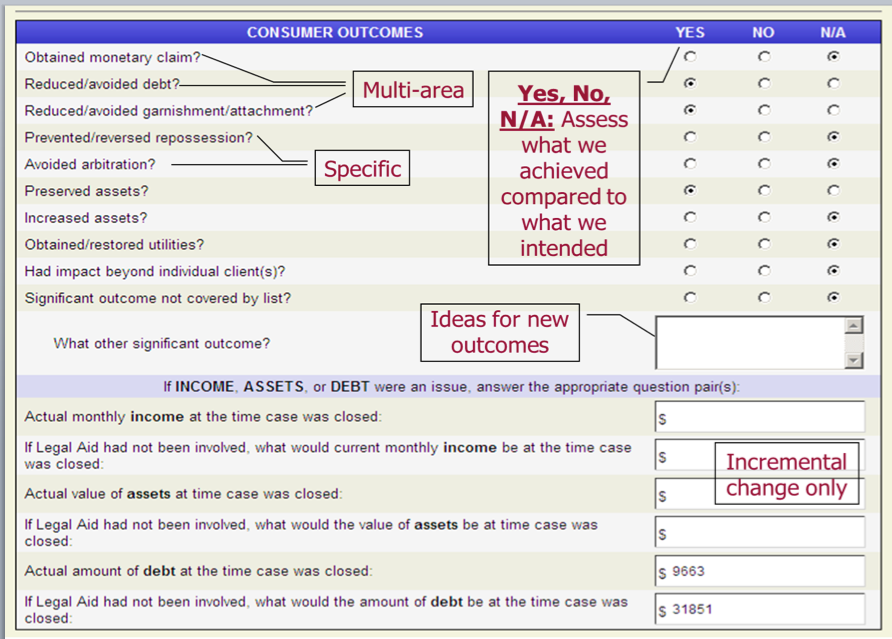
By far the star of the Toolkit and site is the Cleveland Case Study.  The study explains the reasons for the project, the process that was followed internally to develop the outcomes  (including, critically,  extensive staff input) and process, details how the system operates, and lists lessons learned.  Very important was full integration with the overall case management system.  Staff are enthusiastic.

I would hope that screenshots like this one would prove to all the logic, simplicity, and ease of use of the Cleveland system.

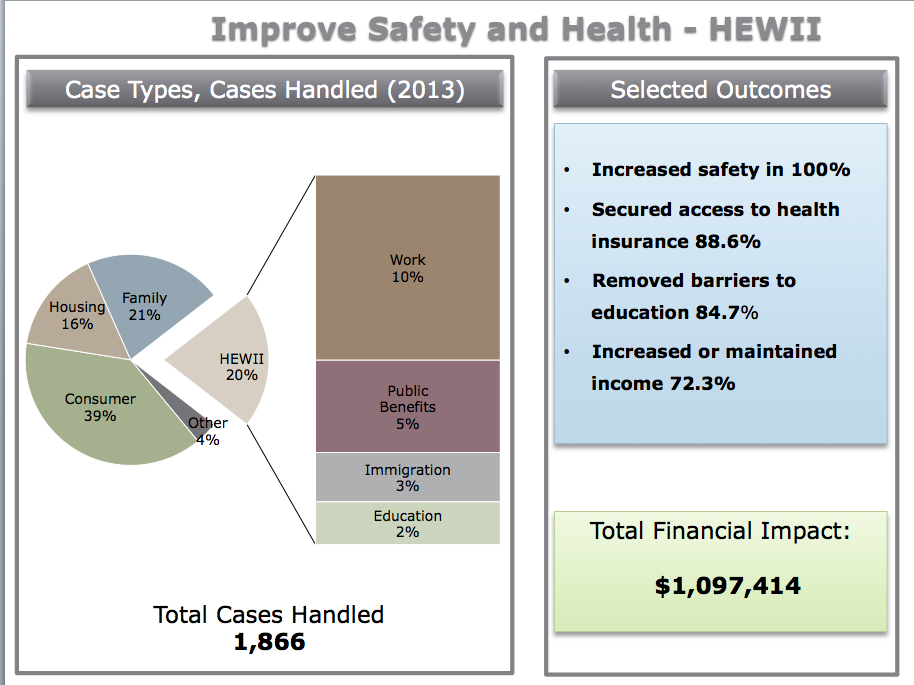
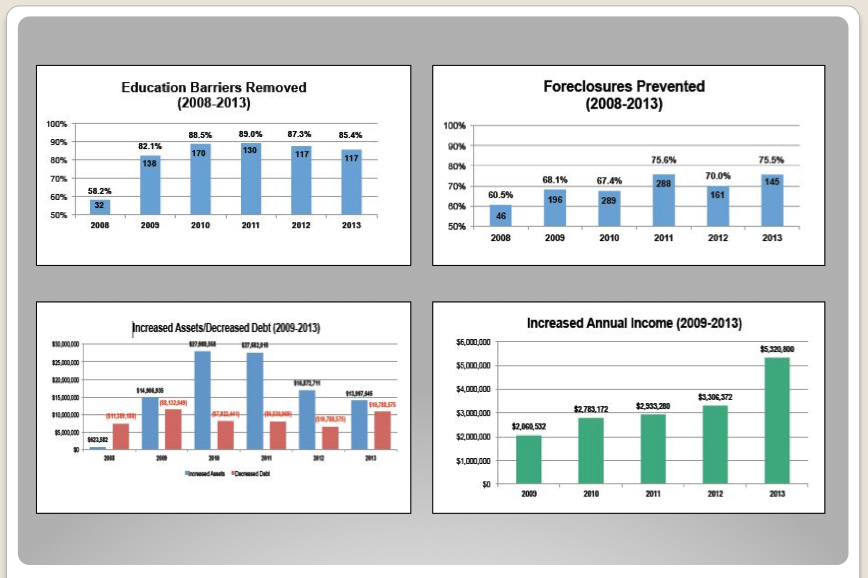
CLAS-Consumer-Outcomes I would also hope that charts like these would sell everyone on the value of the system for showing outcomes.

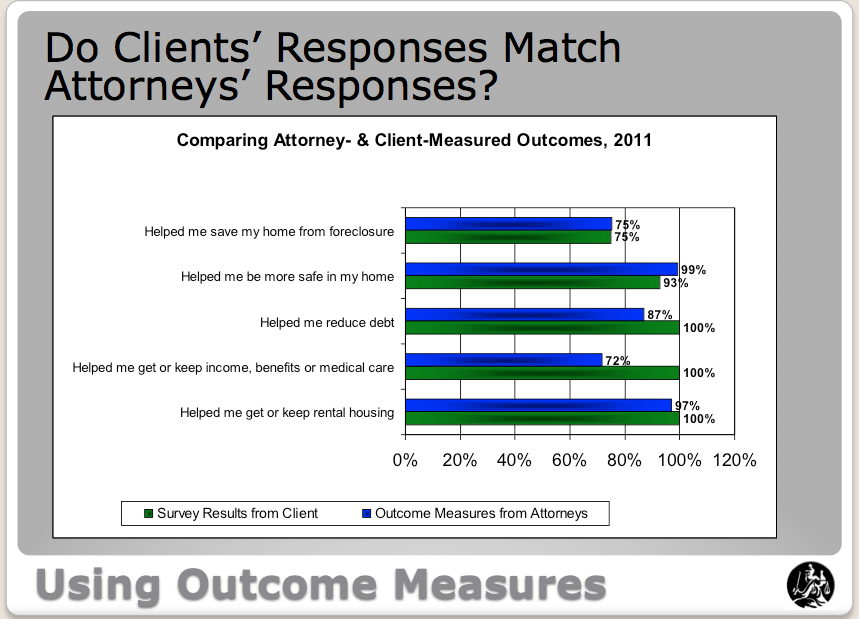
CLAS-HEWII-Health-and-Safety-Strategic-Goal CLAS-Historical-Trend-Report This one, comparing client and advocate views of outcomes shows how useful such systems can be in improving quality — and why we must always include clients in the discussion of what measures to use, and then of actual outcomes.  Why, one asks, are the clients as approximately as positive, or more positive, about every outcome area except the one that deals with keeping the person safe in the home.  I would assume this is the Domestic Violence measure, and wonder if the clients are less hopeful because they know the scope of the ongoing risk.  The obvious suggestion would be to ask clients what could be done to improve this outcome.

Client-Advocate-Outcomes-Comparison

Surely, the case is made.

The bad news, again, is that we still do not end up with a common and comparable outcomes across the system.  I will be honest that I fail to understand why.  I would hope that the illustrations above show the value and potential universality of the approach, and indeed its details.  The lack of comparable outcomes throughout the system makes it impossible to compare the value of innovations or to do the kind of preliminary program and state comparability review that could lead to the more detailed explorations that could then lead to quality and outcome improvements, or, indeed, to a demonstration of the apparent inequities in courts of certain states.

While there is now funding to develop e-training materials on the toolkit (top listing), I very much hope the community will move aggressively to deploy outcomes measures nationally.  (Side Note:  Huge credit to LSC for getting out there and bringing in outside funding to support innovations and improvements, as listed in the above link.  This was a potential too long ignored, largely for fear of reducing local fundraising opportunities.  The truth is obviously the opposite.)

Indeed, with respect to the outcome measures, I offer a specific suggestion and a challenge.  Why not simply take the Cleveland System as the presumptive standard, make the changes necessary to have it work nationally, and then require it to be used?  Maybe the group that worked on the process tried this approach, and it failed.  Then perhaps the larger access to justice community should get an explanation of why this failed.

Similarly, I would offer the same challenge to every legal aid advocacy program, every IOLTA grant maker,  and every state access to justice commission: take a look at the Cleveland model, and see how, with modifications, if really needed, it can be adopted by your program or community.  The burden of justification of any “no” is on you.  If you do feel you need to make a change, minimize it, try to maintain full consistency, and remember the benefits of full comparability.

These are important steps forward.

Posted in Access to Justice Boards, IOLTA, Legal Aid, LSC, Metrics, Outcome Measures, Research and Evalation, Series: Outcome Measures | Comments Off on Outcome Measures #2: LSC Outcomes Measures, Good News, Bad News, and A Challenge

Outcome Measures #1: Why They are Critical for the Future of Access to Justice

This blog posting inaugurates a new feature, series blogs.  When I think an topic is particularly important, I will blog several times about the topic.  Each series will get its own listing in categories, so you can quickly find the whole sequence.

I am starting with a series on outcome measures because they remain somewhat controversial within the access to justice community, and I think it is important to lay out where we are and where we can and should be going.

Let me start by going back to the medical analogy.  Those of us who are thinking about treatments and drugs, and potentially life-changing choices constantly worry about things like impact on life expectancy.  While we may quibble (with energy) about the importance of designing quality of life outcome measures that value more than just time gained — and indeed I am enrolling in just such a study to validate such measures with respect to my disease — the fact is that we would be lost without that data on outcomes.  Imagine if we had to rely on an oncologist saying “Oh, we think that we have found from experience that this drug is better than that,” or “we tell you to hope for the best and prepare for the worst.”  (One of my favorite lines from Terms of Endearment is when the Shirley Mclaine character, in response to a doctor saying that that is what he tells all his patients, she shoots back, “And they let you get away with it.”)

But without validated and legitimate outcome measures that’s exactly where we are in the legal system.   And, just as it would be hard for the medical system to get much research money if they had not committed to studies based on outcome measures a few years before they they went for the big federal money, we are going to find it very difficult to get innovation and research money unless we can show that we are learning from the investments we make.  Indeed, while some would worry that it is unethical to do randomized experiments, I would argue that it may be more unethical to continue to “treat” people’s legal problems if we refuse to use available techniques to get data from which we could make better choices about how to do so.

But even at the substantive level, how can we even argue for innovation if it will not teach us anything?  How can we propose simplification, for example, if we have no way of looking at what the impact of any changes are?  How can we design incentives for simplification if we have no way of measuring what the benefit is?

How, similarly, can be we make decisions as to who would need and benefit from what services, unless we have a way of measuring the impact on outcomes of different services in different situations?  Without outcome measures, any triage systems will be intuitive at best, and surely inconsistent in their application.

Perhaps most importantly in this moment of unqie opportunity, how can we develop and test strategies for 100% access without the “realistic and measurable outcomes” urged by the CCJ/COSCA Resolution.

So we, and by “we” I mean both courts and advocacy organizations, have to get over this hump and design accepted, legitimate, and validated outcome measures.

I would note that one of the hesitations about doing so comes from the continuing confusion about the relationship between what courts need from such measures and what representation/advocacy organizations need.  The two sets of needs have to be different, because advocates want to get the best possible result for each of their clients, while courts want to be fair, neutral, and accessible to all.  I have come to believe that it is possible to develop an overall system of outcome measures that meets the goal of reflecting these different needs and perspectives, and yet ultimately allows the two kinds of institutions to be assessed as an integrated whole.

Stay tuned.


Posted in Outcome Measures, Series: Outcome Measures | 5 Comments

Important Paper On Impact of Technology On Need For Lawyers May Answer One Question, But Ask Bigger Ones

A recent New York Times article reports on a just drafted study on the potential impact on legal employment markets of the spread of technology. As explained in the Times:

. . . [T]here are many human activities that cannot be formally described. It is those aspects of human behavior that computers cannot be programmed to simulate.

That view is supported by a new study, “Can Robots Be Lawyers?”, a draft of which was posted last week on the Social Science Research Network by Dana Remus, a professor at the University of North Carolina School of Law, and Frank S. Levy, an M.I.T. labor economist. In the study, they explored which aspects of a lawyer’s job could be automated.T he research suggested that, for now, even the most advanced A.I. technology would at best make only modest inroads into the legal profession. Based on their analysis of actual billed hours, the researchers examined the work that lawyers do in broad general categories. They then analyzed how much of each category might be displaced by existing A.I. and automation technologies.

As it turns out, being a lawyer involves performing a range of tasks, from reading and analyzing documents, to counseling, appearing in court and persuading juries. Indeed, reading documents accounts for a relatively modest portion of a lawyer’s activities.

The researchers noted that many of the tasks that lawyers perform fall well within what Polanyi defined as human behavior that cannot be easily codified. “When a task is less structured, as many tasks are,” the researchers wrote, “it will often be impossible to anticipate all possible contingencies.”

The paper itself, after careful analysis of the tasks lawyers perform, and the kinds of skills they require, as well as the extent to which they can reasonably be automated, comes to a less dramatic conclusion about the impact of technology than many have embraced, that here would only be a 13% reduction of legal work if there were full use of technologies.

Key is an astonishing analysis of a huge database of hours billed by law firms in a billing companies database (pp. 33-34), leading to a table showing the percentages of time billed by activity, with the activities divided into categories of extent of likely employment impact of technology.

The conclusion (reporting only tier 1 first here, although all tiers give very similar results) is that only 4.1% of work is subject to “strong employment effects” of technology (document review), with 39.7% subject to moderate effects and 56% to light potential effects (such as court appearances) (p. 35). Interestingly, the percentages of time do not change much with length of tenure at the firm, with the exception that document review is very sensitive to tenure, varying from 8.5% for first two years to 1.1% for partners (p. 39). (A side implication may be that labor is not nearly divided enough in the firms, or maybe that the routine work is already all handled by paralegals and computers.)

The paper, by analogizing to data from other fields, then estimates the likely savings of time in these areas from full technology deployment (pp. 39-43). Areas with light employment effects are analogized to the medical context, specifically impact on clinician productivity of electronic medical records (p. 43).   Those with medium level effects are analogized to exceptions processing at a bank (p. 42). The one with high effects (document review) concedes a high 85% impact (p. 41). The bottom line is then the net 13% reduction in lawyer employment, far less than many of the more dramatic articles cited in the paper appear to posit. Applying the assumption that these technologies will take 5 years to deploy fully, the paper goes on to calculate an overall low impact at any point (p. 48).

The final part of the paper discusses the impact of technology upon the legal ethics and deregulation issue, pointing out that replacing the legal analysis activities that are being projected to be replaced by prediction could be both dangerous and less productive than it might seem.

More specifically, the paper asks what will be lost if software replaces lawyers in estate planning and tax. It answers: counseling, robust understanding, respect for clients’ interests, access to reasons, and interaction with the legal system (pp. 64-65).

There is an interesting and complex relationship between this list, and some of access innovators’ thinking about how to define the practice of law, with my own analysis focusing on certainty versus exercise of judgment. Many of these things come from substantive expertise, with many of us believing that the needed skill may sometimes be better found in one without a law degree, as summarized by Lippman, then CJ, at the White House, “Sometimes an expert non-lawyer is better than a lawyer non-expert.”

Obviously this paper has very large implications for our access to justice strategy, which has long included as a critical component the use of technology to increase the efficiency of access to justice services. See. e,g, the recent resolution by the Conference of Chief Justices on 100% access, which explicitly lists technology and many other innovations, themselves leveraged by technology.

Some thoughts on the access distinction:

  1. As a general matter, much of the legal aid access to justice caseload is routine, making much more of the work potentially automate-able. Indeed, the huge numbers of those served by LSC grantees through technology shows the extent to which this already occurring (almost 18 million in 2014, LSC Fact book at 29. Obviously this does not apply to class actions or complex cases.

2.Access to justice innovation, largely unhindered by fears of reducing billable hours, has placed a large emphasis on self-help services and assisted pro se, with technology playing a huge part in this.

3.We have also moved to make much better use of nonlawyers, including not necessarily supervised by lawyers. In this context technology may be the most useful, because it allows the human context to be provided by less expensively trained and paid people, with some of the expertise internalized in the support software.

4.We have promoted discrete task representation which again shifts as much of the work as possible to the client, with the lawyer doing only what the client wants (and can pay for). This again can be done far more easily and safely when the client can use software for things like preliminary document drafting, data gathering, and even outlining of oral presentation.

Perhaps ultimately even more significantly, with initial impact on the access the justice end, but ultimately on the whole legal system, is the potential of technology to change how the dispute resolution and compliance systems themselves work, thus reducing the total need for lawyers.

In the long term, the real savings (and such savings should be seen as positive, rather than negative) will come from changes in the underlying ways in which relationships are formed and in the ways that disputes are resolved when those relationships break down. An analogy might be from the time when it seemed as if horse driven carts would be replaced by engine driven carts. There were surely plenty of theories as to why this would not happen (horses are more intelligent, they navigate varied pathways better, they are more reliable, etc), but the building of high quality roads and other changes made these distinctions irrelevant.

Thus the technical capacities discussed in the paper will not only assist in the specific tasks that the law currently requires, but they are likely to mean that dispute resolution will take fundamentally different forms. We are beginning to see hints of this with moves to simplify court procedures, reduce the numbers of forms and hearings, involve the courts more in the enforcement of the judgements, something that it now left almost entirely to the litigants and lawyers.

To take the enforcement example, all kinds of effort is now required to get money out of the losing party. Linking of banks, government, business databases, could make that largely automatic. Similarly, much of the discovery process could be automated, in the sense that any electronic information required to be provided to the court could be gathered automatically.

It may well be that it will be easier to pilot these changes in low income areas of practice, in which most people cannot afford lawyers, both because there will be less vested interest resistance, and because even the complex tasks may be simpler.

Indeed, this approach is highlighted as follows at the end of the paper:

We have also argued that the existing literature focuses too narrowly on employment impacts, ignoring an important set of broader questions. The broader inquiry starts with the ways in which computers approach particular tasks differently than humans, and then asks how those differences may change legal practice and through it, the law itself. These questions are critical to a meaningful normative and regulatory approach to new technologies, and will only become more pressing as legal technologies continue to advance.



Posted in Access to Justice Generally, Attorney-Client, Bar Associations, Document Assembly, Metrics, Non-Lawyer Practice, Research and Evalation, Rules Reform, Simplification, Technology | Comments Off on Important Paper On Impact of Technology On Need For Lawyers May Answer One Question, But Ask Bigger Ones