Justice Index Next Generation Ideas Can be Foundation of ATJ Reform Agenda

It is great news that the recently released Justice Index is getting strong media.

As we think about the reaction, I have some suggestions about ideas for improvement and next steps.  As you know, David Udell and the project vey much welcome an ongoing  debate about new ideas, which can be submitted here.  Indeed, some of these suggestions might be more appropriate for other organizations to use to build on the Index’s architecture, creating a Justice Index Community.

A Fifth Index – the Innovation Index

This would be measures of the extent to which the state has in place a successful and effective infrastructure for the identification, testing, support and replication of innovation in access to justice.  Among some the score-able items might be:  State innovation funds, discretionary component of IOLTA funding, grant-application office, system for other state identification of best practices, ATJ Commission or equivalent, has received or applied for a grant from LS-TIG or SJI in past five years.

Costing Out Individually What It Would Take to Bring Each Component to the Standard of the Index

This would obviously be helpful to state stake holders in making decisions.  It would be similarly be helpful to national planners in deciding which areas to emphasize and incentivize.  Obviously, the cost would vary with poverty population (and possibly other scores.)

Developing a Way of Analyzing How Much Impact on Overall Access Each Improvement Would Bring

This is actually the key to making the index a true system triage tool for decision makers.

Developing, Based on These, a Way of Recommending Which Changes Would Be Most Cost Effective in Increasing Access.

This derives simply from the two above.

Making it Possible for States to Launch State Analogs for Local Decision-Making in the State Context

Whether this is needed would depend on whether money and decisions are regionalized. Ideally a template tool would guide states through the process of building a state-specific tool

Doing “Big Data” Correlations with Other Variables

As some of the group that developed the index are already discussing, there are some wonderful opportunities for correlating index scores with issues like housing stability, child support compliance, food stamp penetration.  Actually, what is most interesting is whether things are getting better (or worse more slowly) in states with high index scores.

Moreover, one could correlate index scores with things like whether there is an ATJ Commission in the state, and whether the court system or community legal aid system is integrated.  Correlation does not prove causation, but it can start a systematic inquiry.

This whole approach and the Index can be one of the foundational tools of the access to justice reform agenda.
Posted in Justice Index, Research and Evalation | 1 Comment

DOJ Day Highlights Integration of ATJ and LEP Approaches

On Friday at the Department of Justice, the Civil Rights Division launched its Language Access Planning and Technical Assistance Tool. 

While the tool itself, introduced with great skill by Deeana Jang, Chief, Federal Coordination and Compliance Section,Civil Rights Division, is a highly valuable and very detailed checklist of great use in the development and implementation of a language access plan, even more important in terms of Friday’s event was a very major change in focus about how the relationship of language access, access to justice generally, and access for the self-represented are thought of.

While I may be biased by my own perspective, this seemed to me to be the first such event at which LEP issues were seen as deeply integrated with access generally, and specifically with the problems faced by the self-represented.

For example, Associate Justice Ruiz of the DC Supreme Court, and the chair of the ABA Language Access Standards Project Advisory Group, talked in terms of what courts needed to do to help ‘un-represented litigants” become “self-represented litigants”, and how much harder this was for those with language access.  She also analogized from the use by the DC Court of Rule 2.6 of the Code of Judicial Conduct, dealing with the right to be heard, as also being potentially applicable to the court’s role in ensuring that those facing language access challenges would be heard. Jutice Ruiz, of course, chaired the ABA group that advised in the development of the language access standards.

Harry Spence, the new and innovative Massachusetts state court administrator, also placed language access in the context of the overall access problems, particularly given the correlation with poverty, and described various initiatives, including a plan for a pilot LEP court, being developed in association with NCSC. (See my thoughts on the topic in 2011 here.)  He also addressed integration of LEP services into the court services centers the state is deploying, and integration of LEP issues into the case management software being finalized.  The state is implementing pay differentials for staff with non-English language skills, recognizing that there is lots of helping that can be done without being a certified interpreter.  (Harry paid explicit credit to Tony Winsor and Mass Law Reform Institute, the state legal services back-up program, for the fact that the state has had a right to interpreter statute since  the mid ’80s.)

Lisa Wood, Chair of the ABA Standing Committee on Legal Aid and Indigent Defendants made clear that ABA’s commitment to stay involved with the issue, as part of the follow up to the issuance of the comprehensive Standards that are the bedrock on which the DOJ tool is build.

I spoke briefly, including on the need to think more broadly about the role of interpreters.

That all these players were together at DOJ also speaks well for ongoing cooperation in moving forward, as highlighted by Ms. Jang, in her discussion of progress in several states such as California.

I think we will look back on this as a pivotal day.


Posted in Access to Justice Generally, Court Management, Dept. of Justice, Judicial Ethics, LEP, Meetings | 1 Comment

Sad and Glad

Many of you will know that in the Jewish tradition, part of the wedding ceremony is the breaking of glass by the bride and groom  Inevitably, there are many explanations, but the one that has meaning for me, as a very secular Jew, is that it is intended as a reminder that even at the moments of greatest joy, great sadness lurks. (Although I should reveal that the savvy couple uses old style light bulbs, rather than the official wine glasses – they make a much more satisfying sound.)

The “Sad” that I am formally announcing today many of you already know.  I have a bone marrow cancer, called MDS, and the most likely life expectancy appears from two to five years.  Right now the main problem is that although I produce a great number of red blood cells, for some reason they do not last long.  So I get regular transfusions of red blood cells, which help, and am under the wonderful care of Dr. Michael McDevitt at Johns Hopkins.

In any event, in order to make it easy for those who wish to keep up to date, I have started using CaringBrdge as a medical blogspace.  Here is the link, where you will find much more detail on my situation.  While I do not promise every detail, I will try to keep it up to date with major changes. (You can register to get notified of updates if you wish.)

I should add that I am doing well emotionally, and am deeply appreciative of the love and support of friends and colleagues, and particularly happy that the Self-Represented Litigation Network is in wonderful hands with Katherine Alteneder as the new coordinator, and that it has funding from the Public Welfare Foundation has and a strong Executive Committee.  As well as serving on that Committee, I hope to stay active in this  access work in the emerging international arena, as well as on non-lawyer issues, and with Voices for Civil Justice, and, of course, through this blog.

Now the “Glad.”

I have been surprised at how much it has comforted me and meant to me to learn that the Conference of Chief Justices and the Conference of State Court Administrators recently honored me by passing a “Resolution of Recognition.”  The full text is here.  Here is the last part of the Resolution, which includes some of the language most meaningful to me:

WHEREAS, Richard Zorza has been prolific in his production of influential scholarly articles, ground-breaking education curricula, innovative protocols and toolkits, and has served as the foremost ambassador and crusader for the cause of self represented litigants in the United States; and

 WHEREAS, Richard Zorza’s service has been marked by exceptional accomplishments which have benefited innumerable litigants and courts throughout the nation; and

 WHEREAS, Richard Zorza has been an active and loyal supporter of the Conference of Chief Justices and Conference of State Court Administrators attending annual meetings,  serving as a presenter for education programs, and maintaining effective lines of communication between the Conferences, the Network, and its related organizations; and

 WHEREAS, Richard Zorza is respected, admired, and appreciated by the members of the Conference of Chief Justices and Conference of State Court Administrators as an exceptional leader in the law and valued friend;

 NOW, THEREFORE, BE IT RESOLVED that the Conference of Chief Justices and Conference of  State Court Administrators express their deep appreciation to Richard Zorza for his thoughtful, unique, and dedicated service, loyal support and guidance, and for his unfailing commitment to improving the state courts of this nation, and the Conferences extend to him their best wishes for the future.

 As I close in on the end of life, it’s impossible not to worry that I have done at least something to leave the world a better place that it would have been without me. So a million thanks for the honor and for the reassurance.

More importantly, all involved in access to justice work should regard this as a symbolic notice of appreciation of the work that you do.  That work is not going unnoticed.  As I will discuss in future blogs, I really believe that we are at a tipping point.

Finally, I want to note what unique groups the Conference of Chiefs and the Conference of State Court Administrators are.  As I said in my note of thanks:

I have often told colleagues and friends that if the general public were to see the constructive and non-partisan way that the Chiefs and Administrators approach problems, they (the public) would be much more hopeful about the ability of our institutions to navigate the challenges we face.

Onward together even, when the glass threatens to break.


Posted in This Blog | 6 Comments

Massachusetts Supreme Judicial Court Formally Asks for Comments on Proposed Rule To Include ATJ on Bar Exam

The Massachusetts Supreme Judicial Court (the state’s top court) is formally asking for comment on a proposed rule change that would put access to justice issues on the bar exam.

The proposed rule is written in such a way that the continuity with past areas is clear, but the overall impact is potentially significant, with law schools, or at least those that “teach to the test” surely placing more emphasis on those issues.

Here is the proposed list of issues within the topic area:

*Landlord-tenant (evictions, including affirmative defenses and counterclaims and fee­ shifting statutes), foreclosures, real estate-closings (currently within the topics of Property, Contracts and Unfair or Deceptive Practices [including G.L. c. 93A]);

*Divorce, child custody, support, visitation, termination of parental rights, domestic abuse, guardianships and conservatorships (currently within the topic of Family Law);

*Consumer matters, including debt collections, predatory lending and unfair and deceptive practices (currently within the topics of Unfair or Deceptive Practices [including G.L. c. 93A], Contracts, Torts);

*Health care proxies/power of attorneys/advance directives (currently within the topic of Wills & Trusts);

*Due process doctrines related to fair hearings, civil commitment and civil right to counsel (currently within the topic of Constitutional Law);

*Representation of nonprofit organizations (currently within the topic of Business Organizations); and

*Ethical rules including MA Rules 1.2, 1.5, 1.14, 1.15, 4.3, 6.1, 6.5 and Limited Assistance Representation (currently within the topic of Professional Responsibility).

I am particularly excited by the possibility of ensuring that all lawyers learn about unbundling and also that it is OK for judges to be engaged in the courtroom when that is what is needed to ensure that the self-represented are heard.  (This last is important, because I would argue that among lawyers’ ethical responsibilities is not inappropriately interfering with judges fulfilling their duties in this area.  This could happen as a result of lawyers failing to understand the emerging law in this area.)

I understand that while both the Boston and Massachusetts Bar Associations support the proposal, the publication Massachusetts Lawyers Weekly does not.  Apparently they believe that the issue can be better addressed by “incorporate[ing] access to justice issues into the one-day course on practicing with professionalism that all new lawyers must complete within 18 months of admission to the bar.”  This seems to miss the key points, that many law schools, and all bar review courses “teach to the test,” and that knowledge of these issues should be formally required.

I hope that the proposed change for which the Court is seeking comment, if and when adopted, becomes a national model.  Also, I hope that the next step is to add unbundling and judicial engagement to the Multi-state Professional Responsibility Exam.

Posted in Access to Justice Generally, Judicial Ethics, Law Schools, Legal Ethics, Unbundling | 2 Comments

Well-Earned Transitions

A couple of well earned transitions:

Luz Herrera is to move to UCLA Law School as Assistant Dean for Clinical Education, Experiential Learning and Public Service.

As UCLA put it:

She is a Harvard Law School graduate whose bicultural upbringing exposed her to the needs of low-income communities in Los Angeles and Tijuana.  Her post-law school experience includes serving as an associate at a large law firm, starting her own law firm in Compton, and, most recently, holding a tenure-track position at Thomas Jefferson and serving as a visiting professor at UC Irvine School of Law.

Luz has a national reputation in the clinical community, particularly for her work in developing the Small Business Law Center and Solo Practice Incubator Program at Thomas Jefferson, which help graduates understand how to set up and run their own small firms.  Her connections to a wide range of community partners, her experience in building clinical programs and her teaching experience, especially in the transactional area, offer a unique set of perspectives for our students and faculty.

In summary, Luz has the blend of practical and theoretical wisdom that lies at the heart of the UCLA School of Law, and we welcome her as a colleague.

Great news for legal education, in a time of major and positive changes

Similarly, Susan Ledray, longtime and transformative head of self-help services in the Minneapolis courts, which also provides state-wide distance services, is moving to become Hennepin County Examiner of Titles.  Again, as put in the court announcement:

For the past fifteen years, Susan has overseen Fourth District and Statewide Self Help Centers, developing and promoting services for self represented litigants appearing in the  Minnesota Courts.  She has been a has been a leader in establishing pro se/pro bono systems at the District and State levels of the Minnesota Judicial Branch as well as across the country.
 
Susan excels at engaging people and organizations in identifying pathways to positive change. She led through the challenging statewide expansion of Self-Help services and conversion to electronic filing. Also to her credit are a number of improvements for the courts, including the creation of countless forms and instructional materials, an extensive expansion of the Fourth District website, and the development of a highly competent staff working with a very diverse clientele.
 
In addition to her work with pro se and self-help services, Susan has also overseen Family Court and the Domestic Abuse Service Center, and occasionally served as a referee in the Hennepin County Housing Court.
 
In her new role, Susan will utilize her extensive experience in a broad array of legal fields, management, supervision, court administration, judicial process, and public speaking. Hennepin County is extremely fortunate to have such an outstanding individual join their team. She will most certainly be missed by all of us in the Fourth District!

I suspect that we will be seeing some wonderful changes in how titles are examined, first in one county, and then, as with Susan’s other work, nationally.

More generally, it is great to see innovative folks whose lives embody a broad view of access to justice getting recognition and rewards.  It shows just how much the system is changing.

Correction:  In an earlier version of this post, I incorrectly stated that Gary Bellow had started clinical education in the US at UCLA.  That is wrong.  It was at USC.  However my general observation, that it is great to see someone with the perspective of Gary and Jeanne Charn at UCLA remains valid.

Posted in Law Schools, Self-Help Services, Vocation | Comments Off on Well-Earned Transitions

New York Times Editorializes in Support of Court Navigators

Hopefully today’s editorial will help spread the word nationally about the court navigators and other innovations proposed by CJ Lippman.

New York State’s chief judge, Jonathan Lippman, is making some innovative changes to the education and training of lawyers as well as to the workings of the court system that bear close watching around the country.

Starting next year, a new program will let third-year law students take the bar exam in February instead of July, in exchange for spending their last semester doing free legal work for the poor under the supervision of seasoned attorneys.  .  .

Judge Lippman is also seeking to have more non-lawyers assist unrepresented litigants in housing, consumer debt and other cases. A pilot project in Brooklyn and the Bronx will allow trained non-lawyers called “court navigators” to accompany unrepresented litigants to court and respond to questions from a judge, though not address the court on their own. The legal profession has no reason to feel threatened by this since the navigators will be helping people who cannot afford a lawyer and have no alternative form of representation.
(bold added)

Starting in April, at his order, the court system will no longer include misdemeanors on the records of people it sells to background screening agencies, if the individuals involved have no other criminal convictions and have not been arrested for 10 years [and with certain exceptions]. . .

As I have said before, this is leadership.

Disclosure: I am on the Task Force that proposed the Navigator Pilot.

Posted in Access to Justice Generally, Judicial Ethics, Law Schools | Comments Off on New York Times Editorializes in Support of Court Navigators

A Big Day — The Justice Index is Launched

The Justice Index, the pioneering state by state index of access to justice measures, developed by a partnership led by the National Center for Access to Justice at Cardozo Law School, is up, and its very well worth the wait.

The index, the first of its kind for the US, creates for each state an index for each of four areas, dealing with self-represented litigants, availability of lawyers for the poor, disability, and language access.  The score for each state and each separate index is calculated based on responses to specific questions, which vary for each index.  The answers are all listed — indeed, the whole index is transparent.

The four separate indexes are then combined into a “composite” index that shows the overall state of access for the state.  The state results for each index and the composite are ordered, and distributions are plotted, also showing whether most states seem to be the same or different.

At this point, most of you will want to see where your state is, so here is the link to the list. (Not to be glib, but it’s a little like bookshops in DC, where everyone goes to the index to see if they are in the latest political book.)  Knowing where a state stands can be helpful, but really the power comes from seeing what can be done to improve things.  Not all the scored items are necessarily expensive, such as assigning a person in the court system to be responsible overall for access for the self-represented.

For those interested in comparisons, there are powerful tools that allow you to edit what shows on the map, by score and by region.  This can be done for the composite, and for each of the sub-indexes (self-represented here.)

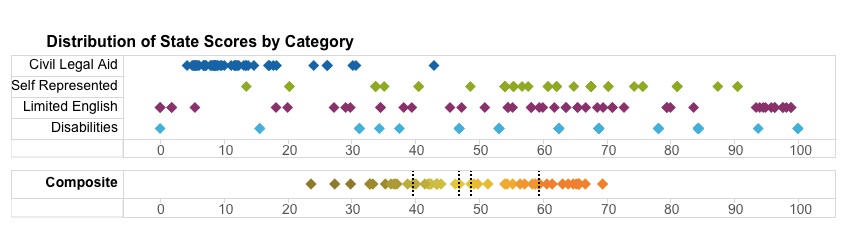
Here is something I did not expect — look at the chart below of state score distribution.

index Note that some of the scores are very clustered — especially legal aid attorneys  — and others much less so — disabilities.  This is interesting because generally we think of legal aid funding as very varied.  Note how, because of LSC there is no zero in that score.  This score is not an absolute number, but compares the number of legal aid attorneys per 10,000 poor people to the number of attorneys per 10,000 of the population as a whole.  (Chart here). It is typical of the transparency that the organizations included in this count are explicitly listed, one of many ways in which the Index invites improvement by crowd-sourcing.

But what really interests me is that each sub-index is much more distributed than the composite.  I think this often happens when you combine scores, but here is is somewhat counter-intuitive.  We tend, for better or worse, to assume that is a state is “good” in one of these areas it will be good in all or most.  This suggests otherwise.  I like to think of that as good news, because it means that every state is relatively good in one area, and that there is a foundation on which to build out in the other areas.

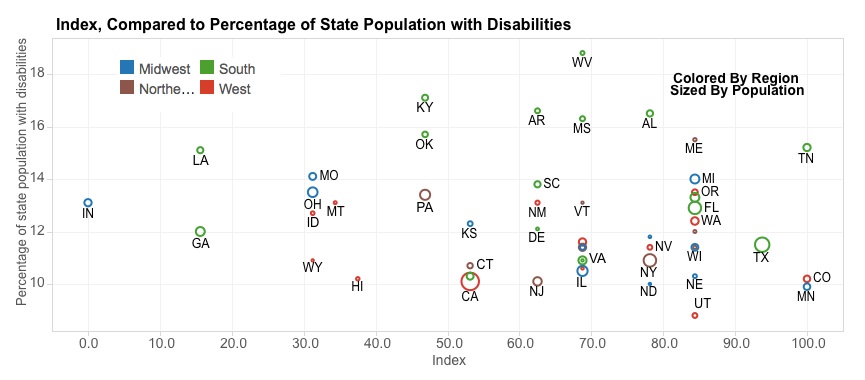
Here is another fascinating counter-intuitive finding.  Below is the chart comparing the percentage of state population with the scores.  My intuitive read gives me the sense that there is no correlation at all, so this suggests that good policies are not driven by sheer voting power, but by other forces.

disabCongratulations to an amazing team for a breakthrough product.  Too big a team to list, but follow the link.

I could go on and on, but leave with one observation and two requests.  The observation is that while the natural and valuable tendency is to look at ones own state, and be thinking about how to use these results in the emerging communications battle — one that the research shows us we will win, this index should be used for much more.  It provides an opportunity and base for careful analysis of the whole picture of access to justice.

Now the requests:  Please, if you see something wrong, don’t focus your energy on attacking the index, no matter what it shows, send in the correction to info@ncforaj.org, and think about the broader lessons.  Second, please do send me thoughts on the overall lessons of these numbers. I will give serious consideration to publishing such analyses as guest posts on this blog.  We need to learn from this and use it as a base.

Disclosure: I have served as an informal adviser to David Udell, the director of the project.  We are also co-authors of a forthcoming article on non-lawyer practice.


Posted in Access to Justice Generally, Legal Aid, LEP, Research and Evalation, Self-Help Services | 4 Comments

One From the ABA

An important developments from the ABA Legal Services Delivery Committee, which is really the only group there that focuses on middle income access.

Reinventing the Practice of Law: Emerging Models to Enhance Affordable Legal Services, edited by the wonderful Luz Herrera, is intended to show that practitioners can build a sustainable business if they focus on middle income clients. As Prof. Herrera puts it in the Forward:

Through this publication, the ABA Standing Committee on the Delivery of Legal Services encourages practitioners and various stakeholders to be creative and entrepreneurial in their efforts to advance access to moderate-income clients. Innovations such as virtual law practices, online case management software and legal document automation are all tools that lawyers can use to build sound economic models that offer greater options for moderate-income legal services consumers. Law schools, bar associations and courts can also look at the models developed in New York and Maryland to connect law students and new attorneys to opportunities to serve those who are otherwise priced out of accessing legal advice.  Lawyers may want to consider new outreach models and niche markets as ways to engage untapped markets with unmet legal needs. Nonprofit models will continue to serve as important vehicles to reach populations not otherwise served by the private bar or legal aid models.

Different chapters are written by different experts.  Here is the Table of Contents:

Part 1: Reinventing Lawyering

Chapter 1:             Limited Scope Representation by M. Sue Talia

Chapter 2:             The Lawyer as Peacemaker by Forrest S. Mosten

Chapter 3:            The Client-Centered Practice: Innovative Outreach and Niche Practices by Will Hornsby

Chapter 4:            Serving Clients of Moderate Means with Online Legal Services by Stephanie Kimbro and Richard Granat

Chapter 5:            Dollars and Sense: Fee Shifting by Gerry Singsen, Joel Feldman, Michael O’Conner and Kyle Dandelet

Part 2: Reinventing Delivery Systems

Chapter 6:            A New Legal Service Hybrid: Increasing Access to Justice Through a Network of Low Bono Attorneys by Brenda Bratton Blom and Philip Robinson

Chapter 7:            Incubating Law Firms to Enhance Social Justice by Fred Rooney; Launch Pads: Law Graduates Providing Access to Justice by Judge Fern Fisher

Chapter 8:            Co-Pay Legal Clinics: An Option for Affordable Legal Services By April Faith-Slaker and Tracy Loynachan

It’s just so nice to see more and more attention to a comprehensive integrated approach to solving the access problem.

Posted in Access to Justice Generally, Books, Incubators, Middle Income, Mixed Model, Unbundling | Comments Off on One From the ABA

Self-Represented Litigation Network Pre-Conference April 30 in Portland

The Self-Represented Litigation Network (SRLN) will be conducting its annual Pre-Conference on Wednesday April 30, 2014 before the main Equal Justice Conference at the Hilton Portland & Executive Tower in Portland Oregon May 1-3.

My replacement as Coordinator of SRLN, Katherine Alteneder, is doing a wonderful job on all fronts, and so this will be a great day to hear about all the energy in the field.  I personally am particularly encouraged by the opportunity to talk about how our work fits in with the communication research and strategy for access to justice.  Since we serve everyone, what we do helps public support for access to justice.

Among the focuses:

  • National Picture and SRLN Developments
  • SRLN Initiatives: remote services study, judicial education & engagement, and
  • Communications strategy for increased support to members
  • SRLN Working Group Reports
    • Courtroom Services
    • Federal Courts
    • Forms
    • Law Libraries
    • Research
    • Strategy & Outreach
  • Tech Summit & Technology Updates
  • Engaging the Private Bar and other community stakeholders in access to justice solutions for the self-represented through unbundling, incubators, non-lawyers practice and stakeholder initiatives.

Register now at http://www.americanbar.org/calendar/2014/04/equal-justice-conference/general.htmEarly Bird Registration ends February 28, 2014.

While we strongly encourage participants to register for the entire Equal Justice Conference, it is possible to register just for the one-day Pre-Conference April 30, 2014, but that request, along with completed registration form available through the above link and fee, will need to be made directly to: Erin Wellin Erin.Wellin@americanbar.org,Re: SRLN EJC Session,American Bar Association,321 N Clark St. Chicago, IL 60654

Posted in Communications Strategy, Meetings | 1 Comment

Califoria Self-Help Family Law Conference March 6-7 With Pre-conference March 5

This speaks for itself.  The California AOC has long been a leader not only in deploying innovations, but in encouraging national outreach and debate.  Note the court staff discount.  Note also the pre-conference, described below.

The Administrative Office of the Courts and the Legal Aid Association of California are proud to announce the 2014 Self-Help/Family Law Conference in San Francisco!

This training, facilitated by attorneys, court staff, and other experts, provides numerous education opportunities and practical resources for self help center staff, interpreters, law librarians, court staff and  family law advocates working in the legal services community.
 
WHEN: Preconference:  Wednesday, March 5, 2014 from 10 – 5:00 pm
 
                Main conference:  Thursday and Friday, March 6-7, 2014, from 9 a.m. until 5:00 p.m.
 
          Special event:  Dinner with Richard Zorza on the evolution of self help services and visions for the future on Thursday at 5:30 – included in conference registration.

WHERE: Administrative Office of the Courts, at 455 Golden Gate Ave, San Francisco, CA.

HOW: Please register for the 2014 Family Law/Self-Help Conference by clicking here. Early registration ends on February 24.
 
 Please remember that LAAC Members and court staff receive a $125 discount!
 
For a full agenda and a list of trainings, click here. To register for the conference, click here.
 
The preconference will have a two full day workshops.  One on expungements and ways to assist persons who are reentering society to clean up their criminal record as possible and handle child support and other family law issues.  The other is offered by the Stanford Design (d) School on user centered design for self help and legal aid programs.  The cost of the preconference is $35 per person including lunch, snacks and materials.
 
Any other questions? Feel free to email Patrick Fodell, LAAC program associate, at pfodell@laaconline.org or  Joseph Nguyen, AOC staff at joseph.nguyen@jud.ca.gov.
 

The pre-conference, presented in cooperation with folks from the Stanford Design School, looks exciting.

Access by Design Workshop

This workshop will be a hands-on training in how self help centers and legal aid services can be made more user-friendly, engaging & client-centered.  Using a design approach, we will work together to go from ideas of how  services may be improved to robust prototypes of how new services and tools may be rolled-out.  The focus will be to train participants in collaborative and creative methods and, while doing so, to develop strong ideas for new apps, websites, forms, services, and technologies that could improve the efficiency & quality of self help and legal aid services.

Posted in Meetings, Self-Help Services | 1 Comment

New York Chief Judge Lippman Announces Court Navigator Program in State of Judiciary

This could be a very important milestone in the development of access to justice.

Building on practice in other common law countries, Chief Judge Jonathan Lippman to today announced in his 2014 New York State of the Judiciary speech, the launch of a pilot project of Court Navigators to help unrepresented litigants in Housing Court cases in Brooklyn and consumer debt cases in the Bronx and Brooklyn.  These trained volunteer non-lawyers will not address the court sua sponte, “but if the judge directs factual questions to them, they will be able to respond.”  They will also be able to provide other assistance described below.  Deputy Chief Administrative Judge Fern Fisher has been particularity involved with this project.

The Chief also announced a similar project to provide legal informational assistance to seniors, including the homebound.  This project will be a collaboration between Albany Law School and the SUNY-Albany School of Social Welfare and make use of existing professionals who visit the homebound.  More details on both projects from the speech at pp 7-9, below.

Our efforts to find ways for non-lawyers to be of assistance begin in the courthouse. As of this month, specially trained and supervised non-lawyers will begin providing ancillary, pro bono assistance to unrepresented litigants in Housing Court cases in Brooklyn and consumer debt cases in the Bronx and Brooklyn. These are courts and case types in which virtually all defendants are unrepresented and are facing serious personal consequences as a result of litigation. It is shocking that in this day and age, over 95 percent of defendants in these critical cases are currently unrepresented. The new court-sponsored projects will offer an array of assistance to eligible pro se litigants ranging from general information provided at help desks and written material to one-on- one assistance, depending on the needs and interests of the litigants. This kind of one-on-one assistance will include providing informational resources to litigants and helping them access and complete court do-it-yourself forms and assemble documents, as well as assisting in settlement negotiations outside the courtroom.

Most significantly, for the first time, the trained non-lawyers, called Navigators, will be permitted to accompany unrepresented litigants into the courtroom in specific locations in Brooklyn Housing Court and Bronx Civil Court. They will not be permitted to address the court on their own, but if the judge directs factual questions to them, they will be able to respond. They will also provide moral support and information to litigants, help them keep paperwork in order, assist them in accessing interpreters and other services, and, before they even enter the courtroom, explain what to expect and what the roles are of each person in the courtroom.

Clear guidelines govern what a non-lawyer can and cannot do to ensure that they do not cross the line into the practice of law. They will receive training and develop ex- pertise in defined subject areas. When these non-lawyers confront situations where the help of a lawyer is crucial, they will have access to legal service providers for help and referrals.

In addition to these courthouse-based projects, we are also beginning projects to reach people outside of the courtroom through a collaboration between Albany Law School and the SUNY-Albany School of Social Welfare to serve the elderly population in the Albany area, providing them with information about their legal rights. New York’s 3.7 million seniors make up 19 percent of New York State’s population. In fact, we have the third largest population of people age 60 and over in the country, and the number is growing. Many of these seniors are eligible for benefits. But they may not be aware that they can access them or how to go about it. The courts are also seeking to utilize non-lawyers to provide legal information and access to homebound individuals. For people who are unable to leave home due to age, disability, or illness, attending court appearances or even answering a lawsuit can be an insurmountable challenge, resulting in high rates of default. Far too many homebound people have no capacity to consult a lawyer. But they do receive home visits from social service providers, who — through training and technology — can be a link and a valuable source of information and re- sources. And these service providers are eager to have better tools to help the people in their care.

All these efforts will help us address the crisis in civil legal services for the poor in ways that will supplement the services provided by the legal profession, which has nothing to fear from these new projects. These efforts are aimed at groups who cannot afford to pay a lawyer under any circumstances and are unable to access free legal services. And they seek to provide information and help that fall outside the practice of law. We are committed to exploring all possible avenues to expand access to justice in our state, and I look forward to further building on these ideas in the future with the help of our terrific Committee on Non-Lawyers and the Justice Gap. I applaud its hard and thoughtful work, and I am energized by the projects the Committee has recommended and that we now put into effect — projects that will begin to change the very contours of how we deliver civil legal services in our state. (Bold added.)

If these projects are successful, and if the evaluation demonstrates their impact on access, I believe that these models could spread very rapidly and could cause a rapid increase in access.  I am a member of the Task Force referenced above, and take my hat off to the way a wide variety of stakeholders were able to coalesce around a common vision and practical implementations.

Posted in Judicial Ethics, Law Schools, Non-Lawyer Practice | 4 Comments

What Are the Implications of George Soros Endorsing Access To Justice As An International Development Goal

George Soros blogged yesterday about his belief that access to justice should be one of the key measurable goals in the United Nations approach to eradicating poverty by 2030. He writes:

What does that mean? It means that anyone should know and be enabled to claim the protections and services due to them under the law, be it in a formal court, an administrative procedure or a community-based forum. It means that no one is left behind because they don’t have the right legal identity documents. It means that people should know about and play a role in shaping the laws and regulations that govern their  lives, and that communities should have the power to manage their land and natural resources.

I am happy to join global leaders, development experts, and grassroots groups in endorsing a statement that sets out in more detail how these five principles can become measurable goals in the new global development framework. As UN members begin to prepare the first drafts of that new strategy for the world, this statement makes compelling reading.

It’s my hope that they hear this simple message: development needs justice. (Bold added)

Specifically, Soros joins a number of other internationally known leaders, including known-leaders such as US Supreme Court Justice Anthony Kennedy, Former President of Ireland Mary Robinson, and former US Secretary of State Madeline Albright, in urging that justice should be added to the UN development goals.  The four page statement is here.

While the call refers to international development, so much of the above applies with equal force (if not necessarily the same overwhelming urgency) to the US as well and our efforts to deal with both poverty and inequality, including of opportunity.

Perhaps even more importantly, given how third-world-like many of our access institutions are, we need to figure out how US experiments with low-cost access strategies such as self-help, court simplification reform, and judicial education, might apply in lower income countries, particularly middle income countries, and conversely, how the experience with innovations in developing countries can inform our choices, including perhaps with expanded use of non-lawyers to assist in access.  While it may be hard to admit that the US and developing world situations with respect to access to justice are closer than we would like, its better to face up to the truth.

For a blog post to where I discuss my recent work with the World Bank making these links, click here.  Also, here is a great piece by Paul Prettitore of the Bank, with whom I have been working.  It is on the legal aid initiative in Jordan.

Posted in Access to Justice Generally, Funding, International Cooperation, International Models | Comments Off on What Are the Implications of George Soros Endorsing Access To Justice As An International Development Goal

Why a “Study” Involving Closing Bridge Access Lanes Does Not Require Human Subject Experimentation Protections

My niece, Professor Dahlia Remler of CUNY, has a fascinating and timely blog post, Bridgegate: The Case of the Missing Ethical Research Review, asking this very question, and then suggesting the need for aligning human subject protections better with the risk of harm.  She asks:

Why didn’t the Fort Lee mayor turn to that [human subject experimentation protection] body? Don’t research studies that affect humans have to show that they don’t harm those humans? Or at least that benefits exceed harms? Decades ago, after scandals like the Tuskegee study which kept poor sharecroppers ignorant of their syphilis, and therefore untreated, we created rules and bureaucracies to protect human research subjects. Currently, regulation 45 CFR 46 ensures this, mandating the creation of Institutional Research Boards (IRBs) who are charged with ensuring that research on humans is ethical.

Her answer:

The mayor of Fort Lee couldn’t turn to an IRB because there wasn’t one. IRBs don’t apply to a government agency—or school or business—trying to improve operations. Studies that are for “internal management” purposes, don’t count as research, which is defined as producing “generalizable knowledge.” (Generalizable means providing information beyond just the specific setting, place and time of the study.)

After discussing the lack of logic and risk of harm from this absence, as well as the dangers of over-bureaucratizing the process, she suggests the following:

At this point, I don’t know how to expand the good of ethical review without a lot of bad side effects. Perhaps going for norms and training before regulation would be best. Perhaps we could require anyone doing any investigation to think about and write up potential harms and benefits, and require them to make it available if concerns arise.

Of course, ethical review of Port Authority studies would not have deterred the Bridgegate perpetrators. After all, the Port Authority does have extensive rules and processes for closing lanes for any purpose  and the perpetrators ignored all of those rules. At best, ethical review of studies on humans would have forced the perpetrators to find another excuse. But the ease with which they used that excuse highlights the immense gaps and inconsistencies in which studies are regulated. As studies explode in all corners of our lives, let’s work on a better approach.

If you are interested, read the whole blog.  Dahlia also discusses the general issue in her textbook, Research Methods in Practice.

Posted in Research and Evalation | 2 Comments

Maybe It Means Something That the Word “Access” Was Used Six Times in the State of The Union

That’s right, while the President mentioned “justice” only once in the State of the Union Address (“. . . to promote justice, and fairness, and equality under the law, so that the words set to paper by our founders are made real for every citizen,”) he used the word “access” a total of six times:

“150 universities, businesses, and nonprofits have made concrete commitments to reduce inequality in access to higher education”

“the best measure of opportunity is access to a good job”

“guaranteeing every child access to a world-class education”

“a coalition of elected officials, business leaders, and philanthropists willing to help more kids access the high-quality pre-K they need”

“Offer every American access to an automatic IRA on the job”

“Across Africa, we’re bringing together businesses and governments to double access to electricity”

This is in comparison to Afghanistan (ten times in only three different paragraphs) and Iraq (only three).

These people know what they are doing, so we have to assume that “access” is a powerful word that resonates with themes of inequality and lack of opportunity, and does so in a non-ideological way.

That’s something to think about as we think about how to talk about justice.

Posted in Access to Justice Generally, Communications Strategy | 3 Comments

A Couple of Thoughts on Getting the ABA Brown Award

I know you should not use you blog to brag, but anyway.  .  .

I am deeply appreciative that I will be getting a lifetime achievement award from  the ABA Standing Committee on the Delivery of Legal Services — the Louis M. Brown Award.

A couple of sentences (bolded below by me) in the letter got me thinking that really it was addressed not so much to me, but the legions of forms designers, court staff, programmers, researchers, etc., who labor largely behind the scenes to make our justice system more accessible.

Your enthusiasm, dedication and commitment have been inspirational to Committee members and staff throughout the past two decades. Beyond that, through this Award, we recognize your tireless commitment to those who may otherwise be denied their day in court were it not for your efforts. It is perhaps ironic that those who are able to have a just result to their legal matters because of your work will never know that that outcome was because of your efforts. But we know that and we take this opportunity to thank you on their behalf.

The comment also make me realize that some of us who end up trying to focus on system change end up losing touch with the day to experience of barriers and overcoming them.

Personally, I would have like it if I could have found better ways of staying in touch with what happens in courtrooms and self-help centers — I am sure I would have done a better system reform job had I done so.  I know that some of my colleagues have spent more time than I observing courts and listening to litigants.  I commend them.

Thanks again to all.

Posted in Uncategorized | 6 Comments