More On Impact of DC Events on Judicial Deference to Congress

Professor Tribe has pointed out to me, in response to my recent blog post about the possible impact of DC happenings on judicial deference to Congress, that: “. . . deference to Congress isn’t either good or bad in itself, and a decline in such deference, if that were the result of Congress’s dysfunction and its inability to reopen the government without playing with debt default fire and taking hostages, wouldn’t be good or bad in itself either. I’d want judges to defer in cases like the challenge to the Affordable Care Act but not in cases like Holder v. Humanitarian Law Project.

Indeed.

A better question that the one I articulated in the first blog post is whether the dysfunction in Congress might make courts more deferential when they should be, and less when they should not be.  There is perhaps an argument that when, in an era of dysfunction, Congress does act on something, it should EITHER be given greater deference than in normal times, as reflecting a broad consensus following careful thought, OR, be given lesser, as reflecting a hot-headed surrender to short term rights-denying passions.  It would be nice to think that such an approach would protect rights in both cases.  It would require looking at the nature of the underlying issue and at the processes of Congress.

Posted in Access to Justice Generally, Budget Issues, Federal Courts, Supreme Court | Comments Off on More On Impact of DC Events on Judicial Deference to Congress

Will DC Events Impact Judicial Deference to Congress

There is an interesting article in Politico today about how anger at Congress is increasing in the Federal Judiciary.  The article focuses mainly on how upset the courts are at the financial impact of sequestration and the shutdown on the courts themelves.  But there is one highly suggestive account of how a Federal judge, asked to exempt the case brought by the House about “Fast and Furious” from the shutdown delays, responded: “While the vast majority of litigants who now must endure a delay in the progress of their matters do so due to circumstances beyond their control, that cannot be said of the House of Representatives, which has played a role in the shutdown that prompted the stay motion.

Of course, judicial deference to Congress, a flexible concept at best, is deeply engrained in our jurisprudence.  But, thinking as a former appellate advocate, I would find it hard right now to keep a straight face trying to make an argument that the court before which I was arguing should assume that Congress had carefully thought through all the implications of its actions, and should be presumed to have meant what it said, and said what it meant.

While there are surely judges, even on the Supreme Court, who will take recent events as further evidence that Democrats are utterly without responsibility, it is likely that at least some conscientious centrist judges will internalize whatever the ultimate broad lesson the public as a whole takes from these events.

At a minimum, therefore, it may be that arguments about lack of resources to meet constitutional requirements will become less sympathetically heard.  Many government due process issues, for example, are decided on Mathews v. Eldridge, which includes cost to the government as part of the balancing test.  Today’s Congressional process on financial decisions can hardly be said to be one to which deference should be paid.

Moreover, the same lack of deference might well extend to other matters.  It would be nice to think that this would result in an increase in judicial willingness to protect rights.

Posted in Access to Justice Generally, Budget Issues, Federal Courts | Tagged , , , , , | 3 Comments

Guest Post From World Bank’s Paul Prettitore on Legal Aid in Jordan

Here is a fascinating guest post from Paul Prettitore of the World Bank on knowlege of, and access to, legal aid in Jordan.  Readers will find many resonances, and also many differences.  I think we have a lot to learn from each other.  (Disclosure: I have been working with Paul on ways of spreading innovation ideas in societies such as this — as well as learning from their experiences.)

Justice Sector Services and Poverty in Jordan

The Government of Jordan has taken a considerable step towards better understanding of the needs of the poor within the justice sector of Jordan.  The ‘Statistical Survey on the Volume of Demand of Legal Aid Services’ (Legal Aid Survey) was administered to 10,000 households throughout Jordan in 2012.  I have been working on justice sector issues in Jordan for about five years, primarily through a program to develop legal aid services delivered by civil society, in this case the Justice Center for Legal Aid (JCLA).  An interesting video on the work of JCLA can be found here: http://www.youtube.com/watch?v=zo_FmraV9oI

I have been lucky enough over the last several months to have access to data from the Legal Aid Survey thanks to the Department of Statistics.  We have disaggregated this data by the expenditure level of respondents.   The findings have been both predictable and surprising.  They suggest the following:

Poor persons have higher demand for, but reduced access to, court and lawyer services

  • More than two-thirds (68%) of survey respondents reporting an actionable dispute fall into the two lowest categories of expenditure levels, with only 6% falling into the highest expenditure category

Differing priorities been richer and poorer respondents

  • Respondents in the lower expenditure categories were much more likely to be involved in personal status (family law) disputes, such as divorce, alimony, child support, inheritance and access to dowries, than richer respondents – around 80% of those in the lower expenditure categories versus roughly 20% in the highest expenditure categories
  • Within the category of personal status cases, poorer respondents were more likely to be involved in alimony and inheritance cases, and richer respondents in cases involving separation/divorce and return of dowries
  • Overall, poorer persons form the bulk of respondents affected by personal status disputes, as highlighted in the figure below

Lack of knowledge of, and access to, legal aid services

  • 98% of survey respondents were unaware of existing legal aid services
  • Of the 2% of respondents aware of legal aid services, only 17% tried to access them, with the primary reasons for not accessing services being lack of knowledge of how to reach service providers (35%), not actually needing services (33%), and complicated procedures for accessing services (27%)
  • On a more positive note, 78% of respondents that sought legal aid services were able to secure them

In addition to the above findings, the survey also demonstrates that state-sponsored legal aid services are poorly targeted from a poverty standpoint.  Jordanians are only entitled to legal aid only for serious criminal cases.  And even that system, administered through the Bar Association and courts, provides relatively few services.  Legal aid has been mostly unavailable for civil cases in general, and personal status cases in particular, which.  The provision of legal aid by civil society is starting to fill this gap.  Personal status cases are also ripe for the development of self-help mechanisms.  These cases fall under the mandate of religious courts, which do not require parties be represented by lawyers and for which fees for court services are minimal or non-existent.  Hopefully, the Government of Jordan will pursue this issue by experimenting further with different mechanisms of legal aid service delivery.

For more information on this topic, follow this link to a World Bank Quick Note: http://siteresources.worldbank.org/INTMENA/Resources/QN96.pdf

Posted in Access to Justice Generally, International Cooperation, International Models, Legal Aid | 1 Comment

Maybe Judges Should Assign Literary Reading to Litigants — and to Themselves

A great article today online in the NYT Mind blog on the impact of reading literary fiction.

Reading Chekhov for a few minutes makes you better at decoding what other people are feeling. But spending the same amount of time with a potboiler by Danielle Steel does not have the same effect, scientists reported Thursday.

A striking new study found that reading literary fiction – as opposed to popular fiction or serious nonfiction – leads people to perform better on tests that measure empathy, social perception and emotional intelligence.

The authors of the study, published by the journal Science, say that literary fiction often leaves more to the imagination, encouraging readers to make inferences about characters and be sensitive to emotional nuance and complexity. They theorize that reading literary fiction helps improve real-life skills like empathy and understanding the beliefs and intentions of others.

The methodology was to ask readers to asses the emotional state of people in photos.

Dr. Wendland said that “reading sensitive and lengthy explorations of people’s lives, that kind of fiction is literally putting yourself into another person’s position.”

“Lives that could be more difficult, more complex, more than what you might be used to in popular fiction, it makes sense that they will find that, yeah, that can lead to more empathy and understanding of other lives,” he said. “Popular fiction is a way of dealing more with one’s own self maybe, with one’s own wants, desires, needs.”

David Kidd, one of the authors of the study, said that “in popular fiction, really the author is in control and the reader has a more passive role.”

I would like to think that people involved in complex emotional situations in which they have lost the ability to empathize might be helped by reading appropriate literary fiction.  It would however, have to be carefully chosen so as not be lilt in one direction or the other.  Maybe people in divorces should not read about divorces, or indeed about romances.

Similarly, maybe judges would get better at appreciating complexity of emotions if they read.  Indeed, the desensitizing/exhauston of judges that some research is reporting might be countered by a “Chekhov break” more efficiency than by a “chai break.”

It would be fascinating to do some research into this.

Posted in Judicial Ethics, Research and Evalation | Comments Off on Maybe Judges Should Assign Literary Reading to Litigants — and to Themselves

NYT Piece on Doctor “Mindfulness” has Major Implications for Lawyers and Judges

A fascinating article in the New York Times focuses on doctor “mindfulness” suggests how helpful it is to train professionals on how to clear their minds so that they can focus on the person and situation in front of them.  Dr. Pauline Chen describes her mindset when a patient asks for a second opinion because of fear that the first doctor was not listening.

I had walked into the exam room to listen to this patient; but my mind was a few steps behind, as I struggled with thoughts about the colleague who’d just snapped at me over the phone because she was in no mood to get another new consult, my mounting piles of unfinished paperwork, and the young patient with widespread cancer whom I’d seen earlier in the day. Thoughts about my new patient jumbled in the mix, too, but they came into focus only after I had pushed away the fears that I might have neglected to order a key test on my last patient, that I’d forgotten to call another patient and that I was already running behind schedule.

She goes on to describe studies on the impact of training of mindfulness:

In one study, researchers first assessed the baseline mindfulness of 45 doctors, nurses and physician assistants by asking them to respond to statements like, “I tend to walk quickly to where I am going without paying attention to what I experience along the way,” “I find myself listening to someone with one ear, doing something else at the same time,” and “I forget a person’s name almost as soon as I’ve been told it for the first time.” Then the investigators recorded the clinicians’ interactions with more than 400 patients and interviewed the patients to gauge their level of satisfaction.

After analyzing the audio recordings and the patients’ responses, the researchers found that patients were more satisfied and more open with the more mindful clinicians. They also discovered that more mindful clinicians tended to be more upbeat during patient interactions, more focused on the conversation and more likely to make attempts to strengthen the relationship or ferret out details of the patient’s feelings.

The less mindful clinicians, on the other hand, more frequently missed opportunities to be empathic and, in the most extreme cases, failed to pay attention at all, responding, for example, to a patient’s description of waking up in the middle of the night crying in pain with a question about a flu shot.

Significantly, the most mindful doctors remained efficient. They accomplished just as much medically for their patients as their least mindful colleagues, despite all the extra conversation with patients about experiences and relationships.

The studies are here and here.

We really need judges who know how to be mindful, and we need to figure out how to help them to learn such mindfulness.  Here is a University of Wisconsin tool aimed at doctors.

It might be worth noting that for doctors the issue is paying attention to the patient.  For the judge it is even more complex — it is about paying attention to two competing parties, and, indeed, in the case of a self-represented litigant case, making sure that the quieter party is fully heard — not necessarily an easy thing to do.

Posted in Judicial Ethics | Comments Off on NYT Piece on Doctor “Mindfulness” has Major Implications for Lawyers and Judges

Reflecting on Court Technology at Midtown Community Court’s 20th Anniversary

It is hard to believe that the 20th anniversary of Midtown Community Court is fast approaching.  While not the first drug court — that honor goes to Miami Dade — Midtown is broadly recognized as having played a major role in the spread and popularization of community and drug courts nationwide.  According to NIJ, as of the end of 2011 there were over 2600 drug courts operating in the US.

As I recall the start of Midtown, in which I was honored to participate, the key to the concept was to combine immediacy of actual consequences with close judicial monitoring, and real community input into policy.   As we designed the technology, a major goal was to ensure that judges got broad information before they made a sentencing decision, and also afterwards, so they could monitor ongoing compliance.  Important to the model was having a broad range of intermediate sanctions available for the judge to choose.

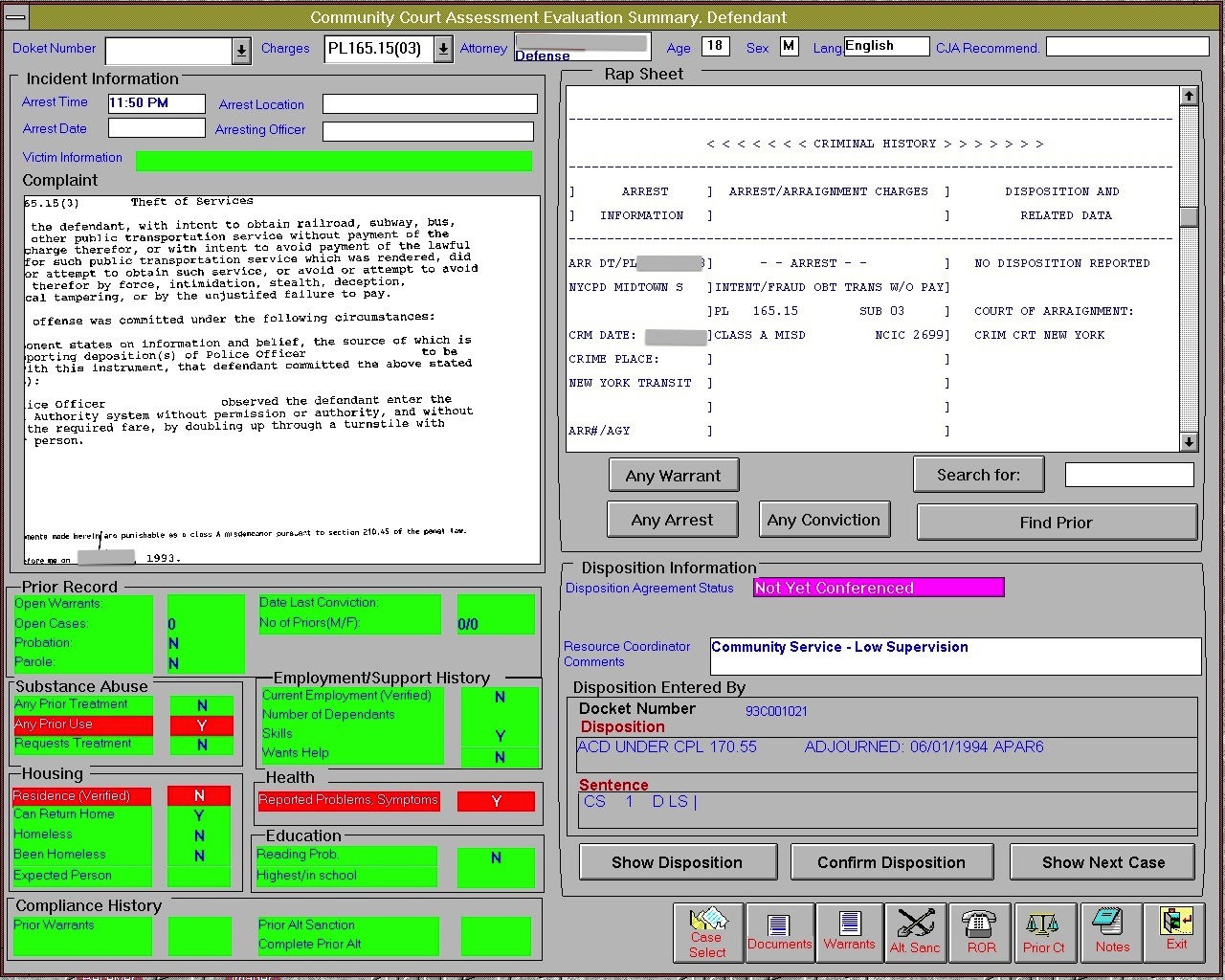
Below is the screen that we designed — with strong judicial input — to give judges just this information.

MCC-2

As you can see, the top left is the charging information, downloaded directly from the DA’s system, the bottom left is information about the defendant, from the bail release interview, the top right is the criminal record, downloaded from the state criminal record database, and the bottom right is disposition information.  The bottom right also includes various tools.  As time went by, these were expanded to include the ability for judges to see the defendant’s arrest record in geographical context, or to see a statistical prediction of the defendant’s chance of completing an alternative sanction.

I hope it is OK to say that I am very proud of this product.  There is more information about the technology aspects of the project in a paper, the Ten Commandments of Electronic Court Design, which I wrote with Judge Robert Keating, then Chief Judge of the New York City Criminal Court.  Many of the ideas are based on a presentation at the National Center for State Court’s Court Technology Conference in 1992, organized by Jim McMillan and others.  The overall court project head was John Feinblatt.

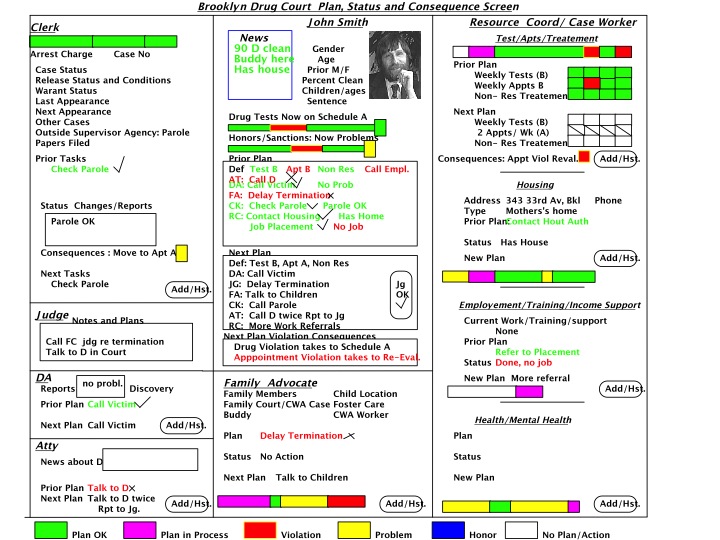
While the design below was never fully deployed, I would also like to post the mock-up that I did for the then being planned Brooklyn Treatment Court, which would have gone further by providing judges with tools to track and monitor not only the defendant’s compliance, but also the participation of DA, defense and social services in wrap around care for the defendants.

Brooklyn Treatment Court Proposed Screen -- Rights Reserved

Brooklyn Treatment Court Proposed Screen — Rights Reserved

Note the use of color, the emphasis on status reporting, the idea of supervision bands, the explicitness of warning of the consequences of different kinds of violations, the use to sliders to show status, etc.

Please note that rights are reserved in these designs.

Posted in Court Management, This Blog | 1 Comment

ABA Task Force Recommends Legal Education Changes, Including Licensing of Less Trained Legal Pofessionals

Just released, and drawing wide attention, is the Draft Report of the ABA Task Force on Legal Education.  The NYT Summary:

Faced with rising student debt and declining applications to law schools, a task force of the American Bar Association is calling for sweeping changes in legal education, including training people without law degrees to provide limited legal services and opening the bar to those who have not completed four years of college and three years of  law school.

The report, to be issued on Friday, does not refer specifically to President Obama’s suggestion last month that law schools might limit classes to two years, and have students spend their third year clerking or practicing in a firm. But it did recommend the elimination of the rules that law students must have 45,000 minutes in a classroom to graduate and that they cannot get credit for field placements that are paid.

Here is the Draft Report’s own Summary, with some of the most key language underlined bye.  I must say that I am impressed by the depth of perspective and the range of changes promoted.  The chair of the Task Force is retired Chief Justice Randall Sheppard, of Indiana.  He has been a long-time friend of access innovation, and this Draft Report would appear to reflect his well thought out perspective.

Sadly, however, I do not see any endorsement of the required pro bono hours approach for bar admission candidates, pioneered in New York. I do not understand why, unless it is because of the fear that such an endorsement would lead to increased demand for mandatory pro bono for all lawyers, perish the thought.  (My own thought on that one is that admitted lawyers should be required to do pro bono, but the option of a buy out based on an escalating multiple of hourly billing rate, with the multiple going up with the rate.)

The Draft Report includes specific recommendations directed to a wide variety of stakeholders.

Pricing and Funding of Legal Education: Law schools are funded through a complex system of tuition revenue and non-tuition sources such as endowment income and state subsidies. Law school pricing practices are also complex, and involve extensive discounting and reliance on loans. A currently widespread practice is for a school to announce nominal tuition rates, and then chase certain high LSAT/GPA students by offering substantial discounts (styled as scholarships) without regard to financial need. Other students, by contrast, receive little if any benefit from discounting and must rely extensively on borrowing to finance their education and various federal programs make such loans virtually open- ended. One result is that students whose credentials are the weakest incur large debt in order to sustain the school budget and enable higher-credentialed students to attend at little cost. Many of these less credentialed students also have lower potential return on their investment in a legal education. These practices are in need of serious re-engineering.

Accreditation: The system of accreditation administered by the ABA Section of Legal Education and Admissions to the Bar has served the profession and the nation well. Today, however, it reinforces a far higher level of standardization in legal education than is necessary to turn out capable lawyers. The ABA Standards for Approval of Law Schools also impose certain requirements that increase costs without conferring commensurate benefits. The Task Force concludes that the Standards would better serve the public interest by enabling more heterogeneity in law schools and by encouraging more attention to services, outcomes, and value delivered to law students. The Task Force thus recommends that a number of the Standards be repealed or dramatically liberalized.

Innovation: The ABA accreditation system should also better facilitate innovation in law schools and programs of legal education. The current procedures under which schools can seek to vary from ABA Standards in order to pursue experiments are narrow and confidential. The Task Force recommends that the Section use the variance system energetically as an avenue to foster experimentation by law schools and open the variance process and results to full public view.

Skills and Competencies: The principal purpose of law school is to prepare individuals to provide law-related services. This elementary fact is often minimized. The profession’s calls for more attention to skills training, experiential learning, and the development of practice-related competencies have been well taken. Many law schools have expanded such opportunities for students, yet, there is a need to do much more. The balance between doctrinal instruction and focused preparation for the delivery of legal services needs to shift still further toward developing the competencies required by people who will deliver services to clients.

Broader Delivery of Law-Related Services: The delivery of law- related services today is primarily by lawyers. These services may not be cost-effective for many who are in need of them, and some communities and constituencies lack accessible legal services. State supreme courts, state bar associations, and admitting authorities should devise new or improved frameworks for licensing providers of legal services. This should include licensing persons other than holders of a J.D. to deliver limited legal services, and authorizing bar admission for people whose preparation may be other than the traditional four-years of college plus three-years of classroom- based law school education. The current lack of access to legal advice of any kind that exists across the country requires such innovative steps.

Update (9/22/2013):

The highly reflective Richard Granat has posted an analysis of why he has recently come to the view that creating a category of limited legal technicians may do more harm than good.  In short, he worries that the pricing model will be no cheaper than lawyers, and that such non-lawyers will force out solo lawyers.  In my opinion either may (or may not) be true, but not both.  In any event, my view is we should test the concept and see what happens.  In short, even in the unlikely event that non-lawyers had to train for three years, they would probably be better than traditional lawyers at the limited tasks for which they had been trained.  But, Richard’s views are always worthy of great attention.

Posted in Law Schools, Pro Bono | 1 Comment

Fordham Law Shool Plans Broad Access Symposium Nov 1 in NYC

Fordham Law School plans a broad Symposium on Access to Justice, on Nov 1 at their campus near Lincoln Center in Manhattan.

While I find the formal title “Until Civil Gideon” a little confusing, the overall agenda gives a feel for an overall analysis of the non-Gideon elements of a comprehensive access strategy, and how they relate to Gideon components of such a strategy.

The session titles are revealing:

  • Civil Gideon?
  • The Role of Non-lawyers
  • Unbundled Legal Services
  • Technology and Self-Help
  • Court Innovations

The announcement says “While obtaining a form of civil Gideon is a goal, the conference will ask, from a broad variety of perspectives, what are the best strategies until that point?”  Personally I think that as a practical matter most people accept that we are likely to end up at best with a system of triage that ensures that those who need counsel to be heard will get counsel.  I will be one of the responders to Earl Johnson’s opening presentation (Civil Gideon?), and look forward to an opportunity for a discussion about developing a strategic consensus.

Chief Judge Lippman will deliver the keynote.  Given his visionary leadership, that should be something to hear.

Registration information (including pricing — very low except for those seeking CLE) is here.

Posted in Access to Justice Generally, Meetings | 1 Comment

Michigan Intrpreter Rule May Raise Questions About Middle Income Access to Justice

A recently issued Michigan court rule, dealing with interpreter costs, raises broader and troubling questions about middle income access to justice.

As reported by the Detroit Free Press, the US Attorney for Michigan points out that the rule, which requires those over 125% of the poverty line to pay for court interpreters, could pose a significant access barrier.  As discussed below, the rule envisions collection of these costs only when: “An assessment of interpreter costs at the conclusion of the litigation would not unreasonably impede the person’s ability to defend or pursue the claims involved in the matter.”  In the real world, this should mean that most such costs would be borne by the court.  So the devil is likely to be in the details, and as so often, discretion is both the key and a major risk, which is presumably why DOJ takes the position it does.

But the broader question is this — what happens to those not eligible for public defender or other such state services because they are over the income standards, which often, have no “out” of the kind Michigan has put into place for interpreter costs. Continue reading

Posted in LEP | Comments Off on Michigan Intrpreter Rule May Raise Questions About Middle Income Access to Justice

Implications of the “No Lawyer Plus No Interpreter Equals No Access” Truism

With the release of the NCSC Call for Action on Limited English Proficiency, I have been thinking about the very complex relationship between the access to justice challenges suffered by those without a lawyer, and those without effective English proficiency.

The first point is obvious.  There is a huge overlap between the Limited English Proficiency (LEP) and Self-Represented Litigant (SRL) populations.  Indeed, my own personal inferential and impressionistic sense of the civil litigation population is that maybe as many as a third of SRLs are LEP and that, more importantly for LEP strategy, maybe  as many as 90% of LEP litigants are self-represented.  Of course, the figures must vary hugely from court to court — the 2005 California Pilot Study, with one Pilot aimed specifically at the LEP population reported 16%, 16%, 47% and 87% of self-help center clients using a language other than English at home.  As a baseline, the overall national statistic is that in 2010, 9% of the population were LEP [Call to Action at iv.)

In any event, the non-LEP population will have a far higher representation percentage of SRLs.  This is because of economic status, lack of connection to referral networks, and, of course, the lack of attorneys who are bilingual and/or available to LEP populations.  Any court or self-help center not seeing the number of SRL-LEP cases predicted by census data might ask itself if the LEP population is simply staying away — and why.

This really means that we need to re-think how we conceptualize the LEP problem — on the civil side it is not an LEP problem, it is an SRL-LEP problem, and our thinking about civil LEP should be structured to focus on what we have to do to provide access to the SRL-LEP population.

Indeed, this makes all the sense in the real world.  If you have a lawyer, then there is someone who can help in getting interpreter services, can object when those services are not provided, and can help ensure that the client understands what is going on, and that the client can be understood by the court. On the other hand, if you are an SRL with no lawyer, unless there is good assistance structured for an LEP litigant, you are going to be completely at a loss.  “No lawyer plus no interpreter equals no access” is a pretty safe descriptive formula.

So, if the right way to think about this problem is as an LEP-SRL problem with some limited exceptions for those who do have access to attorneys, what are the service and access agenda implication?

  • The gateways to the system are very important.  LEP Concierge, multi-lingual forms, signage, and multi-lingual websites, are critical to even getting in to the system.  Those with attorneys seldom face these challenges.
  • Testing of the physical and electronic gateways — bringing an outsider in and having them describe what is happening so court leaders see it through users’ eyes — must be done with LEP folks, as well as those who speak English proficiently.
  • Self-Help services must be fully integrated with LEP capacity.  While controversial with some interpreter groups, interpreters should provide direct informational assistance to the extent of their training and capacity.  Consideration should be given to additional certification and payments to such interpreters.
  • Just providing interpreters for standard English language services to those in need is not sufficient for the self-represented.  This is because the informational and support needs of the LEP population are both greater than, and different from, those of the English-speaking population.  The LEP population is likely to face additional challenges in understanding the US legal culture, and what is required to participate fully and appropriately in the case, as well as be able to do so.  It is not only that the legal culture may be different, it is also that LEP folks may have seen less TV on the subject, and be less experienced at navigating US institutions.
  • Because self-help is required for so much greater a percentage of the LEP than the non-LEP population, looking at the case flow as a whole, and integrating needed bi-lingual self-help services is even more important.
  • Community outreach is obviously even more important for the self-help population.
  • Self-help capacity can help ensure that interpreters are provided all the way through the case — including compliance.
  • Data is critical.  Every court should be comparing its LEP caseload to census figures, and, if the numbers – taking into account poverty distribution – are not at least as predicted, should be asking itself why.

I very much hope that these thoughts will stimulate a more comprehensive dialog between LEP and SRL advocates.  Please participate in the comments and share this blog post.

Posted in LEP, Self-Help Services | Comments Off on Implications of the “No Lawyer Plus No Interpreter Equals No Access” Truism

NYT Article on Gender and Class at Havard Business School Inspires Admissions Rule Suggestion

On Sunday the New York Times ran an article that was both inspiring and chilling.  Bottom line — energetic intervention by the administration almost completely eliminated the prior huge grade gap between men and women.  The chilling context, however, is a very depressing of a money soaked, class divided, status oriented and ambition-to-the-point-of-nihilism environment.  Not a place I would ever want my grandchildren to go — although they are of course free to make their own bad decisions.

Tonight the Times is running a follow up article on the follow up, suggesting that many think that class rather than gender is the real issue, and showing the huge gap between the rich and the rest there.   I blog, therefore, to pass on this wonderful suggestion from the new piece, one that law schools should surely adopt.

To help bring the school’s culture back down to earth, Thomas J. Peters, a co-author of “In Search of Excellence” who has spoken at the Harvard Business School and has been a frequent critic of business education, suggested that the school apply a simple admissions rule: anyone from an ultraprivileged background needs to have done something of significant social value to be admitted.

“If you’re 27 years old and you’ve been given a lot of money, that’s plenty of time to have done something,” he said, adding that he and many of his friends at Stanford Business School in the 1970s were veterans. “Why can’t that be in the admissions criteria flat out?”

And, making a donation after deciding to go to law school does not count.

Posted in Law Schools | 1 Comment

Greater DOJ Inlolvement in Defense Services Issues Gets Attention

The intervention by the Department of Justice in the quality of indigent defense services — very much a first from this administration — is getting deserved praise.  NPR had a story:

. . . an unprecedented recent court filing from the Justice Department has cheered the typically overburdened attorneys who represent the poor and could have dramatic implications for the representation of indigent defendants. . . .

Plaintiffs [represented by the ACLU] in the case say around the time they sued, the cities had just two part-time lawyers running 2,000 misdemeanor cases. The Justice Department didn’t take a position on whether public defenders in those cities — Burlington and Mount Vernon, Wash. — systematically deprived people of their Sixth Amendment right to legal counsel.

But if a judge finds those cities should be on the hook, Justice lawyers urged that an independent monitor be appointed for public defender workloads, the first time ever in a federal case like this one. The overwhelming majority of cases about the quality of indigent defense move through state courts, which makes it much more rare for the U.S. Justice Department to intervene.

The New York Times, focusing on New Orleans, is blunt in an editorial today:

The disadvantage [faced by the defense] may be nowhere more glaring than in New Orleans, where indigent people sit in jail uncharged, sometimes for months, waiting for a lawyer whose workload far exceeds any reasonable standard. Professional guidelines recommend that public defenders handle no more than 400 misdemeanor cases in a year, yet a 2009 report found that part-time public defenders in Orleans Parish handled the equivalent of 19,000 misdemeanor cases per attorney annually — which means an average of about seven minutes spent by a lawyer on each case.

This terrible system is hobbled by a perverse funding mechanism. Traffic fines and court fees paid by defendants who are convicted or plead guilty account for nearly half of the annual budget of the Orleans Public Defenders Office. This is an unpredictable revenue stream, and it may also pose a conflict of interest since public defenders end up representing many defendants whose fines support their salaries.

Not only is it great to see DOJ involved in this issue, it is interesting to see creativity about the form that its involvement might take.  The combination of non-governmental plaintiffs making the underlying case in state courts, and DOJ urging long term monitoring, has the potential to avoid the anti-DC backlash, while mobilizing local bar and judiciary in support, with the feds in the background.

It makes one wonder if a similar formula might eventually be used in Turner type cases, although the need for a monitor can probably more strongly be argued in situations in which the law is well recognized.

Posted in Dept. of Justice, Funding, Public Defender | Comments Off on Greater DOJ Inlolvement in Defense Services Issues Gets Attention

Training 211 Operators on Legal Access Resources Has Major Impact in Minnesota Collaboration

One of the great — and too little explored — potentials of having integrated access services is the potential of much better linkages with broader help gateways.  A recent report on such an approach in the Minnesota Twin Cities area between Call for Justice and the United Way shows just how dramatic the results can be — for both sides of the partnership.  The key components seem to be meetings between information providers and trainings for the 211 staff and others.  The Projects annual budget is $175,000, which came from the foundation arms of the Hennepin and Ramsey County Bar Associations, the Saint Paul and Bigelow Foundations, and 29 Twin Cities law firms — again a great collaborative model.  Given how dramatic the results shown below are, I can not see how any state legal access website can justify not exploring such a relationship with the 211 system.   Here is a link to the National 211 Gateway.  211 Systems now cover 90% of the US population.  How many of these systems are linked to state LawHelp systems?

According the Minnesota project’s new press release and report:

Outcomes referenced in the report include:

  • A 200 percent increase in referrals for 9 key legal resources—to providers that previously had received more limited referrals, effectively helping connect callers to programs more appropriate to the callers’ legal needs.

  • A 786 percent increase in referrals to LawHelpMN.org, a resource-based website related to the Minnesota Legal Services Coalition.

  • Increases of 336 percent and 560 percent to Court Self-Help resources in Hennepin and Ramsey Counties, respectively.

  • Connecting attorneys with nearly 80 women and their children involved in a large Twin Cities program fighting intergenerational poverty. This “adoption” by two Minneapolis law firms was the result of an offshoot program that convenes various nonprofit legal and social service providers to facilitate organic collaborations.

  • Providing more than 70 homeless individuals with legal advice within the first four months of a collaboration between a Legal Aid organization and a homeless meal and resource center.

  • The creation of the first-of-its-kind (in Minnesota) panel of LGBT lawyers to serve homeless and at-risk LGBT youth.

  • Nearly 1100 views of 2-1-1 training videos posted on the C4J website, including videos on immigration law, landlord-tenant law and bankruptcy.

  • 8,035 page views of the C4J website (which includes 2-1-1 training materials) by 3,134 visitors.

  •  533 views of the C4J website page that lists legal clinics. This is one of the few “print friendly” lists of Twin Cities metro legal clinics.

  • Multiple outreach presentations to community organizations (Rotary, Optimists, etc.) regarding United Way 2-1-1 as a legal referral resource.

  • Key assistance in helping to recruit more than 100 attorneys to assist low-income tenants at risk  of eviction in housing court.

Some of these results are just stunning.

Here is the portion of the Report on the increased overall use of LawHelp MN:

Beginning in March, 2012, C4J identified LawHelpMN.org as a key legal resource, in part because one only needs access to the Internet as a way of obtaining important legal information. Thereafter, C4J repeatedly referenced the LawHelpMN website in its United Way 2-1-1 trainings as well as in public outreach and Legal Liaison programming.

Data on vastly increased traffic to the LawHelpMN website coincide with C4J’s efforts to publicize the website as a key legal resource:

  • 7/1/11 – 12/31/11: 88,312 visits (479 average visits per day)

  • 1/1/12 – 6/30/12:  101,603 visits (558 average visits per day)

  • 7/1/12 – 12/31/12:  158,590 visits (862 average visits per day)

  • 1/1/13 – 6/30/13: 169,728 visits (938 average visits per day)

The key comparison is June 2012 with June 2013, which reflects a near 60% increase in LawHelpMN.org visitors. While many factors contributed to that increase, we believe this single metric underscores the value of the C4J-United Way 2-1-1 collaboration and how it better connects low-income people with under-utilized legal resources.


Posted in Funding, Referral Systems, Self-Help Services, Technology | 1 Comment

Fascinating UK Project on Making Outcome Data Easily Available Might Offer Models

Here is a fascinating description of a UK project that makes re-offending data available to non-profits working in the justice system.

This flagship initiative allows charities to access real data on offending rates. It works like this; a charity that has worked with offenders or ex-offenders can upload to the lab the details of cohorts of people they have worked with. The lab supplies actual data on their re-conviction rates and those of a matched comparison group. The result? Charities get to find out if their approach has had an impact on re-offending, and are able to prove it. And over time the evidence on what works will be built across the sector. We know the Justice Data Lab won’t solve everything, and that measuring re-offending rates provides only a snapshot of impact. But providing charities with access to statutory data so they can prove their worth is a big deal, and a big win for NPC.

According to the online description, the next project will try to take the same approach with homelessness.  It works much more easily with binary outcomes such as re-offending or homelessness.  Note that the lab does the process of finding a matching group, based on the uploaded data, and doing the comparison — making research much cheaper and more practical.

Could we make this model work in the US?  Even in the re-offending area, we would run into obvious problems, the largest of which might come from our chaotic multiple jurisdiction system, from our relative lack of reliable identifiers, and from our privacy concerns (even is now shown to be, shall we say, inconsistently applied).  But a state with a good integrated court data system should be able to do this, and indeed, for decades researchers have been able in many states to obtain this data on an ad hoc negotiated but routine basis.

Doing it in areas like homelessness would be much harder, since so few of those in the situation receive services and are properly tracked.

One way of addressing privacy concerns would be for the central lab to only report aggregate outcomes.

A more general point is that the US here pays a heavy price for its fragmentation and lack of integrated services and data collection.

Who could take the lead in a model data lab?  Could DOJ make the establishment of such a system at the state level a condition of its massive funding of state criminal justice record automation?

Of course, the Social Security Administration could do it for employment, but the data to create a matched comparison group would be much more limited.

Thanks to Claudia Johnson for pointing this one out.

Posted in Research and Evalation | 1 Comment

Martha Bergmark’s Son’s Film Featured in Washington Post

Many, of not most, of the readers of this blog are well familiar with Martha Bergmark and her wonderful work, including as VP of NLADA and as head of the groundbreaking Mississippi Center for Justice.  Martha will be taking charge of the new Legal Aid Communications Hub on November 1.

Now she has a new path to well earned fame, the film-making achievements of her son, reported today in the Washington Post.

When [Martha’s] son David Andalman asked whether he could borrow the family house for a little movie project, she and her husband, Elliott Andalman, said sure. They were thinking of the modest short films their cinema-loving boy had been making since he was a student.

“It never occurred to us that we’d have 25 or 30 people wandering around our house for a month, not to mention the enormous panel truck that spent the night in our driveway,” said Bergmark, a civil rights lawyer who splits her time between Takoma Park and Hattiesburg, Miss.

The blue frame house on Montgomery Avenue became studio central, with wardrobe racks in the living room, sets built in the attic and daily shooting schedules lining the dining room table each morning by 5 a.m. The basement became the art department, crammed with mid-90s props, from boxy computer monitors to vintage video games. Bergmark shared her home office with rows of massive hard drives where the crew would back up the day’s digital footage each night.

As to the film:

 “American Milkshake,” [is] a small-budget teen comedy about race, class and basketball in 1990s Takoma Park. Created by a 1997 graduate of Montgomery Blair High School who is now based in Los Angeles, the project grew into a kind of townwide enterprise in the summer of 2012. The film was shot in area schools, actors bunked with local families, and Internet mailing list callouts provided the extras even as producers scoured neighborhood driveways for period cars.

But the little local project has gone bigger than its many volunteers ever imagined. The film was selected for the Sundance Film Festival earlier this year and, after being picked for distribution by independent-film guru Kevin Smith, will open Friday in limited theatrical release and become available on video-on-demand systems at the same time.  (Link added.)

It is on iTunes here.

Posted in Uncategorized | Comments Off on Martha Bergmark’s Son’s Film Featured in Washington Post