Plain Language and LEP — Resource Site

In all the talk about LEP and plain language, this site has tended to sit under the radar.  This great resource site includes a wide range of model plain language informational sheets, including non-English information.  WriteClearly.org includes informational materials, and ATJ interview screens, as well as a gadget to find non-plain language.

Here, for example, is a Spanish name change information sheet.

The site was developed under an LSC TIG grant.


Posted in Forms, LEP | 1 Comment

PSLawNet Blog — a Great News Resource

I must give a shout out to the PSLawNet Blog, which does a great job of collecting and spreading a wide range of access to justice news.  They report on more news than my blog does.  Here, for example, is the just-sent-out list of what is on their end of week summary:

  • an AtJ commission formed in Illinois;
  • LSC funding cuts will wreak havoc in Puerto Rico;
  • the need for reform in Michigan’s indigent defense program;
  • pro bono patent work;
  • a Chicago law school gets HUD funding to smite housing discrimination;
  • Legal Aid of W. Virginia gets desperately needing funding from state AG;
  • bad news for the Public Defender Corps;
  • prosecutor layoffs in Sacramento?;
  • access-to-justice bonanza in the Treasure State;
  • 5 tips for fixing the civil justice system;
  • a Wake Forest Law clinic promotes rural economic development;
  • Alaska Legal Services Corporation opens its 11th office;
  • business is booming in an Oklahoma veterans court;
  • the June edition of LSC Update;
  • civil Gideon in San Fran.

Lots of good — and often, but not always, encouraging — stuff.


Posted in Access to Justice Generally | Comments Off on PSLawNet Blog — a Great News Resource

Open Society US Progams New Head Has ATJ Experience

As announced by incoming OSF head Chris Stone, US programs have a new head.  It is Kenneth H. Zimmerman. The OSF profile notes his legal aid roots:

Zimmerman began his career as a legal services lawyer in Oakland, California, where he successfully challenged discriminatory actions by FEMA in the aftermath of the 1989 Loma Prieta earthquake.

Here is a more complete bio.

As Chris Stone sums it up:

Ken’s experience makes him superbly qualified to lead our U.S. work. Collaboration among public, private, and nonprofit sectors is crucial to turning smart ideas and hard work into real world results. I look forward to his help as a partner in carrying on the efforts of the Open Society Foundations to promote democratic governance, rule of law, the rights of minorities, and civil and political liberties.

Posted in Funding | Tagged | Comments Off on Open Society US Progams New Head Has ATJ Experience

NCSC Court Trends 2012 Online — Article on Turner v Rogers and Due Process

The NCSC publication Future Trend in State Courts 2012, is now up on their website.

From the preface by Mary McQueen:

This year’s edition of the National Center for State Courts’ Future Trends in State Courts series focuses on “Courts and the Community”—not only how courts are presenting themselves to lawmakers and the public, but also what courts are doing to confront social problems in their jurisdictions. It’s inspiring to read articles about how courts have responded to social issues, such as:

  • Blighted housing and real estate in Cleveland due to questionable “flipping” practices involving depressed properties;
  • The plight of returning combat veterans, both men and women, in Orange County, California;
  • Coordination between state agencies and tribal courts on issues involving children; and
  • Intensive monitoring for child support cases in Virginia.

Future Trends 2012 confronts other topics, as well—a number of which also feature “Courts and the Community” as an essential component. For example, “Better Courts” features articles about the work of the American Bar Association’s Task Force on Preservation of the Justice System and how to effectively present court budgets to legislatures by stressing concrete results over abstract concepts. “Court Education” discusses generational differences among those who work in the courts—and what needs to be done to improve their commitment to court administration as a career. “Leadership in the Courts” includes the perspectives of judges and state court administrators on where the courts need to go next. A special section examines what courts are doing to ensure the privacy of personal data.

There is a wide range of articles that are both fascinating and change-oriented, including on leadership, language access, veterans, child support, and housing court.

My own contribution, on Turner and due process, is here.

Please spread the word.

Posted in Court Management, Funding | Comments Off on NCSC Court Trends 2012 Online — Article on Turner v Rogers and Due Process

More on the Turner v. Rogers Anniversary Forum — DC In Person and Streaming Seats Available

Here is the text of the invite from HHS to the 2 PM Eastern, Wed June 20th session, to be held at Hubert H. Humphrey Building, 1st Floor Auditorium, 200 Independence Avenue, S.W. Washington, DC 20201:

You are invited to a forum co-sponsored by the Office of Child Support Enforcement (OCSE) and the Department of Justice’s Access to Justice Initiative.  Please join a panel of experts on June 20, 2012, for a discussion of the critical messages from Turner v. Rogers.

One year ago, the United States Supreme Court decided Turner v. Rogers, which requires states in civil contempt proceedings to provide procedures that ensure a fundamentally fair determination of whether an unrepresented parent is able to comply with a court order to pay child support.  This forum will include a discussion of setting realistic child support orders, and other promising practices that avoid the build-up of arrears, explore cost-effective strategies for child support compliance, including alternatives to contempt, and, discuss expanding self-help services and access to justice for unrepresented litigants.  The forum will also highlight OCSE policy guidance arising out of Turner.  This forum is appropriate for a wide audience, including everyone in child support and access to justice issues.

Confirmed speakers include George Sheldon, Acting Assistant Secretary Administration for Children and Families; Vicki Turetsky, OCSE Commissioner; Daniel Olmos, Department of Justice Access to Justice Initiative Senior Counsel; Alan Houseman, Center for Law and Social Policy Executive Director; Richard Zorza, Self-Represented Litigation Network; Diane Potts, Illinois Deputy Attorney General; and, Pamela Lowry, Administrator of the Division of Child Support Enforcement for Illinois.

Link to get an in person seat here.

Link to register for streaming here.

I am a speaker, so I hope it is not out of place for me to commend both HHS and DOJ for taking the initiative to make sure that the Turner decision is seized as an opportunity not only to improve child support procedures, but to highlight the due process rights of the self-represented.  I will be talking about these broader issues at the Forum.  Others will be providing fascinating detail about model changes in child support.  It should be made clear that this is about much more than enforcement — it is about minimizing contempt and incarceration, about maximizing appropriate family participation and about due process in courts (including triage) and agencies generally.  I hope that as many as possible can attend, in person or over the Net, including folks from access commissions, and indeed all those committed to access.

See you there!

Posted in Meetings, Self-Help Services, Simplification, Supreme Court, Systematic Change | Tagged , , | 1 Comment

Data Mining — Using Google Tools to Track Changes in Legal Needs

This should make everyone sad, regardless of political affiliation.  Its a study, described in the New York Times, using Google Insights, of the relationship between racism and voting in the 2008 election.

What the researcher did, brilliantly, was to use Google Insights to identify parts of the country with apparently racist use of Google, and then look at how the 2008 vote for Obama compared with what the vote would have been if spread between the 2004 Kerry vote and the 2008 Obama vote had been even across the country.  Here are portions of the article.

I performed the somewhat unpleasant task of ranking states and media markets in the United States based on the proportion of their Google searches that included the word “nigger(s).” This word was included in roughly the same number of Google searches as terms like “Lakers,” “Daily Show,” “migraine” and “economist.”

.  .  .

Consider two media markets, Denver and Wheeling (which is a market evenly split between Ohio and West Virginia). Mr. Kerry received roughly 50 percent of the votes in both markets. Based on the large gains for Democrats in 2008, Mr. Obama should have received about 57 percent of votes in both Denver and Wheeling. Denver and Wheeling, though, exhibit different racial attitudes. Denver had the fourth lowest racially charged search rate in the country. Mr. Obama won 57 percent of the vote there, just as predicted. Wheeling had the seventh highest racially charged search rate in the country. Mr. Obama won less than 48 percent of the Wheeling vote.

Apart from a reminder about the sad reality of ongoing racial prejudice, what’s the relevance of this for access?

Let me suggest that a process of using the Google database to show changes in legal related searches, over the whole Internet, not just our databases, could reveal changes in legal need, and even the distribution of such changes.

I understand that there is no public API for Google Inisghts, but there have been efforts to use Google Suggests to achieve some of the same results.  Here  and here.  Assuming that could be got to work, (and that is a big if) someone could play around with a program that put LawHelp menu categories into the search database.

Or, more ambitiously, maybe the LSC relationship with Google could be expanded into a project in which programmed access into the database would provide ongoing information on legal needs trends — something of huge help to LSC, programs, Congress, ATJ Commissions, and the public.

Otherwise, we should be mining our own huge pools of search data.

Posted in Research and Evalation, Technology | 1 Comment

Richard Moorhead on Simplification and Beyond

Richard Moorhead, UK academic, expert on self-represented issues, and frequent source of ideas for this blog, has a fascinating post up on the Guardian’s blog.

He talks about the claimed relationship between legal complexity and predictability and discusses a recent study tending to cast doubt on the claim.

There is some reason to doubt that complexity increases judicial objectivity. A recent study by Laura P Moyer in Law and Policy adds to a significant body of work on how judicial decision making is influenced by underlying political attitudes. I don’t much like the simplification of judges into liberal and conservative (left and right to us [in the UK]) – judicial attitudes are much more nuanced than that, I suspect. Nevertheless, this literature has yielded some very interesting results. Moyer’s study is particularly interesting because it looks at the interaction between complexity and judicial ideology. If complexity rendered law more certain and objective, judges’ ideology would have less influence on case outcomes as complexity increased. In fact, the opposite occurred. The more legally complex cases became, the more judges decided cases on the basis of their ideological inclinations.

Sadly the underlying paper does not seem to be available for free.

I guess I would need analysis that goes beyond ideology to be convinced that complexity leads to lack of consistency.

What I do feel pretty sure of is that in that in cases without counsel, complexity of law or procedure leads to uncertainty and unfairness because it is much harder to make sure that the issues are either narrowed appropriately or all fairly addressed.

My own view is that in many jurisdictions with complex underlying law, when tenants are well represented they can get very good results, but that when they are self-represented it may be impossible for them to take advantage of the rights nominally given them by the legislature or by appellate court decision.  The end result can be a massive difference in outcomes depending on whether there is a lawyer.  That can hardly be fair.

Ironically, given the ways that systems respond to pressures, making sure that all tenants had lawyers might well result in less favorable outcomes for tenants with a lawyer, and perhaps little or no average change in result, only a redistribution of outcomes in favor of those who previously had no lawyer.

This is only one part of the case for simplification, but it is a strong one.

Posted in Access to Justice Generally | 1 Comment

Court Watching Pays Real Dividends

Eight months ago, I blogged about a promising domestic violence court watching project in Montgomery County MD.

Turns out the project has been a great success:

We’re very excited. Clearly there have been dramatic changes, and we are pleased with the progress,” said Laurie Duker, executive director of Court Watch Montgomery, which began using 25 courtroom observers last year to attend restraining-order hearings to critique judges and the system.

Some lapses noted in the group’s inaugural report in October remain. But the overall trend is good, and sometimes very good, according to the latest report, which cites progress in reducing risks to victims and in emphasizing to offenders the consequences of violating protective orders.

. . .

Judges and their staffs have made dramatic progress in the practice of staggering the departures of victims and offenders after hearings, the report says. Briefly delaying the departure of abusers gives victims a chance to leave court safely and reach transportation. In the latest review, the judges staggered departures in more than half of their cases, compared with 15 percent during the previous review.

The demeanor of judges also “improved significantly,” the report says. Six judges — up from three last year — had a perfect record of treating the parties to cases respectfully, the report says.

Among the lingering problems, the report says, were a judge who “regularly” started court at least 20 minutes late and two judges who used “rapid-fire questions” in a way that suggested that they were trying to push through agreements.

Part of the reason for the success was the clear message sent by judicial leadership.  From the original Post article announcing the project:

[Judge Eugene Wolfe, administrative judge for the county’s 11 district judges] said that he couldn’t comment on Court Watch’s findings until he read the report but that feedback could be helpful for judges. “I think you can learn things from that,” Wolfe said.

A model well worth duplicating, and not just in domestic violence.

Posted in Domestic Violence, Judicial Ethics | Tagged | Comments Off on Court Watching Pays Real Dividends

On Preventing Unconscious Judicial Bias — a Model Personal Approach

Thoughtful judges recognize the inherent risk of unconscious bias, and the difficulty of preventing it.

A wonderful article based on an interview with Federal District Court Judge Ricardo Urbina lays out his approach to sentencing, and perhaps even more important, his personal approach to minimizing unconscious bias.

That morning, as was his routine for more than three decades, the 66-year-old judge, who retains the lean build of a former high school and college track star, sat cross-legged on a blue mat in a sunny second-floor room of his D.C. home and meditated.

His goal was simple, if not always easy to achieve: “I try to see where my biases and prejudices that day are hiding,” he said of a practice he first took up as a young law professor. “If you don’t find them, they have a tendency to come out at the most unusual of times. . . . Your mind is like a murky glass of water, and meditating is like letting the sediment settle until the water clears.”

The article also includes a wonderful example what cultural knowledge and experience can bring to the judicial process.  In this case, as woman had pled guilty to faking documents to help her boss steal $10 million from the federal government.

The judge then grew silent and pondered a stack of papers in front of him before locking eyes with [the defendant]. “My parents were immigrants,” he told her. “They came from Latin America. I am very much acquainted with the qualities and characteristics of the Latin culture from a long time ago: ‘The woman obeys the man. Period.’ But this was very bad judgment on your part. The fact that it was a man telling you what to do is not an excuse, but it is a factor.(bold added)

An important distinction that is sometimes lost.  Refusing to accept something as an excuse does not mean that we have to ignore it as a factor in societal response.

I have heard of other judges who consciously spend time with people from the ethnic groups over whose members they may sit in judgement, so that they feel more comfortable in their understandings.

This is a huge and difficult area, and we should honor those who engage it directly and honestly.

Posted in Judicial Ethics | Tagged , | 1 Comment

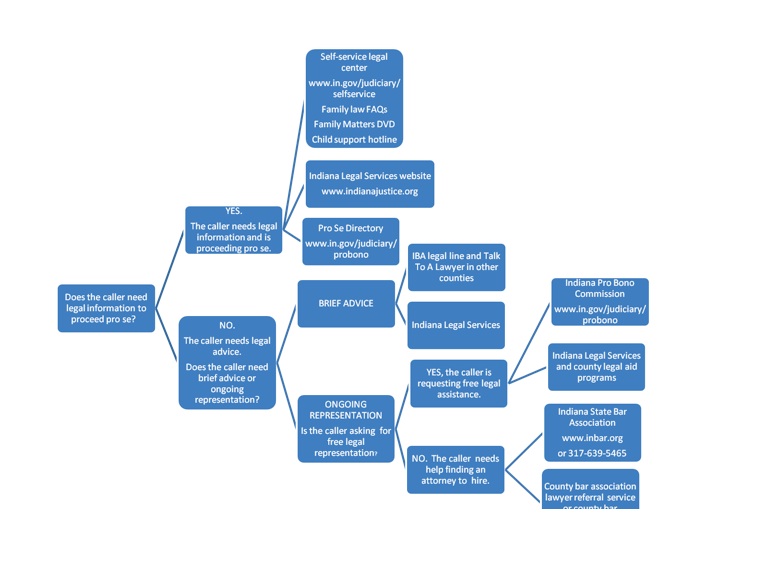
Nice Simple Triage Chart

Monica Fennel, back in 2008, created this simple chart for people answering phones in Indiana.

I thought it was worth sharing as a good example of clear thinking.  We are to note that it is no longer fully up to date, so think of it as a sample.  (Click for clearer image.)

Posted in Access to Justice Generally, Transparency, Triage | Comments Off on Nice Simple Triage Chart

Will Hornsby Reports on Year’s Key Events

Each year, Will Hornsby, as staffer for the ABA Standing Committee on the Delivery of Legal Services, puts out a summary of key events.  It is all worth a read, but particularly useful is this summary of rule and ethics changes:

Continue reading

Posted in Criminal Law, Legal Ethics, Unbundling | Tagged | 3 Comments

Claudia Johnson Blogs on the Equal Justice Conference

I have been lucky enough to have been in almost every single Equal Justice Conference since 2002. My first EJC was with Tanya Neiman—she gave me the opportunity to come with her and do a workshop on holistic advocacy while I was working with her. Tanya taught me how to enjoy EJC—I recall that months prior to the conference, the fax machine at work would be in hyper mode—with fax proposals flying in and out. EJC is my favorite conference because it brings a diverse group of doers and thinkers—and it is a forum where the challenges that legal nonprofits are faced are explored, along with the pro bono community at large. In the past three years, courts and librarians have started to come and now with the necessary advent of the Access to Justice Commissions—we have ATJ Commissioners contributing to the discussion and sharing of ideas.

This year, to me, the informal theme of the conference was “Who moved my Cheese”.  http://en.wikipedia.org/wiki/Who_Moved_My_Cheese%3F This book by Spencer Johnson,  is a team of two  2 mice and 2 humans, who live in a maze and have an apparently never ending supply of cheese A short video  can be found here: http://www.videoarts.com/product/CHEESE3/Who-moved-my-cheese

Continue reading

Posted in Systematic Change | Comments Off on Claudia Johnson Blogs on the Equal Justice Conference

NYT Blog on OMB Memo — “The Dawn of the Evidence-Based Budget” — Implications and Ideas

The Times has a fascinating blog starting with a discussion of a recent OMB memo requiring federal agencies in their 2014 budget planning to build in use of evidence and a focus on low-cost evaluations.

As the Memo puts it:

Agencies should demonstrate the use of evidence throughout their Fiscal Year (FY) 2014 budget submissions. Budget submissions also should include a separate section on agencies’ most innovative uses of evidence and evaluation, addressing some or all of the issues below. Many potential strategies have little immediate cost, and the Budget is more likely to fund requests that demonstrate a commitment to developing and using evidence. The Budget also will allocate limited resources for initiatives to expand the use of evidence, including but not limited to approaches outlined below.

The following language is particularly apposite for programs like LSC:

Continue reading

Posted in Dept. of Justice, LSC, Research and Evalation | 3 Comments

New York Times Invites Responses to Udell Letter on Pro Bono Requirment for Possible Publication in Sunday Review

Get your keyboards clacking.

Today the New York Times publishes David Udell’s letter on the new New York State requirement for bar applicants of 50 hours of pro bono as service.  David supports the requirement, as not burdensome and as helpful for access to justice:

“Alternative approaches may also have merit, but credit the chief judge for acting in urgent times to make this good idea a reality.”

The Times clearly wants a major dialog on the topic.  They add:

Editors’ Note: We invite readers to respond to this letter for the Sunday Dialogue. We plan to publish responses and Mr. Udell’s rejoinder in the Sunday Review. E-mail: letters@nytimes.com

This is a great opportunity to weigh in, both on the pro bono issue, and on other directly related issues of access.

I suspect that time is of the essence, and urge people to get writing, and to use e-mail rather than snail mail.

Note that the Times policies for letters are here.

Posted in Access to Justice Generally | Comments Off on New York Times Invites Responses to Udell Letter on Pro Bono Requirment for Possible Publication in Sunday Review

Access to Justice as a Bipartisan Issue

As the election heats up, it is important to note that access to justice is a bipartisan issue.

While obviously there are significant differences of perspective between the parties on matters of funding, particularly for LSC, in many states, support for access comes from wide range of stakeholders.

As so much becomes understandably caught in the political cross winds, we should remember that access appeals to universal values, and that, whoever wins the election, a strong case can be made for continuing the recent stronger federal presence in access issues, particularly the support of the Department of Justice Access Initiative for expansion of state level access to justice Commissions, and for adequate funding for broadly supported access initiatives.

Posted in Access to Justice Generally, Dept. of Justice | Comments Off on Access to Justice as a Bipartisan Issue