Another “Roles Beyond Lawyers” Evaluation Adds To the Very Encouraging Mosaic and Highlights Need For Replication Support

This week, the Preliminary Evaluation of the Washington State Limited License Legal Technician (LLLT) program, performed by the National Center for State Courts and the American Bar Foundation, was released.  The basic idea of the program is to permit certain highly trained nonlawyers to perform tasks traditionally viewed as limited to licensed lawyers.  The intent is to reduce the costs of access to justice.

The project should be seen as a companion project to the differently conceived New York Court Navigators program, the evaluation of which was performed using the same Framework.  The New York project is  evaluated here.

Here is the  important and very positive bottom line from the new Washington State LLLT Evaluation:

The LLLT program offers an innovative way to extend affordable legal services to a potentially large segment of the public that cannot afford traditional lawyers. While the scope of the role is limited and will not be the answer for every legal problem, LLLTs definitely can provide quality legal services to those who need it and also significantly reduce the stress of navigating a foreign process that is complex and daunting.

The LLLT program also offers the possibility of improving the quality of filings in court cases involving self-represented litigants and thus reducing the time and cost required for courts to deal with such cases. The Washington State example suggests that LLLTs and lawyers may form mutually advantageous business relationships, making referrals to each other as appropriate. Since LLLTs appear to assist customers who could not afford lawyers, they do not compete directly with lawyers.

This program should be replicated in other states to improve access to justice. As experience is gained and its program design is optimized, affordable legal services should become widely available to those with needs in areas where the public typically must now use self-representation. By offering low cost legal services, state bar associations will be able to compete directly with for profit businesses operating outside the regulatory umbrella of state justice systems. By doing so, they can ensure that the public has access to quality legal services.

I would urge everybody to read both evaluations.  But it might be helpful to start to pull together some overall lessons from the two together — and indeed from the emerging pattern around the country.

Roles Beyond Lawyers Work

Both pilots, one allowing license non-lawyers to enter the market, and one using non-lawyers to provide support, including the courtroom, but for free, are successes.

Opposition is less than expected

While both evaluations report some initial uneasiness, both seem to have achieved general acceptance.  This should give some reassurance to those still holding back on introducing an innovation.

There is opportunity for a wide range of experiments

While we only have two evaluated experiments — New York and Washington State — the general findings about utility, acceptance and impact on access to justice in these two very different contexts strongly suggests that there is room for many other kinds of expansion of the work that nonlawyers are permitted to do, and the kinds of contexts in which it is appropriate.

Training, supervision and approval structures are important

In Washing the cost of establishing the program was high, and ongoing costs of education continue to be a concern. In New York, the impacts (and indeed even the goals) were closely tied to extent of, and investment in, training and supervision.  So new experiments would do well to pay particular attention to these aspects of the design — including perhaps experimenting with several different models at one time.

The kinds of tasks appropriate for such roles is only just beginning to be explored

Given the success of these projects , even with with somewhat limited authorization of tasks, there is every reason to believe that the programs would be even more effective if they authorized a broader range of tasks to be conducted by the nonlawyers.  The decision about the scope of such expanded roles should be based on the extent to which the education provided and other protections ensure that the nonlawyer can and will perform authorized tasks appropriately.  It should not be driven by a desire to protect the profession.

As we simplify systems, such roles will become even more appropriate

This is really obvious.  Right now, certain roles may not be appropriate for nonlawyers because they are so complex and/or uncertain.  So simplification gives yet another benefit by making it possible to have related tasks performed by less hyper-trained people.

Ongoing networking and advocacy among those conducting these programs, those planning them, and those considering them should be a high priority for all

This is a task that will take leadership and incur costs.  It is not fair to expect the pioneer states to absorb this burden.  Tasks will include organizing presentations at access to justice gatherings, supporting day to day networking and calls, developing materials (including videos), encouraging research, and advocating for the idea.

A particular priority should be integration into the Justice For All 100% Strategic Planning Processes

Now that we have two evaluations essentially putting American Bar Foundation and National Center for State Courts imprimaturs on this general approach, and indeed two specific implementations, there is just no reason not to consider this as one of the components of the full Justice For All System, as called for by the Chief’s Resolution — subject of course to triage assessment of appropriateness in particular situations.

The evaluation framework Works, and should be broadly used

The framework, while drafted initially for “Roles Beyond Lawyers, is in fact approariate, in my opinion for all access to justice innovation evaluations, and should be used whenever possible.  As here, such use will facilitate comparison and the building of an actionable overall picture.  Focusing on the three issues of Efficacy, Effectiveness and Sustainability, is a brilliant breakthrough that covers everything.

Finally, huge thanks to the Public Welfare Foundation, in the lead as always, for supporting the development of the Framework and its application to these two projects.

Disclosure: I have been involved in multiple ways with these projects.
Posted in 100% Access Strategy and Campaign, Bar Associations, Court Management, De-Regulation, Law Schools, Legal Aid, Legal Ethics, Mixed Model, Non-Lawyer Practice, Public Welfare Foundation, Research and Evalation, Systematic Change, Triage | 1 Comment

Nevada Shows It Is Time for Another Shot at the Equal Rights Amendment

I have been thinking for a few days that maybe it was time to think about a new initiative to pass the (gender) Equal Rights Amendment (ERA).

My thought was that the last failures to reach the required three quarter of states threshold were in part caused by the then superficially appealing claim that there was no need for such a constitutional change because of the idea of equality was both accepted and enshrined in law.

Well, whatever the truth of that back in 1982, the last year or so have shown the utter speciousness of that argument.  Things we thought were settled in this area just are not, and hostility to women’s rights remains a real and appealing force.

The news is that yesterday the Nevada Legislature actually passed the ERA!  (Some technical fixes, due in the next few days, are still reportedly needed.)  So, we need only two more states to get to the point that enough states have passed it that, had the enabling legislation not had a 1982 cut-off, the Amendment would have gone into force.  That does not make it the law, but would give the effort huge additional force.  As the LA Times also reports:

This year, Nevada was one of eight states with resolutions calling for ratification. But in six of those states — Utah, Arizona, Missouri, Virginia, Florida and North Carolina — at least one house of the legislature is controlled by Republicans, who have opposed ERA ratification.

Actually, I am somewhat surprised that the the Republicans continue affirmative opposition.  It seems to me that this is the perfect wedge issue, in that the Republican voters must be split on this issue.  Moreover, drawing national attention to it would be disastrous for the party as a whole, even if in some states it is still less toxic a position for them.  Amazingly, while being introduced every year into Congress, there has not been a floor vote since 1983.  Moreover, some non-ratification states have passed state versions.  Indeed, while some want an approach that removes the 1982 deadline by statute, I would argue that forcing Republicans in states that had already ratified to take stand again would be far more effective politically, and perhaps create unstoppable momentum very quickly.  For national figures this would be about as no-win as you can get.  (I wonder if there has been any poling on this recently?)

With so much at stake, one can see why this is not getting the attention it deserves.  But, I suspect that many newly angry women (and men) would find opposition to the ERA beyond their understanding or acquiescence today.

Lets hear it from, for, and in support of, Nasty Women.

Wikipedia has a good history of the ERA.

Update:  On March 25, the New York Times posted an editorial on the same subject.


Posted in Constitution, Discrimination, Supreme Court | Comments Off on Nevada Shows It Is Time for Another Shot at the Equal Rights Amendment

A Tool For Assessing SRL Hearing Quality from the US Dept. of Labor

As state start to think about evaluating how their judges do in cases without lawyers, this might be a useful starting point.  It is US Department of Labor Handbook on measuring hearing quality in unemployment hearings (in which the vast majority of claimants, and many employers do not have representation).  The link is here.

At least initially, such evaluation might well be a general statewide self-evaluation, rather than any attempt to get a  handle on individuals.

By breaking down specific kinds of behavior and hearing attributes which might be assessed, the Handbook might offer a useful beginning.

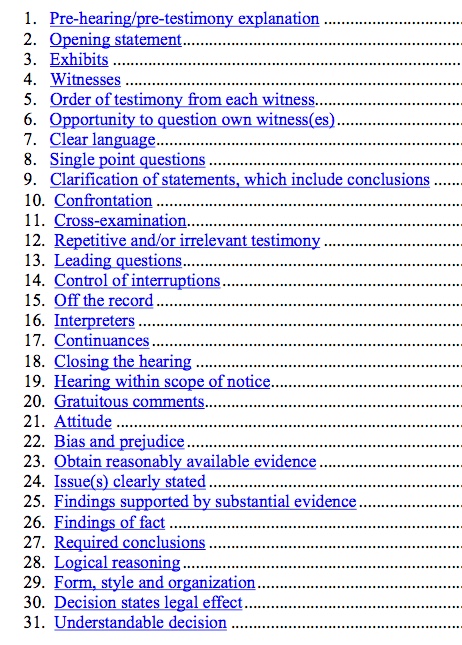
Here are the areas for which scoring systems are recommended:

decision-ass

For example, here is the scoring system for the administrative judge explanation of the process (#1):

CRITERION 1: PRE-HEARING/PRE-TESTIMONY EXPLANATION.

PURPOSE – At the start of the hearing, the hearing officer should clearly explain the procedures to be followed. The elements shall be covered in the recorded prehearing explanation or opening statement. The explanation must be clearly stated and delivered in an understandable manner.

SCORING SEGMENT

Good (6):  After recording began and before testimony was taken, the hearing officer clearly explained the hearing procedures. This explanation included: (a) the order of testimony, (b) the right to question witnesses, and (c) an opportunity for each of the parties to ask questions about the hearing process or procedures.

Fair (3):   The hearing officer allowed an opportunity to ask questions about the hearing process or procedures, but did not explain all of the elements (a) through (c). Unsatisfactory (0):  The hearing officer did not explain the procedures or did not allow an opportunity to ask questions about the hearing process or procedures.

While, obviously, this whole issue is very very sensitive indeed, we have to recognize that cases without lawyers provide particular quality challenges.  When there are two lawyers in the room, it is a reasonable bet that a) the judge will be aware of the possible consequences of sub-par performance, and b) that serious problems will ultimately be bought to the relevant authority.  However, when there are no lawyers, things may be different.  (I remember appealing a parking ticket in San Francsico in the 1970s, and hearing the hearing officer, a retired cop, comment to a different appellant that, “I do not believe the officer would have issued a ticket if you had done nothing wrong.”  So much for neutral judging.

So, we need some method of quality control, and a system like this, in place in all states through US government standard setting for unemployment hearings, is a good place to start the discussion.


Posted in Administative Proecdure, Judicial Ethics, Metrics, Research and Evalation | 1 Comment

Yet Another Way to Challenge the Legal Sufficiency of the Trump Presidency — Competency to Sign Orders and Bills

There has finally started to be some attention to the 25th Amendment mechanism for removal of the President (Larry Tribe on MSNBC, transcript here).

The main problem is that while the VP would surely welcome such a development, can not be seen to doing so.

However, there is another legal mechanism.  Surely any document is subject to forms of legal challenge when the signatory lacks sufficient mental capacity to sign it.  And, remember, the level of capacity required depends on the complexity of the document and issues, and to a certain extent its importance and significance.

So,  what about all those Executive Orders?  What about any bill that might get passed?  How do we know if Trump had or will have the mental capacity to sign them.

Think about it this way.  As a lawyer, given Trump’s constant changes of direction, denial of reality, and inability to engage with, remember the accuracy of , and act on, facts as presented to him, would you be willing to submit his will to probate? Surely yes.  Would you tell relatives who wanted to challenge the will that there can be no case at all if lack of capacity?  Well maybe yes, maybe no.  But, more importantly, is it the case that under no theory could the case be made?  Not so sure at all.  Moreover, it is far from clear that the capacity standard for the signing of an Executive Order or a Bill is as low as that for a will.  (Think of it as a will that gives away the whole country!)

While it is hard to imagine a court ultimately voiding Trump’s presidency based on this, it is not hard to imagine this as a way of legitimately and legally drawing attention to, and promoting discussion of, the 25th Amendment approach.  Indeed, the only reason it is hard is because if the evidence started to stick together, the 25th Amendment process would kick in.

Any thoughts, folks?

Posted in Access to Justice Generally, Attorney-Client, Congress, Constitution, Supreme Court, White House | Comments Off on Yet Another Way to Challenge the Legal Sufficiency of the Trump Presidency — Competency to Sign Orders and Bills

Cop House Lawyers Ordered In Chicago

This could be the begining of a major change.  As few outside the criminal justice system know, in the US most people without resources do not get to talk to a lawyer until shortly before they see a judge.

That means that opportunities for early investigation, for getting the family in for the bail hearing, for preparing arguments for ail are all lost, with immeasurable negative impacts on poor defendants.

But now, as reported by the Hufffington Post:

Chief Judge Timothy Evans of the Circuit Court of Cook County signed an order Tuesday that would make a county public defender or a designated private attorney available to anyone who is in custody at one of the Chicago Police Department’s 22 stations with lockup facilities.

It is not clear from the article if the prosecutors or police have any objection or how the assistance is going to structured and coordinated, but the overall feeling is that the ducks are in a row for this important change.  I suspect a lot of behind the scenes negotiation.

I hope it will be properly researched, and the savings in jail time documented.  If so this could be the beginning of a very major change,finally bringing the US more in line with the rest of the higher income countries.


Posted in Bail, Chasm with Communities, Criminal Law, Defender Programs, Policing, Public Defender, Research and Evalation | Comments Off on Cop House Lawyers Ordered In Chicago

What Does It Say That Courts Records Are No Longer To Be Used For Credit Score Calculating and Reporting

What a judgment on the courts.  As reported by the Washington Post — (Kenneth R. Harney):

In a little-known policy shift, the three national credit bureaus — Equifax, Experian and TransUnion — plan to stop collecting and reporting substantial amounts of civil judgment and tax lien information on public records affecting millions of American consumers starting July 1.

OK.  But why?

In response to a request for this column, the bureaus’ national trade organization, the Consumer Data Industry Association, provided a statement indicating that the changes are part of the bureaus’ “National Consumer Assistance Plan” that follows a settlement in 2016 with 31 state attorneys general over alleged problems with credit reporting accuracy and correction of errors on credit reports.

Eric J. Ellman, the group’s interim president, said the bureaus have adopted “enhanced public record data standards for the collection and timely updating of civil judgments and tax liens.” The standards will apply to new and existing data in files and will require that the public records sources include the individual’s name, address and Social Security number or date of birth. Public records sources will also need to be updated on a timely basis to be eligible for inclusion in credit files. Most civil judgment data and up to half of tax lien information cannot currently meet these tests, according to one industry estimate.

In other words, the data is neither sufficiently identified, nor sufficiently up-to-date to be used in something as important as a credit score.

You do not have to be too much of a troublemaker to ask the obvious question:  So, how come its OK to use them for other things — like landlord eviction databases, and got knows what other purposes to which this data — now often public and aggregated — can be put to.

Surely this development makes those who make use of this data vulnerable to all kinds of claims, including defenses in particular situations, and affirmative litigation to reduce abusive practices.  And that’s without even getting into issues of warrants, arrests, fees, and the Ferguson Chasm.

This has to raise all kinds of uncomfortable questions for the courts — although it might help engender corporate and prosecutor support for court funding increases.

Good for the AGs.

(Thanks to David Udell for pointing this perspective out.  Maybe a court record reliability number should go in the Justice Index?)


Posted in Bankruptcy, Consumer Rights, Court Fees and Costs, Court Management, Debt Collction, Evictions, Foreclosure, Housing | 3 Comments

Wonderful Video on Self-Help Services Is a Tool to Ensure 100% Availability of this Key Service, and Introduces the Triage Concept

The Justice of All Strategic Planning Guidance, issued last August, identifies a number of basic services which should be available to all if 100% access is to be provided.  Obviously one of the most critical is universally available self-help services.

For those seeking to make that idea real, a nine minute video just released by the Public Welfare Foundation is a perfect tool.  The California courts explain the need for the services, how they are integrated with triage, and how they look day to day.  This includes the obvious need for help with forms, no matter now simple.

Above all, the totally commonsense non-ideological presentation (narration by Bonnie Hough) conveys the simplicity of the overall idea, and its utterly non-controversial essence.

I would urge everyone to watch it, and to present it to any group involved in any kind of access to justice planning.  It is particularly critical that those who are thinking of “For All” strategic planning make use of the video to get commitment from their group to include this in their core strategy and planning.  In making this argument, never forget to highlight the two for one match for child support self-help services available from the uncapped HHS Child Support Enforcement grant stream.  That can be used to fund an initial statewide infrastructure, that can then be expanded to other issues when the value of the approach is demonstrated.

Note: The video and others about access to justice, are also available at the PWF website, here.


Posted in 100% Access Strategy and Campaign, Forms, Funding, Self-Help Services, Triage | 1 Comment

CCJ/COSCA Letter to OMB on LSC Funding Highlights Bipartisan Support for Access to Justice

In response to recent stories that the Administration had LSC on a target list, perhaps the most powerfully bipartisan bodies in the US legal system chimed in in support for LSC funding.

The Presidents of the Conference of Chief Justices and the Conference Of State Court Administrators wrote on February 24 to the head of OMB, that:

[T}he Conferences urge OMB to promote stable and adequate funding of the LSC rather than a defunding.  .  .  .

Since the great recession in 2008, the Conferences have unanimously adopted several resolutions documenting the shortfall in civil legal aid and reaffirming the importance Census Bureau data show that nearly one in five Americans – 61.8 million people – are eligible for legal aid, a 21% increase since 2007.   In 2012, we called upon all members of Congress “to fulfill our nation’s promise of ‘Equal Justice Under Law’, by restoring funding for the federal Legal Services Corporation to the level necessary to provide critically needed services to low-income and vulnerable Americans.”  We have reason to believe these efforts have contributed to a stabilization and occasional modest increase in Congressional appropriations to LSC in recent fiscal years.  .  .  .

Our research makes clear that the large number of unrepresented citizens overwhelming the nation’s courts has negative consequences not only for them but also for the effectiveness and efficiency of courts striving to serve these and other segments of the community who need their disputes resolved.  More staff time is required to assist unrepresented parties.  In the absence of a fair presentation of relevant facts, court procedures are slowed, backlogs of other court cases occur, and judges confront the challenge of maintaining their impartiality while preventing injustice.  Clearly frontline judges are telling us that the adversarial foundation of our justice system is all too often losing its effectiveness when citizens are deprived of legal counsel.

Given these facts on the ground, we hope you will support our struggle to increase the availability of legal assistance to the most-needy members of our communities lest we further compromise our nation’s promise of “equal justice under law.”

The sustained work by LSC’s President Jim Sandman to build the bipartisan case, and indeed the extensive multi-organizational collaborations in support on access to justice generally that are now embedded into the justice system, help support much greater optimism about LSC’s future than might once have been the case.

There is a moral here for much of our work.  The credibility that the Chiefs bring to access to justice is one of our greatest assets, and we must make full use of that credibility, and must also remember the reciprocal obligations of respect that that support imposes on us.

Posted in Access to Justice Generally, Budget Issues, Census Bureau, Funding, Legal Aid, LSC, Political Support, White House | Comments Off on CCJ/COSCA Letter to OMB on LSC Funding Highlights Bipartisan Support for Access to Justice

Do Not Call Us Immigrants, Call us “Americans By Choice”

That’s what I am, that’s what millions of us are.

So, why are we supposedly lesser Americans, or rather why do so many others think we are lesser.

If anything, the argument that “we Americans by Choice have shown more committement to America” would be stronger than the one that “Americans by Birth have shown more committement.”

And, pray, how come Americans by Ancestor Capture are so often the most truly patriotic of all?

Posted in Access to Justice Generally, Immigration | 2 Comments

Relationship of Global to US Access to Justice

The upcoming Tuesday March 21 gathering, at Fordham Law School, on Unifying Global and U.S. Access to Justice Movements: The Judicial Perspective should help get us thinking about that huge and challenging topic.

The speakers will be: Matthew Diller, Dean and Paul Fuller Professor of Law, Fordham Law School; Jonathan Lippman, Of Counsel, Latham & Watkin, Chief Judge, New York Court of Appeals (2009-2015); Willy Mutunga, Distinguished Scholar-in-Residence, Leitner Center for International Law and Justice, Fordham Law School, Chief Justice and President, Supreme Court of Kenya (2011-2016); Rebecca L. Sandefur, Faculty Fellow and Founder, Access to Justice Research Initiative, American Bar Foundation, Associate Professor of Sociology and Law, University of Illinois at Urbana-Champaign, David Udell, moderator
Executive Director, National Center for Access to Justice.

The first point is that the national political context in which an access to justice innovation issue arises can make all the difference.  Thus, in the US, the question of adding forms of nonlawyer assistance or self-help services has to be assessed in a context in which the alternative status quo would be no assistance.  In much of the developed world, however, the context of these proposals is proposals or plans to reduce  provision of assistance of counsel — an entirely different matter.  It is really important, I would suggest, that in international discussions we should be very careful to clarify the context in which a proposal, evaluation, research, etc., comes up.  The Third World context is like that of the US, only more so.

The second point is that in many countries the phrase “access to justice” focuses more on “justice,” and less on”access.”  By this I mean that the phrase focuses more on substance rather than process.  In many countries the political and legal structures are so weak in their protection of rights that the focus is on establishing the effective recognition of rights, rather than ensuring that the processes of legal structure are fully accessible.  While the two areas obviously overlap greatly, there can be confusion on this point.

Finally, nothing said here should in any way under the conclusion that these kind of gatherings are very very helpful in illuminating the issues in all contexts, in providing opportunities to learn about new ideas and new approaches. I would hope that the proceedings and lessons are well shared, something that has perhaps tended not to happen enough with International Legal Aid Group meetings, which are always attended by a number of Americans.


Posted in Access to Justice Generally, International Cooperation, International Models | 1 Comment

Clint Bamberger’s Death Kicks In the Gut

We heard today of Clint Bamberger’s death, at age 90.  The New York Times obituary focuses mainly on his landmark Supreme Court case of Betts v. Brady, establishing the obligation on prosecutors to disclose exculpatory evidence.

But for generations of lawyers committed to access to justice, that case, while critical, is far from the most important piece of his massive legacy.  As one of the tiny group of visionaries who envisioned the original legal services program, as its first director, as a founder of clinical legal education, as one of the founders of Harvard’s Legal Services Center, as one of the originators of the Reginald Huber Smith fellowship program, and as an endless advocate for innovation and access, Clint really was the trailblazer who build the foundations on which all of us try to build.  Much more of Clint’s story is told in the Baltimore Sun obituary.  The LSC statement is here.

I got to meet Clint during my second year of law school, when he, Garry Bellow, Jeanne Charn, Bill Simon, Isaac Borenstein, and Michael Lipsky were setting up the Harvard program.  My wife Joan was one of the first students in the only year that the program actually functioned as a full year 100% clinically focused program, and then she was hired to work for the program.

So, for some reason Clint’s death, foreshadowed on December 6th by that of his beloved and equally contributing wife Katharine, hits particularly hard in the gut.

I think it’s because Clint and Katharine managed to make me feel like they thought I was an equal.  They were always full of respect and interest in even my crazier ideas, and always just as humanly interested in every aspect of our lives.  We always parted from them, most recently a couple of years ago, I think, reinvigorated and with greater self-acceptance.

Clint and Katharine were born healers, both of individuals and society as a whole.

I hope to be able to put together a more detailed appreciation, but will not be at peace till at least this has been said.

My wife Joan adds:  Clint and Katharine were wonderful friends, mentors, and models of mine.

P.S.  Alan Houseman’s obituary, prepared for the Equal Justice Library, is here.


Posted in Access to Justice Generally, Law Schools, Legal Aid, LSC, Obituaries and Appreciations | 1 Comment

A New Era of Jury Nullification?

Trump threat tweeted today that “the spotlight has finally been put on the low-life leakers! They will be caught!”

That leaves a big loophole, since the vast majority are probably not”low-life” at all, but patriots.  They should be safe.

But then, grammar was never a strong point for the Donald.

Seriously, time to dust off our jury nullification research.  And, surely the necessity defense would be strengthened by Trumps prior expressions of support for hacking.

Do you really think that today you could get a conviction out of a DC area jury on these leaks?  Good luck on that one.

Posted in Criminal Law, Policing, White House | Comments Off on A New Era of Jury Nullification?

The Totally Unbalanced Amici List in the Ninth Circuit Tells the Whole Story

As a general matter, the line up of amici in a significant case provides some indication of how institutions are lining up on the issue.  If this were an issue on which the country were split, one might expect that those in support of the administration and those challenging Trump’s Executive order would be in rough balance.

So, I engaged in a quick research project and looked at the Ninth Circuit docket entries, which are here.

There are approximately twenty briefs, and only two were in support of the Executive Order.  One is from from Freedom Watch., and the other does round up a number of the usual suspects, with the list reading as follows:

Amici Curiae U.S. Justice Foundation, Citizens United, Citizens United Foundation, English First Foundation, English First, Public Advocate of the United States, Gun Owners Foundation, Gun Owners of America, Conservative Legal Defense and Education Fund, U.S. Border Control Foundation, and Policy Analysis Center

In contrast to the outpouring of states, technology businesses, law professors, advocacy organizations, etc supporting the challenge to the Order, this is a remarkably weak display.

No states, no Republican officeholders, no businesses.  Only a few frequent litigators and a few far-right frequent fliers, heavy on guns, English language monopoly, and border control.  Not a cross section of even just conservative America, let alone America as a whole.

That suggests to me the deep ambivalence of the institutional structures of our society, not only about the Order, but about the administration from which it came.

This adds to the increasing evidence that the policies of the last three weeks are built on shifting sand in terms of support.  At a minimum, this gives the courts far more freedom to follow the law, knowing that if that triggers a formal constitutional crisis (rather than just the de facto one we already have), the courts will have almost all the system on their side.

Posted in Constitution, Judicial Supremacy | Comments Off on The Totally Unbalanced Amici List in the Ninth Circuit Tells the Whole Story

Rebranding and Revitalizing the Legal Profession

Whatever you make think about the Trump administration, one thing is clear, the public is being reminded of the importance of the availability of lawyers.  Maybe also, the profession itself is remembering also how much helping real people with real problems can give meaning to life.  The last para of the Washington Post piece on the legal volunteers at Dulles airport reads as follows:

“It’s a good feeling,” Fezan Rizvi, a psychiatrist who lives in Loudoun County, said as he nodded toward a half-dozen sign-holding lawyers amid the crowd. “If you have any questions, they’re right there, and it’s pro bono. That feels like America.”

Meanwhile earlier in the article:

Welborn [one of the 1200 volunteers who have signed up to help at Dulles] said she had come because it felt right. “Yeah, we are the good guys,” she said. “Sam and I were talking in the car on the way here, about how we’re proud that it will be the lawyers who will be the ones fighting on the front lines.”

Helps us remember why we went to law school — sadly something many of us had forgotten just three years later.  You don’t have to hang out at Dulles to get a feeling of caring juice flowing through your veins again.

Read the whole piece and share.


Posted in Access to Counsel, Access to Justice Generally, Immigration, Pro Bono | 1 Comment

What Emma Lazarus Would Write Today

Christine Webb is a British poet of great accomplishment and also a close multi-generational family friend.

I feel honored that we are able to share this magnificent poem that Christine has written in response to recent actions taken in the name of the United States.  It is an almost unbearable reminder of the contrast between what our country used to be seen as, and what we are now doing.

We can only hope that the millions around the world who have been inspired by the best in us, even as they always saw our defects, will remember that this is in no way a majority Presidency, and that what is done in our name is not what the majority of us tried to choose.webbI am certain that Emma Lazarus would have welcomed these words, even as she cried with us. (Statue of Liberty plaque poem here.)

Note: Updated with slightly different first stanza.


Posted in Access to Justice Generally, Dept. of Justice, Immigration, International Cooperation, Personal, White House | 2 Comments