On the Need for Uncompromising Reassertions of Neutral Principles Regardless of Inevitable Political Implications

There is obviously a lot to cheer about today, as different aspects of our complex, flexible, and therefore very resilient system starts to trigger its anti-fascism-antibodies.

One of the most important, in the long term, may be the fact that institutions with nonpartisan missions are coming to realize their right, obligation and need to reassert the neutral principles that inspire them and to act in accordance with those principles.  They are coming to see that non-partisanship does not impose passivity.

To put it another way, when the inconsistent actions of others highlight the difference between those actions and the actions of the nonpartisan institution, then that does not make the nonpartisan institution partisan, rather it just illuminates the hyper-partisanship of the actions of others.

Two simple and inspiring examples, from institutions large and small.

Under the heading “We Are All Harvard,” the President of my alma mater (not a phrase I usually use) issues a clarion call:

.  .  . I write to share information about resources available to students and faculty and to underscore that our international students and scholars are essential to our identity and excellence. We are all Harvard.

In times of unsettling change, we look toward our deepest values and ideals. Among them is the recognition that drawing people together from across the nation and around the world is a paramount source of our University’s strength. Thousands of students and scholars and visitors come to Harvard each year from all over the globe—to study, to teach, to propel our research enterprise, to join in conferences and colloquia, to share insights and abilities that transcend nationality. Thousands more leave Harvard each year to travel abroad, learning from experiences they could not replicate here, gaining insight into cultures and perspectives different from their own, visiting colleagues and family and friends, forming and sustaining the human bonds essential to mutual understanding.

Our robust commitment to internationalism is not an incidental or dispensable accessory. It is integral to all we do, in the laboratory, in the classroom, in the conference hall, in the world.

Very similarly, the Executive Director of Collington, the retirement community where I live, sent all the staff a letter yesterday, including the following language:

Each and every one of you reading this is a part of a large and close knit international family here at Collington.  We represent numerous countries from all over the world and proudly celebrate that diversity throughout our community.  .  .  .

I feel it is important for you to know that Collington stands firmly shoulder to shoulder with all of you.  We welcome with open arms all individuals.

He then quoted from the values and practices document.  “To encourage and welcome all people without regard to race, color, gender, sexual orientation, religion, national origin, or any other characteristic protected by law, to live in our communities and to serve on our staffs and boards.” He added, in a cover note to the Board:

For those that may not know, a significant portion of our staff are Muslim and/or immigrants and the recent executive order has many of them fearful even though they are all either naturalized citizens or permanent residents of the US.  As one staff member said to me today, “Collington could not exist without immigrants that come here to work.”

So, I would suggest that the path forward is simple: reassert core values and principles without fear that that will be seen as partisan — it is not.  Make plans to act in direct accord with those values and principles and be transparent about the need, the relationship between values and actions, and be proud of it all.  That will result in a stronger institutions, community and country, even more deeply grounded in our common principles and values.

With respect to the courts, this is not harder than for other institutions, but it does require more clarity of thought.  All too often, neutrality has been seen as requiring passivity.  But what we do have behind us is the experience of working through in the self-represented context that, neutrality does not prevent judges from taking actions to ensure fairness.  (See also general pre-election discussion here.)



Posted in Access to Justice Generally, Constitution, International Cooperation, Judicial Ethics, Science | Comments Off on On the Need for Uncompromising Reassertions of Neutral Principles Regardless of Inevitable Political Implications

SRLN Conference Schedule and Early Registration Deadline

The Tentative Schedule for the SRLN Conference (Feb 23-24) in San Francisco is now available, and early price-reduced registration, link here, closes very soon, on Feb 1.  General registration will remain open after that day.

A two-day in-person national conference for lawyers, judges, clerks of court, self-help services professionals, librarians, technologists, funders and other allied professionals to explore and develop successful strategies and new thinking for providing 100% access to justice.

It will be held at the Judicial Council of California, Milton Marks Conference Center, and is in affiliation with the Judicial Council of California’s Family Law Facilitator and Self-Help Center Conference.  This change will enable a greater focus on 100% access to justice, the Chief’s Resolution, and the Justice for All Initiative, as well as the myriad innovations spreading throughout the movement.

From looking over the schedule, I would suggest these reasons for making the financial and time effort to get there.

  • This is the only gathering that gives appropriate equal weight to the courts in the access to justice triad of courts, legal aid and bar.
  • This is an important opportunity to think positively rather than defensively about the changed climate.
  • This is the first conference at which there will be specific attention to ensuring that the voice of the litigant and consumer is heard by legal institutions.
  • This is the first conference in the ATJ world that will focus on on simplification issues.
  • There is he first non-tech conference at which there will be significant focus on human design issues.
  • A track on engaged and active judging will move this critical area forward.
  • There will be a special series of workshops focusing on establishing new self-help programs.
  • With all the movement in research and indicators, this will be the first opportunity to think about how it relates to practice and how it should move forward.

Above all, take a look at the list of speakers.

As you may know, I have had to cut way back on my travel, but this is so important in setting directions for the future that this will be my first trip outside the DC area since June.  I look forward to connecting with old friends and new allies as we move forward together.

See you there.


Posted in Meetings | 2 Comments

Karen Lash, LAIR, Transitions and the Future

Another sad but expected one.

As Karen Lash of the DOJ Access to Justice Office announced, with her usual grace and optimism, in an email earlier today:

Today is my last day with the U.S. Department of Justice Office for Access to Justice. It has been an extraordinary honor and privilege to serve as a Deputy Director and to lead the White House Legal Aid Interagency Roundtable. Each of you has played a critical role in the myriad accomplishments  — whether creating and using new resources for civil legal aid that further federal priorities, to statements of interest in access-to-justice litigation, and to support for strategies that enhance the public defense function.

 I’ll miss the work and all of you.

 Karen, in over six years with the Office, has touched every aspect of its work. However, her greatest legacy is probably the Legal Aid Interagency Roundtable (LAIR), which is already having, and will surely continue to have, a huge impact on access to justice through the sensitivity that it has already engendered throughout many of the Federal agencies to the need to integrate that access perspective into agency functioning.

Indeed, that legacy is particularly appropriate, since from very early on Karen was working to focus the ATJ Office on just that integration. Her efforts to ensure a research commitment have been massive, and are now deeply embedded, and not just in the Federal government.

As I have previously noted, LAIR is a perfect model for replication in the states, that are now so far behind the Federal government in taking advantage of the leveraging potential from such relationships.

I would like to add a personal note. When I told Karen about four years ago at an NLADA meeting about my medical diagnosis, we had a very nice supportive conversation. A day or two later, she reached out to me (completely unnecessarily) wanting to apologize for not having, as she felt, risen to the occasion, and we then talked deeper and further. This was so typical of her. She always sets the very highest standards for herself, and when she feels she has not met them, goes back and does what needs to be done to meet those standards.

In terms of the future, I understand that Karen will be doing some consulting projects and working on ways to apply all she’s learned about how the executive branch of government functions and the myriad ways access to justice is essential to good government.  That would be truly wonderful. So, what seems today like a sad day may later be remembered as a launch day.

But in any event, it is still a day to again thank you, Karen, for the warmth, intelligence, focus, strategic perspective and energy you have brought to our community.

Posted in Dept. of Justice, Funding, LAIR, Transitions | Comments Off on Karen Lash, LAIR, Transitions and the Future

Transitions: Access to Justice Office

Sadly, there are going to be a lot of these in the next few days.

This is from an email sent out by Lisa Foster, outgoing Director of the Office for Access to Justice at DOJ.  The good news is that, as she leaves with a job wonderfully done, the Office stays not just very alive, but in very good hands under Maha Jweied who has been such a big part of everything that has been happening.

As most of you know, Thursday will be my last day as Director of the Office for Access for Justice. For a little over two years, I have had the privilege of leading a team of committed and talented attorneys and working under the leadership of two extraordinary Attorneys General. I am enormously proud of the work we have done, but none of it would have been possible without all of you.  One of the singular aspects of this Office is our mandate to reach outside the building and engage with the wide and wonderful community of advocates, judges, administrators, researchers, educators and policy makers engaged in justice reform.  Collaborating with all of you has made our work better.  And I have made so many good friends.  Thank you for welcoming me into your company and for all that you do to pursue justice.
 
And you will still be able to pursue justice with ATJ.  I am pleased to announce that Maha Jweied will be the Acting Director of the Office for Access to Justice. You can also can also contact Senior Counsel Allie Yang-Green or Senior Counsel Bob Bullock. 
 
I do not know yet exactly what I will do next.  I do know that I will continue to focus on state and local justice system reform.  In the short run, I will likely do some consulting; in the long run . . . I’ll keep you posted.  .  . 

Each Director of the Office has brought new and different strengths to the task.  We appreciate Judge Foster for many things, but I remember her in this role most of all for her ability to articulate a broad integrated and innovative vision for access to justice that did so much to get the community ready for a much deeper understanding of how to provide access.  As such, I think we will look back at her tenure and see this as a time in which that broad vision gave the movement a flexibility and strength that will enable it to do well regardless of the environment.  Moreover, her work with Karen Lash and many others on LAIR helped provide roots in the system that will help ensure the ongoing effectiveness of the bipartisan agenda, again regardless of short term environment.

We look forward to many future contributions.


Posted in Access to Justice Generally, Dept. of Justice, LAIR, Systematic Change | Comments Off on Transitions: Access to Justice Office

Moving Forward With Federal ATJ Data Collection To Support the Chiefs 100% Access Resolution

Its a routine thing, best seen as the normal functioning of government, which is coming more and more to recognize the nonpartisan importance of access to justice issues and measures to all government goals, including making the system work for all.

A new LAIR Factsheet issued by DOJ’s Office for Access to Justice, which summarizes recent activities, includes this very important institutionalizing step.

To further build a statistical infrastructure in the United States that addresses key civil access to justice questions that are not currently answered, BJS will undertake a multi-year effort to develop, test, and implement a person- based survey of legal needs, services, and outcomes. The survey will augment the limited administrative data currently collected by the federal agencies. Work will begin in March/April 2017, with a goal of fielding a supplement to the ongoing National Crime Victimization Survey (NCVS) at the earliest feasible time (January to June 2019 or later) The civil justice supplement will be administered over 6 months in more than 70,000 households to a randomly selected adult in each household. Prior to data collection, BJS will develop the instrumentation, draw on the expertise of ATJ and Working Group stakeholders, develop data collection protocols, conduct cognitive tests of proposed measures, and complete a full pilot test.

The key phrases are “a person- based survey of legal needs, services, and outcomes” and  “supplement to the ongoing National Crime Victimization Survey.”  (link added.)

This means many things, but perhaps the most important is that by the end of 2019 we will have a routine, institutionalized national measuring system to help us guide the successful implementation of the Chief’s unanimous, and thus bipartisan 2015 100% access to justice resolution.  That remember, reads as follows:

NOW, THEREFORE, BE IT RESOLVED that the Conference of Chief Justices and the Conference of State Court Administrators support the aspirational goal of 100 percent access to effective assistance for essential civil legal needs and urge their members to provide leadership in achieving that goal and to work with their Access to Justice Commission or other such entities to develop a strategic plan with realistic and measurable outcomes; and

BE IT FURTHER RESOLVED that the Conferences urge the National Center for State Courts and other national organizations to develop tools and provide assistance to states in achieving the goal of 100 percent access through a continuum of meaningful and appropriate services.

The two fit together perfectly, and even more so, now that the states are affirmatively moving forward through the Justice for All initiative.

I am sure that the two will work together to make sure that they support each other in every way possible.


Posted in 100% Access Strategy and Campaign, Access to Justice Generally, Census Bureau, LAIR, Legal Aid, Metrics, SRL Statistics, Systematic Change, Triage | 1 Comment

Now is the Time to Preserve the History of Government (and More) on the Internet –The WayBack Machine

Very few people know about the Internet Archive’s Wayback Machine.  It is an amazing tool, which lets you look at the history of websites, that is to say how they have looked over time.

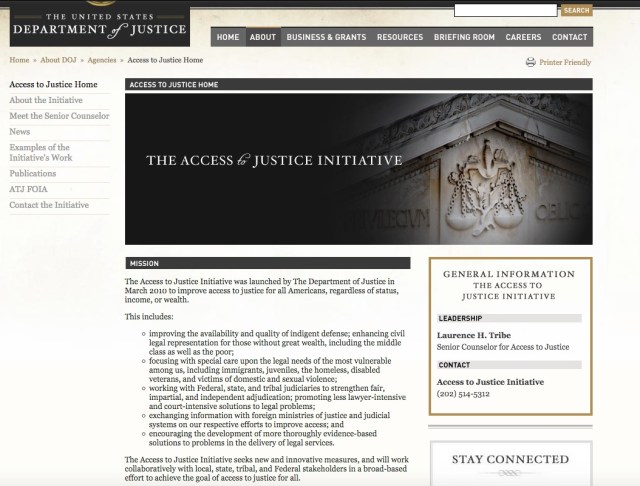
Here, picking an example totally at random, is the history of the Department of Justice Access to Justice Program Website.

Here is part of the page, which acts as a gateway into all the dates that have been captured.

back-doj

Using this, you can see what many many sites looked like in the past.  Here, for example, is the first capture of that site, performed in November 2010, when Larry Tribe was still head of the Access Office.

old-doj

This may turn out to be a particularly important tool as government data may be less reliably permanent in the time to come.

The system even includes a tool to capture a website as of now,, for future precise and reliable citation.  (This only works with sites that allow crawlers.)

I would strongly encourage anyone dealing with governments that might change their histories and commitments to use this tool to trap and keep the history.  It can also be used to prove the public positions that corporations have taken or implied.

It is almost as if we were to discover that the Memory Hole in 1984 in fact kept a history, rather than burned everything.  (Now there is a nice idea for a novel.  It would make all the Stasi revelations seem like child’s play.)


Posted in Consumer Rights, Dept. of Justice, Evidence, Freedom of Expression, Technology, Tools | Comments Off on Now is the Time to Preserve the History of Government (and More) on the Internet –The WayBack Machine

Legal Aid HackathonShows the Coming Change in Access to Justice Culture is Enormous

I love it.

Before the TIG conference, there was a legal aid Hackathon.  Here is the presentation that summarized it.  Astonishing.

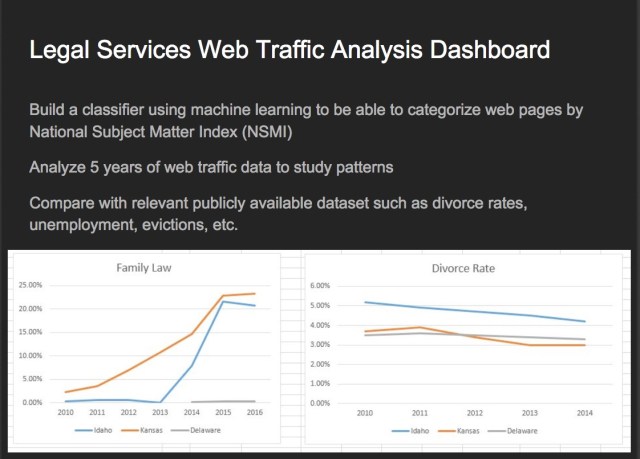
This slide is my own favorite, and self-explanatory.

dash

Other projects included a write clearly tool, a legal check-up tool, legal aid grants open data standard, knowledge management, and justice hub.

All fascinating and exciting.

But the really big point is the cultural transformation that is starting to happen within the legal aid community.  Almost all of these are not “new” ideas, in the sense that they have never come up in a brainstorm.  Some have even been the subject of prior TIG grant applications.  But they show a new level of creativity and concrete vision that sees tech as fully integrated into — or rather the leader in integrating and transforming into capacity for 100%.  That makes this an important cultural change moment.

Now actual steps are happening.  And look at who is making them happen.

hack

I do not know whether I am more embarrassed or delighted to report how few of the people in the room I know.  A new generation with new energy and productivity, not just for tech but for an integrated access to justice vision.

But more importantly, these are not the traditional power holders, or “old lions” of legal aid.  These are the new doers.

That is why it is in rooms like this that the access to justice revolution is happening.

I invite of any of the hack groups to please write a guest post for this blog on their project, now or as their project moves forward.  Regardless of this, groups should feel free to reach out to me if they think I might be of any conceptual help.

I hope that hackathons like this will become a routine feature of every ATJ conference, and that there will be a system for quick and small TIG grants to facilitate immediate action on good ideas, not constrained by the length of the funding cycle.


Posted in 100% Access Strategy and Campaign, Legal Aid, LSC, SRL Statistics, Technology | 2 Comments

A Challenge: How Do We Even Out The Rates of Media Outreach Capacity for Access to Justice at the National and States Level?

Voices for Civil Justice, funded by the Public Welfare Foundation, the Kresge Foundation, and others, and headed by Martha Bergmark, has done amazing work in terms of getting the access to justice messave out at the national level.

They have had a hand in 250 placements of media coverage about civil legal aid in more than 80 national and significant regional outlets. This has included multiple placements in prominent outlets including the New York Times (19 pieces), NPR, Wall Street Journal, Washington Post, Los Angeles Times, Associated Press, Bloomberg News, CBS Evening News, PBS NewsHour, and The New Yorker.  They have built a 1,000-member, 50-state network of media spokespeople.  Clips are here.

But progress is less dramatic in terms of the state ATJ programs of all kinds rising to the challenge and developing the capacity to do this on their own.  In the end, such local capacity is far more effective, not only because it simply provides better content, but because it builds the local relationships that can be called on in moments of challenge and crisis.

To be specific, based on a survey conducted by Voices with over 300 responses from 47 states:

  • At the organizational level, 32% of respondents organizations had communications plans, significantly up from 2o14 when the number was only 26%.
  • But, at the statewide level, the story is not so good.  Only 3.5 percent of statewide entities (e.g. Access to Justice commissions, IOLTA funders) said their state has a written, coordinated communications plan. (Its a little better that 29% have a written plan for specific initiatives such as fundraising and legislative advocacy, but that should be 100% already.)

I suspect that the reason is that only one third of state entities have staff or consultants working on communications, and I suspect that most of those have many other tasks.  This work is too easy to put to the back of the pile — at least unless there is an urgent nudge e-mail from Voices in your inbox!

At the organizational level, the the percentage with staff assigned has stayed the same since 2014, but there has been a 6 percent increase in organizations devoting 50-100% FTE to communications, a 4 percent increase in organizations devoting 101-150% FTE to communications; and a 3.5 percent increase in organizations devoting 201% FTE or more to communications. These higher numbers would help explain the existance of the plans.

This just underlines how far we have to go in getting capacity to be built at the statewide and multi-stakeholder level.  Obviously, this parallels the many other capacity areas in which so much needs to be done.

While the challenges of messaging are now more complex than ever, this is not the time to be frightened of telling those aspects of our story that have universal or near universal appeal.


Posted in Access to Justice Boards, Access to Justice Generally, Communications Strategy, Legal Aid | 1 Comment

Algorithms and Checklists May Help Deal With Implicit Bias

While I am an advocate of algorithm driven processes in law, I still have a slightly queasy feeling about the whole idea.  It comes from the fear that outcomes are not going to be “far,” but are going to be driven by limited and over-detirminative factors.

Recent medical research suggests that we may be hugely underestimating the benefits of protocols to increase fairness.

Specifically, a recent study at Johns Hopkins of checklists to drive prescription of blood thinners turned out to have far broader effects than expected.  As the New York Times article, by Jessica Nordell, explains, once the study started:

Whenever a provider is admitting a patient to the hospital, a computerized checklist pops up onscreen. It asks if the patient has specific risk factors for blood clots, or for bleeding from blood thinning medication. Then the system offers a recommended treatment.

No surprise that the number of clots declined.

The Hopkins blood clot prevention checklist has been enormously successful — after the intervention, the incidents of potentially preventable blood clots in medical patients [in the study] dropped to zero.

But much more happened:

Haut is a trauma surgeon, not a bias expert, so gender disparities were the last thing on his mind when he and his team put together a computerized checklist that requires doctors to review blood clot prevention for every patient. “Our goal was not to improve care for men or women or whoever, it was to improve the care of everybody,” he said. But what they found was that after the introduction of the checklist, appropriate treatment for everyone spiked. And the gender disparity disappeared.  (Emphasis added.)

Given the prior numbers, that is an enormous change.

At Hopkins, as at many hospitals, both men and women were receiving treatment at less than perfect rates, but while 31 percent of male trauma patients were failing to get proper clot prevention, for women, the rate was 45 percent. That means women were nearly 50 percent more likely to miss out on blood clot prevention.

It turns out that to be effective the use of the checklist must be universal and mandatory, and benefits from extensive consultation and training.

But for us in the legal system, this result suggests that if, for whatever reason, we move towards concrete and specific decision protocols, we might squeeze out much of the unintentional bias that pervades the system.  As the article explains:

First, it disentangles the thinking that goes into a medical decision. Typically, clinicians aggregate relevant patient information and use their judgment to arrive at the best course of action. The Hopkins checklist disaggregates that decision into its constituent parts. In a sense, the Hopkins checklist puts the decision about blood clot prevention through a prism, separating out and clarifying the sub-decisions the way a prism separates white light into its rainbow colors. In illuminating each step, the checklist interrupts habitual biases, preventing them from corrupting the decision-making process.

Second, the checklist reduces reliance on human judgment. “The decision support tool makes it very cut and dry — the decision isn’t, ‘Hey, what do you think you should do?’ The decision is — click, click, click, here’s what the computer says to do,” Haut said.

That sounds like an almost perfect description of the problem in the legal system.

Indeed, one can imagine such an approach being used in triage, in intake, in caseflow allocation, in sentencing, parole and probation, in child support decisions, in domestic violence order conditions, in visitation decisions, in eviction extensions, etc.  These are all areas in which extensive discretion is applied, and there is good reason to suspect various forms of pervasive unintentional bias.

Now, most of these systems may require facts to be “found,” so a risk of bias remains at that step in the process, and some fact finders might consciously or unconsciously tilt their “facts” to get the result they feel is fair, but overall you are ahead.

I wonder if there have been any studies of whether racial disparities are reduced after formula driven child support decisions are implemented.  Or of what happens when domestic violence laws are changed so that findings trigger dispositions.

In any event, let’s remember three things.  One, that algorithms may increase fairness, , two, that we can study results to make sure that that is the case, and, three, that moving to such systems may well mean that less heavily trained advocates can carry the process, since so much less effort has to go into appealing to a maybe spuriously neutral discretion.

Posted in Court Management, Criminal Law, De-Regulation, Domestic Violence, Evictions, Legal Aid, Medical System Comparision, Non-Lawyer Practice, Outcome Measures, Science, Simplification, Systematic Change, Tools, Triage | Comments Off on Algorithms and Checklists May Help Deal With Implicit Bias

Dean Minnow’s Retirement From Harvard Law Deanship Reminds Us of Law Schools Importance to and Potential For Access to Justice

In a time of many transitions, we must note the news, sad for access to justice, that Dean Martha Minnow will be retiring, after eight years of very significant achievement, from the deanship of Harvard Law School.

I suspect that Martha Minnow is one of the very first Deans whose retirment notice is headlined with language like, “With a focus on access to justice, public service, and entrepreneurship, Minow has guided HLS in new directions to prepare lawyers for challenges and opportunities brought by globalization and a changing legal profession.”

That access to justice is listed first can never be forgotten.  As Vice-Chair of the LSC Board, and in many many other ways, Dean Minnow bridged the ATJ to Law School gap.  She was one of those most responsible for the huge positive changes at LSC in the last few years, developed ATJ links to the courts, deeply encouraged the Bellow Sachs Project on the Future of Access to Civil Legal Services, and helped make possible the American Academy of Arts and Sciences involvement in access to justice, as well as myriad achievements listed in the formal announcement.  Rather than repeat those achievements, I want to note what it meant to me personally to know that I could always connect to a law school dean who “got it” and who understood ATJ at the deepest level.

At the human level, I can not resist sharing how, when my wife Joan and I had Martha and her partner over to dinner many years ago, and I was showing off about my Massachusetts intermediate appellate court clerkship, and that she managed to include her clerkship with Justice Marshall without in any way suggesting a lack of comparability.  Not an easy thing to do.

I also have to share Martha’s graciousness when I was managing a panel at an After Gideon Conference at the Law School, and she made a comment, and I started pushing follow up questions, and could not resist making a smug reference that I was finally engaging an HLS Dean in Socratic dialog, and she responded beautifully with humor and pleasure.  A class act.

More generally, Dean Minnow set a standard for ATJ commitment by which other Deans will long be judged.  As those institutionally responsible for shaping the next, and indeed often the current, generations of lawyers, law schools’ relative abdication is slowly being overcome.  This is therefore a particularly good moment to talk about the need to hold law schools accountable and strongly to encourage their participation in Access to Justice Commissions, in projects deriving from the Justice For All Strategic Planning process and the Chief’s 100% Resolution, in the training and certification of those in “roles beyond lawyer” initiatives, in expanding the role of incubators, in research into access issues, in development of international access networking, in simplification and system reform, and, of course, ensuring the integration of access into the curriculum as a whole.

My wife Joan Zorza, who helped Martha teach a family law course back in the 1980s adds:

Working with Martha was a privilege and a joy.  She always combined a deep human understanding of people’s lives, even poor people’s lives, with her unique analytic experience.  I am sure I learned at least as much as the students about teaching as well as the law and being a human.  Although just a clinical supervisor, I never felt treated as anything less than an equal,  Thank you, Martha, and I know we will continue to hear your desperately needed voice.

For the future, I am not surprised, but deeply encouraged, by the language in the retirement announcement that Dean Minnow:  “will remain on the faculty and return to active participation in public dialogue and legal policy.”  We do indeed need it.

Posted in Access to Counsel, Access to Justice Generally, Incubators, International Cooperation, International Models, Non-Lawyer Practice, Outcome Measures, Personal, Simplification, Systematic Change, Transitions | Comments Off on Dean Minnow’s Retirement From Harvard Law Deanship Reminds Us of Law Schools Importance to and Potential For Access to Justice

Official Report on Russian Hacking Recommends Actions by Organizations

In order to understand what is happening in the world, everyone should look at the new DHS/FBI Report on the Russian hacking.  It is here.  This para introduces the chilling facts:

This Joint Analysis Report (JAR) is the result of analytic efforts between the Department of Homeland Security (DHS) and the Federal Bureau of Investigation (FBI). This document provides technical details regarding the tools and infrastructure used by the Russian civilian and military intelligence Services (RIS) to compromise and exploit networks and endpoints associated with the U.S. election, as well as a range of U.S. Government, political, and private sector entities. The U.S. Government is referring to this malicious cyber activity by RIS as GRIZZLY STEPPE.

The document lists extensive steps that organizations should take to protect themselves and to check for attacks.  While most of us probably do not think of ourselves as part of this world, we all need to be vigilant, if only because of the stakes.

“Loose systems sink democracy.”

Posted in Dept. of Justice, Security | Comments Off on Official Report on Russian Hacking Recommends Actions by Organizations

The New HHS Child Support Regs Will Increase Child Support Payments and Strengthen the Argument for Expanded Self-Help Services

There is additional good news in the new HHS Child Support regs, which are to be effective Jan 19, 2017 (analysis and link to full text of regs here).  They will increase payments to custodial parents, and they also strengthen the argument that states should be leveraging the two thirds reimbursement to provide a wide range of self-help services and assistance.  (Remember that providing representation is not reimbursable, but such informational services are.)

As a Fact Sheet from HHS explains:

The rule requires state child support agencies to increase their case investigative efforts to ensure that child support orders – the amount noncustodial parents are required to pay each month – reflect the parent’s ability to pay. Taking a more realistic approach to calculating child support payments, the rule requires states to consider a low-income noncustodial parent’s specific circumstances when the order is set, rather than taking a one-size-fits all approach. And the rule requires that states take the investigative steps necessary to ensure that all relevant information about the noncustodial parent’s circumstances are collected and verified.

The goal is to set realistic orders so that noncustodial parents pay regularly, rather than setting an unrealistically high order that results in higher rates of nonpayment. At the same time, states retain flexibility in the level of orders they set.

Rule Highlights

The new rule updates the child support program by amending existing policy in order to:

  • ensure child support obligations are based upon accurate information and the noncustodial parents’ ability to pay
  • increase consistent timely payments to families as well as the number of noncustodial parents supporting their children
  • strengthen procedural fairness
  • improve child support collection rates
  • reduce the accumulation of unpaid and uncollectible child support arrearages
    incorporate evidence-based standards tested by states that support good customer service
  • increase program efficiency and simplify operational requirements, including standardizing and streamlining payment processing so employers are not unduly burdened
  • incorporate technological advances that support cost-effective management practices and streamlined intergovernmental enforcement
  • prohibit states from excluding incarceration from consideration as a substantial change in circumstances, require states to notify parents of their right to request a review and adjustment of their order if they will be incarcerated for more than six months, and ensure that child support orders for those who are incarcerated reflect the individuals’ circumstances while continuing to allow states significant flexibility in setting orders for incarcerated parents
  • require state child support agencies to make payments directly to a resident parent, legal guardian, or individual designated by the court in order to reign in aggressive and often inappropriate practices of third-party child support collection agencies

This will increase both the fairness of the system and actual payments and collections.  This is because, as Mark Greenberg, Assistant Secretary for Children and Families at HHS is quoted in the Fact Sheet as saying:

“We know from research that when child support orders are set unrealistically high, noncustodial parents are less likely to pay. In fact, several studies say compliance declines when parents are ordered to pay above 15 to 20 percent of their income.”

I think it is obvious that for states to come into compliance with these requirements will take significant effort.  That provides an excellent opportunity for courts and child support agencies, as well as those who advocate for both custodial and non-custodial parents to engage in a process of studying how to improve the services provided to parents in the decision-making and compliance processes.  I suspect the costs of such a process would, at least in part, be considered an administrative and state compliance cost, for which the Federal Financial Participation formula would be available.

I would hope that national networks will make themselves available to states to help states figure out how to take full advantage of innovations such as self-help centers, online forms, non-lawyer informational services in the courtroom, etc., to improve accuracy.  That the new regs require the gathering and consideration of additional data underlines the importance of using every available proven technique to do so.

I refer you again to the SJI-funded Manual developed by SRLN and designed for just that purpose.

This Action Transmittal from HHS provides more information on which sections of the new regs deal with what topic areas.

I urge every group involved in any way with access to justice, not just those directly dealing with child support cases, to look very carefully at the potential of these developments.

HHS deserves our thanks for their sensitivity to these issues.


Posted in Access to Justice Generally, Debt Collction, Document Assembly, Family Law, Federal Agencies, Forms, Funding, Non-Lawyer Practice, Self-Help Services | Comments Off on The New HHS Child Support Regs Will Increase Child Support Payments and Strengthen the Argument for Expanded Self-Help Services

New HHS Rules Effective Jan 19, 2017 Include Very Good News About the Scope of Federal Reimbursement for Paternity and Child Support Establishment Expenditures For Self Help and Educational Services

As I hope most of you know, two thirds of eligible state costs incurred for the establishment and enforcement of child support obligations are reimbursable by HHS.  There is no cap on the total amount, but expenditures must be pursuant to an approved state plan and meet other requirements.

Many states have taken advantage of this funding availability to establish extensive networks of self-help services, thereby both improving the efficiency of the overall child support enforcement program, and helping lay the foundation for broader self-help capacity in the future.  However, some states have been reluctant to proceed down this path because of anxiety as to a perceived lack of clarity in the scope of services covered, specifically whether self-help and educational services are reimbursable under the formula.

The very good news is that as part of a massive largely technical rulemaking, that becomes effective on Jan 19, 2017, clears up this uncertainly, as described below in the language from the Federal Register, at printed page 93500, issued today December 20, 2016 (bold added):

Section 304.20(b)(2) clarifies that FFP [Federal Financial Participation] is available for services and activities for the establishment of paternity including, but not limited to the specific activities listed in paragraph (b)(2). The rule adds educational and outreach activities to § 304.20(b)(2)(vii) to explain that FFP is available for IV-D agencies to educate the public and to develop and disseminate information on voluntary paternity establishment.

In accordance with the requirement in section 454(23) of the Act to regularly and frequently publicize the availability of child support enforcement services, including voluntary paternity services, paragraph (b)(3) clarifies that FFP is available for services and activities for the establishment and enforcement of support obligations including, but not limited to the specific activities listed in paragraph (b)(3). The rule adds allowable services and activities under paragraph (b)(3) related to the establishment and enforcement of support obligations. A new paragraph (b)(3)(v) allows FFP for bus fare or other minor transportation expenses to allow participation by parents in child support proceedings and related activities such as genetic testing appointments. We redesignated the former § 304.20(b)(3)(v) as § 304.20(b)(3)(vii).

In addition, new paragraph (b)(3)(vi) recognizes that FFP is available to increase pro se access to adjudicative and alternative dispute resolution processes in IV-D cases related to the provision of child support services. We added a clarification in the final rule that this paragraph only applies when the expenses are related to the provision of child support services.
.  .  .  .

Finally, we added a new paragraph (b)(12) to allow FFP for the educational and outreach activities intended to inform the public, parents and family members, and young people who are not yet parents about the Child Support Enforcement program, responsible parenting and co-parenting, family budgeting, and other financial consequences of raising children when the parents are not married to each other.

The package of changes as a whole is described in the Federal Register as follows:

This final rule makes changes to strengthen the Child Support Enforcement program and update current practices in order to increase regular, on-time payments to all families, increase the number of noncustodial parents working and supporting their children, and reduce the accumulation of unpaid child support arrears. These changes remove regulatory barriers to cost-effective approaches for improving enforcement consistent with the current knowledge and practices in the field, and informed by many successful state-led innovations. In addition, given that almost three-fourths of child support payments are collected by employers through income withholding, this rule standardizes and streamlines payment processing so that employers are not unduly burdened by this otherwise highly effective support enforcement tool. The rule also removes outdated barriers to electronic communication and document management, updating existing child support regulations, which frequently limit methods of storing or communicating information to a written or paper format. Finally, the rule updates the program to reflect the recent Supreme Court decision in Turner v. Rogers, 564 U.S. __, 131 S Ct. 2507 (2011).

Regular readers will not be surprise to learn that in due course, I will post an additional comment on the Turner aspects of the Regulations.

The key point, for now, is that the path for use of two thirds reimbursement of child support establishment and enforcement costs will now be unquestioned effective January 19, 2017 (unless intervening events will have caused otherwise), provided the other requirement of law are met.  That both child support enforcement and self-help access services enjoy broad non-partisan support, as evinced by the unanimously passed Conference of Chief Justices Resolution, make such an intervening event far less likely.)

The Self-Represented Litigation Network has, with funding from the State Justice Institute, a detailed manual describing how to take advantage of this long term funding opportunity. (It should be noted that these rule changes may make some changes in the detail described in that prior manual, but those changes are likely to have minor effect.  Checking the law is advised.)

The citations above are to 45 CFR.  The Federal Register citation of the Notice is 81 FR 93492.


Posted in Child Support, Court Management, Funding, Self-Help Services, SRLN, Technology | 1 Comment

Final Rule Facilitating Non-Lawyer Practice in Immigration System, Taking Effect Jan 18, Reminds of the Relevance of This Approach in Access Reform

Time  passes.  On Jan 18, the rules changes governing non-lawyer practice in the immigration system — which in this way, although surely not others, could be a model for other forums, take effect.  As explained in the Notice in the Federal Register:

The rule transfers the administration of the Recognition and Accreditation (R&A) program within EOIR from the Board of Immigration Appeals (Board) to the Office of Legal Access Programs (OLAP) (8 CFR 1003.0); amends the qualifications for recognition of organizations and accreditation of their representatives (8 CFR 1292.11 and 1292.12); institutes administrative procedures to enhance the management of the R&A roster (8 CFR 1292.13 through 1292.19); and updates the disciplinary process to make recognized organizations, in addition to accredited representatives, attorneys, and other practitioners, subject to sanctions for conduct that contravenes the public interest (8 CFR 1003.101 et seq.).

The broad authorization to approved organizations for non-lawyers to assist in the decision and hearing process has been of very significant assistance in making sure that at least some people get the help they need.

As the advocacy organization CLINIC notes:

The R&A program governs how nonprofit organizations provide charitable immigration legal services. Nonprofits that meet certain requirements apply for recognition and non-attorney staff members may apply for accreditation after completing rigorous training focused on immigration law. Accredited individuals can help clients with immigration matters before government agencies, including U.S. Citizenship and Immigration Services and the asylum office. Certain accredited representatives may represent clients in immigration court. Currently, nearly 1,000 nonprofits are recognized and 1,900 non-attorney staff members are accredited. (Bold added)

As CLINIC also explained in an e-mail.

The [nonprofit] organization [seeking approval] itself must meet certain requirements to become recognized, and non-attorney staff members go through extensive legal training to become accredited. For decades, this program has allowed nonprofits to provide quality affordable immigration legal services to immigrants who otherwise might not have access to legal assistance because many cannot afford the services of a private attorney.

For more information, see the CLINIC Toolkit (being updated).

Note: The earlier version of this blog was headlined, “Final Rule Expanding Non-Lawyer Practice in Immigration System.”  While I believe and hope that the new Rule will have that effect.  It may be that use of the word “expanding” was overly optimistic, at least without additional more detailed analysis, and I have replaced it with “facilitating”.  Apologies for any confusion.


Posted in Access to Justice Generally, Immigration, Non-Lawyer Practice | 2 Comments

Principles for Legitimacy In Questioned Elections

Given the extreme importance for access to justice that even highly inflammatory issues are decided on a neutral and principled basis, I cross post my recent blog that discusses Legitimacy.  The Principles are intended to be non-partisan and universal.

++++++++++++++++++++++++++++++++++++++++++++++++++++++++++++++++++++++

I have previously written to make the point that a President legally elected without a popular vote majority has legal and constitutional legitimacy but not political or moral legitimacy

That is still true, and hopefully helpful, but no longer a sufficient analysis.  Now I offer a number of additional propositions that would apply in a reasonably healthy republic.  (The word President should apply with equal force to  a “President-elect.”

A President whose formally legal election has been conclusively proved to have been procured by crime or external influence does not enjoy legitimacy of any kind beyond the formal title.

A President, about whose election serious questions have been raised by credible US government institutions as to whether crime or external influence produced the result, is one whose legitimacy is in serious doubt.

A president faced with such serious doubt about their legitimacy should regard it as their first task to resolve that uncertainty, regardless of risk to their continued power.

The duty in this situation of other political and legal actors, and indeed of citizens, is to take every step to resolve that uncertainty, regardless of consequences to their careers or institutional roles.

During the period of uncertainty during which the facts and outcome impact are being explored, the President and other political and legal actors should refrain from actions that assume the legitimacy of the President, other than those actions immediately necessary for the defense of the nation, and those actions that were not in any way at issue in the election as to which doubt exists.

If, after exhausting all efforts to discover the facts and the impact of those facts, doubt remains about what caused the result, the President and the political and legal system should should consider the President to have only qualified legitimacy, with the President’s duty to act on behalf of all Americans being even greater than usual, their responsibility to seek consensus and common ground overwhelming, and with any claims of authority for controversial actions illegitimate.

Finally, it must be emphasized that, if we are to take our Constitution seriously, these principles should apply even when President who had a majority of the electoral college also had a majority of the popular vote, they apply with even greater force when the formal winner did not win even a plurality of the popular vote.

I would urge people to talk with those of all political persuasions about these principles, not in order to delegitimize the apparent victor, but in order to create some consensus about the principles that should guide the nation’s actions.

I believe these principles to be unassailable (although I would welcome suggested improvements).  What would surely be more in dispute is what has to be done if and when a President and/or party fail to follow them.

Posted in Access to Justice Generally, Congress, Constitution, Judicial Ethics | 1 Comment