My Video on Ensuring that the Litigant Voice is Heard as We Transform the System to 100% Access

I am experimenting with making short videos that express hopefully challenging ideas about access to justice transformation.

In the first one, made for the SRLN Pre-Conference held as part of this years Equal Justice Conference, I discuss some approaches to ensuring that the voices of litigants are truely heard as we redesign the system around goals of 100% access.

I would very much appreciate comments, both on the content, but also whether these are good to watch, and more importantly, whether you find that they are an effective tool to stimulate discussion in meetings.  After all, there has to be an affirmative reason to make a video, when people can always read more quickly than they can listen.  Do let me know what you think, in the comments, or directly.

Posted in Litigant Voice, video | 3 Comments

Important Suggestions for All of Us as State Dept Official Comments on What Retired Foreign Service Officers Can and Might Tell People Around the World to Reassure About US Stability

At the American Foreign Services Association day at the U.S State Department on Friday, I got to ask John Heffern, Principal Assistant Deputy Secretary, and a career officer, about what retired Foreign Services Officers could and might tell their friends around the world to make clear that America’s institutions are not crumbling. (See my prior general post on the need for this kind of outreach through international networks of professionals and friends)

I did the best I could to reconstruct his reply, so this is not an exact quote:

First, I would say that retired Foreign Service Officers can say, write, or do anything.

I would urge you to be vocal on US values, on the Constitution, on what we do internationally.

Tell people that there is not going to be chaos, that our institutions are not going to crumble.

Tell them to watch what we as a country say and do. Judge us by what we do, not by what might happen. Tell them that this kind of frank debate is what we do.

Our global role is not going to go away. The American people are vibrant and look outwards.

 I would ask that you avoid name-calling. Rather be positive in your description, and tell people how important it is to remember that most Americans agree with the essential bi-partisan consensus that has stood for more than 40 years in support of NATA and our commitments.

I would ask that you help us get that word out as much as you can

This pretty much speaks for itself — except that I would reiterate that this advice applies to all of us, particularly those who may have credibility in the rest of the world in our personal networks.

Lets think about how to engage as many people and organizations, academics, medicine, foundations, sports, media, business networks, professional organizations, in getting this kind of word out.  Remember that very very few of our friends in other countries have anything like our record of stability, and are therefore less likely to be able to understand the strength of enduring institutions supported by long term consensus.

I will try and follow up later with more ideas on how to do this oureach this most effectively.

Its worth observing that State Dept officials are here in some ways in the same place as judges and judicial officials, all needing to both to be neutral while also being effective in communicating their organizations message in complex and freighted situations. We can learn from each other on how best to do this.

By the way, I was at the gathering at the State Dept to represent Collington, our retirement community, that has many residents who worked in the Foreign Service, and related international organizations.

P.S.  I have posted similar content on my politics blog, and the Collington Residents blog.

Posted in Access to Justice Generally, International Cooperation | Comments Off on Important Suggestions for All of Us as State Dept Official Comments on What Retired Foreign Service Officers Can and Might Tell People Around the World to Reassure About US Stability

Video of the SRLN Day at the Equal Justice Conference Will be Available

Video will soon be made available.

Full agenda below (Central time):

7:30 – 8:30
Newbie Coffee Hour
Led by Melissa Moss, Deputy Director for Strategic Initiatives at The Florida Bar Foundation. See http://www.srln.org/node/905 for details. If this is your 1st SRLN Pre-Conference, please join us!

8:00 – 8:30
Breakfast and Check-in

8:30 – 9:30
Welcome and Introductions
Led by Katherine Alteneder, SRLN Coordinator

9:30 – 9:45
Table-Topics Introduction

9:45 – 10:15
Topic “Speed-dating”
Attendees will be advised to spend 10 minutes at 3 tables to “test the waters” and find a topic of their choice

10:15 – 10:30
Break

10:30 – 11:30
Table-Topics (create your own “Ignite” talk)
Groups will have time to create their own ignite talks. We will provide a template and presentations will take place in the afternoon

11:30 – 11:45
Work and Network
Combo time to let groups to finish their ignite talks or just mingle with others!

11:45 – 12:00
SRLN Updates
Announcments from the SRLN organization

12:00 – 1:00
Lunch & Networking
Box lunch provided

1:00 – 1:30
Announcements
Attendees are invited to announce any information they would like to share

1:30 – 2:30
Keynote
Judge Kevin Burke

2:30 – 3:30
“Ignite” Talks
Tables present their outcomes from their group discussions earlier in the day

3:30 – 3:45
Break
Snacks provided

3:45 – 5:00
Panel Discussion (SRLN Executive Committee)
Moderated by the Honorable Lora Livingston


Posted in Access to Justice Generally, Meetings, SRLN | Comments Off on Video of the SRLN Day at the Equal Justice Conference Will be Available

US Institutions, Maybe Even SCOTUS, Prepare to Protect Against a President Trump

I just posted on my Politics and Humor blog, a post about how US institutions are moving to prepare to protect themselves (and us too) against a possible Trump presidency.

I share here the highly speculative paragraph on the Supreme Court’s possibly related action.

The most fascinating, I find, was the addition by the Supreme Court, when it took the immigration case, of the issue of meaning of the language that the President should “take care that the laws be faithfully executed.”  It is generally assumed that the addition, very rare indeed, was driven by Scalia, and that his death puts the matter on hold (indeed, it seems not to have received significant attention at oral argument).  But imagine the back and forth in the Conference, and the liberals having to concede that they might want to join with conservatives in beginning to create a consensus intellectual framework to constrain out of control chief executives.  I would have gone for it.

For the full post, click here.

For the whole new site, click here.


Posted in Access to Justice Generally | 1 Comment

Opportunities at the New Access to Justice Research Lab at Harvard Law

A big step forward.  These wonderful job opportunities at the new Harvard Law Access to Justice Research Lab established by Jim Greiner.  This from Jim:

The Access to Justice Lab is a startup effort, with sufficient funding in hand for three years, headed by Jim Greiner at Harvard Law School.  The Lab will produce randomized control trials (“RCTs”) directly involving courts and lawyers, particularly in the areas of access to justice and court administration (including agency adjudication).  It will also combat the legal profession’s current hostility to RCTS through short courses, publications, presentations, and other methods.  The Lab is hiring a Research Director, a Research Associate (Field), and a half-time Research Associate (Data).  Lab personnel will be trained and expected to produce their own interventions and RCTs and, after sufficient time, to create their own self-sustaining research agendas at other institutions (including legal academia).  See the links below for the position announcements.  Contact Jim Greiner, jgreiner(at)law.harvard.edu, for further information.

Research Director Access to Justice Lab
Research Associate (Field) Access to Justice Lab
Research Associate (Data) Access to Justice Lab

So spread these great opportunities around.

I look forward to reporting more on the vision and activities of the Lab.

Posted in Research and Evalation | Comments Off on Opportunities at the New Access to Justice Research Lab at Harvard Law

Launching My Politics and Humor Blog – “zorzapolitics”

For a long time, I have been wanting to launch a politics and humor blog.

I have held back, largely because I did not want to to dilute in any way the non-partisanship inherent in this access to justice blog’s hopefully effective presenting of the important access issues.

But now things have changed, and I feel the need, not to make this access blog partisan, but rather to say what I want to say on broader issues and context.  I hope I can do that with a separate politics and humor blog.

So, as the launching post of the new blog, dated May 3, says:

A Washington Post Editorial for today, May 3, 2016, contains the following:

Someday, everyone involved in American politics will be called upon to account for his or her behavior during Mr. Trump’s run for the White House.

I take this as my final nudge to launch this “Politics and Humor blog.”

Please enjoy and share.

Please take a look at it.  The name/URL being used is https://zorzapolitics.wordpress.com/.

If you want to get emails when I post there, you can subscribe on the left side in a “subscribe’ box.  Government employees may want to use a personal e-mail to do so.

And, if you like it, please do share with your friends on every form of media.  And, do comment on both blogs.


Posted in Humor, Political Support | 1 Comment

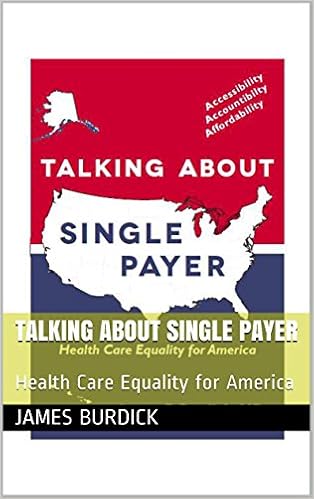
New Book on “Single Payer” has Important Insights on Lessons From Medicine For Access to Justice

My friend, and commentator on this blog, Dr. Jim Burdick, has just published his new book, Talking about Single Payer.

Jim forcefully makes the case, based on his experience in the transplant world, for a system in which the availability of services in a single payer world is legitimated by a strong role for the medical profession in determining appropriate treatments.

His trenchant analysis of dealing with issues of demand, supply, legitimacy and costs raises obvious parallels with our struggles in the access world to figure out how to get to 100% without committing to politiclly unacceptable costs.

I have just reorded two short interviews with Jim, one on his general approach, and one on the possible access to justuce lessons.  Here they are, in order.  Enjoy.

Here is the second, with more of a legal focus:

Here is how to get the book.

Posted in Funding, Medical System Comparision, Triage, video | Comments Off on New Book on “Single Payer” has Important Insights on Lessons From Medicine For Access to Justice

Council of Economic Advisors Report on Costs and Benefits of Incarceration Versus Other Approaches Incudes Excellent Arguments for Broader Impact of Access to Civil Justice

When the White House Council of Economic Advisors (CEA) speaks, the world listens.

And, indeed, when the CEA issued Economic Perspectives on Incarceration and the Criminal Justice System, it was a very big deal.

What was unusual was that the Report did not just report the costs and benefits of incarceration, but rather looked into other ways of reducing crime and concluded, with numbers, that a wide variety of of interventions would be far more cost effective.  Interestingly the Report concluded that the most cost-effective intervention of all was increasing policing.  It found that it is not necessary for those caught up in the policing to receive harsh penalties.

The detail of the Report is unambiguous about the areas of intervention that might be helpful.  For example, as the Executive Summary says:

Addressing criminal record employment restrictions, through expanding record expungement, “banning-the-box”, and limiting blanket criminal record exclusions in occupational licensing laws, as well as improving access to health care and housing can help reduce the collateral consequences of convictions.

Obviously these are all things that can be impacted by access to justice innovations, even if it is hard to change the underlying policies.

With respect to the job market (which access initiatives should be doing more to help):

Labor market conditions and increased educational attainment can have large impacts on crime reduction by providing meaningful alternatives to criminal activity. Estimates from research suggest that a 10 percent increase in the high school graduation rate leads to a 9 percent drop in arrest rates, and a 10 percent increase in wages for non-college educated men leads to a 10 to 20 percent reduction in crime rates.

Those advocating for the enhancement of access investments would do well to read and frequently cite the CEA Report, depending, of course, on the political context.

While beyond the scope of this blog, a full report of the relationship of such access investments would be a valuable document, both underlining the need for the changes the CEA recommends, and the potential access to justice contribution.  Maybe a LAIR/DOJ addendum to the CEA Report?  Maybe a Voices project (particularly since it is about the full Justice for All continuum of services outlined in the Chiefs’ Resolution.)

Posted in Access to Justice Generally, Budget Issues, Chasm with Communities, Criminal Law, expungement, Family Law, Legal Aid, Outcome Measures, Poverty, Research and Evalation, Science, White House | 3 Comments

China, Environmentalists and the Rule of Law

China’s crackdown on independent expression continues, and we always wonder what we can do.

Maybe one approach may come from what at least some commentators believe is a greater interest in international cooperation from the Chinese leadership in the environmental area.  (See here.)

If so, maybe us lawyers, but particularly our environmental lawyer friends, can find ways to suggest to our colleagues in China that you can never get environmental problems dealt with unless you have a rule of law system in which there are effective tools for those harmed by environmental to challenge the perpetrators.  I suspect that there would be a very strong correlation between position on Rule of Law indexes and environmental quality (or maybe the direction of environmental quality.)  Without such a system, the incentives for environmental corner-cutting a just too great.

Of course, this, as so much else, puts the leadership in a quandary.  The appalling state of the environment is one of the main forces pulling down the legitimacy of the regime, but returning to greater commitment to the rule of law risks releasing forces that, in the short term, threaten to further de-legitimize the leadership.


Posted in International Cooperation | Comments Off on China, Environmentalists and the Rule of Law

Importance of White House Initiative, Legal Aid Interagency Roundtable, Gets Recognition in DC Bar Journal

The current issue of Washington Lawyer, the DC bar journal, contains a great article on the Legal Aid Interagency Roundtable.

The article, under the title Ensuring Justice for All:  The White House Plan, finally gives some public recognition to the importance and potential of this initiative.  As the article puts it:

A White House announcement on September 24, 2015, may signal a change in the federal government’s involvement in access to justice efforts. On that day President Obama formally established the White House Legal Aid Interagency Roundtable (LAIR), which brings together 21 federal agencies to work on expanding access to legal services for the most vulnerable and undeserved people in our communities.

President Obama signed the memorandum on the eve of the United Nations’ adoption of its 2030 Sustainable Development Goals, one of which involves making justice accessible to all. “By encouraging Federal departments and agencies to collaborate, share best practices, and consider the impact of legal services on the success of their programs, the Federal Government can enhance access to justice in our communities,” the memorandum states.

The article goes on to quote Jim Sandman of LSC, Lisa Foster of DOJ, and myself.

The importance of LAIR is underlined by what it has done already:

  • Clarifying more than two dozen grants involving reentry, access to health care, citizenship, homeless veterans, and other federal priorities to allow legal services that further program goals;
  • Hosting more than two dozen Webinars and other presentations to federal grantees, the civil legal aid community, and federal agency staff about how legal aid advances federal priorities;
  • Offering new training and technical assistance opportunities; and
  • Conducting new research about civil legal aid.

As we all know, its this kind of institutionalization that maximizes the change that things will keep moving during a presidential transition, which can be a time of stasis even when there is no change of party.  Keeping things going is even more likely when career civil servants in the agencies become involved, not just the political appointees.  This seems to be the case here.

Please help by doing what you can to get this article distributed and republished in other places.  Maybe it will also help spur thinking about the relationship of the many agencies that are planning their work with LAIR to the State ATJ Commissions.  See discussion here.


Posted in 100% Access Strategy and Campaign, Access to Justice Boards, Access to Justice Generally, Dept. of Justice, Federal Agencies, Funding, Legal Aid, White House | Comments Off on Importance of White House Initiative, Legal Aid Interagency Roundtable, Gets Recognition in DC Bar Journal

Maybe Flight Attendants Can Teach Courts Something about Overcoming Unconscious Bias

I think there is pretty broad agreement that all of us who work in and with the court system that it could benefit to more mindfulness in dealing with unconscious bias.

A recent article in the Washington Post by a woman who previously worked as a flight attendant, Gillian Brockell, might help us.

In an article responding to the recent incident on SouthWest, Ms. Brocknell describes the pressures under which flight attendants operate, conscious both of the importance of avoiding over-reaction, and at the same time the huge stakes if there is a failure to correctly identify a real risk of terrorism.

Flight attendants are trained extensively in evaluating suspicious behavior with videos, checklists, regular exams and drills. (And drills and drills and drills.) This infuses you with an automatic, paranoid vigilance that follows you forever and insists that you take all threats seriously, since the cost of being wrong is too high.

And:

Flight attendants are often made to play referee when hundreds of humans with wildly different life experiences are crammed into an aircraft cabin.

It’s usually simple stuff, like asking a young woman who has never seen a Hasidic Jew if she can switch seats with her boyfriend so she’s not touching the devout man next to her. (She, of course, has the right to say no.) Or moving the man with the severe dog allergy as far away as possible from the blind woman’s service animal. Or asking the bachelor party to pipe down for the umpteenth time, because not everyone is going to Las Vegas to get drunk.

But sometimes you’re asked to be someone’s accomplice — in their racism, their homophobia, their cruel joke about the larger person seated next to them or their demand that the mother in front of them drug her children to shut them up. For professionals who are supposed to be polite, it can get awkward. The expression “Takes all kinds!” becomes your best friend.

Ms. Brockell concludes that keeping an eye on someone perhaps wrongly reported is the right way to go.  But what I like in the article most is her sensitivity to how differences in background can cloud perception (including, I infer, her own.)

When passengers report an issue, it’s impossible to know what their life experiences are. That’s why it’s so important to make assessments based on training. In this case, being polite and being vigilant should have called for the same thing: a conversation. Anyone who makes a snap judgment from the cocoon of the galley has no business being a flight attendant.

All in the court need to be thinking about this, and thinking of how to be clear of whatever may be influencing their own judgements. In a court, unconscious bias would not lead to a plne diversion, but it might result in an increased or decreased sentence, or a failure to understand the source of articulated resentment.

The more we talk, and are unafraid, the more mindful we can become, and thus the more just.


Posted in Court Management, Discrimination, Judicial Ethics | Comments Off on Maybe Flight Attendants Can Teach Courts Something about Overcoming Unconscious Bias

Supreme Court Nominee Garland’s Perhaps Unprecedented Speech Today Highlights Access to Justice

The normal rule is that Supreme Court nominees do not give speeches or interviews to the media.  But, then, the normal rule is also that the Senate does not block a highly respected and previously easily confirmed nominee a few minutes after the announcement of the nomination.  Actually the normal rule is that Senate does not block even a relatively lowly-respected nominee who has never been confirmed to a Federal Court before.

So, Politico reports, today Garland did give a speech

Making an unannounced appearance at an annual breakfast that the federal courts hold to salute Washington law firms active in pro bono work, the veteran jurist paid tribute to lawyers who contribute time to public causes and he linked that work to his own biography. It’s the kind of address that’s relatively common for a sitting judge to make, but one that previous high-profile court nominees have studiously avoided.

In a roughly five-minute speech to about 100 lawyers and judges gathered in the atrium of the federal courthouse in the shadow of the Capitol, Garland said “their and your commitment to public service and the law is the same commitment that has shaped the choices that I have made throughout my career.”

He added that by “helping to provide access to justice for the underprivileged all of you are helping to shore up the rule of the law that is the foundation of a just society.” (Bold added.)

I very much doubt that any prior nominee to the Court has publicly used the phrase “access to justice,” and I hope that the White House judgement that this is an appropriate message reflects the fact that access to justice is a broadly bipartisan issue.

P.S.  It is surely worth mentioning that Garland was present (but did not speak) at the previously mentioned LSC Reception at the Supreme Court on Tuesday Evening.

Nice.

Posted in Access to Justice Generally, Pro Bono, Supreme Court, White House | 2 Comments

Today’s Legal Humor Aside

When at Harvard Law School Cruz reportedly set up a study group that allowed as members only those who had been to Harvard, Yale, and Princeton.

So, while Cruz is clerking at the Court, a bunch of fellow clerks are chatting over lunch about Cruz.

“Did you hear that when at Harvard his study group only allowed people from Harvard, Yale and Princeton?”

Sounds of shock, agreement, and sympathy.

Then one of the clerks articulates the reason for the astonishment that they are all feeling:

“Why on earth did they let in someone from Princeton?”

Posted in Humor | Comments Off on Today’s Legal Humor Aside

White House Forum on Access to Justice — Livestream at 1 PM Eastern Today, April 19

Today, at 1 PM, click on the link today to watch the livestream of the White House Forum on Increasing Access to Justice.

https://www.whitehouse.gov/live/white-house-forum-increasing-access-justice

There is an article in the American Lawyer, which describes the anticipated announcement at this event of a $1 million contribution from Microsoft to the LSC Portal Project, which was conceived at the last Access to Justice Technology Summit, and which is to be developed in partnership with Pro Bono Net.

“This $1 million dollars from Microsoft is a godsend,” said [LSC President Jim] Sandman, who added that the company will also provide technical assistance and project management. The first programs to be funded will be selected through a competitive application process, and Sandman hopes they’re operating within two years.


Posted in Access to Justice Generally, LSC, White House | Comments Off on White House Forum on Access to Justice — Livestream at 1 PM Eastern Today, April 19

UK Supreme Court Might Be Able to Teach US Court a Lesson on Urgency of Protecting Legal Aid

Tomorrow, Tuesday the 19th, LSC and its friends will enjoy an invitation-only reception at the US Supreme Court following the LSC day at the White House, and to be addressed by Justice Kennedy, among others.  It is obviously a very important step to have access to justice and LSC recognized in this way by the Court, and a great achievement for the LSC Board and President.

But, I can not help noting that today the UK Supreme Court took an even more important step, that was also profoundly symbolic in the way they took it.

As the Guardian puts it:  “Judgments from the supreme court in Westminster are invariably reserved and delivered months after any hearing.”

That certainly sounds familiar.  But, when the Court was hearing a case challenging the imposition of a residency test for legal aid by the Ministry of Justice (MoJ):

Halfway through a two-day hearing, the bench of seven justices in the UK’s highest court abruptly halted the case and announced on Monday afternoon that it had found against the Ministry of Justice. .  .  .  the justices, led by the president of the supreme court, Lord Neuberger, delivered their decision after a few minutes’ recess at the end of the afternoon.  .  .  Such a swift ruling is a humiliating setback for the MoJ. 

In a brief statement, the supreme court said: “The issues in this appeal were whether the proposed civil legal aid residence test in the draft Legal Aid, Sentencing and Punishment of Offenders Act (Amendment of Schedule 1) Order 2014 is ultra vires [beyond the powers of the legislation] and unjustifiably discriminatory and so in breach of common law and the Human Rights Act 1998.

“At the end of today’s hearing the supreme court announced that it was allowing the appeal on ground [of ultra vires] … The supreme court asked the parties whether they wished to address the court on the second issue. The case has been adjourned while this is considered.”

The Guardian also carried the plaintiff’s response to the decision:

Welcoming the decision, John Halford, the solicitor from Bindmans law firm who respesented the PLP, said: “The British legal system is rooted in two fundamental principles – that all equally enjoy the protection of our laws and all are accountable to our courts.

“The lord chancellor takes an oath of office to honour these principles but planned to undermine them by withholding legal aid from those who failed his residence test, leaving them unable to enforce legal rights in the most compelling cases.

“Yet today, after minutes of deliberation, seven justices of our highest court held him accountable, ruling he was acting in a legal vacuum and without parliamentary authority. Rationing justice using a residence test was, and always will be, repugnant to British law.”

Can you image Justice Roberts announcing a decision about legal aid eligibility after hearing only half the case, because of the overwhelming force of the position.  (Interestingly, the case summary on the UK Supreme Court’s website makes clear that the residency test was for civil, not criminal legal aid.)

Its a nice thought to ponder.  Actually, I’d be happy with the right decision immediately after the end of the hearing!

Posted in Access to Counsel, Discrimination, Immigration, International Models, Legal Aid, LSC, Supreme Court, White House | Comments Off on UK Supreme Court Might Be Able to Teach US Court a Lesson on Urgency of Protecting Legal Aid