CJ Lippman Announces Neighborhood Legal Information Centers — Implications and Possibilities

This ground-breaking news, once again from the New York Courts.  As the press release puts it:

[The] Network of Walk-in Storefronts Will Be First of Its Kind in New York and the Nation to Bring Basic Legal Information, Assistance and Support to Residents in Low -Income Communities.

In more detail:

[The] singular new program [ ] will bring a corps of trained community volunteers to storefront locations in our most vulnerable neighborhoods, offering free legal information, assistance and referrals to residents grappling with legal problems relating to the very basics of life.

The storefronts will be called “Legal Hand,” the program, developed in collaboration with Helaine Barnett, the chair of New York’s Permanent Commission on Access to Justice, will be operated by the Center for Court Innovation and local community-based legal aid providers.  One center is already open with two more to come soon.  The idea will build heavily on the Courtroom Navigator program, will take advantage of the range of informational assistance that non-lawyers can appropriately provide, and:

Each Legal Hand will be managed by a volunteer coordinator and staffed with trained volunteers to provide information and guidance to low-income individuals on how to navigate the court and social services system and how to protect and represent themselves in a legal matter. A legal services attorney will also be on-site to help train and aid volunteers.

Legal Hand volunteers will receive substantive training focusing on areas where emergencies commonly arise, such as housing, physical safety, immigration, family matters and benefits. Training will also cover cultural competency, interviewing skills, the limits on the advice non-lawyer volunteers are legally permitted to provide and the availability of referrals to other services, including full legal representation. Periodic training will continue throughout each volunteer’s tenure. Volunteers come from a wide spectrum of backgrounds including retirees, college students, long-time residents and individuals new to the community. Volunteers who have already signed up and received training in the Crown Heights location reflect the diversity of the community they serve and include many with second language capabilities.

As Judge Lippman puts it in the press release:

When people are in trouble, they do not immediately look to the courthouse for assistance. Our goal with the Legal Hand Centers is to break down barriers between the community and the justice system and to demystify some of the simple steps people can take to protect their rights under the law. This will lead to more just outcomes, more crises averted, less litigation, and money savings for our state and local governments. Most important, the centers will contribute greatly in transforming the ideal of equal justice into a reality in New York.”

While the program starts with a one million dollar anonymous grant, this is likely to be demonstrated to be a highly cost effective way of increasing access to justice.  It leverages the skill and knowledge of community based legal aid with the energy and commitment of trained volunteers, and takes full advantage of our newly developed understandings of how unauthorized practice of law rules need not be so constraining of innovation as was once assumed.

For a longstanding observer of legal aid, there is both joy and irony in seeing access to justice services return to the neighborhoods.  It was only in the funding crises of the 1980s that community-based legal aid programs throughout the country largely retreated from the community and centralized most of their services in downtown locations.  Courts have also been heavily centralized.

Perhaps with access to justice services moving back into neighborhoods, we will start to see a new (or rather renewed) kind of energy that draws on the reality of all the crises that people are suffering, rather than only those that make it through complex intake filters of courts and community-based legal aid.

This is particularly apposite as we are reminded of the community/system chasm, of which we have been so urgently reminded by  events in Ferguson and Baltimore and beyond.

I hope that this project will be conducted with the kind of research and evaluation that will assess its impact and cost effectiveness, and thus hopefully facilitate its speedy and broad rollout as part of the 100% access to justice solution.  In particular, I would hope that we can be looking at these centers as potential triage locations — indeed, the inclusion at every center of a legal aid attorney should help make this much easier to do.  The centers will offer an environment to test different approaches to triage.
Posted in Access to Justice Generally, Chasm with Communities, Court Management, Legal Aid, Non-Lawyer Practice, Self-Help Services, Technology, Triage | 1 Comment

Richard Granat Proposes Safe Harbor for Law Firms Serving Low and Moderate Income Clients With Technology

Richard Granat has recently made an interesting proposal to facilitate the use of technology to improve access to justice by loosening the law firm ownership rules for groups using automated solutions to serve low and middle income clients.  Specicially, he suggestions that:

The American Bar Association amend Rule 5.4 to permit private investment in just those law firms that serve low and moderate income clients exclusively.

Personal injury and other contingent fee practices would be excluded from this exception as capital is self-generating for successful firms in these practice areas.

To comfort to those who are concerned that the independence of the lawyer is compromised by this proposal, the law firm must remain at least a 51% owner of the law firm. Private investors can be minority shareholders only.

It is relatively easy to create an income generation screen to capture just low and moderate income clients for the law firm, and exclude those of higher income. The data from this intake process can be archived and audited to comply with the exception to the rule.

He notes that “Creating this exception opens up the opportunity for smaller law firms to take advantage of crowd-funding opportunities, the angel investor community, and the new SEC rules that [will] permit crowd-funding investment. Further, the rich relatives a young lawyer could fund the new lawyer’s law firm, and get a return on investment, without the lawyer risking disbarment because of violation of the 5.4.”

I like it, because it allows for experimentation in a relatively small sector, in which access to capital is perhaps a more significant barrier.  I am less convinced that access to capital is as much of a problem in the larger market, and I suspect that the problem there might be the lower rate of return to investments, rather than a lack of capital.

I recommend the full blog for a more comprehensive analysis.

Posted in Forms, Middle Income, Self-Help Services, Technology | Comments Off on Richard Granat Proposes Safe Harbor for Law Firms Serving Low and Moderate Income Clients With Technology

An Economic Analysis of the “One Hundred Percent Access to Justice” Phrase

If we are to assess the viability of 100% access to justice solutions, we must at least begin to have an economic model for what 100% access means, and particularly for whether we can regard services as sufficient in any particular context. This can help lead to a more realistic estimate of resources likely to be consumed by any comprehensive solution.  Let me suggest this way of thinking about it.

Continue reading

Posted in Access to Counsel, Access to Justice Generally, Legal Aid, Self-Help Services, Triage | 6 Comments

West Virginia Supreme Court Afirms Right of Self-Representation

In an important decision, the West Virgina Supreme Court has affirmed that self-represented litigants have the same right of access to the courts as one with an attorney.  The issue derives as follows:

In April of 2014, the Honorable Booker T. Stephens entered an “Administrative Order regarding vexatious, intimidating, harassing, and frivolous filings and court personnel security in pro se litigation in magistrate and circuit courts” which required all pro se litigants to obtain permission prior to the filing and docketing of their complaint in the Circuit Court of McDowell. In July of 2014, petitioner attempted to file a complaint against D. Adrian Hoosier II, and The Hoosier Law Firm, PLLC, alleging negligence and gross negligence related to its handling of Jimmie McClure’s case against USA Rental. Thereafter, Respondent Stephens did not approve petitioner’s complaint for filing and docketing in the circuit clerk’s office pursuant to his administrative order. It is from this procedure that petitioner now appeals.  (Bold added.)

The Supreme Court ordered that the complaint be filed. Continue reading

Posted in Access to Justice Generally | Comments Off on West Virginia Supreme Court Afirms Right of Self-Representation

What Do We Do With the Apparant Fact That People Who Beleive They Are More Creative Are More LIkely to Believe That They Are Entitled, and To Act Unethically?

Richard Moohead wonderfully picks up on recent research on the relationship between creativity and entitlement. The research, reported in the Harvard Business Review, tested whether people who beleived that they were more creative were, for example, willing to lie for money, and found, sadly, that the answer was yes.  (Steve Jobs is reported to have parked in handicapped parking without a special plate.)  Earlier research seems to show that there is a correlation with actual creativity, as opposed to perceived creativity.  (Irony alert: some of these papers can not be accessed for free.  I managed to overcome the urge to be creative to get at them!)

Richard summarizes and quotes the article as follows:

They identify studies by Francesca Gino and Dan Ariely showing that creative thinkers are better at rationalizing dishonesty and that “thinking outside the box” may lead to a greater propensity to act unethically.  Vincent and Kouchaki claim:

This is because, at least in the U.S., creativity is often celebrated as a special attribute. The idea that creativity is rare leads to a sense of entitlement; if you are creative, you see yourself as more deserving than others. Leaders reinforce this when they don’t hold creative people to the same rules as those who are less creative, or when they give them special treatment. Steve Jobs even had a habit of parking his Mercedes in handicap parking spots and driving it without a license plate.

Continue reading

Posted in Judicial Ethics, Legal Ethics, Research and Evalation | 1 Comment

The 100% Access Movement Has A New Poster

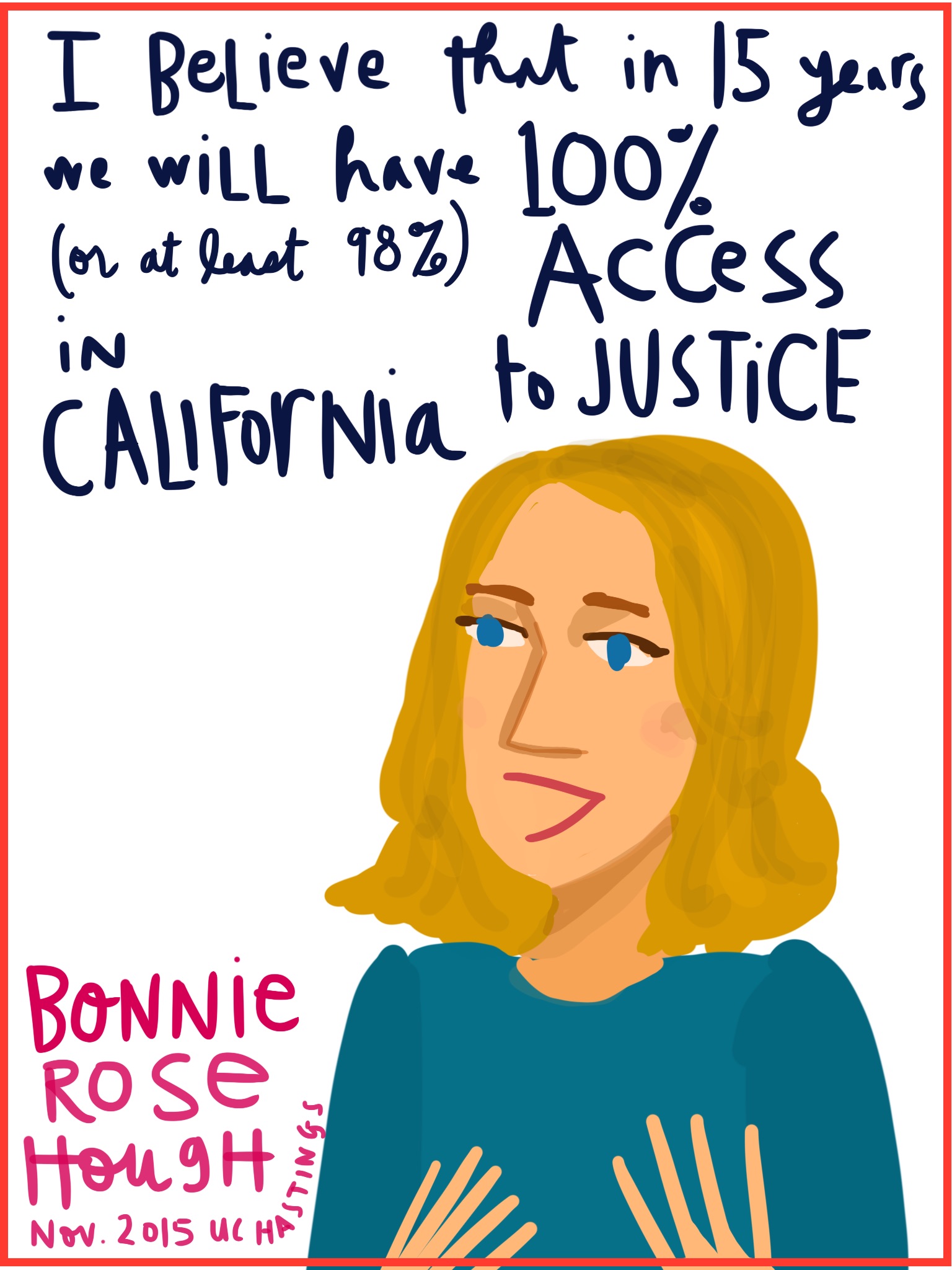
Here is a great poster made by Margaret Hagen of Stanford showing Bonnie Hough speaking at the recent Access to Justice Conference at Hastings Law School.

BonnieIts a great idea, and a great expression, from a great person.  It is another example of how the Chief’s resolution is stimulating debate and planning.

It will be fascinating to see how the Shriver Project, in which Bonnie is playing such an important role, provides data and ideas for how we can get to that 98% more quickly and more cheaply with the data on what works when, what is needed when, and how to organize it most effectively and efficiently.  Because Shriver has both full representation and other forms of help in the same projects, and because we will learn a lot about various forms of triage, it is really unique and critical in what it is doing.

I also love the “or at least 98%” because it reminds us to be both visionary and realistic at the same time, something this movement seems very good at.

Posted in 100% Access Strategy and Campaign, Access to Justice Generally | 1 Comment

The Begining of A Discussion of ADR and 100% Access to Justice

One of the many impacts of the Chief’s 100% resolution is that it is starting to stimulate discussion in many communities that are or should be part of the broad 100% solution.

So it is great to hear that Resolution Systems Institute is promising the start such a debate within the Alternative Dispute Resolution community.

Specifically, Hanna Kaufman, after referencing the Chief’s Resolution and this blog, explains:

By specifically calling for access to justice in “dispute resolution institutions,” Zorza has invited input from organizations like RSI in developing an understanding of what access to ADR looks like, how it can be achieved, and how it relates to the overall concept of ATJ. We have long understood the potential ADR has as a tool for underrepresented parties, and are beyond thrilled to see other stakeholders in the justice community make that tool a greater priority.

Over the course of my next three blog posts, I will respond to this invitation by sharing examples of how we are currently using our expertise in dispute system design to improve access to justice in the foreclosure mediation programs we administer. Each of these posts will serve as a portrait of how to apply principles of careful dispute system design to promote access to justice through ADR. I welcome your comments on how ADR enables justice and hope to utilize your experiences as a way of framing this conversation.

I look forward to reading these posts.  Let me also suggest some focusing questions that may be useful as the broader discussion moves forward.

Continue reading

Posted in Mediation, Mixed Model, Outcome Measures, Research and Evalation, Triage | 2 Comments

On the Only Right Response to the Idea of US Government Making All Muslims Register

Obviously, the recently partially apparently walked-back endorsement by a US Presidential candidate of the idea of making all Muslims register is truly obscene in the light of what such a requirement led to in the Holocaust.

The answer to such demagoguery is simple, and I wonder who will be the first to utter it.

“If that is required, I will be the first to register, and I wold will urge everyone in this country to join with me as registering as a Muslim.”

There is precedent in the Danes’ response to Hitler’s order that all Jews wear stars.

Let’ see if any of the current crop of candidates can rise fully to this challenge.  In my opinion, any of them who fails to do so is not fit to be President.

Maybe we should start an online project — “Registermefirst.net.”


Posted in Access to Justice Generally, Discrimination, Technology | 5 Comments

“Making Justice Accessible” At the American Academy of Arts and Sciences

The American Academy of Arts and Sciences was founded in 1790, so they can hardly be called a fad.  So it is surely of some meaning when they decide it is worth spending a couple of days paying attention to the problem of access to justice.  While the “Making Justice Accessible” Symposium held last week operated under rules generally forbidding attribution of comments, I am able to convey my general sense of the conversation and my sense of its implications.

The first obvious point is that when State Chief Justices, Federal Court trila and appellate Judges, academics, LSC, ABA retired presidents, the US Department of Justice, and community-based legal aid program staffers gather for two intense days at the national level, that alone marks a recognition of the issue.

My second take-away is that there is now a very broad leadership consensus in support of the Chiefs 100% Resolution, including the understand that moving towards that goal requires triage, a continuum of services, many innovative, including those delivered through technology, strategic planning, and the measurement of outcomes.

My third take-away that there is an increasing understanding that regulatory flexibility in support of access to justice may well be both appropriate and required.  It’s now OK to talk about real changes in the regulatory environment in ways that were not true even very recently.

My fourth take away is that many of the non-legal aid participants were impressed by the range of engaged innovations that are going on in access to justice.

Personally, I would hope that recognition by the Academy of the importance of the issue, and of the extent to which innovations and new ways of thinking are justifying a fresh look at the problem by national leaders, will cause funders and policy makers to do just that.  Indeed, the speech by Congressman Kennedy, about which I previously blogged, shows the extent to which this is already true.

While no one should have general or specific expectations, stay tuned, as a planning process for consideration of possible additional steps by the Academy moves forward.

Among the possibilities might be analysis of possibilities of enhancing leadership coordination, a focus on research, bringing non-legal communities into the access movement.

One idea that appeals to me particularly is engagement with economists to enrich our understanding of the relationship between access to justice and the economy, and of how incentives might be used to improve our delivery systems, including their relationship to the private bar.


Posted in Access to Justice Generally | Comments Off on “Making Justice Accessible” At the American Academy of Arts and Sciences

A Way For Courts to Show They Are Serious About Making The Law Accessible — Plain Language Explanations of Appellate Decisions

Here is an idea for how appellate courts could demonstrate their committement to making the law accessible.  They could include in all decisions a short explanation of the decision in plain language (great examples of plain language in box in linked doc).  This would help ensure that the increasing free access now being developed would actually be comprehensible, and would maybe help answer fears that providing such access would be inadequate, misleading, or even cause judicial hostility if it lead to real or apparent failure to understand and correctly argue from cases (for a frightening example, see here).

Including such a plain language explanation might be made a formal requirement by court rule.  Appellate court staff would then be responsible for drafting the explanation, for review by the writing judge.  Sometimes the staffer would get it wrong — surely a signal that the opinion needed revision to clarify the intent of the court.  At other times the staff might be unable to find the words, again an indication of something needing attention.  In any event, such a process would surely sensitize staff and judges to the practicalities of plain language.

There are many tools for measuring comprehensibility.  Indeed Word has one built in.  In an embarrassing disclosure, I should admit that the score using the Flesch-Kincaid Grade Level test for the text above is 11.7, meaning that you would have to be very near graduating from high school to understand it.  Oops.

Perhaps some courts should experiment with this, so that they can develop the skills and experience needed, and then share that with others.

Posted in Appellate Practice, Plain Language | 1 Comment

Congressman Joseph Kennedy III Planning Access to Justice Caucus

Congressman Joseph Kennedy III (D. Mass) told us in a speech at the American Academy of Arts and Sciences last week that he plans to launch an Access to Justice Caucus in the House of Representatives next year.

This is obviously an important additional step in the now rapidly building of a new national support network for access to justice innovation and resources.  It joins the Conference of Chiefs Resolution, the White House Presidential Memorandum on LAIR , the DOJ Access Initiative, and the Public Welfare Foundation’s access work, as very significant additions to the group of existing organizations that have previously been involved in this work.

Having congresspeople and their staffs actively involved in the issue can only help move a broad transformative agenda forward — one that goes beyond the critical but insufficient one of protecting LSC.  Anyone who knows anything about Washington knows that having someone in the room makes all the difference, whether early in the markup process, in the final hectic hours when decisions about tens or hundreds or millions of dollars are made in literally seconds, or in the complex negotiations about legislative text which can often have far greater significance and impact than the participants realize.  So having a group of Congresspeople who care enough to inform themselves is beyond value.  Moreover, the creation of the caucus will signal the arrival, or rather the re-arrival and resuscitation of an issue too long in the background for the nation as a whole.

It is particularly appropriate (and moving to some of us) that Congressman Kennedy is the one taking the lead on this.  Readers of this blog will recall that I previously shared in this space the speech on access to justice his grandfather, Robert Kennedy, as attorney General gave in 1965.  As I wrote when I posted that speech, almost everything we are doing now was foreshadowed there.  (The main exception being using technology for access to justice.)

One point the Congressman made, which is rarely understood or addressed, was the absolute artificiality of the current almost complete barrier between civil and criminal access to justice.  That he explicitly addressed this issue — often a bit of a third rail in both defender and community based legal aid groupings — suggests that he is willing to take a broad look at our whole system.  That, surely, is in his genes.

P.S.  I should add that the Symposium on Making Justice Accessible at which the Congressman spoke, was held at the American Academy of Arts and Sciences under rules that permit attribution only with the consent of the speaker.  I have obtained this consent from Congressman Kennedy.

P.P.S.  Here is the formal announcement.

Posted in 100% Access Strategy and Campaign, Congress, Defender Programs, Legal Aid | 2 Comments

Answering a Law Professor’s Worry that Free Online Access to Caselaw Will not Help Access to Justice

Brian Sheppard, who teaches at Seton Hall Law School, in an interesting blog post on Bloomberg, raises the question whether the Harvard Law School digitization project I blogged about recently, might not really help access to justice.

His worry is that neither the search tools nor visualization tools intended for the project will deal with the reality that drafting search terms is very difficult for nonlawyers, and that most of the cases that come up will not be that relevant, and will be far from the ones on which judges rely.

Continue reading

Posted in Document Assembly, E-filing, Libraries, Self-Help Services, Technology | 8 Comments

Could We Get to 100% Access Without As Many New Resources As We Now Assume, a Very Rough Analysis?

It’s a truism and an article of faith in the access to justice community that the only way to get to 100% access to justice is a massive infusion of money. It might well be true, but try this mental exercise:

Continue reading

Posted in Access to Counsel, Access to Justice Generally, Budget Issues, Court Management, Legal Aid, Research and Evalation, Rules Reform, Self-Help Services, Simplification, Systematic Change | 5 Comments

What Might “Access to Justice Sullivan Principles” Look Like?

I recently blogged about the idea of access to justice “Sullivan Principles”.  As man will remember, the Sullivan Principles were a set of principles for corporations about dealing with the old apartheid regime in South Africa.  While some criticized these as merely a way of providing cover for corporations to avoid responsibility for their continued engagement and practical support for the regime, they did help energize a new group to take at least some action against the horror of apartheid.

Continue reading

Posted in Consumer Rights, Funding, Rules Reform, Simplification | Comments Off on What Might “Access to Justice Sullivan Principles” Look Like?

Today Really is “Love Your Lawyer” Day

It may seem hard to believe, but the “movement” to celebrate today, and other “first Fridays” as “Love your Lawyer Day,” really is gaining momentum, with the Law Practice Division of the ABA passing a Resolution in support.

Why does this get the ironic juices flowing?  Perhaps because it suggests that lawyers are an under-appreciated group, in need of love and understanding.

Well, as cited in the Law Practice resolution, there may be negative feelings in the world about lawyers (only 21% consider us honest and trustworthy) given how much money moves into the profession, and given the power we have to protect ourselves through self-regulation, it seems that putting ourselves in this victim type position is likely to increase cynicism rather than “love” for lawyers.

The resolution, for example, in addition to asking that the day be “a day for the public to celebrate lawyers and express their gratitude to them for their affirmative contributions to the public good and the administration of justice” only specifically urges that “Lawyers throughout the nation are urged to celebrate “Love Your Lawyer Day” to help promote a positive and more respected image of lawyers and their contributions to society and that they do so by providing pro bono legal services to their communities and supporting charitable causes that promote the administration of justice.”

In other words, the only three fixes to our reputation are: asking for love, doing pro bono, and making charitable contributions.

Sorry, but I don’t think that’s going to fix the problem.

At the risk of being over-earnest, here are some more, most of these focused on access to justice, because that is the area that causes the most exclusion (although there are plenty of other problems with the profession that lead us to seek love rather than improvement):

  • Playing a far more active advocacy and financial role in access to justice, including significant institutional financial contributions
  • Making a committement to play a major role in helping the system meet the Chiefs Resolution on 100% access to justice
  • More serious institutional commitment to pro bono, beyond exhortation
  • Serious research into the inherent tensions in the lawyer role as representing the unpopular (including the poor and other “takers”), and figuring out how to explain that tension to the public (actually they get a lot of exposure to that in the media and entertainment industries, so one might wonder why it does not have more effect)
  • Reflection about the extent to which the profession, through its pricing and structure, is largely aligned with wealth and power, and further centralization thereof, including figuring out how to make ourselves genuinely diverse in our loyalties and impact
  • Figuring out how we can have more impact on those powerful institutional clients — how many firms do good pro bono (and get a lot of praise for it) while supporting mandatory arbitration clauses, with their appalling anti-access and anti-equality components
  • One possibility would be the profession endorsing a Sullivan Principles type approach to getting client corporations to engage in access to justice friendly practices, such as not requiring such clauses
  • Taking a much more serious access to justice look at deregulation
  • Including access to justice on the bar exam

Any other ideas?

(Thanks to Responsive Law for getting me thinking about this.)


Posted in Access to Justice Generally | 2 Comments