Moving to Open Access For All Decisions — Implications for SRLs and For Access Organizations

Today’s New York Times reports on what has the potential to be a revolutionary development in access to legal materials for access to justice.

Now, in a digital-age sacrifice intended to serve grand intentions, the Harvard librarians are slicing off the spines of all but the rarest volumes and feeding some 40 million pages through a high-speed scanner. They are taking this once unthinkable step to create a complete, searchable database of American case law that will be offered free on the Internet, allowing instant retrieval of vital records that usually must be paid for.

“Improving access to justice is a priority,” said Martha Minow, dean of Harvard Law School, explaining why Harvard has embarked on the project. “We feel an obligation and an opportunity here to open up our resources to the public.”   (BlogNote: it is nice to see Dean Minow using access to justice in such a broad sense.)

And, again from the Times.

Complete state results will become publicly available this fall for California and New York, and the entire library will be online in 2017, said Daniel Lewis, chief executive and co-founder of Ravel Law, a commercial start-up in California that has teamed up with Harvard Law for the project. The cases will be available at www.ravellaw.com. Ravel is paying millions of dollars to support the scanning. The cases will be accessible in a searchable format and, along with the texts, they will be presented with visual maps developed by the company, which graphically show the evolution through cases of a judicial concept and how each key decision is cited in others.

Note that Ravel now offers an open plan and broader priced plans.

Also from the Times:

Under the agreement with Harvard, the entire underlying database, not just limited search results, will be shared with nonprofit organizations and scholars that wish to develop specialized applications. Ravel and Harvard will withhold the database from other commercial groups for eight years. After that, it will be available to anyone for any purpose, said Jonathan L. Zittrain, a Harvard Law professor and director of the law library.

That may be the key.  It raises the possibility of a wide variety of front ends, or full systems, that are customized for self-represented litigants seeking information and help in various kinds of environments, such as libraries, court self-help centers, online, at self-help appellate clinics, in both short and long term.

Its time to open up a discussion about what such interfaces should look like, including how they can be as accessible as possible and provide information focused on what people need to help them navigate their case and the courtroom. At this point for example, very few self-help programs on or offline offer links to the small number of leading cases on the topics that self-represented litigants actually engage with.  One way to deal with this would be to ask the trial judges which cases they are most guided by in each kind of case, and make these easily available.

More ambitiously, one might be able to develop search algorithms that found for litigants the cases closest to the facts they cited in their pleadings.  Similarly, it might be possible for self-help materials to contain pre-loaded searches to provide information on any newly decided relevant cases.

There are obviously particularly powerful partnering opportunities for public law libraries, indeed all libraries, and for courts that operate broad networks of self-help services.  That this is starting in NY and California is obviously particularly opportune.

One early analytic step will be to think about when and for what purposes the self-represented actually need and would gain from access to the cases.   While, some might think that such access would be more confusing than helpful, I trust that this is not true, or rather that is will only be true when the system is much simpler, and the help resources much more comprehensive and up to date.)  Anyway, that’s yet one more thing we need to research

In any event, this all offers a huge opportunity, and I hope the access community will start a very serious exploration of how to take advantage of it.  (At the risk of again repeating the obvious, I can not resist pointing out that this opportunity provides yet another argument for improving our coordination, division of labor, and innovation focusing capacities.)

Please suggest how this opportunity might be moved forward, and your ideas for tools and applications using this huge resource.
 

Posted in Libraries, Self-Help Services, Technology | 2 Comments

Law School Loan Incentives Reconsidered

The New York Times has an excellent article on the wasted money going into encouraging law school loans for people who will never get bar cads, or pay back their loans.  The law schools get cash, and everyone else gets hurt.

The Times suggests:

Perhaps the most galling part of this crisis is the misallocation of resources. Even as law schools are churning out unqualified graduates stuck under hopeless mountains of debt, millions of poor and lower-income Americans remain desperate for quality legal representation. Public defenders around the country rely on minuscule budgets to handle overwhelming caseloads. In many cases, the lawyers are so overworked that they cannot provide constitutionally adequate representation for criminal defendants. Civil legal services that help people with housing, immigration and workplace issues are even more scarce, with hardly any public support.

If fewer federal dollars were streaming into law schools’ coffers and more were directed to fund legal services organizations, the legal profession — and the American legal system as a whole — would be better for it.

Indeed.  But perhaps we should also be thinking in a more advanced way about making the incentives more sophisticated.  How about giving loans only for law schools that have incubator programs designed to get graduates into sustainable practice, and enougth seats in those programs? How about incentivizing states that have bar exams that are validated as testing for skills that help graduates actually practice?  How about taxing profit-making law schools in part on their graduation rates? How about requiring law schools themselves  to forgive 50% of the loans if their enrollees fail to graduate, or if their graduates who have taken the bar exam fail to pass?  How about reducing this requirement when the school’s graduates that work in nonprofit or solo middle income practice?  How about incentives for law schools that also offer nonlawyer programs whose graduates will get limited practice licenses that cost far less money to get, and will be able to charge lower rates to the public? (In Washington State, the law schools are deeply involved with these programs.)

A risk-free legal education system would be a rich white system, not the one we want.  But, we want a system in which schools take risks on some students — but not because the system is set up so that the schools always win, but because some students are worth taking a risk on, for the schools, and for society.

I am sure that there are lots of other good ideas.  The point is that we need to think in a more nuanced way about incentives.  That way we avoid the risk of seeming to care more about fundraising than about the end results.


Posted in Incubators, Law Schools, Non-Lawyer Practice | 1 Comment

Making a Mockery of Indigents’ Right Of Court Access, and a Former Chief Justice shows Leadership

A clerk in Texas has been making a mockery of the right of access to justice of indigents.  As explained in the Texas Tribune:

In 2012, six plaintiffs from Tarrant County sued the local district court clerk for charging them court fees even after they filed affidavits of their indigent status — also known as “pauper petitions” — when they filed for divorce. But the clerk says final divorce decrees require that each party pay its share of the court costs.

“They’re saying this boilerplate language in their final divorce decrees gives the court the right to charge court fees even though they’re indigent,” said Lee DiFilippo, who represents three of the six Tarrant County plaintiffs. (Link added)

What makes the case even more Kafkaesque is that when the plaintiffs filed their case against the practice, and after winning in the trial court, as reported by the Fort Worth Star Telegram,

In a ruling described as a blow to poor Texans, an appeals court says a trial court lacked jurisdiction when Tarrant County District Clerk Tom Wilder was ordered to stop collecting court fees from people who can’t afford an attorney.

The ruling by the 2nd Court of Appeals, issued last week, reverses a lower court ruling that ordered Wilder to stop collecting court costs from poor litigants although they had filed uncontested indigency affidavits.

In its 2-1 ruling, the appeals court said the judgments should have come from the family courts where the divorces were handled.

Justice Lee Gabriel, who wrote the majority opinion, said the case was dismissed and the original judgment was vacated, but also emphasized that “courts are to be open to all including those who cannot afford the costs of admission.”

So now, the Texas Cavalry to the rescue.  As reported by the Texas Tribune,

Former Texas Supreme Court Justice Wallace Jefferson, an attorney arguing on behalf of the plaintiffs, said individuals who file indigent petitions, otherwise known as “pauper petitions,” must be able to participate in the judicial system despite their inability to pay court fees. He called it a “hallmark of justice.”

Perhaps not surprisingly, Justice Jefferson seems to have been taken seriously.

Chief Justice Nathan Hecht joined that line of questioning: “Suppose a clerk just decided to defray the expenses of the office,” adding a $50 charge per divorce filing, Hecht asked. “Would this kind of relief be proper in that situation?”

Of course, the whole charade is an outrage, and it is no surprise that Wallace Jefferson, long a friend of access to justice, and one who understands the role of courts as leaders and as institutions responsible for providing access, stepped up to the plate here.

The role that the retired Chief is playing here should be a powerful model for other chiefs and judicial leaders who want to continue to play a role in access to justice.  High visibility cases dealing with matters of principle are ideal for such roles.  Moreover public speaking and leadership work with bar, legislature, and the public are just as important, particularly as we gear up to make the 100% access Resolution campaign a movement, one that will need messengers who engender the highest trust.  Lets talk about how to support such leaders as they consider these roles.

The Texas ATJ Commission has a full summary of the case here.  Lots more materials here, on the website of Lee DiFilippo’s Holistic Law Center.  Good work all around.

Posted in Access to Justice Generally, Court Fees and Costs, Court Management | 1 Comment

What Do Courts Mean to Say When They Cite the Proposition That The Same Rules Apply to the Self-Represented and the Represented

All to often, appellate courts cite something for the proposition that self-represented litigants are held to the same rules as those with lawyers.  The problem with this obvious statement (which is even in its own terms untrue when the rules create specific exceptions as a few do) is that often what they really mean is that 1) the self-represented are not entitled to ignore the rules and not suffer the consequences, and 2) that while the self-represented are entitled, to the extent that the rules permit discretion in a matter, to have the possibility of that discretion being exercised considered, and to have their self-represented status taken into account in any such consideration, they are not entitled to any specific exercise of discretion or result.

What happens in many of these appellate cases is that the self-represented litigant has in fact received the benefit of appropriate consideration and flexibility from a trial judge, and finally the judge decides that enough is enough.  On appeal, the self-represented litigant in effect says that what he or she received was not enough.  Then the appellate court ends its summary and analysis with the language about the same rules being applied, and the result is probably fair, and if considered in the context of the summary, the general language is probably appropriate.    However, what they happens is that the language is taken out of context and cited to stand for the generally erroneous proposition that every ruling must be identical, regardless of whether the litigant has, or does not have counsel.  In other words that the self-represented litigant’s efforts and words must be treated exactly as if made a trained lawyer.

Rather it must be remembered that judges have broad discretion, and that they are actually in error when they refuse to consider whether to exercise that discretion.

The same rule applies to procedures on appeal.  If the appellate rules require an appeal to be dismissed for non-compliance with the rules, or require something to be ignored if not properly put in the record, then that rule must be followed — or if permitted — the case must be delayed with opportunity to cure.  If, on the other hand, the appellate rules merely state that a court is not required to consider something not properly in the record, then the court is not necessarily required to ignore it, and it might even be an abuse of discretion to refuse to even consider if a milder remedy, or even full consideration, might be more appropriate on the facts of the case.

Indeed, in criminal law, most states have one form of doctrine or another that allows courts to ignore procedural defects when required to do justice.  Indeed, one interesting point is that at no point in Turner v. Rogers is the claim made that since no request for counsel was made a trial, the issue was waived.

There is a great law review article topic here for someone to write.

Posted in Appellate Practice, Judicial Ethics, Supreme Court | 3 Comments

A Tribute to My Father

Today would have been the 90th birthday of my father,  Victor Zorza.  Anyone who has read his biography, here, would know that he and I did not always have the easiest of relationships, and I have to often found it hard to acknowledge his contributions and how much I owe him.

He was always pushing, as a journalist to understand and explain the then Communist world, as a hospice advocate to cajole and persuade any and all to expand hospice care, and as a father to have his son get every word perfect.  It was not easy for any of us, reader, doctor, public person or son, to take the good in his unceasing advocacy and not push back against the intensity and certainty.

It has taken me a lifetime to understand how he could not have been otherwise, and that I could not have done anything other than protect myself as I did.  As as a survivor of both the Holocaust and Stalin’s worker’s paradise, he always felt that the only way he could survive the next crisis was both to be the smartest person in the room, and to be known to be the smartest person in the room, not a prescription for calmness and peace for himself or others.  But it often meant that by determination and intellect he did indeed become the become the smartest person in the room, and the room and the world gained.  (See Washington Post obituary)

Eleven years ago, at the 10th anniversary of the founding of the Moscow Hospice, several people from around the former Soviet Union who had founded hospices in their own communities told me that my parents’ book on my sister’s death in the second hospice in the world in 1977 was “the only textbook we had.”  Not a bad epithet for either of my parents.

Posted in Hospice, Personal | 1 Comment

ABA Commission Recomending Model Regulatory Objectives Can Lay Groundwork for Innovation and For Integration with CCJ/COSCA 100% Access Resolution Process

The ABA Commission on the Future of Legal Services, is seeking comments on proposed ABA Model Regulatory Objectives.  The proposed Objectives are as follows:

A. Protection of the public
B. Advancement of the administration of justice and the rule of law
C. Access to information about, and advancement of the public’s understanding of,the law, legal issues, and the civil and criminal justice systems
D. Transparency regarding the nature and scope of legal services to be provided, the credentials of those who provide them, and the availability of regulatory protections
E. Delivery of affordable and accessible legal services
F. Efficient, competent, and ethical delivery of legal services
G. Protection of confidential information
H. Independence of professional judgment
I. Accessible civil remedies for breach of duties owed and disciplinary sanctions for incompetence, misconduct, and negligence
J. Diversity and inclusion among legal services providers and freedom from discrimination in the delivery of legal services and in the justice system

I would assume that the purpose of these Objectives is to provide an environment for assessment of the proposals that will emerge from the Commission’s Working Groups as suggestions for significant changes in th regulatory environment.

Indeed, the key paragraph in the accompanying materials is the following:

Regulatory objectives are different from the legal profession’s core values in at least two respects. First, the core values of the legal profession are (as the name suggests) directed at the “legal profession.”  By contrast, regulatory objectives are intended to guide the creation and interpretation of a wider array of legal services regulations, such as regulations covering new categories of legal services providers. Second, while the core values of the legal profession remain at the center of attorney conduct rules, they offer only limited, though still essential, guidance in the context of regulating the legal profession. A more complete set of regulatory objectives can offer U.S. jurisdictions clearer regulatory guidance than the core values typically provide. [Footnote omitted.]

Explicit in this language is the (new) possibility of additional categories of legal services providers.  Also implied is the possibility of broader mechanisms for regulation than now exist.

In any even, the good news is that the proposed objectives imply a broader taking of responsability for the whole system than the individual regulation of lawyer behavior, which at least in practice has tended to be the main focus of most of the system.

Thus Proposed Objective D. Delivery of affordable and accessible legal services, is stronger than the prior language governing lawyers’ responsibilities, adopted by the ABA House of Delegates on July 11, 2000 which was the “lawyer’s duty to promote access to justice.”  The new language is much more specific, adding “affordable” and replacing “promoting” with “delivery.”  The replacement language actually means doing it, while the original meat talking it up.

Of course, language in many if not all of the goals also supports a comprehensive approach, such as those dealing with the protection of the public, transparency, diversity and the “Efficient, competent, and ethical delivery of legal services”

While the proof of this pudding will be in its eating, and specifically what actual changes are recommended, not to mention whether they are adopted by the ABA as a while, it is nice to see the Commission laying the groundwork for flexibility in the future.

Most importantly, this proposal, and particularly Objective D, fits in nicely with the Conference of Chief’s/COSCA Resolution on 100% Access to Justice Services.  If that goal is to be met bar and other regulation of legal services is going to have to be modified not just to allow, but to incentivize such delivery by lawyers.

As more and more organizations sign on to equivalent goals, it will become easier for states and access to justice commissions to develop concrete strategic plans with outcome measures and goals, as called for in the CCJ/COSCA Resolution.


Posted in Access to Justice Generally, Bar Associations | Comments Off on ABA Commission Recomending Model Regulatory Objectives Can Lay Groundwork for Innovation and For Integration with CCJ/COSCA 100% Access Resolution Process

Both Disturbing and Humorous Piece on Ways Women Have to Present to Avoid Being Ignored

Alexandra Petri  has a piece in the Washington Post which I find sadly disturbing on Famous quotes, the way a woman would have to say them during a meeting.

Example:

“Mr. Gorbachev, tear down this wall!”
Woman in a Meeting: “I’m sorry, Mikhail, if I could? Didn’t mean to cut you off there. Can we agree that this wall maybe isn’t quite doing what it should be doing? Just looking at everything everyone’s been saying, it seems like we could consider removing it. Possibly. I don’t know, what does the room feel?

As Petri explains it:

You will think that you have stated the case simply and effectively, and everyone else will wonder why you were so Terrifyingly Angry. Instead, you have to translate. You start with your thought, then you figure out how to say it as though you were offering a groveling apology for an unspecified error. (In fact, as Sloane Crosley pointed out in an essay earlier this year, the time you are most likely to say “I’m sorry” is the time when you feel that you, personally, have just been grievously wronged. Not vice versa.)

Not withstanding all the incredible advances women in the law have fought for and gained, it makes me think about how hard it still must often be for women (or indeed for all except white males) in the courtroom to find just the right balance of strength and acceptability.

As an almost 66 year-old white male with all kinds of extra labels of privilege, including what is probably best described as a somewhat deteriorated Masterpiece Theater (AKA Master Race Theatre) accent, I think I may have started to experience a tiny version of the phenomenon.

When I am in a group of people outside my professional circle, I sometimes feel that I am no longer able to influence the direction of the conversation.  My age, and perhaps my reduced energy, have the effect that my words no longer carry the same presumption of significance that they used to enjoy.  I have even now had the, common for many experience, of hearing my ideas attributed to someone else, usually someone sitting close to me in a meeting.  (The opposite still happens, but only within my professional community.)

I hope this does not sound like a complaint, or arrogance.  I suppose I am suggesting that we could all do with the right balance of humility and strength, and be respected for it.  It’s hard for all of us to find the balance, but most of us face so many extra barriers to doing so.  A world desperately in need of every idea loses so much by this awful waste.


Posted in Attorney-Client, Discrimination | 3 Comments

New York Making Big Progress on Multi-Lingual Court Orders

Many of us have long believed that creating multi-lingual court orders could have a big impact on compliance and court efficiency.

The New York courts have recently started taking big steps in that direction.  As the press release says:

In April of this year, the [New York Unified Court System] commenced a pilot program utilizing bilingual orders of protection forms in Family Courts located in New York, Monroe, and Westchester counties. These forms have a Spanish translation either below or alongside the English text. Approximately 300 of the Spanish-English orders have been issued, with Chinese and Russian translations to be introduced by year’s end.

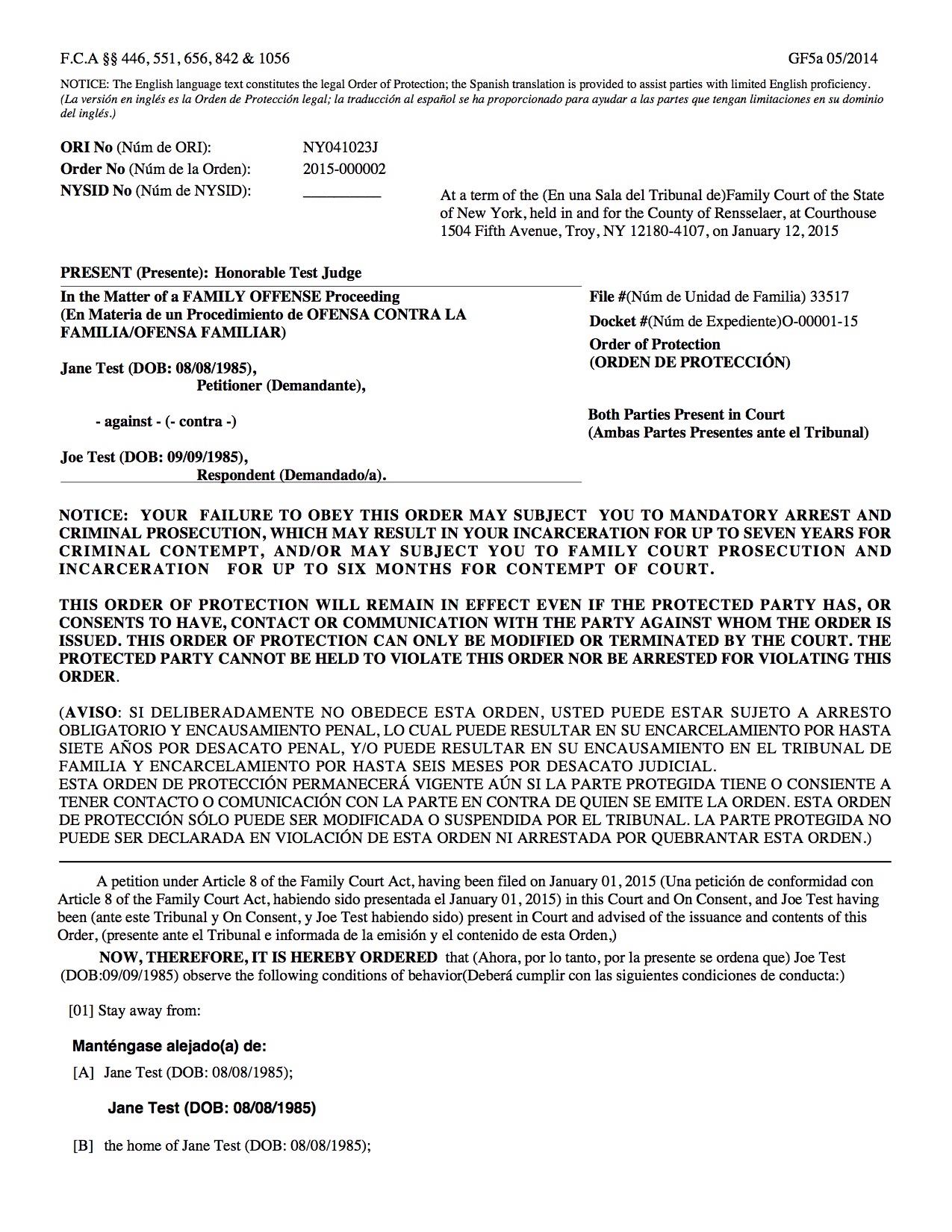
While, obviously, just the idea of bilingual orders is great, it is the way that they are being done that makes this project broadly viable, and relatively easily replicable nationally.

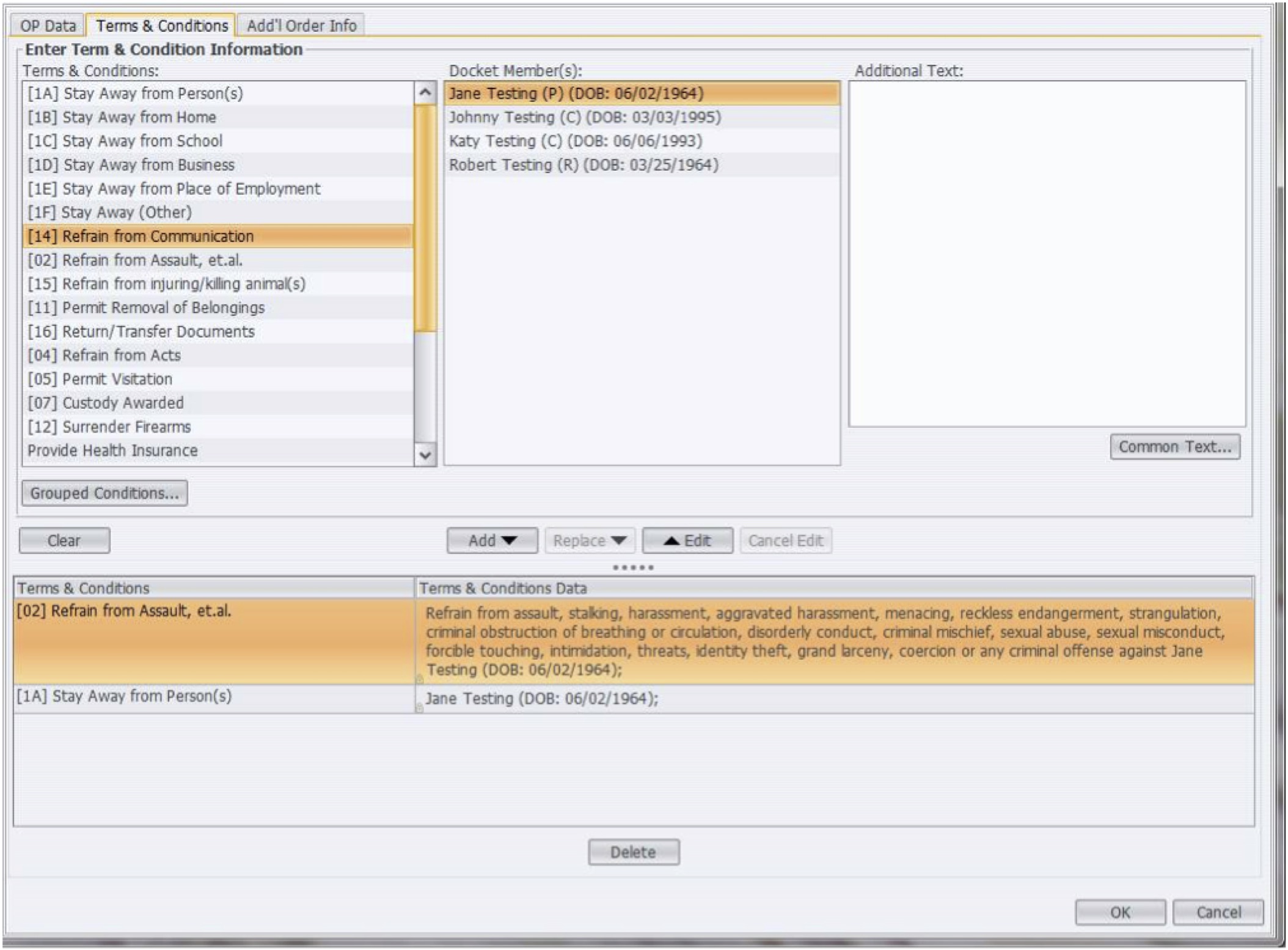
The software that they have developed has “drop down” or standard terms and phrases, with translations pre-loaded into the software.  So no extra effort is required to generate the Spanish version.  Sometimes there are terms not yet loaded in the system, so litigants are sent to an interpreter to translate — and the system is expanded so that next time the next time that term or text is needed, language is available for automatic translation.  I understand that at this point, this happens very rarely.

Here is the key screen, the one in which the terms and conditions are entered:

terms And here is what the first pages of the temporary and permanent orders look like in bilingual form.

bilingual order-Temp-UCMS-Mar3-2015

bilingual Order-final-UCMS-Mar3-2015And, here is the full multi-page text of those forms in pdf, Order-TempOrder-final.

Lets hope we start to learn about the impact that this kind of change has on courts and lives.


Posted in Court Management, Document Assembly, Domestic Violence, LEP, Technology | 2 Comments

Deregulation of Nonprofit Legal Practice — An ATJ Breakthrough?

Here is an idea that might be a breakthrough for access to justice, while enhancing the role and reputation of community based nonprofit legal aid programs.

How about almost complete deregulation of nonprofit legal practice.  True nonprofits (defined not only in terms of ownership, but also remuneration and remuneration to principals of contractors) would be almost completely deregulated.

That would mean that they could use nonlawyers however they judged appropriate — even in court — they could operate across state lines, and they could use technology as they saw fit.  They could market, and they could charge. They would, of course still be under obligations of competence, zealousness and confidentiality, once the relationship was established.

Previous rule changes and proposals have foreshadowed this approach, with, for example, the conflict checking requirements in limited services cases relaxed for nonprofits under Rule 6.5, and the proposal from the NY courts to the NY legislature to allow certain nonprofit legal programs to pilot experiments using nonlaywer “court advocates.”

The core idea is simply that nonprofit programs are not under the same competitive pressures to cut corners and ignore the interests of the clients which the ethical rules are designed to counter.

Thus the nonprofits become safe and appropriate laboratories for experimentation, and the ideas they could freely pioneer would help move a radical expansion of access forward.  This could only help the role and reputation of community-based legal aid.

It might be that some lawyers currently in small or solo practice would switch to a nonprofit model to take advantage of this freedom, and that might be all to the good.  This flexibility would surely be helpful to the incubator movement, both because most are set up as nonprofits, and because it would offer a model of sustainable organizations into which young lawyers could graduate.


Posted in Access to Justice Generally, Attorney-Client, Incubators, Legal Aid, Legal Ethics, Non-Lawyer Practice, Systematic Change, Technology | 3 Comments

Triage and Means Testing

A question has come up on where means testing comes in the triage process.  I think the model is the LSC websites, which do not do means testing.

To be more precise, people should be able to go through the whole system without being means tested, until it gets to the point that whether you meet program’s requirements actually matters.

I suppose the only exception might be when the vast majority of users are either income eligible or not income eligible, in which case it might be good to identify any clear exceptions to the general flow of choices.

As a general matter, sinding the message that this is an overall 100% system is critical.

By the way, some people have pointed out that one downside of the phrase 100% for the public is that it might be interpreted as meaning that everyone gets every service — the antithesis of triage, of course, and perhaps perceived as frighteningly expensive.

So we need to think about wording, but I love how the number 100 emphasizes both universality and accountability.

Posted in Triage | 2 Comments

We Never Think of the Tax Code As a Tool for Access to Justice – It Could be Huge

I am working on a paper for the Georgetown Journal of Legal Ethics 2016 Symposium issue on the relationship between access to justice, legal ethics and commercialization.  It as been a great opportunity to think about creating ways of transcending some of the tensions and interplays between those three themes.

During this process, I realized that we never ever talk about the impact of the tax code on access to justice.  This is largely because we think of ATJ initiatives funding as all coming from tax exempt resources, either government money, or tax exempt funders.

But, once we move to thinking about middle income people who are not eligible for traditional community based means tested legal aid, and we deal with those who are paying for their own access to justice costs, we find the following astonishing facts (as I understand them from IRS pub 529, subject to expert correction — do use not my tax thoughts as guidance in preparing your own return!):

As a general matter, landlords get to deduct their legal fees as business expenses.  But the typical tenant does not, no matter what the financial implications are for them of being evicted, since personal legal costs are not deductible.

The same with banks, personal loans, credit cards, etc.  One side get to deduct,  the other does not.

So, the tax code is making a huge contribution to landlords and banks, while doing nothing for almost always poorer other side (unless the are being serviced by those who received a deduction for a cash or equivalent donation.)

Note that this is not caused by the rules governing itemization of deductions, but by the underlying deduct-ability itself.  I have no idea of the total subsidy, but I am sure it is huge.

One can imagine a rule that allows for deductabiity of legal or equivalent expenses in any dispute in which the other side can deduct.  It would also be important to structure the deduction so that it could be taken even by those who do not itemize, and perhaps even taken in an alternative manner such as a credit or a so-called refundable credit.

But, once you start thinking about the tax code, you realize all kind of other possibilities.  Pro bono work by lawyers is not considered a deductible contribution, but surely when a lawyer, specifically licensed to perform a task, does that for free for a tax exemmpt organization, shouldn’t there be different treatment?  Or, maybe there are other ways of lessening certain kinds of tax rules for those who do pro bono.

Of course, with all such tax expenditures, it is important to try to structure them so that you do not end up reducing tax revenue significantly, while not getting an appropriate change in behavior.  The problem is that when a lot of money is already being spent in an area (such as eviction defense), making it newly deductible can result in a big increase in deductions, even before it draws more lawyers into doing the work, or encourages more tenants to pay a lawyer or other authorized professional.  This might require some very skilled drafting to avoid such an outcome.

But the fact remains.  Its an astonishingly powerful argument that the IRS is subsidizing people who are trying to get people out of their homes, but not those trying to stay in them.  (except, as discussed above through deduct-ability of tax exempt contributions, a tiny portion of the costs in this area, which in any event also help low income landlords.)

Even if it turned out to be hard to generate an effective tax change in this direction, this way of looking at things provides a useful rebuttal to those who try to stop government funding of tenant assistance programs, on the grounds that it is not fair to landlords.

Any ideas and thoughts on how the tax code could be leveraged for ATJ at state, local, or municipal levels, much appreciated.  Surely this is a surface we have only just begun to scratch.

Posted in Access to Justice Generally | 1 Comment

Presidential Memorandum on Access to Justice and Legal Aid Interagency Roundtale is Major Milestone in Creating the National ATJ Mosaic

A big deal.  The President has put in place a Presidential Memorandum on access to justice and the Legal Aid Interagency Roundtable (LAIR).  This joins the Conference of Chiefs/COSCA 100% Resolution as the second huge piece in the national Mosaic of vision, leadership and coordination.  While the President’s Memorandum does not explicitly use the phrase 100%, the formal message of the Memorandum is unambiguous and makes it a fitting partner and amplifier, with the heft in the Federal government to be of real force in moving things forward.

First the Memorandum establishes the goal and the policy:

This Nation was founded in part on the promise of justice for all. Equal access to justice helps individuals and families receive health services, housing, education, and employment; enhances family stability and public safety; and secures the public’s faith in the American justice system. Equal access to justice also advances the missions of an array of Federal programs, particularly those designed to lift Americans out of poverty or to keep them securely in the middle class.

Note the multi-class approach, broad appeal, and linkage to Federal agency missions.

After detailing the need and problem, the Memorandum goes on to highlight the coordination need:

By encouraging Federal departments and agencies to collaborate, share best practices, and consider the impact of legal services on the success of their programs, the Federal Government can enhance access to justice in our communities.

Then it goes on to list the agencies that are to participate or to be invited to participate, as well as how LAIR is to be chaired:

Membership. (a) The Attorney General and the Director of the Domestic Policy Council, or their designees, shall serve as the Co-Chairs of LAIR, which shall also include a representative from each of the following executive departments, agencies, and offices:

(i) the Department of State;
(ii) the Department of the Treasury;
(iii) the Department of Justice;
(iv) the Department of the Interior;
(v) the Department of Agriculture;
(vi) the Department of Labor;
(vii) the Department of Health and Human Services;
(viii) the Department of Housing and
Urban Development;
(ix) the Department of Education;
(x) the Department of Veterans Affairs;
(xi) the Department of Homeland Security;
(xii) the Equal Employment Opportunity Commission;
(xiii) the Corporation for National and Community
Service;
(xiv) the Office of Management and Budget;
(xv) the United States Agency for International Development;
(xvi) the Administrative Conference of the
United States;
(xvii) the National Science Foundation; and
(xviii) such other executive departments, agencies, and offices as the Co-Chairs may, from time to time, designate.

(b) The Co-Chairs shall invite the participation of the Consumer Financial Protection Bureau, Federal Trade Commission, Legal Services Corporation, and Social Security Administration, to the extent consistent with their respective statutory authorities and legal obligation

Only those who have served in governmental bureaucracies, perhaps only those who have served in the Federal one, can appreciate the symbolism, value, power, and potential of having such a group co-chaired by the Director of the Domestic Policy Council and the Cabinet member most responsible.  This puts it right into the White House, and indeed very near the top.  According to Wikipedia, the DPC is chaired by the President, and attended by the Vice President and most of the Cabinet, including the AG, of course).

Just think of the huge collective impact that these agencies have on access to justice, how much money flows through them, how many adjudicatory procedures they manage or fund, and what a difference as they start to converge behind an access to justice vision and mission.

The tasks are really as we might have written them (and its rare that I can say anything like that!):

(i) improve coordination among Federal programs that help the vulnerable and underserved, so that those programs are more efficient and produce better outcomes by including, where appropriate, legal services among the range of supportive services provided;
(ii) increase the availability of meaningful access to justice for individuals and families, regardless of wealth or status;
(iii) develop policy recommendations that improve access to justice in Federal, State, local, tribal, and international jurisdictions;
(iv) assist the United States with implementation of Goal 16 of the United Nation’s 2030 Agenda for Sustainable Development; and
(v) advance relevant evidence-based research, data collection, and analysis of civil legal aid and indigent defense, and promulgate best practices to support the activities detailed in section 4(a)(i)-(iv).

Notice the combination of the general (“increase the availability of meaningful access to justice for individuals and families, regardless of wealth or status“) and the quite specific (“improve coordination among Federal programs that help the vulnerable and underserved, so that those programs are more efficient and produce better outcomes by including, where appropriate, legal services among the range of supportive services provided“)

Notice also the link to Goal 16 of the UN Agenda for Sustainable Development, essentially putting on the record our commitment to “implement[]” that goal.  See also the reporting requirement discussed below

Notice also the advancement of research, data collection and analysis, combination of civil and criminal with respect to research, and the development of best practices.

The annual reporting requirement to the President appears to begin to hold agencies generally accountable, and underlines the wisdom of those who have argued for the value of UN Goal 16 for moving the US agenda forward. (

The LAIR shall report annually to the President on its success in achieving its mission, consistent with the United Nation’s 2030 Agenda for Sustainable Development. The report shall include data from participating members on the deployment of Federal resources that foster LAIR’s mission.

The required reporting on the “deployment of Federal resources that foster LAIR’s mission,” is likely to be particularly important in ensuring that the Federal agencies listed above keep their eye on the ball, and assign staff to move things forward.  Who wants their report to the President to be “No progress,” “no resources has as yet been deployed,” or the like.  And, who wants to submit that language to their Cabinet member or other leader for inclusion in the Report.  That’s how you move things in the Federal government.

It may be important to note that as in the announcement of the LAIR Toolkit, the Memorandum appears to use the phrase “legal aid” in its broad access to justice sense, potentially, as appropriate, including courts and other agencies that can provide a broad range of legal aid ATJ services — Quoting again from the Memorandum “gaps in the availability of legal aid — including legal representation, advice, community education, and self-help and technology tools — for America’s poor and middle class threaten to undermine the promise of justice for all and constitute a crisis worthy of action by the Federal Government.”  (Check the Toolkit announcement for the language that document uses: “Civil legal aid is provided free of charge by nonprofit legal aid organizations, “pro bono” volunteers (attorneys, law students and paralegals), law schools, court-based services such as self-help centers, and online technologies such as document assembly and legal information websites.”

Finally, note that leadership responsibility is placed exactly where it should be:

The Director of the Office for Access to Justice in the Department of Justice, or his or her designee, shall serve as Executive Director of LAIR and shall, as directed by the Co-Chairs, convene regular meetings of LAIR and supervise its work. The Office for Access to Justice staff shall serve as the staff of LAIR.

And, do not miss the huge mission and bureaucratic implications of this:

The LAIR members are encouraged to provide support, including by detailing personnel, to LAIR

OMG, are we starting to build a permanent ATJ group with links into all the agencies that can make a difference?

Huge congratulations to the DOJ ATJ Director and staff.

And, what organization or organizations are next to become part of the Mosaic.   How do we help them along?  And, what a difference this is going to make to the LSC mission and capacity.

Posted in Access to Justice Generally, Budget Issues, Discrimination, Funding, International Cooperation, Outcome Measures, Research and Evalation, Tools, White House | 6 Comments

The VW Scandal Tells Us That We Have to Find a Way to Make Software Transparent — Particularly for Courts

The truly shocking VW emissions fraud should force us to think through how we can ensure the transparency that is needed in software.  The general issue is excellently summarize in this recent NYT article:

“Intelligent public policy, as we all have learned since the early 20th century, is to require elevators to be inspectable, and to require manufacturers of elevators to build them so they can be inspected,” [Mr. Moglen, a lawyer, technologist and historian who founded the Software Freedom Law Center] said. “If Volkswagen knew that every customer who buys a vehicle would have a right to read the source code of all the software in the vehicle, they would never even consider the cheat, because the certainty of getting caught would terrify them.”

That is not how carmakers or even the E.P.A. see things. The code in automobiles is tightly protected under the Digital Millennium Copyright Act. Last year, several groups sought to have the code made available for “good-faith testing, identifying, disclosing and fixing of malfunctions, security flaws or vulnerabilities,” as Alex Davies reported last week in Wired. Continue reading

Posted in Technology, Transparency, Triage | Tagged , , , | 1 Comment

Jim Greiner’s Comment on the Inherent Conflict Respresented by Funding Public Defenders by Fees Charged Defendant’s and My Response

Jim Greiner has submitted a brilliant and challenging comment on my recent post about the funding of 41% of the New Orleans Public Defender from court fines, fees and assessments.  It is worth very serious consideration.  Here is the full text, with my thoughts below:

Richard, Everyone, I desperately want to be wrong about the following reasoning. Please tell me that I am, and why.

“When the gods wish to punish us, they answer our prayers.” Oscar Wilde.

1) What do we think will happen to the New Orleans public defender’s funding if a lawsuit alleging a conflict of interest is successful in declaring the present funding scheme unconstitutional? Do we think the state legislature or the city council will find a new source of revenue to replace all of the money that previously came from fines and court fees? Most of it? I think not. There might be a partial restoration, but probably not the full 41%, resulting in a net loss of funding for the public defender. Legislators lack the integrity to deal with public defender funding in a principled manner.

Continue reading

Posted in Attorney-Client, Bail, Budget Issues, Chasm with Communities, Commentators, Court Management, Criminal Law, Defender Programs, Political Support, Poverty, Public Defender | 4 Comments

Meeting on ATJ and UN Development Goals in NY on Sept 24 Offers Opportunity to Engage Important Subject

As David Udell has been urging, it is long past time for US access to justice advocates to engage with the UN on Goal 16 of its Development Goals, dealing with access to justice, and with its potential implications.  As shown in this Invite, an upcoming meeting provides an opportunity to help shape the US response by attending a meeting at Skadden Arps in New York at 10:30 on the Thursday the 24th.  Acceptances must be sent to the e-mail listed in the invite by Sept 21.

The current proposal, likely to be finalized at the UN at the end of next week, would ask members to  “Promote peaceful and inclusive societies for sustainable development, provide access to justice for all and build effective, accountable and inclusive institutions at all levels.”

The challenge for those who see this as an opportunity to align what is going on in the US with the rest of the world, is the current text of the so called “Targets” for this goal.

Continue reading

Posted in Access to Justice Generally, International Cooperation, International Models | 1 Comment