High Lifetime Chance of Being Poor Suggests a New Legal Aid/ATJ Funding Argument

For decades we have been struggling with the fact that we think that many, perhaps most, people are resultant to fund legal aid, and particularly means-tested community-based legal aid because they think that it will never help them. (Incidentally, every article on how few people are helped by legal aid probably increases that perception, and so may  be courter-productive.)

A new study of the chances of being in poverty over the long term may upend our strategies for dealing with this.  As reported in the Washington Post’s Wonkblog, a study going back to 1968 shows that in fact:

By the time they’re 60 years old, [University of Washington Sociologist Mark] Rank has found, nearly four in five people experience some kind of economic hardship: They’ve gone through a spell of unemployment, or spent time relying on a government program for the poor like food stamps, or lived at least one year in poverty or very close to it.

So, by age 60, 45% have received some form of public assistance, 67% have experienced a period of extended unemployment, and 54% lived near or below the poverty line.

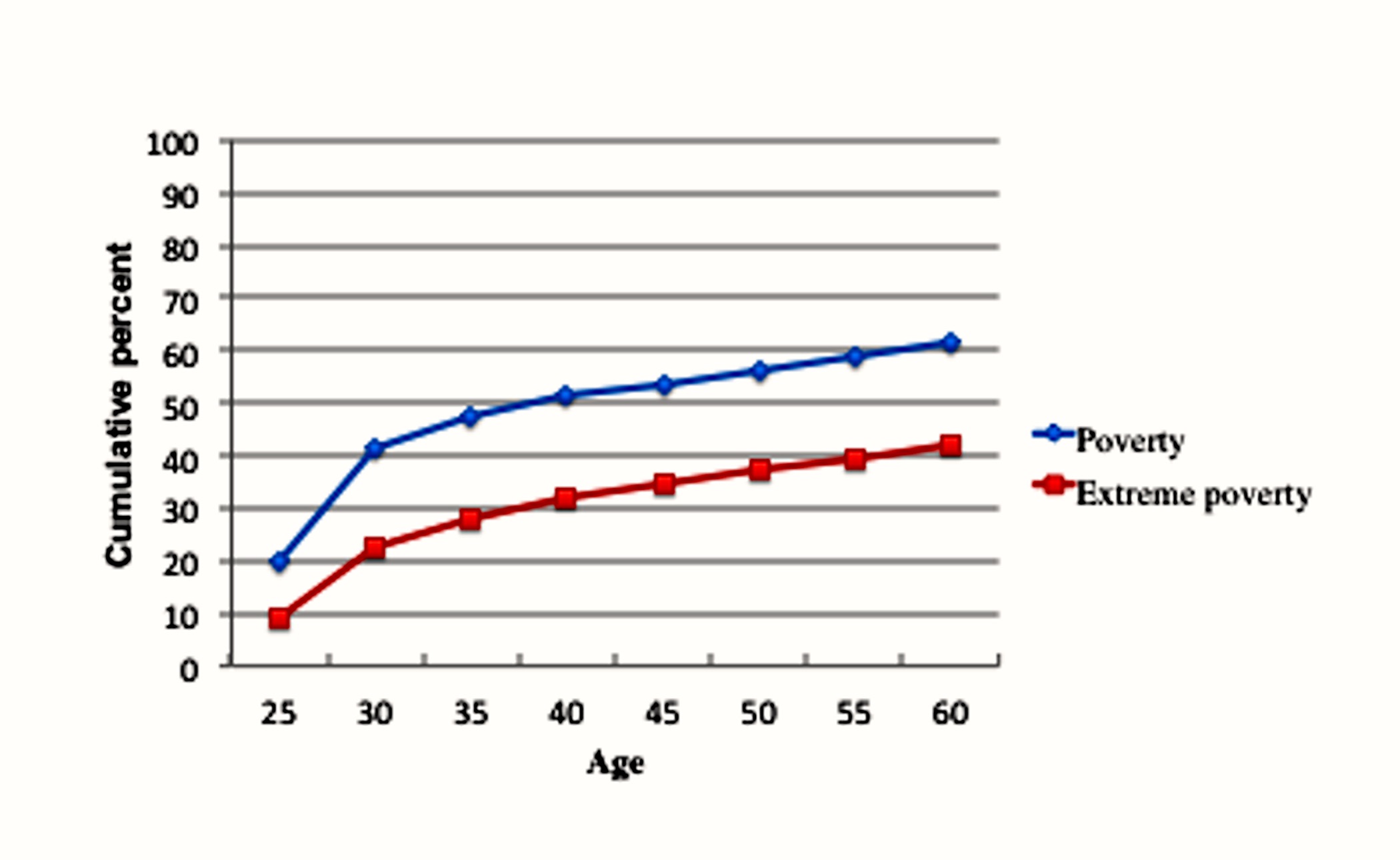
Indeed by age 60, 62% of people will have been in the bottom 20% and 42% will have been in the bottom 10% of the income distribution for at least a year.

Here is a graph showing the increasing numbers as one ages (distributed under Common Commons License, © 2015 Rank, Hirschl).  (The full two-author study that gives this chart is here.)poverty-1 year by age

Legal Aid, even means tested community-based Legal Aid, is a majority-serving program, and we have to start thinking about, and talking about it as such.

So, we obviously need this research to be tweaked to show the percentage who have been community-based legal aid eligible at some point in their lives.

Till recently, the communications strategy — wise and fair — has been to combine means-tested community-based legal aid and non-means-tested court-based (and some other) and make the argument that legal aid as a whole is available to all.

These numbers make possible a far more appealing argument — that parts of the legal aid service system are available to all, and that almost two thirds of people are at some point in their lives eligible for the type of services targeted for those most in need.  (Actually, given that senior legal aid is not means-tested, there is an even broader argument that 100% are eligible at some point in their lives, but I think the non-senior argument feels more honest and more credible.)  So, you can imagine a message/ad like — Most Americans are eligible for legal aid at some point in our lives — and that is a really good thing because the program ……  Indeed, in talking to people about legal aid, we might ask them to think back to when their income was low, and the challenges they faced.

So, lets get the research tweaked, and start using it.  Any ideas on how to make the research even better, or how to tweak the message?

Posted in Budget Issues, Communications Strategy, Legal Aid, Political Support, Poverty | 7 Comments

Research Suggests “In Court, Your Face Could Determine Your Fate”

NPR picks up on recent research about the relationship between facial appearance and sentencing. (Full study here.)

Individuals who are deemed to have untrustworthy faces are significantly more likely to be on death row compared with other people convicted of murder, according to a study published Wednesday in Psychological Science. Inmates thought to have trustworthy faces, however, have a higher chance of receiving the more lenient punishment of life in prison.

“Facial trustworthiness is a significant predictor of the sentence people receive,” says John Paul Wilson, who led the study and is a social psychologist at the University of Toronto.

They got lots of mugshots of those convicted of Murder in Florida, and got large numbers of people to rate those photographed as “trustworthy” or “untrustworthy.”  Sue enough, those judged to have trustworthy faces were more likely to have been sentenced to other than death.  To see if those with more heinous crimes/backgrounds were just more likely to have “untrustworthy faces” the researchers then got photos from the Innocence Project of people who had been exonerated.  As the study abstract reported.

“[W]e found that the link between trustworthiness and the death sentence occurred even when participants viewed innocent people who had been exonerated after originally being sentenced to death.”

While death penalty outcomes are surely highly likely to be related to perceptions of character, many other decisions made by fact finders are also likely to be subject to the same kind of bias.  We believe those we think are trustworthy.

How would we try to deal with this?  Do jurors need special training in avoiding summary conclusions?  Should attorneys we allowed to make arguments using this kind of research?

And, what about self-represented litigants, who are seen most directly by fact finders and judges, and who do not receive the benefit of the implicit “vouching” that those with clients receive?

Note: Florida is very unusual in that in its death penalty procedure the jury recommendation is only that, and the judge makes the final decision.  Moreover, the jury makes its recommendation by majority vote, not unanimity.  We are told that the judge rarely does other than follow the majority vote.  Its really speculative to try to figure out the impact of this proedure on results.  (It may also be that Innocence Poject photos may be from more than Florida.)

Posted in Criminal Law, Public Defender, Research and Evalation | 5 Comments

Announcing the Access to Justice Blog Board of Commentators

I am pleased and proud to announce that fifteen thoughtful and distinguished friends of access to justice have agreed to become members of this blog’s Board of Commentators.  I am particularly pleased that not all are lawyers, since we have so much to learn from other professions and areas of knowledge and experience.

I hope that the members of this Board will help make this a much more interactive site, with a range of ideas, reactions and conversations, all ultimately advancing our understanding and energy.  The aim is to encourage, not discourage, additional comments by everyone.

Here the members are (all links are for purposes of identification and information only):

Katherine Alteneder, Coordinator, Self-Represented Litigation Network.

Martha Bergmark, Executive Director, Voices for Civil Justice.

James Burdick, MD, retired Professor John Hopkins Medical School and retired Director Health Resources and Services, Division of Transplantation, HHS.

Kelli Evans,

L. Peter Fielding, MD, retired surgeon and medical administrator.

James Greiner, Professor Harvard Law School.

Claudia Johnson, LawHelp Interactive Program Manager, Pro Bono Net.

Paula Litllewood, Executive Director, Washington State Bar Association.

Ed Marks, Executive Director, New Mexico Legal Aid

Paul Prettiore, Senior Public Sector, Specialist, World Bank.

Joyce Raby, Consultant

Glenn Rawdon, Program Counsel for Technology, Legal Services Corporation.

Linda Rexler, Executive Director, Michigan State Bar Foundation

Lisa Rush, Manager, Travis County Law Library and Self-Help Center, Austin TX.

Rebecca Sandefur, Associate Professor of Sociology and Law at the University of Illinois at Urbana-Champaign.

Gerry Singsen, Consultant, Massachusetts Access to Justice Commission.

Welcome to all.  Lets get this 100% thing going!

Posted in Access to Justice Generally, This Blog | Comments Off on Announcing the Access to Justice Blog Board of Commentators

The Nighmare of Website Bias — Lack of Specific Intent, And Hard to Prevent

Back in the early civil rights days, the strongest argument against effective civil rights enforcement was the claim that employment discriminators, for example, were merely following the demands of the market when they hired the most “appealing” staff.  (For a recent general example (not apparently using that word), see here.)

The insidiousness of these risks, and how deeply engrained they are in a market economy is highlighted in the recent New York Times article by Claire Caine Miller.  It is called “When Algorithms Discriminate.”  My question is this — Can any really good profit oriented algorithm not discriminate, unless explicitly designed so it does not?”

As the article explains:

There is a widespread belief that software and algorithms that rely on data are objective. But software is not free of human influence. Algorithms are written and maintained by people, and machine learning algorithms adjust what they do based on people’s behavior. As a result, say researchers in computer science, ethics and law, algorithms can reinforce human prejudices.

Google’s online advertising system, for instance, showed an ad for high-income jobs to men much more often than it showed the ad to women, a new study by Carnegie Mellon University researchers found.

Research from Harvard University found that ads for arrest records were significantly more likely to show up on searches for distinctively black names or a historically black fraternity. The Federal Trade Commission said advertisers are able to target people who live in low-income neighborhoods with high-interest loans.

One explanation discussed in the article is that advertisers, for example, specifically ask for certain attributes, such as gender, zip code, etc, and that the “logical” result follows.

I would suggest a much deeper problem, that a well designed algorithm will inevitably discover and perpetuate bias.  For example, a good potential employee search algorithm, it would seem, should look at employment successes, find the correlates, and bump up in the results those who are more likely to succeed in the current social political and economic environment.  Similarly, a good pricing algorithm will look at things like how far people have to drive to a brick and mortar store in order to identify where the supply and demand curves interest for a particular potential buyer, and to do so will look at lots of information — all raising the price for those with less economic clout.  It’s the global extension of low income area supermarkets charging more.

The Times piece concludes:

It would be impossible for humans to oversee every decision an algorithm makes. But companies can regularly run simulations to test the results of their algorithms. Mr. Datta suggested that algorithms “be designed from scratch to be aware of values and not discriminate.”

“The question of determining which kinds of biases we don’t want to tolerate is a policy one,” said Deirdre Mulligan, who studies these issues at the University of California, Berkeley School of Information. “It requires a lot of care and thinking about the ways we compose these technical systems.”

Silicon Valley, however, is known for pushing out new products without necessarily considering the societal or ethical implications. “There’s a huge rush to innovate,” Ms. Mulligan said, “a desire to release early and often — and then do cleanup.”

I have to say that I do not think that it is enough to “design[] from scratch and not discriminate,” because it is about more than avoiding the explicit use of prohibited factors, or even identified correlates, because any good software will just be clever at finding other correlates.

Are there any alternatives to simply prohibiting price differentiation based on personal attributes (just like Obamacare does, albeit with certain exceptions!)

p.s. we explored this general topic at the first LSC Tech Summit almost two decades ago.  It is a pity that we have not continued this process.  See paper here.

,

Posted in Discrimination, Poverty, Technology | 1 Comment

Love’s Promises — Wonderful Book on Shaping Marriage and Family To Reflect Choice

Everyone in the access to justice community knows Karen Lash as a dedicated and brilliant deputy director of the DOJ ATJ Office.

Now she may be about to be even better known as the loving and loved family member portrayed in Love’s Promises: How Formal and Informal Contracts Shape All Kinds of Families, written by her, wife Martha Ertman, a professor at the University of Maryland Law School.

It is a transformative, beautiful and astonishingly well timed, because it blends her personal story with astute yet accessible legal analysis.  It conveys both the extent to which contracts law allows people to shape what she calls “Plan B families,” and the impact on those who are able or unable to do so.  It might seem at first blush that this is now unnecessary after the recent Supreme Court decision.  In fact, such a conclusion would fail to recognize the extent to which the need to go beyond status law to shape families by agreements goes way beyond those (now much fewer) denied the availability or assistance of the legal status of marriage to define their relationships.  Rather, as Professor Ertman’s careful analysis of issues such as insemination, surrogacy, and parenthood in gay families, shows, there are still not only needs for, but huge benefits for the people involved making their own choices, and using contracts to give them their own status.  I find her brief accessible summaries of the law, stating the general rule, the exceptions, and (when needed) the exceptions to the exceptions, quite wonderful, and in exactly the same spirit as the more narrative parts of the book.

As so often, a writer speaks best for herself.  Here, with permission (rights reserved), is an extract in which she tells a story of her son and wife.

 As usual, Walter’s tearing around with other kids. This time they’re being led in a fierce game of tag by a wiry girl whom I’ve just learned has two dads. When I get a chance, I lean in to tell Walter this news, which he brushes off. But the sturdy blond behind him is nonplussed. He snaps his hand at Walter’s arm, exclaiming, “Two dads?!” clearly expecting a response.

Walter doesn’t respond, just keeps on running.

As soon as the blond boy catches up with Walter, he whaps him again on the arm, crying out more loudly this time, “TWO DADS??!!”

Again Walter blows him off and keeps running.

Finally, the blond boy grabs Walter’s sleeve, forcing him to stop and answer the urgent query, put yet again. Hovering at the sidelines, I’m wondering whether I should jump in, explain that love comes in different packages and give a few examples of Plan B families, when Walter finally responds. Apparently, he’s picked up a generous habit that Karen and Victor [the boy’s very involved father] share, finding one sliver of a statement to agree with and pretending that it’s all that’s been said.

“You’re right, it is unusual. Usually, it’s two moms,” Walter says easily, looking directly at his interrogator, barely waiting for the blond boy to take in his answer before sprinting away. The boy looks a little stunned, then grunts, either conceding the point or just giving up as he takes off after Walter.

Walter, it seems, can convey an idea much more succinctly than his mother. Though I wrote this book in part to protect him by nudging the world just a little toward embracing Plan B families, he’s doing fine on his own.

On a different front, Professor Ertman tells of her effort to persuade their attorney of the value of including emotional statements and memories in the document that restructured their family to include Karen in pre-existing Plan B family with Victor and the son.

A month before our wedding, Karen and I are here in this lawyer’s office to make sure that we’ve made Karen as much of a parent as the law will allow. But that’s edgy enough for the attorney without all the language she’s dubbed “extraneous.” I explain to her that all that mushy stuff is in the contract so that a judge doesn’t see it. Like the Utah lawyer who reviewed Victor and my initial coparenting agreement, this lawyer would rather fold Karen in as Walter’s third parent with as little flowery language as possible. She has circled my suggestion that we start off by proclaiming the “spirit of love, hope, cooperation and mutual respect” we bring to the agreement, and also the part about Karen reading Walter Curious George the first night she came over for dinner. But Gaty’s Day bugs her the most.

To defend this infusion of love into otherwise lawyerly language, I tell the lawyer that Gaty is Walter’s name for Karen, that he gave it to her when he could barely talk. Gaty’s Day was Victor’s idea, a Sunday between Mother’s Day and Father’s Day, to honor her in-between situation. Walter was just four years old then and made a card with me for her. When I asked Walter to tell me special things about his Gaty, he dictated, “She reads to me,” and “‘Gaties make Mommies happy.”

“It’s true, Gaties do make Mommies happy, and even Walter knows that if Mamma ain’t happy, ain’t nobody happy,” I finish, relieved to hear Karen’s chuckle. The lawyer’s expression remains blank, so I explain that I put the story in our contract to function like a levee. If any one of us gets awful or stupid or mean, I hope that it could hold us back from getting even more awful. The idea is that reminding us of the full hearts with which we started out could decrease the likelihood of an acrimonious, expensive legal fight that would hurt Walter most of all.

 Knowing that I’ve slipped into law professor mode, I glance over to Karen and see her wipe away a tear. That feeling is precisely what I’d like to cue up if one of us became a drug addict or went orthodox and shaved her head, either of which could land us in some other lawyer’s office to negotiate a separation agreement. The point of committing these emotions to paper is to evoke them later, if need be, to trigger memories of the full hearts and big hopes on the front end of our marriage.

To make Karen a legal parent, we each give and take. Victor and I give Karen the right to visitation with Walter if she and I break up, and Karen takes on the duty of paying child support. We also build in the possibilities of change, amping up her visitation and child support after we’ve been married for a while. Fortunately, DC has just enacted a law recognizing a status like Karen’s, calling it “de facto parenthood.”

 It takes two more trips to the lawyer’s office to hammer out terms that satisfy Karen, Victor, the attorney, and me, from lawyerly technicalities to the emotional terms we all call “mush.” What started out as an addendum to Victor’s and my coparenting agreement has blossomed into a bouquet of wills and powers of attorney, alongside the amended parenting agreement. As we sign the lawyer says that she’s never had clients think through everything so carefully, then adds, “in a good way.” On the way downstairs, clutching documents still warm from the copying machine, Karen squeezes my hand, as if she, too, feels that signing on all those dotted lines brought into being a family every bit as much as the vows of forever that we plan to recite, all dressed up and surrounded by a hundred dear ones summoned to celebrate with us.

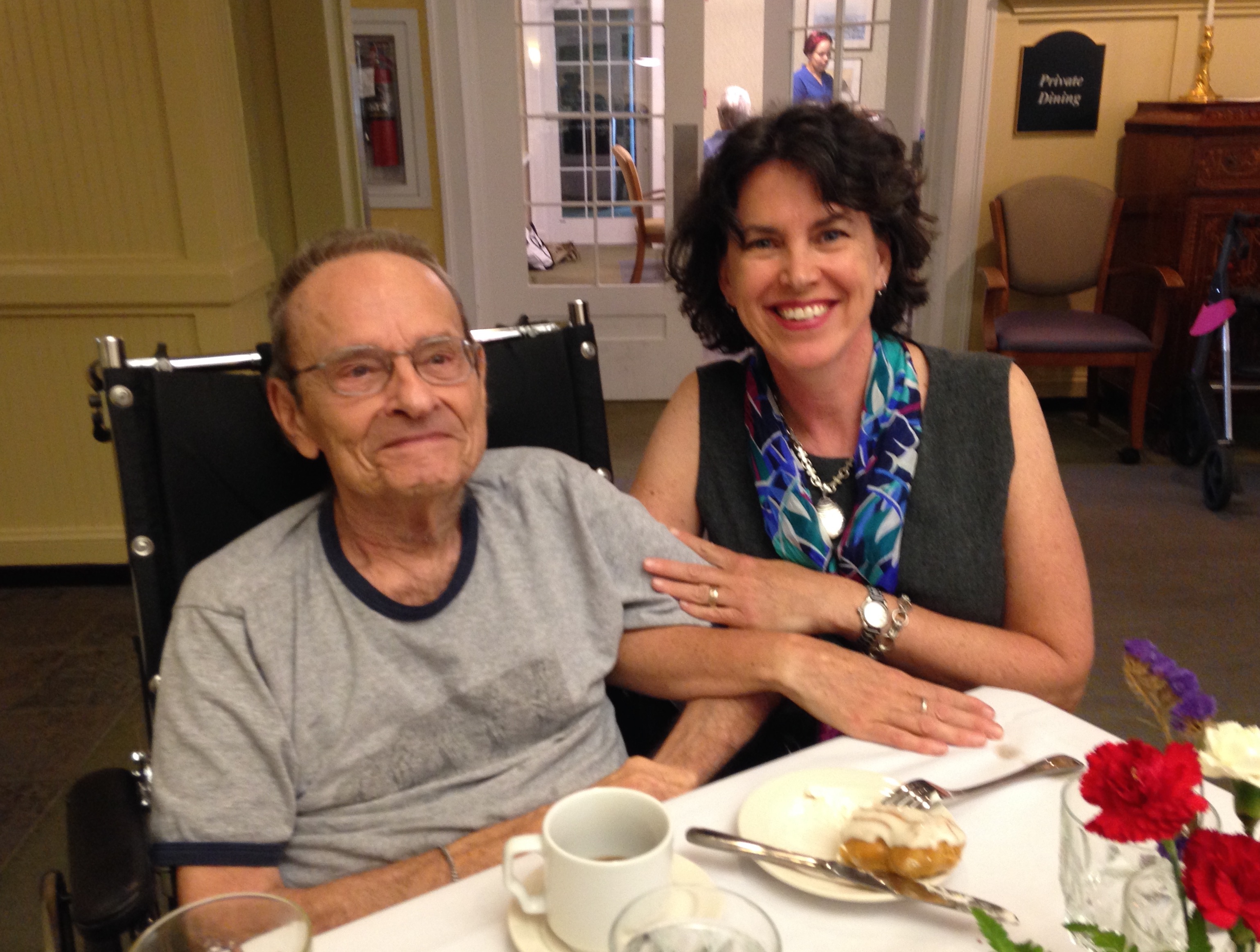
Professor Ertman spoke at our retirement community a few nights ago.  It so happens that one of the developers of the other “Plan B“, Doctor Philip Corfman, lives here.  So we got a wonderful shot of the ultimate “Plan B family,”  The one joining the person who helped us understand Plan B parenting (and more) and the one who brought us Plan B non-parenting.  Both, of course, are really about choice and freedom.  Look at those smiles!
PlanB2

Posted in Family Law, LGBT, Love, Self-Help Services | 3 Comments

World Bank Working Toward Legal Aid Outcome Measures Including Impact on Poverty

This is news that might have a major long term impact.  As this blog by World Bank
Senior Public Sector Specialist Paul Prettitore reports:

JCLA [Jordanian CSO Justice Center for Legal Aid] and the World Bank are now designing a methodology for measuring the impact of legal aid on poverty. We will go beyond case outcomes (what happened in court) and the social return on investment assessments that are common in this field. Instead we will measure impacts on poverty levels, social development indicators, and agency at the level of household and individual beneficiaries. We hope that JCLA will be able to track their beneficiaries over time (perhaps several years) to capture evolving impacts. This will contribute to enhancing what remains as a surprisingly limited knowledge base on the anti-poverty effect of legal aid, and hopefully open the door for wider evaluation of the role of justice sector services in addressing poverty. (Bold added)

If they can take this on this broader definition of outcome, why not us?  Note that the outcomes that are described as “common in the field” are all too often a struggle to define and collect in the US.

Note also that this follows a “needs study” involving a survey of 10,000 households, conducted by the Jordanian Dept of Statistics.  How about our Census Bureau playing the same role.  Indeed, how about the Bureau including ATJ questions in one of their regular surveys — after all, they do investigate poverty.

Also note how well this resonates by the work by the Public Welfare Foundation on spreading the word within the philanthropic community on how legal aid (broadly defined) can help funders meet their goals.

Posted in International Models, Outcome Measures, Poverty, Research and Evalation | 2 Comments

Mixed Thoughts on Arguments Against Comparability of Data and Goal Setting

A few days ago, I blogged about recent massive reductions in heart attack deaths, and the contribution that the establishment of required reporting of comparable data, and the setting of clear goals, contributed to those improvements.

While doing so, I planned to include an ironic listing of the kinds of arguments likely to be or to have been used in both legal and medical fields to argue against this powerful innovation approach.

But then I had my doubts, so I polled some folks I respect with a draft, and got very mixed responses, from “go with it — hilarious” to “better coming from someone else.”  It was urged that  “the tasks are difficult on the merits,” and that my ironic arguments caricatured as resistance to change might in fact be legitimate as far as they went.  It was aruged that what is needed now is thought leadership in developing indicators, rather than criticism for the failure to do so, so that we can transcend the reasonable resistances.  And, indeed, it is true that doing this right is hard.

It set me thinking, and I realized that I wanted so badly to go with the list for not entirely healthy reasons.  I have just sat in too many meetings over the years in which data gathering and particularly comparative data gathering has been argued against.  This includes one Summit in the mid 80’s and one in the early 2000s.  In the first case I was probably arguing for caution, in the second less so.  In the second, the facilitator asked something like “is there any way that we could set this up so people would be able to go with this,” and one person replied “no.”

So there is a history there.  Perhaps the most throughout comments I got back on my proposed draft was something like.  “Do not fight the last war.”

I would like to think that that is the case, and that with the rapidly growing commitment to research, we can focus on how to ensure true outcome measures and true comparability.  I particularly hope that in the intermediate time period, in which outcome measures are  not yet fully comparable, we find ways to make them effectively so (such as by looking at changes in different programs outcomes over time, and seeing who is most effective at improving theirs.

In which spirit, I offer my initial ironic thoughts on how people might have argued against the hugely impactful heart attack studies.  (See for example, an argument here that “the impact for patients was unclear because of heterogeneity in presentation and severity of illness for unselected admissions, and challenges in the definition of ‘specialist’ relative to individual clinical need, [commenting on time to specialist measure].”

“If we produce data it will be used by our opponents.”

“If we produce data our funders will use it to reduce our budget, or reduce our unit payments.”

“An approach like this will mean that doctors will stop trying to help their patients.”

“Doctors and hospitals will stop treating the sicker people.”

“Its too much of an administrative burden.”

“We report too much to funders already.”

“Different kinds of procedures are just so different that you can not compare outcomes.”

“Survival is not the only important measure.”

“Its not fair to judge doctors and hospitals because of failures in other parts of the system.”

Sometimes patients are to blame for not following orders.”

My favorite, however, remains:

“Every heart is different.”

I have to admit that I too have been fearful of the impact of data on the credibility of directions that I believed were worth following. It is hard not to become vested in such directions, and harder still to balance the risks against the benefits.

I guess the moral is while these are complex matters, we need to be careful not to let anxiety about downsides blind us to the huge advantages of data in general and outcome comparison in particular.   In the end, it is only be all committing to a data driven culture that we will built an access to justice system strong enough to take those risks in its stride because the general case has been so strongly made — by the data itself.

Ideas on how to design an appropriate system of outcome comparison as welcome in the comments.  (Indeed, one of people who reviewed the drag blog pointed out that “nor are you approaching [the issue] in an alternative way, would be by articulating proposed measures.”)  It will surely be helpful to this discussion when the LSC-led process on improving data gathering publishes its results and recommendations.

Posted in LSC, Research and Evalation | 7 Comments

Perhaps the Most Important Thing of All About The Marriage Decision Is That It Was a Movement Victory

As the plates of law and society shift under our feet, there are a thousand things to celebrate (even if some occur in the context of deep mourning).

I think that for me however, after decades in which there were few if any progressive victories that could be labeled movement victories, the marriage decision was the first true movement victory.  There were legal victories, moral victories, legislative victories, political victories, personal victories, but few movement victories in the decades since the civil rights movement, the anti-Vietnam war movement (which victory always seemed a little unclear), and the women’s movement (whose victories always seem under assault at the intellectual and legal level.).

My wife and I were congratulating and thanking a potentially deeply impacted relative, and the reply was “I had absolutely nothing to do we it.”  We responded along the lines of, “yes you did, because you stood up and were yourself, and stood up for who you are.  It was millions like you doing that that won this fight.”

Later we added “That is what a movement is.”

I do not mean by this way of celebrating in any way to lessen either that this is a victory of and by the LGBT community, indeed this just underlines its importance.  Nor do I want to lessen the importance of the so far less complete victories of those such as dreamers — rather this also highlights those movements’ huge potential.

Above all, I just want to underline the hope that we remember that lawyers as such alone don’t change the world, we just help those who find a way to unite in a movement to do so.  And, as is so often the case, one movement can lead to another, and to another, but only if folks are willing to grab the courage — and hopefully that it will be less than a few decades more until another such movement victory.

Thank you all.

P.S. And, maybe sometime, we will figure out how to shape our attempts to urge access to justice into a true movement.  Thoughts on how are for a future post.

Posted in Political Support | 2 Comments

Reasons for Thirty Eight Percent Reduction in US Heart Attack Deaths in Ten Years Have Obvious and Detailed Implications for Access to Justice Reform

It’s an amazing statistic: in just ten years, the US heart attack rate has been reduced by 38%, as reported in a wonderful and hightly suggestive article in the June 21, NYT, here.

Perhaps most hopefully, in this week of renewed attention to matters of race and poverty,  disparities that used to exist in times to treatment with respect to age, poverty, and race have disappeared.

There are many reasons, but one of the most signficant, and the one that I will analyze today, are focused attention to, and changes in the reasons that there is such a long time between arrival at the hospital, and the treatment to push through the blockage.

The story really begins, significantly, with the fact that Medicare had long been collecting data on that length of time for each hospital.  (I do not need to point out the reaction to any suggestion that equivalent data be collected about legal aid.)

What that data made possible was a study, conducted by Yale University Hospital, which showed that”

[i]t was a bell curve year after year, and the times were not getting any better. But there wire a few hospitals at the tail end of the curve that year after year were treating people in an hour or so.

Dr. Krumholz and his colleagues visited the 11 best performing hospitals. They were not famous institutions or major medical centers, said Elizabeth Bradley, a professor of public health at Yale and a leader in the project. Some were community hospitals; others were far from major population centers. The investigators recorded every detail of how the hospitals got things done and ended up with a short list of what the stellar performers had in common .  .  .

The procedures identified by the researchers included things such as transmitting the EKG from the ambulance, allowing the ER doctor to make a decision to go for a procedure without consulting others, having the whole team called in quickly from nearby, with a single call, even before the patient arrived, and, continuous monitoring of outcomes.  (Most of these might seem obvious to us, but they were far from universally used.)

Then it gets really interesting.

Dr. Krumholz and his colleagues persuaded The New England Journal of Medicine to publish their already accepted paper in the same week at the end of November 2006 that the American College of Cardiology announced a national campaign to get hospitals to change their ways. Twelve hundred committed to doing so.

The challenge had specific targets, to get the blood flowing for half of patients within 90 minutes of arriving at the hospital.  (To some of us that might seem un-ambitious.)  “Now, nearly all hospitals treat at least half their patients in 61 minutes or less, according to the most recent data from the American College of Cardiology.”

The campaign (for that is what it was) had immediate results:  “Doctors and hospitals began competing to see who could have the best times. The initiative tapped into professional pride and a thirst to be the best. And, of course, hospitals wanted patients.

End of story?  Not quite.  And there is an important lesson in how to think about data in the next chapter.  The research started to show that while times were being reduced, overall outcomes were not.  Is this an argument against the theory and the campaign.  No, because what was happening was that word was out, the culture was changing, and sicker people were now having the procedure.  So the impact on the original treatment population was indeed still positive.  It is easy to imagine that, similarly,for example, improvements in assistance to eviction defendants could result in reduced default rates, and increased post substantive hearing eviction rates.

The article concludes with a discussion of how hospitals continue, case by case, to review why times were not shorter, and what could have been done (and would be done in the future) to reduce times.

There are so many lessons here for the legal system, and here are just a few of them. Of course medical outcomes are often easier to measure, and of course there is agreement rather than disagreement about what is good or bad, but overall the lessons are waiting to be applied.

1.    Setting public, concrete, measurable, and achievable goals is critical.  In the legal context they will vary by type of institution, but that’s no reason not to analse them.  Courts should have all litigants given sufficient information to understand their rights and how to protect them, as well as understanding the court’s orders.  Advocacy legal aid programs should have goals for percentages of those given full triage, and how quickly, those given full information, and specific outcomes by case type.

2.   Such goals should whenever possible be within the control of a single institution.  The medical system did not use as its measure time from 911 call, or time from pain, but time from arrival.  So “just outcome” is a hard one, but “everyone fully heard with case decided on facts and law,” is, at least theoretically, doable

3.   We desperately need nationally comparable outcome measures, and the centralized reporting that gives them utility.

4.   Competition is critical.  In a monopoly system, there is almost none.  No wonder the pressure to adopt innovations is so low.  It is a little scary that much of the openness to court reform has come from the argument that private sector players are moving to private courts.

5.   Outcome data needs to be read carefully.  Successful programs almost always produce unanticipated consequences. And, unless fully understood, those may undercut the clarity of the success, but not the fact of the success.

P.S.  For follow up plans for this heart research, see here.

Posted in Court Management, Forms, Legal Aid, Medical System Comparision, Mixed Model, Triage | 2 Comments

A Different Approach to Integrating Litigant Services and Security Screening

This from Mental Floss on a better way to security screen — in this case in airports:

Since 2007, the TSA has been pouring $200 million a year into agents trained to spot suspicious behavior in passengers. The program, called Screening of Passengers by Observation Techniques (SPOT) was developed by a psychology professor at the University of California Medical School in San Francisco named Paul Ekman. It involves a list of 94 signs of anxiety and fear, like lack of eye contact or sweating. But one report found that SPOT is ineffective because “the human ability to accurately identify deceptive behavior based on behavioral indicators is the same as or slightly better than chance.”

Another method of screening passengers is simply to talk to them. A 2014 study found that asking open-ended questions—known as the Controlled Cognitive Engagement method (CCE)—is 20 times more effective than trying to monitor based on behavior. For example, an agent might ask a passenger where they’re traveling before prodding them with a random question like where they went to college and what they majored in, then watch for signs of panic. “If you’re a regular passenger, you’re just chatting about the thing you know the best—yourself,” says researcher Thomas Ormerod, PhD, head of the School of Psychology at the University of Sussex in England. “It shouldn’t feel like an interrogation.” In the study, officers using conversation-based screening caught 66% of deceptive passengers, compared to just 3% who used behavior-based screening.
(Bold added)

 I remember a trip to a New Hampshire court, I had a wonderful discussion with the head of security about how his philosophy was that security staff should talk with each person entering the building.  This was done by asking people if the staff could help them find what they needed.  Security staff were then able to act to maximize the chances of avoiding any problems.

I wish we could find a way to build the same philosophy into all courts.  We could then make sure that everyone feels welcomed, as well as gets the information they need, while optimizing security.

Posted in Security, Self-Help Services | 1 Comment

Every Community Should Have a Civil Justice Coordinator and Coordinating Council

The New York City Council recently passed a bill to create an Office of Civil Justice Coordinator.

The bill, which was co-sponsored by Councilman Mark Levine, would create an office within the Human Resources Administration and have a budget of about $2 million. The office would work with city agencies to collaborate with nonprofits, pro bono programs and advise the mayor on implementing legal services as well as make budget recommendations.

Apparently the bill, which has the Mayor’s support, is now awaiting his signature.

Its actually really rather astonishing that this idea is not standard.  While the state Access to Justice Commissions provide some (but often not enough) of this role statewide, it rarely reaches down to the local level of community or courthouse.  Some directors of self-help services similarly surely play this role, but not in an officially recognized — and funded way.

By embarrassing comparison, Criminal Justice Coordinating Councils (at least statewide), go back to the 70’s.  I know, having worked closely with the NYC Criminal Justice Coordinator in the 1990s, that it made a huge difference in making possible innovations such as Midtown Community Court.  Similarly, Neighborhood Defender Service of Harlem, and other defender innovations.  I am sure that the new cvil access office will make use of these experiences.

Its easy to image the roles that such a Coordinator and Coordinating Council could play.

  • Creating and supporting local innovations
  • Ensuring availability of an unbundled panel
  • Scheduling pro bono dockets to lessen the burden on attorneys
  • Local legal need and capacity studies
  • Study of flow in the courthouse
  • Ensuring information in as broad a range of locations as possible — including online
  • Developing a community access to justice strtegic plan
  • Inputting in to the judicial selection process
  • Imputing into the legal aid priority setting process
  • Supporting statewide initiatives
  • Collaboratively raising local money for initiatives
  • Creating the missing collaborations with libraries and social service agencies
  • Involving local business and politicians in access to justice

Its not hard to build a much broader and more ambitious list that would be about problem solving, not just advocacy for money community based legal aid within the bureaucracy.

I would suggest that setting up a statewide network of such groups might be high on the agenda of state Commissions.  They would be particularly helpful as we may move towards setting of more specific access to justice goals.  Such goals will have been implemented locally not just statewide.

Finally, I hope NYC folks work hard to give the new position as broad a focus and ambition as possible.


Posted in Access to Justice Boards, Access to Justice Generally, Bar Associations, Budget Issues, Legal Aid, Triage | Comments Off on Every Community Should Have a Civil Justice Coordinator and Coordinating Council

Noting the Range and Significance of NSF Research Grants into Access to Justice

Regular readers of this blog will not have been able to avoid the drumbeat of attention to the importance and potential of DOJ’s bringing NSF to the access to justice table.  But, I have not as yet explicitly listed or discussed the current grants.

While the grants are described in academic terms, and while it sometimes takes work (at least for folks like me) to translate their significance into access to justice terms, they are going to make a big difference to the way we think and act.  Specifically, they are likely to cast whole new lights on what happens when people, usually without lawyers, interact with a system that is still largely designed to assume the inclusion of lawyers in every process.  When done, we are likely to think in much less narrow ways about how people think of and approach legal problems, and how the institutions can or can not respond.  Given the range of innovations being studied, and not yet studied, taken together, these studies have a great potential for change.

Here, so far as I know them, are the grants (with the, perhaps, key sentence in bold): Continue reading

Posted in Dept. of Justice, Judicial Ethics, Plain Language, Research and Evalation, Self-Help Services, Triage, Usabilty | Comments Off on Noting the Range and Significance of NSF Research Grants into Access to Justice

Rapid California Court Rule Action Shows Momentum is Building on Fines and Fees Issue

Here is the story.  On May 1, the Fresno Bee ran a story under the headline: ACLU: Traffic-ticket policy by Valley courts unconstitutional.  The core of the story follows:

A court policy of making Valley traffic offenders pay fees upfront in order to challenge a ticket in court is unconstitutional and unfairly impacts low-income residents, the associate director of the American Civil Liberties Union of Northern California said Friday.

In a move to give the public their right to due process, the ACLU has sent letters to Fresno and seven other counties, reminding them that a person’s right to appear in court — even traffic court — should not depend on their ability to pay a fee.

The Bee explained the back ground and significance as follows:

A recent report by the Lawyers’ Committee for Civil Rights and other advocates found that California traffic courts have saddled millions of people with unjust, unpayable fines and fees, and have limit their ability to contest those charges.

The report says the U.S. Department of Justice found that courts and law enforcement in Ferguson, Missouri, are systematically and purposefully taking money from the pockets of poor people — disproportionately from black people — to put into court coffers. “The context may be different in California, but many of the practices are chillingly similar,” the report says. “As a result, over four million Californians do not have valid driver’s licenses because they cannot afford to pay traffic fines and fees.”

That’s because a typical traffic ticket in California is nearly $500, consisting of a base fine of $100 and several hundreds of dollars of additional fees and penalties that are used to generate revenue for court construction and to help fund night court, the report says.

Because many jobs require a driver’s license, the loss of the license can lead to chronic unemployment, damage a family’s credit rating and push families into poverty, the report says.

Well, looks like there is no need to litigate.  Continue reading

Posted in Chasm with Communities, Court Fees and Costs, Court Management, Poverty | 2 Comments

Counsel Who Won Bail Affordability Case Guest Blogs on “Human Beings in cages because they can not afford to pay money bail”

This is an important post by Alec Karakatsanis, of Equal Justice Under Law, counsel in a recent victory in a case dealing with unaffordable cash bail.  The lawsuit was brought by Equal Justice Under Law and ArchCity Defenders, a non-profit law firm based in St. Louis that has been working for years with homeless and impoverished people in municipal courts in the St. Louis area.  The post speaks for itself.

++++++++++++++++++++++++++++++++++++++++++++++++++++++++++++

On June 3, 2015, the federal court in St. Louis, Missouri, issued an injunction ending the use of secured money bail in Velda City and a declaratory judgment affirming that the use of secured money bail schedules to detain impoverished people after arrest violates the United States Constitution.

This is a watershed moment in the movement to rid American courts of the scourge of money bail.

On any given day in the United States, there are about 500,000 human beings in cages because they cannot afford to pay money bail. Of the many grotesque features of the legal system created and perpetuated every day by lawyers and judges, the use of money to determine who is caged and who is freed prior to trial remains one of the most cruel, unnecessary, and irrational.

This lawsuit arose out of the arrest of Donya Pierce, a 26-year-old mother of two. Ms. Pierce was stopped while leaving the parking lot of a Walgreen’s blocks from her house because she forgot to turn on her headlights. Ms. Pierce was issued citations for driving with a suspended license, failing to turn on her headlights, failing to produce a driver’s license, and having no proof of insurance. She was taken to jail and told that she would not be released unless she paid $650. Because Ms. Pierce was indigent, she was unable to make the payment. Like so many impoverished arrestees every day, she was in danger of losing her low-wage job and frightened about being away from her young children.

Without thinking about the goals, the consequences, or the legality of these practices, lawyers and judges around the country have been processing thousands of people like Ms. Pierce through their cages and courts every day. So normalized has this brutal treatment of other human beings become, that no significant challenges to this system on due process or equal protection grounds have been made in decades.

Keeping a person in jail because the person cannot make a monetary payment is blatantly unconstitutional, and the American money bail system is thoroughly illegal as it is practiced in almost every American jurisdiction. It has persisted, however, because of the willingness of lawyers and judges to participate in it. This lawsuit, along with several others filed since the start of the year, brings out into the open this dirty secret of American “justice.” Along with a movement of dedicated pretrial justice advocates and communities of those affected by these practices, these lawsuits will force our courts and our society to confront in the open and with intellectual rigor and honesty the devastation that our irrational money-based pretrial detention practices have brought to many of our society’s most vulnerable people.

Getting rid of the use of money bail will be a long fight because entrenched habits and interests do not die easily. Whether we are lawyers, judges, pretrial services providers, or community members, we must all use our passion, our intellects, and the energy that animates our bodies every day to ensure that fundamental principles of fairness, equality, and logic are not merely slogans etched behind us on walls and buildings. We must ensure that they are applied every day in our streets, in our jails, in our courtrooms, and in the daily lives of real people.

You can read more about our work on these and other issues at www.equaljusticeunderlaw.org. You can read other pieces that I’ve written on this and related topics here, here, and here. My most recent piece, Policing, Mass Imprisonment, and the Failure of American Lawyers, is available here.

++++++++++++++++++++++++++++++++++++++++++++++++++++++++++

Richard Adds:

I love the clarity and passion from folks who are clearly also highly skilled in the more technical aspects of the profession.

The Order in this case is Here: Final Judgment and Injunction.  There is a clear summary of the law in the DOJ’s filing of a Statement of Interest in the Clanton Alabama case, which deals with similar issues.

This post is being cross posted by the National Association of Criminal Justice Attorneys, and the Pretrial Justice Institute.  (First link is organizational.  Blog link to be added).

Some cases that might be useful are:

Pugh v. Rainwater, 572 F.2d 1053, 1056 (5th Cir. 1978) (en banc) (“At the outset we accept the principle that imprisonment solely because of indigent status is invidious discrimination and not constitutionally permissible.”);

Bearden v. Georgia, 461 U.S. 660, 672-73 (1983);

Griffin v. Illinois, 351 U.S. 12, 19 (1956) (“There can be no equal justice where the kind of trial a man gets depends on the amount of money he has.”);

United States v. Hines, 88 F.3d 661, 664 (8th Cir. 1996) (“A defendant may not constitutionally be incarcerated solely because he cannot pay a fine through no fault of his own.”);

Lee v. Lawson, 375 So. 2d 1019, 1023 (Miss. 1979) (“A consideration of the equal protection and due process rights of indigent pretrial detainees leads us to the inescapable conclusion that a bail system based on monetary bail alone would be unconstitutional.”);

State v. Blake, 642 So. 2d 959, 968 (Ala. 1994).

Posted in Bail, Chasm with Communities, Court Fees and Costs, Public Defender, Reentry | 1 Comment

The DOJ Access to Justice Research Workshop Is An Important Achievement And A Milestone

The recent Research Workshop was sponsored by NIJ (National Institute of Justice) and ATJ (Access to Justice Initiative) within the Department of Justice, and by the National Science Foundation (NSF).  Attorney General Loretta Lynch both spoke and blogged about it here.  Obviously it is very important for the future that she said this in the post:

Through the Access to Justice Initiative, we’re building partnerships across the country to expand legal aid and rethinking policies that reduce its impact.  Thanks to the Legal Aid Interagency Roundtable, which ATJ helped launch in 2012, more than two dozen federal grant programs—involving health care, citizenship, post-incarceration reentry, housing for veterans, and other federal priorities—have now been clarified to allow funding for legal services to further program goals. And under the Department’s recently-expanded Pro Bono Program, any DOJ employee can now use up to 30 hours of administrative leave for pro bono work that takes place during work hours, such as court appearances and mediations.

With the work of the Civil Legal Aid Research Workshop, we are taking another important step toward identifying strategies that will help us improve the ways we serve those who look to us for help.  Among its important contributions, the workshop highlighted new research that shows how legal aid interventions can significantly improve lives and respond to critical civil justice needs.  It put a spotlight on innovative cross-disciplinary tactics, such as combining medical and legal services under one roof.  It also furthered the Department’s commitment to an evidence-based approach that will produce better outcomes for individuals in need of assistance.

Federal participants also included Jon Gould and Helena Silverstein, Co-Directors of the Law and Social Sciences program at NSCF, Fay Lomax Creed, also from NSF (Social Behaioral and Economic Sciences Director), Amy Solomon, Director of Policy at OJP, AAG Karol Mason, Lisa Foster, Director of the ATJ Inititive, Karen Lash, Deputy Director,  Maha Jweied, Deputy Director, Roy Austin from the White House Domestic Policy Council, Jennifer Park, Senior Statistician at OMB, and folks from Office for Victims of Crime, Elder Justice and NIJ at DOJ, and the Consumer Financial Protection Bureau.  Its a huge achievement for access to justice that a group such as this takes us seriously.

That achievement comes in part from the years of hard work  that the ATJ Initiative has put into developing the relationships, but, more importantly, developing and making the case that access to justice/legal aid, are integrally intertwined with the missions of the groups listed above.  Thus when they heard from international experts like Alan Patterson from Scotland (and head of the International Legal Aid Group,) and Suzie Forell from the Law and Justice Foundation of New South Wales, they knew it related to their own work.

Similarly, when they heard from US researchers and legal aid advocates, our work was becoming real in the context of theirs.

The history of how we got here is laid out in Karen Lash’s recent blog post describing the history.

As Stanford Law Professor Deborah Rhode wrote in the Journal of Legal Education .  .  ., “The [ATJ] office’s interest in building bridges to legal academics prompted a meeting at Stanford University in 2011 under the sponsorship of the Stanford Center on the Legal Profession, the American Bar Foundation and the Harvard Program on the Legal Profession.  One result of that meeting was the creation of a Consortium on Access to Justice.  The mission of the consortium is to promote research and teaching on access to justice.”

Building on the Stanford convening, ATJ then hosted a series of meetings that led to a National Science Foundation (NSF) workshop led by principal investigator and American Bar Foundation (ABF) Fellow Rebecca Sandefur.  The December 7-8, 2012 ABF workshop .  .  .  , entitled Access to Civil Justice: Re-Envisioning and Reinvigorating Research, was designed to identify key unanswered questions in access to justice central to both scholarship and practice, to open a conversation about partnerships on specific research projects and to launch a durable, national Access to Justice research program.  The workshop, coupled with inspiration from NSF’s March 13, 2013 Dear Colleague Letter – Stimulating Research Related to the Use and Functioning of the Civil Justice System, contributed to the successful applications of four joint practitioner/researcher NSF applications on a range of topics such as studying outcomes from self-help strategies and representation in housing and small claims courts.   

.  .  .

All of this combined explains why this administration—and the Justice Department in particular—seeks new funds in the 2016 budget request for nearly $3 million to build the department’s capacity for research and data collection related to civil legal aid.    

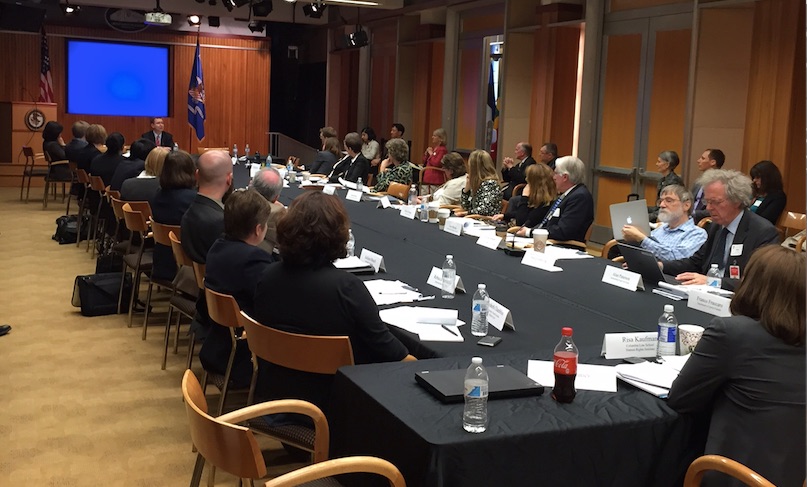
Here are two photos from the event.

Research2

Research1After this meeting, I am even more hopeful that access/legal aid issues will be deeply embedded in the bureaucracy.  We all owe a huge thanks to DOJ’s Access Initiative.  And we should all use and spread the LAIR Toolkit.


Posted in Access to Justice Generally, Dept. of Justice, Research and Evalation | 1 Comment