NYT “Fixes” Column Highlights “Downshift Jobs” as Problem Solver — Consider Legal System Implications

Those who are worried about the emerging trend to use more non-lawyers in the legal system, including perhaps in the courtroom, might be somewhat reassured by the evidence that this approach is being used in other professions.  Indeed, a recent NYT Fixes Column highlights what it calls the “Downshift Jobs” approach to solving problems:

Reading Partners in Charleston, Project ECHO in New Mexico, and Strong Minds in Kampala all rely on task shifting: taking jobs normally restricted to specialized professionals and turning them over to people with far less training in order to reach underserved groups.

At face value, task shifting sounds dangerous. After all, we have professional qualifications for a reason. It takes training and experience to be a good teacher, hepatologist or psychologist. People in those professions have learned things they need to know.

.  .  .

Task-shifting doesn’t necessarily mean second-class care, and sometimes it produces better results than the specialists do. The patients with hepatitis C in rural New Mexico seen by local nonspecialists do better than those seen at the specialist clinic in Albuquerque, possibly because health workers from the same community do better at getting patients to stick to their care plans, and can interact regularly and catch problems early.

.  .  .

Especially when care involves behavioral change, less training can be an asset, not a liability. Who’s better at getting people to improve their eating and exercise habits? A doctor — an authority figure who can spend only 15 minutes and generally learns little about a patient’s life — or a health worker from the patient’s own community, with the same problems, who can visit the patient at home and has the luxury of spending time? Experience indicates it’s the latter.

Task-shifting can be an alternative any time resources are short and people can learn to do a specific activity without the full training specialists receive. Reading Partners succeeds, for example, because it isolated the key components of helping children learn to read, and found a way to teach them clearly and quickly to community volunteers.

Like other forms of task-shifting, this is a money-saver, as volunteers or low-paid workers are stretching the efforts of higher-paid professionals. Such programs also allow people to get access to preventive services, which almost always result in huge savings later. The advantages of task shifting can be summed up in the aphorism: “Don’t let the perfect be the enemy of the good.”

Anxiety about expansion of what some of us are calling “beyond laywer roles” is often expressed in terms of concern to the client.  What this article demonstrates so powerfully that sometimes a less trained person may be better (or rather often that a person who has less formal training but more experience in the specifics of a matter is better), and then even if they are actually not better, clients usually benefit from having something rather than nothing, someone rather than no-one.

With so many innovations in delivery moving forward, those who would restrict innovations bear a real burden in justifying prohibition of such innovations — which is not to say that all regulations are wrong or unjustified, only that the justification needs to be examined and tested.

Posted in Access to Justice Generally, Non-Lawyer Practice, Research and Evalation, Systematic Change, Technology | Comments Off on NYT “Fixes” Column Highlights “Downshift Jobs” as Problem Solver — Consider Legal System Implications

Webinar on IV-D Funding for Self-Help Services — How to TRIPLE Your Money

Awareness is slowly growing that Federal IV-D  funding has the potential to triple state investments in child support and related activities.  Obviously this funding stream, which is not capped, has the potential to help states build out a very significant self-help capacity, that can ultimately be expanded, with funding from other sources, to include areas beyond IV-D.  This is the model that California followed.

With funding from the State Justice Institute, the Self-Represented Network has developed a manual on the potential of this approach, and how to take advantage of this Federal funding.

In addition, the Network, on December 18, is offering a free webinar on the topic, presented by John Greacen, who surely needs no introduction to those interested in access to justice, and Lee Morhar, who was instrumental in steering California through the process of obtaining the funding stream.

Registration information is here.

In addition, it is very important to point out that HHS has issued proposed changes to the Federal regulations governing IV-D and invited comments due January 16. The SRLN is preparing an analysis of these proposed changes, and they will also be discussed on the webinar.  As a general matter, the changes are likely to facilitate the process of obtaining IV-D reimbursements in this area.

When finalized, I will make the analysis available through this blog.

This is important, and we may well look back nationally at IV-D in ten years, as they already do in California, as the tipping point facilitator for statewide self-help.  Please take advantage of this opportunity to learn more.

Posted in Child Support, Funding, Self-Help Services | Comments Off on Webinar on IV-D Funding for Self-Help Services — How to TRIPLE Your Money

ABA Commission on Future of Legal Services Comment Deadline Extended to Dec 20

The deadline for comments to the ABA Commission on the Future of Legal Services issues document has been extended to Dec 20.  I have previously blogged with some ideas.

Here are some more thoughts:

Institutionalized Consumer Input

Should there, perhaps, be more institutions for consumer input into the operation of the profession.  Whatever else one can say, one can not argue that the market is working to align the needs of the public and the profession.

The Role the ABA should play in National Access Advocacy

The ABA is very present on issues such as LSC funding.  And it has supported the creation and networking of state level access to justice commissions.  But its role in advocating for a national voice, national research, national solutions, etc, has been more muted.  How could this be strengthened?

Happy commenting.


Posted in Access to Justice Generally | Comments Off on ABA Commission on Future of Legal Services Comment Deadline Extended to Dec 20

ABA Commission on Future of Legal Services Comments — Now Due Dec 20 — Some Challenging Thoughts

Update:  The comment period has been extended to Dec 20.

+++++++++++++++++++++++

I should have blogged about this weeks ago.  But the due date of Dec 10 for comments on the ABA Commission on the Future of Legal Services has almost crept up on us.

The paper on which we are supposed to make comments asks for reactions on a myriad of issues.  It is here.

The list includes:: Better service, Most important problems in delivering legal and law-related services, Alternative providers and regulatory innovations, Underserved communities, Policy changes, Insights from other fields, Data, Legal education and training, Diversity and Inclusion.

If you are not convinced that this is a massive project, go read the detail.  The issues will be addressed in working groups that are listed in the document.  There are some very fine people on the Commission, and that is a very good sign that making comments is worth the effort.

So, rather than try to address every issue, I am trying to shape a few general points that maybe will be of use to the Commission as they work through these many issues.

Access as the Ultimate Criteria

The Commission needs a framework for assessing the appropriateness of the current situation and of proposed changes.  I submit that there is really only one question.  Does the current system of rules, practices, processes and professions provide access to all?  Given how appalling the answer is, we have to make major changes throughout, and while there may be legitimate disagreements about the potential impacts of the changes, the only legitimate debate is about those impacts on access, not on the profession itself.  If we fail to deploy this perspective, we abandon any claim to self-regulation.

The Outdatedness of State Level Regulation and Structures

Most of the regulatory environment is federal, and it is hard to find real justification for the huge differences in bar admission, professional training, and the like.  They create barriers to entry that are indefensible in economic terms.

The Financial Obligation of the Profession to Access

The massive income levels at the top of the profession (see this article about NY associate bonuses) are destroying the legitimacy of our claims to support access for the poor and middle income folks.  If you take the LSC budget, and a rough average of the bonuses described in the article linked to, it turns out that about 7,000 bonuses would pay the entire LSC budget.  Somebody is going to call us on this one of these days.  We have to find a way for the the vast amounts of money going into legal services (with small letters) to generate at least a tiny percentage for access.  I personally would support a 1% access fee on all legal bills over a set amount or a set hourly fee.  Why not?  Its not going to stop anyone sending their kid to college, and might save a lot of people from disaster.

Management of Pro Bono

I fear that the apparent mismatch between the public reports of self-reporting on pro bono hours and the number of cases is staggering.

DC Bar pro bono full representation clinics represented 438 people according to the December 2o14 issue of the Washington Lawyer, (at page 28). In an obviously inexact comparison, Maryland’s voluntary reporting asserted an average of 31 hours per attorney in the state.  While obviously, there are huge reporting issues, with the definition of “pro bono” being very varied, and this being a comparison between different states, at a minimum we have to conclude that the actual number of full representation pro bono cases can not be used to say that the volume of pro bono shows that the bar is doing all that it can (or else that the system is astonishingly varied between states, and we would have to ask why).

Legal System Simplification

Many of us believe that the underlying problems come from a system that is both procedurally and substantively much too complex, and that access for middle income and poor people will only happen when we simplify.  This needs major and politically very sensitive attention.

Sorry to be so blunt.  And congratulations to the Commission and the President for raising these big questions.  But lets do a good job of doing so.

I encourage all to say their piece to the Commission by December 20 (as extended).  Send to IPcomments@americanbar.org.

Posted in Access to Justice Generally, Attorney-Client, Legal Aid, Systematic Change | 1 Comment

What Might a National Expungement Strategy Look Like?

There is now pretty wide bi-partisan and multi-regional agreement that we have to make the re-entry of the convicted into society much easier, and that expunging prior criminal records will be an important part of this initiative.

While lots of people are working on expungement, and there is at least one great local model (PA)

We really have no national strategy, indeed, not even a list of the elements that such a strategy might include.  So, to help start the discussion, here is a beginning list of such elements.

  • A model statute that states might be encouraged to adopt.  Given the range of politics relating to this issue, I would suggest that the model statute have two sections, a procedural section, dealing with how applications are processed, and a substantive one dealing with what kind of cases get automatic expungement, which ones require application, but are automatically granted, and which ones require discretionary decision making.
  • Model, and perhaps national, software which would allow self-represented application for expungement.  Ideally this would be built to interact automatically with e-filing and caseflow management software.
  • These would have to be multi-lingual
  • Grants to states for implantation of such changes, including self-help services, software implementation, and community outreach.
  • Grants to community-based legal aid programs to provide help and representation in the more complex cases.
  • Various forms of support to courts in states that want to follow New York and simply make the decision not to report out certain kinds of criminal situations beyond the legal system.
  • Research on the impact of broader expungement.  New York is already providing a natural experiment, and other states that deploy in other ways will provide similar opportunities.

Quite apart from the obvious human value of such an initiative, it could also be an excellent driver of much closer cooperation between the civil and criminal sides.  Another opportunity for ATJ Commissions.  This might also be an ideal area for DOJ, including the Access Initiative, to take a major leadership role.

Posted in Access to Justice Boards, Criminal Law, Defender Programs, Dept. of Justice, expungement, Legal Aid, LEP | Comments Off on What Might a National Expungement Strategy Look Like?

Preparing for DAPA: A New Self-Help Need for Court and Community-Based Legal Aid

The State Justice Institute has just distributed a memo on likely ways that the President’s Delayed Action for Parental Accountability program will result in requests for help to state courts.  The nub of the memo is here:

The requirements for DAPA may result in numerous requests to state courts for records, such as arrest records, records of criminal convictions and sentences, and records evidencing family relationships such as parentage, divorce, and child custody. For example, any individual with an arrest record will have the burden of showing to USCIS, on the initial request and as part of any request for subsequent renewal, that the arrest did not result in conviction of any of the crime(s) that preclude eligibility for deferred prosecution. Furthermore, in some cases applicants may need state court records to establish identity, relationship to a U.S. citizen or lawful permanent resident, and length of continuous residence in the United States.

Remember that several million people will be applying for this program, and many may need to establish several pieces of such information for eligibility.

While the program will apparently not start accepting applications until May 2015, surely many people will want to collect this data starting soon.

So it would appear to make sense for courts, self-help centers and community-based legal aid to start planning early on how to handle these requests.  It would be nice to think that access to justice Commissions would take the leadership in developing integrated plans with appropriate division of labor between the various entities.  Some of the more detailed planning will have to await issuance of the regs.

The announcement came from the SJI funded Center for Public Policy Studies Immigration and the State Courts Strategic Initiative.  They plan additional DAPA resources.

,

Posted in Access to Justice Boards, Court Management, Immigration, Legal Aid, Self-Help Services | 1 Comment

Colorado Civil Access Pilot Project Highlights Potential of Simplifcation

The October E-SJI News includes an article on the report by the Institute for the Advancement of the American Legal System (IAALS) on the Colorado Civil Access Pilot.

The core idea of the project which is focused on business cases, is as follows:

The basic idea is that through new pleading and disclosure procedures, all known information comes to light at the earliest possible point. With the disputed facts and issues thus narrowed and framed, the parties and the court work together to determine the extent of additional discovery necessary and to shape a proportionate discovery process focused on enabling a fair resolution. To reduce expert witness costs, each side is permitted one expert per issue or specialty, and all aspects of the expert’s testimony are contained in the disclosed report and files. A single judge provides close case management on an expedited time frame, leading up to a firm trial date.

The evaluation, as reported by SJI, shows that:

The CAPP rules reduce the time to resolution over both of Colorado’s existing procedures (standard and simplified). The rules increase the probability of an earlier resolution over the standard procedure.

Four out of five attorneys in CAPP cases indicated that the time it took to reach resolution in a case was proportionate, and three out of four agreed that the costs to get there were also proportionate.

CAPP cases benefit from management by a single judge, who handles the case much earlier and twice as often.

The CAPP process is not tilted in favor of either plaintiffs or defendants.

The full report is here.  It includes the following:

The judge survey requested an opinion on the overall impact of the CAPP rules during each quarter. Considering all of the surveys administered over the course of the project, a slight majority (51%) characterized the impact as positive, another 28% characterized it as neutral, and 21% characterized it as negative.

It also includes the following tactfully put comment with respect to attorney feedback:

A variety of opinions on CAPP were expressed through the attorney survey, though the suggestion to eliminate the project was more prevalent among attorneys who provided feedback in the comments section than was the suggestion to maintain or expand it. In this respect, the qualitative comments are not exactly consistent with the quantitative data, which show compelling benefits to the project. The objective numbers (the docket data and the case- or quarter-specific survey data) provide insight into the project itself, while the subjective comments provide insight into attitudes in relation to the project. Both perspectives are important, which is why a multiple methods approach to research is valuable.

I would comment that These results highlight the value of experimentation and research in this field.  The core idea, as with so many other innovations, seems to be to increase the role of the judge in managing the litigation.  As such, it is fully consistent with the day to day and often unrecorded changes happening nationally, and perhaps worldwide, with self-represented cases, which simply cannot move forward without such involvement.

This consistency should make the process of overall reform much simpler, if only because it may be possible to create flexible rules that can apply to both attorney and non-attorney cases, something that I would far prefer if at all possible.

I do suspect however, that including non-lawyer, and lawyer on one side only cases will require even more flexibility, a lager role for the judge, particular in areas in which judicial supervision has been largely absent, such as discovery, and shifting more and more of management of the flow of information directly to the court.  Thus court-driven, if limited, mandatory discovery may be critical.  So may be far greater court involvement in the compliance and enforcement phase, which is still essentially unreformed since the 19th century.

It would be fascinating to have more information on the impact on the self-represented cases.

P.S.  IAALS has a nice map chart of their involvement in these experiments nationally.  Federal court discovery and e-discovery seem to be the main areas of movement.

Posted in Court Management, Rules Reform, Simplification | Comments Off on Colorado Civil Access Pilot Project Highlights Potential of Simplifcation

Some Observations on the Newly Updated Justice Index

The National Center for Access to Justice recently put in place a number of corrections offered by 21 states to the Justice Index, so its time to take a look and see what we learn.

The most important point is that 21 states did correct data — in other words they care enough about their score to do so.  This is very reassuring, since it means that states are not putting their energy into debunking the score, but rather want to look good.  Hopefully this means that the Index is doing just what it was meant to do — help generate a “race to the top.”

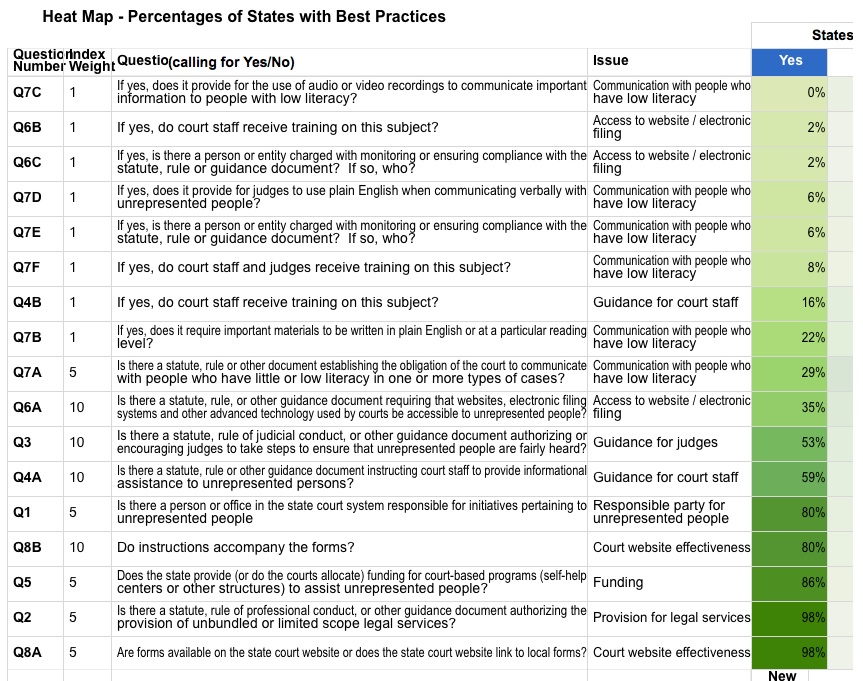
From a national policy point of view, sorting the best practices charts to show the penetration of each practice is fascinating.  Here is the sorted chart for self-represented best practices.

best-srlAs a general matter, it is notable how many of what I think all would now agree ar e”Best Practices” are scoring relatively low (e.g. 8% training on low literacy communication; 16% training on guidance for court staff on handling SRLs; 53% court guidance for judges.)

Moreover, even the good scores raise questions, as all data should.  You can see that 98% of states report at least some forms available — showing that there is a theoretical consensus about the value of forms.  (That last state had better get a move on!)  Of course this tells us nothing about how many states have anything like the full suite of needed forms.  I am deeply skeptical that many do, and take this result more as showing that while the principle is largely accepted, there is still a huge amount of work to be done even in this focused area.  Nor does this number deal with plain English, with automation, e-filing, or “mandatory acceptance” — that there is a form for each situation that every court in the state must accept.  I am confident that the next version of the Index will delve much more into these issues.  This analysis also highlights how valuable the Index is as a beginning point for discussion.

I would encourage states to see how they do in these individual comparisons, and try to understand why they are off where they should be.  Given the overall scores, no one should be discouraged, and all  should be challenged.

I would similarly urge those involved at the national policy level to use all these results, in each of the four areas, to help build an overall picture of where the opportunity and need is most focused.

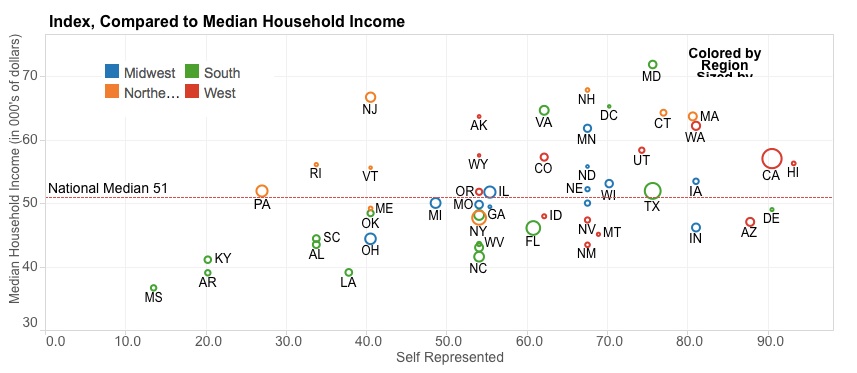
On a different topic, I am also struck by the fact that SRL access scores does correlate, but only relatively weakly with median income.

SRL-IncomeThe formal statistical tests would be interesting, and others may disagree, but it seems to me that while there is a some correlation, particularly for the very poor states, there is a quite a lot of distance from the line.

Finally, I hope to blog soon about the exciting range of local attention this, and other innovations are receiving.  I think we can thank Voices for Civil Justice –as well as all those who cooperate with it — for the fact that the media is finally “getting it.”

Congratulations to all who made this project possible.  The range and size of the team is itself an important lesson.


Posted in Access to Counsel, Access to Justice Generally, Forms, Justice Index, Legal Aid, LEP, Plain Language, Self-Help Services | Comments Off on Some Observations on the Newly Updated Justice Index

If Pilots Have to Pass Simulator Tests, Why Not Cops

There are now probably more people killed by police shootings than die in air crashes each year, and we insist that pilots get all kinds of simulator tests before they get to fly what can be killing machines.  Why not similar testing for cops?  Indeed, simulators do exist.

The real dilemma in these police shooter cases comes from the fact that the problem is not that white cops want to kill blacks, rather it is that their deeply ingrained and often unconscious racism makes it hard for them to make objectively correct split second decisions.  Then, grand juries apply a subjective standard (did the cop really believe he was in danger), and then, because he did, there is no punishment, and much natural anger.

So the solution is that before a cop can be approved for patrol duty, they have to pass a simulator test in which they have to deal with varied situations that include both those that are objectively ones in which deadly force is justified, and those in which it is not, and of course with different racial configurations.  That would mean that cop candidates can not pass by just never using deadly force, but rather that their ability to analyze and react quickly is properly tested.  The result, particularly after proper training, would surely be better and more confident policing all around.  There is research suggesting greater reluctance to shoot blacks, which would mean both that this is much more complicated that it might seem, and also that such testing might be successful at finding the minority for which this is not true.

Note: This post has been updated to reflect that such simulators are available, and that the research shows how complicated this is.


Posted in Criminal Law | 2 Comments

NYT Publishes First Article on Comprehensive Changes in Legal Aid (Broadly Defined)

Showing the huge value and potential of a coherent communications strategy for the legal aid world (broadly defined to include both community-based and court-based legal aid) the New York Times on Saturday published its first real comprehensive article on the changes occurring in the sector.

Instead of the usual stuff on the extent of the problems, the article goes into a broad range of innovations, including the potential of self-help services and non lawyer advocates, and the Shriver Pilots in California, as well as the civil Gideon push.

While everyone should read the whole thing — if only to know what may now be much more in other people’s consciousness — I want to draw attention to a few points.

  1. This article shows the huge value of the communications initiative funded by the Public Welfare Foundation and Kresge.  Congratulations to Voices for Civil Justice and the funders, as well as those mentioned and/or who helped.  (I understand that this was a collaborative effort.)
  2. The article also shows the strength and effectiveness of pointing to innovations and successes, rather than just the endless litany of funding complaints.
  3. The article shows the value of a comprehensive approach, far more appealing to the lay reader or policy person.
  4. The article represents an important step in moving public perception about the meaning of “legal aid” to including court as well as community based components.
  5. One thing still missing is attention to the need to simplify the underlying court processes, and the extent to which much broader of these innovations can lay the groundwork for this — but that is for another day. (Note: I stand corrected.  There is an excellent quote from Deborah Rhode on this very topic.)
  6. Hopefully the article, together with Voices, will help persuade the legal aid community and the bar about the value of this comprehensive approach, and get away from a focus only on traditional lawyer-centric approaches.

Its a good step forward for the way the world sees us, and should also teach us a lot about messaging.


Posted in Access to Counsel, Communications Strategy, Legal Aid, LSC, Non-Lawyer Practice, Political Support, Self-Help Services, Systematic Change, Triage | Comments Off on NYT Publishes First Article on Comprehensive Changes in Legal Aid (Broadly Defined)

Michigan Judge Inadvertantly Underlines Need for Changes in Language Access

In a week during which we have been given another opportunity to reflect upon the benefits of integrating people from all backgrounds into our richly varied country, we are — albeit unintentionally — reminded by a Michigan Judge of how far, even a system that is supposed to be about justice, has to go.  We are also given hope that the court system understands its responsibilities.

As reported by the Michigan Oceana County Press, Judge Terrence R. Thomas, of that state’s 27th Circuit, became annoyed when a defendant facing a cocaine possession charge brought an interpreter to court, rejecting his plea offer:

Thomas scolded Juan Leonel Estrada for wasting the court’s resources. “You don’t really need an interpreter,” Thomas said.  “You don’t impress the court by using another resource of the court that you don’t need.”

Estrada’s attorney, Doug Springstead, told the judge that Estrada is “fairly fluent,” but utilized an interpreter because he was nervous and doesn’t understand legal language. “The legal vocabulary is different from the English vocabulary,” Springstead said.

“It is for everybody,” Thomas retorted.

“I’m not going to play these games with this baloney,” the judge said. “Why is this court paying for a translator? I think you’ve misused the process of the court. I think you’re playing a game with me.”

.  .  .

The judge was so irked that he rejected Estrada’s plea and set the case for trial. “You’re going to pay for a translator at trial,” he told Estrada. “We’ll set the trial for as early as we can before the end of the year, and he might learn English in the meantime.”

In a final incomprehensible burst the judge ordered him to surrender his driving license:

“If you can’t understand English, how the heck did you get a Michigan driver’s license?” the judge asked. “You will surrender your driver’s license today.  Anybody who has a driver’s license and doesn’t understand English can plead guilty to a cocaine charge.  He’s getting his driver’s license suspended until he understands English and is safe on the road. He’s a threat to the public.

 When given an opportunity by this blog to comment, the Michigan Courts replied:

The Michigan Supreme Court and the State Court Administrative Office are committed to steadfast compliance with court rules regarding protections for persons with limited English proficiency (LEP).  We are aware of this case and will ensure the local trial court is fully cognizant of its responsibilities under MCR 1.111. [Interpreter rule – link added]

It does not take a lot of skill to read between the lines of this response.

More generally, however, we have to ask what changes in the system would help avoid these kind of embarrassing events. (see , e.g., my recent posts on the “electric shock judge”.)

P.S. We now also hear from the Oceana County Press that Judge Thomas has asked to be appointed Sheriff upon his mandatory retirement from the bench on Jan 1, triggered by his age.  No comment needed or offered.

Update:  a new pretrial date has been set, and “’I am certain that the case will move forward, and there will be a resolution acceptable to both sides,’ said Estrada’s court-appointed attorney Doug Springstead.” according to the Oceans County Free Press.

Posted in Judicial Ethics, LEP | Comments Off on Michigan Judge Inadvertantly Underlines Need for Changes in Language Access

Proven Value of Timely Texting of Tips Might Extent to the Justice World

A recent report in the New York Times descried a study that showed that low income children’s reading skills improved very significantly when parents were texted timely reminders about how to help their kids learn:

A new study shows that mobile technology may offer a cheap and effective solution. The research, released by the National Bureau of Economic Research this month, found that preschoolers whose parents received text messages with brief tips on reading to their children or helping them sound out letters and words performed better on literacy tests than children whose parents did not receive such messages.

According to the abstract:

We find that READY4K! [the tool tested] positively affected the extent to which parents engaged in home literacy activities with their children by 0.22 to 0.34 standard deviations, as well as parental involvement at school by 0.13 to 0.19 standard deviations. Increases in parental activity at home and school translated into student learning gains in some areas of early literacy, ranging from approximately 0.21 to 0.34 standard deviations.

While obviously one should be careful about over generalizing, this study got me thinking more about the possible value of courts offering to text and email clients not only with reminders about court appearances and obligations, but also with links to tools that can help them prepare or even fulfill obligations.  For example:

  • Videos of the judge before whom people are to appear, showing their personality and what they expect
  • Lists of materials and evidence to bring to court, and tips on how to obtain and authenticate them.
  • Reminders about child support obligations, and how to make and document payments
  • Reminders about visitation times and conditions
  • Reminders about due dates for court and for the filing of papers
  • Links to document assembly programs to prepared required filings

The list is of course endless, and many of the possibilities apply just as much for a legal aid programs reminders to their clients, or an unbundled lawyer’s reminders to a client (caution that sending a reminder might impose additional obligations beyond the scope of the agreement.)

In any event, I remain confused about why so few courts make use of this simple and relatively cheap technology.  Maye this is an LSC/SJI opportunity to create a standard system that could interface with the major case management software in both court and legal aid worlds.  Obviously, such messages should be one of the products of any integrated portal.

If anyone knows why these systems were not deployed years ago, please let me know, and we can try to figure out how to get beyond the barriers.  (I would hate the think that the reason is that the content is not yet developed — if so, maybe an initiative like this would push the development of the content.)

Posted in Court Management, Technology | 3 Comments

Part IV of “Assessing Innovations,” The Private Sector Legal Market

Previous posts in this series have offered cost-benefit, rights-oriented  and “targeted representation” approaches to analyzing whether innovations should be viewed as appropriate.  This post asks the same question about innovations in the private sector market, although with more of a focus on human-delivered services.

In an unregulated market, of course, we don’t need to analyze it.  “If it buys, it flies.”

But the legal market is highly regulated, with strict limits on both human-provided legal service and constraints upon technology-enabled services that also derive from those strict limits which were originally written long before the possibility of technology in the delivery of the legal services.  (And I include the ball point pen and the photocopier in the definition of “before.”)

The initial additional complexity in the private sector comes in part from the fact that there are multiple decision-makers, the individual buyers.  I think the way to analyze  the problem is consider:  “At what point do we think the benefit of potential additional intermediate and lower-cost services that individuals choose to purchase is outweighed by the harm caused by individuals choosing to to purchase services that in fact do them more harm than good?”

When analyzed that way it becomes clear that the answer depends very much on the regulatory structure — not just who is allowed to do what, but how those limits are enforced by qualification and training requirements, and by enforcement of consumer protections.  Since it is not politically hard to get such consumer protections, given the strength of the organized bar, it seems reasonable that the analysis should assume that strong protections are in place and enforced.  Therefore what is permitted should not be reduced based on the worry that authorized non lawyers will do more than they are permitted and qualified to do.  (Although when such services are very strictly limited, there is often an underground market that is largely unregulated.)

Put this way, in the private sector analysis of the question becomes much more simply how to draw the line so that the tasks authorized are those that can competently be done by those individuals or those technologies authorized.  This is done by looking at the specific tasks and deciding what skills and competencies are needed to be able to perform them by the individuals.  It may well be that this specific analysis may be more productive than many of the general philosophical discussions currently taking place.  Moreover, this analysis will vary very much with the substantive area of law, and the custom and practice of the legal system in the jurisdiction.

I welcome additional thoughts on the topics raised in this series.


Posted in Non-Lawyer Practice, Systematic Change, Triage | 1 Comment

Evaluation of Idaho Informal Custody Trial Raises Interesting Questions

For several years, Idaho has been experimenting with an “Informal Custody Trial” (ICT).  They have recently released the evaluation, and we have permission to post it on this blog here, Informal Custody Trial Evaluation Report.

Big kudos to the state for the experiment, and for evaluating it.  As so often, these pioneering experiments raise more questions than they answer, and this is an important contribution.  As described in the evaluation:

On September 29, 2008, Idaho Rules of Civil Procedure 16(p) was adopted to include a Consent and Waiver for Informal Custody Trial (ICT). The basic premise of the ICT is suspension of the formal rules of evidence, waiver of the rules of discovery, and waiver of the normal question and answer format of trial that allows litigants to directly present their case, issues, and concerns to the court. The ICT model excludes cross-examination, a procedure that can increase conflict in an already highly emotional and often hostile environment.

In the ICT model the judge still directs the proceeding, allowing the parties to speak, and the judge is allowed to ask parties additional questions designed to clarify and keep the testimony focused. Although the parties waive their rights to formal rules of evidence and other trial rights, including the right to direct and cross-examination, the judge still hears the evidence, makes a decision for the parties, and enters the orders based on his or her decision. This decision may consist of creating, modifying, or enforcing an order.

Based on observations of court proceedings around the country in recent years, this Idaho procedure may reflect the standard procedure in many states for dealing with cases in which both parties are self-represented, Judges take control of the courtroom process and proceed in this informal manner – ignoring the standard question and answer format of presenting evidence and using the rules of evidence only as a guide to the weight to be given to evidence introduced. The major difference is with respect to waiver of the formal rules of procedure: under the Idaho ICT there is a formal, written waiver; in other jurisdictions there is no such waiver.Some of the more detailed findings from the Idaho ICT are described as follows:

An encouraging finding is that 73% of parents reported that they understood the ICT before agreeing to participate. The data also shows that parents overall more often than not agreed that the ICT was fair (56%), focused on the best interests of the children (57%), that decisions made were good for the children (55%), and were glad they had decided to do an ICT (57%). Of note, statements on whether or not the ICT focused on the best interests of their children or whether the decisions made were good for their children garnered the most “strongly disagree” responses (36% strongly disagreed/disagreed for both statements). Also of note, parents were the most evenly split on perceptions of whether or not the ICT model decreased conflict: 34% agree/strongly agree, 31% neutral, and 34% disagree/strongly disagree.

Parents were also presented with two questions about their perceptions of the judge presiding on their case. The majority of parents (74%) agreed or strongly agreed the judge treated them with respect, and 60% believed the judge listened to them.

 As the report itself emphasizes, there was no survey of those who did not participate in the ICT, or affirmatively chose to refuse participation, so there are obviously huge limits to the inferences that can be drawn, but at least questions can now be asked about what might have shaped these results.

Some of the most interesting data comes from the second half of the study in which the participants were asked about the outcome.

 In the middle of the data collection period, it was determined that the parent survey should be enhanced with an additional statement: “The outcome of the informal custody trial was in my favor.”  This statement was added in order to better understand the extent to which the outcome of the ICT influenced parent responses to other survey questions.

Thirty-two (32) of the 75 respondents completed a survey with this additional question. A comparison was then done of those who believed the outcome was in their favor to those who did not believe the outcome was in their favor. Individuals who agreed or strongly agreed the outcome was in their favor also more often believed the ICT was fair, focused on the best interests of the children, and believed the decisions were good for their children.

 The report cautions that “This is a small number and making conclusions on this data is discouraged. The data presented is for informational purposes but cannot be considered conclusive. More study is warranted.”

Bearing that caution strongly in mind, however, the data is interesting:

As a general matter, it is unavoidable to conclude that litigants’ views were very significantly correlated with the outcome, and the extent of this effect (0% versus 100% for one question) means that even a small sample must be viewed with respect.

One the other hand it is interesting that more of the “outcome not in favor” group thought that the judge “listened to me” (23%) or “treated me with respect,” (42%) than that the ICT was fair (0%).

When I first read these results (and indeed for a time afterwards), it seemed to me that they were profoundly inconsistent with the procedural justice research, which teaches us at the most general level, that litigant satisfaction is driven more by how people are treated – specifically by whether they feel listened to, treated the same as the other side, treated with courtesy and respect, and whether they trust the judge – than by whether they win or lose. This, of course, is not consistent with the general expectation of the bar or judiciary, and this research has had a huge impact on facilitating a discussion within the judiciary about engagement as opposed to passivity.

The Idaho study collected data on two of the four procedural justice factors, but not on the other two (an even playing field for the participants and trust in the judge as a benevolent figure who cares about the parties and visibly seeks the best resolution of the proceeding. If fact, from this research we do not know enough about what really transpired in the ICT courtrooms to suggest an explanation of the high correlation of negative feelings about the process and the litigant’s perception of losing the case. However, the findings are sufficiently disturbing that they warrant further such studies. Idaho will soon begin implementing new family court rules under which the rules of evidence will be inapplicable in all family law hearings unless both parties stipulate to their applicability. Idaho would be well advised to continue to gather data on litigant outcomes and litigant satisfaction under the new procedures, perhaps with the addition of a control group of cases in which the parties opt to make the rules of evidence applicable to their hearings.

In any event, forcing people to surrender formality is a path, regardless of constitutionality, that should be treated with great caution.

In the end, it is our job to ensure engagement and fairness regardless of procedural environment, as well as to understand what procedural environment best produces engagement and fairness.

Much more generally, obviously, as pointed out in the Report, we need proper control data, and really a randomized experiment, in which some would be offered, and others would not, the ICT.

Similarly, we need better data on what happens in actual ICT cases, and thinking about which procedures should be waived.  I, for example, would prefer to full waiver of cross examination, a system in which the litigant is asked by the judge if there are any questions that the litigant would like the judge to ask the opposing party.  This seems to work quite well in some administrative procedures, such as New York unemployment hearings.  While it does away with the element of surprise, it keeps the value of the admission by the opponent, which is far more useful that the assertion by a party on their own behalf.

This is totally speculative, but it might also be that additional judicial probing skills might increase the sense of fairness. In particular, I think that when a judge feels that a litigant has not carried the burden on an important element, the judge should so inform the party and ask if they have any other evidence.

More generally, we should be thinking about how to design a new set of friendlier procedures that nonetheless improve satisfaction and also actually improve substantive outcomes (an issue not explored at all in this evaluation, yet obviously critical.)

All in all, there is lots here to think about, as we try to make the system that deals well with the reality that most people just do not have lawyers.

Note: Special thanks to John Greacen, who helped particularly with this post.  Opinions and faults remain my own.

Posted in Court Management, Judicial Ethics, Research and Evalation, Systematic Change | Comments Off on Evaluation of Idaho Informal Custody Trial Raises Interesting Questions

Part III of “Assessing Innovations”: Guest Post by Russell Engler on the Targeted Representation Approach

I am happy to guest post Russell Engler’s helpful and insightful response to Part II of my series on assessing innovations.  Part II focused on a rights-oriented analysis.  Russell writes about what he calls the “targeted representation” approach as follows:

+++++++++++++++++++++++++++++++++++++++++++++++++++++++++

There are a broad range of views among Civil Right to Counsel /Civil Gideon advocates, which are not fully represented in Richard’s discussion.   The apparent either/or choice Richard describes is between a categorical right to counsel, in which everyone with a certain type of case gets counsel, or individualized system in which the right is determined on a case-by-case basis. I believe this analysis misses the targeted represented option which is in between, and frankly fits the notion of triage.

The targeted representation approach involves the identification of subcategories within certain substantive areas, and triggers to identify them.  The subcategories could be all elders, minors or people with disabilities or children, within such a substantive category.  They could instead be gleaned from factors related to power imbalances, with or without a merits screen.  But once the trigger is identified (or features identified in a jurisdiction or type of proceeding) the right kicks in.  Outside the scope of the subcategory, there still would be the right/obligation to have the court look at the matter on an individualized basis.  But the subcategory analysis avoids putting the demonstrative burden of proving the RTC on the vulnerable litigant most in need of counsel and ill-equipped to prove the need.  The litigant who can articulate the need for the right and carry the burden is probably less likely to need counsel. In my view, the targeted representation model flips the burden in a crucial way, and better protects the most vulnerable litigants without putting them in the impossible situation of having to prove the need for counsel in the face of a system that resists appointment.

This targeted representation approach is certainly the one embraced by Civil Right to Counsel Advocates in Massachusetts, as reflected in two reports identified below. In California, the Sargent Shriver pilots projects are consistent with the targeted representation approach, involving a sorting of cases, both in the housing and custody area, based on a series of factors that lead some clients to receive full representation and others limited representation. The Civil Right to Counsel in the immigration area is evolving this way as well (unaccompanied minors and people with mental disabilities, so tied to capacity, though note the push for full representation in NYC for detained immigrants, with a cost savings justification).  The approach is also consistent with some of the City Council ordinances championed by housing advocates in NYC- one version provides counsel for seniors facing eviction, while a second provides counsel for all families with children (a third would provide a more comprehensive right to counsel ion eviction proceedings)

For those unfamiliar with the developments in the areas I have described, I list below resources for more information. My main point is to move our collective thinking past the point of either/or analysis and to a consideration of the targeted representation approach. The line-drawing can be painful, but where consensus can be reached in a jurisdiction about subcategories, the approach offers the promise of protection for many vulnerable litigants facing loss of their basic human needs without the automatic requirement that full representation must as a result be available to every litigant in a substantive category even in the face of evidence that lesser forms of assistance might achieve comparable results.

The links, or citations, below provide more information on the initiatives referred to above, including 1) the two reports from Massachusetts, 2) two articles by Clare Pastore describing the Shriver Pilots in CA, 3) links to litigation and reports in the Immigration area and 4) links to the NYC housing ordinances.

Massachusetts Reports:

Boston Bar Association Task Force on Expanding the Civil Right to Counsel Gideon’s New Trumpet: Expanding the Civil Right to Counsel in Massachusetts, (2008). available at https://www.bostonbar.org/prs/nr_0809/GideonsNewTrumpet.pdf

The Importance of Representation in Eviction Cases and Homelessness Prevention: A Report on the BBA Civil Right to Counsel Housing Pilots (March 2012)( The Importance of Representation).  http://www.bostonbar.org/docs/default-document-library/bba-crtc-final-3-1-12.pdf.

 California- Shriver Pilots

Clare Pastore, “Gideon is My Co-Pilot: The Promise of Civil Right to Counsel Pilot Programs,” 17 U.D.C. L.Rev. 75 (2014)  http://www.udclawreview.com/wp-content/uploads/2014/08/GIDEON-IS-MY-CO-PILOT-THE-PROMISE-OF-CIVIL-RIGHT-TO-COUNSEL-PILOT-PROGRAMS.pdf

Pastore, Clare, California’s Sargent Shriver Civil Counsel Act Tests Impact of More Assistance for Low-Income Litigants, Clearinghouse Review Journal of Poverty Law and Policy, 47 Clearinghouse Rev. 97, July-August 2013

 Immigration

Franco-Gonzalez litigation (mental capacity)

https://www.aclu.org/immigrants-rights/franco-gonzales-v-holder

JEFM litigation (unaccompanied minors)

The case, J.E.F.M. v. Holder, was filed in U.S. District Court in Seattle, Wash.

The Complaint is available at: http://legalactioncenter.org/sites/default/files/Counsel%20Complaint.pdf

NYC Report on Cost Savings involved in representing detained immigrations facing deportation:

http://nylawyer.nylj.com/adgifs/decisions14/060214report1.pdf

NYC Housing Ordinances

http://www.civilrighttocounsel.org/major_developments/829

Posted in Access to Counsel, Systematic Change, Triage | 1 Comment