LSC Issues Pro Bono Innovation Fund Notice of Funds Availability — Applications Due June 30, 2014

Here is the Pro Bono Innovation Fund 2014 Notice of Funds Availability.  The applications, which must be filed by an LSC grantee, are due June 30, 2014.  It is important to emphasize that LSC welcomes grants that include extensive participation, including potentially expenditures, by non-LSC grantee entities.

The program is modelled extensively upon the TIG program, and would surely have not been funding by Congress without the recognized success of TIG.  The goals are described as follows:

Address gaps in the delivery of legal services to low-income people.

Engage more lawyers and other volunteers in pro bono service.

Develop and implement new, innovative, and replicable strategies that address persistent challenges in pro bono delivery systems.

The grant criteria are very broad within the pro bono context:

In the pilot year of the Pro Bono Innovation Fund, LSC will welcome applications in a wide variety of areas without targeting its FY 2014 grant making to specific areas of interest. Consistent with the key goals of the Pro Bono Innovation Fund, however, applicants are encouraged to consider developing project models that offer novel and replicable solutions to persistent challenges in their current pro bono delivery systems. Such challenges and solutions may include, but are not limited to:

  • Addressing duplicative or fractured pro bono efforts by forming partnerships with pro bono and community stakeholders or adding new partners to existing collaborations (e.g., working with state and local pro bono committees, specialty and minority bar associations, aligning with state Access to Justice Commission initiatives, and complementing self-represented litigant efforts).
  • Using technology to streamline the process of matching, supporting, and training pro bono volunteers.
  • Developing strategies to bring pro bono services to the locations and communities where clients reside or are accessing services (e.g., medical-legal partnerships, mobile or remote services for rural populations, or adopting a neighborhood), particularly for hard to reach populations.
  • Developing quality controls and setting goals for timely, effective pro bono work. This can include technology solutions and/or innovative ways to provide more mentoring, training, and support for volunteers (e.g., designating experienced volunteers to mentor newer pro bono attorneys, developing process improvements to share resources through common data portals, and sharing case updates and files with shared case management systems).

Here are some ideas:

  • Replicating successful pro bono innovations such as self-help center based pro bono clinics, attorney of the day programs, and programs that focus pro bono resources on cases that are almost ready for resolution.
  • Development of replication kits and technical support for such proven innovations.  It might be that LSC would be particularly interested in grants that would provide results quickly, helping to make the case for additional ongoing innovation funding.
  • Systems to promote corporate or other partner pro bono such as that highlighted recently at the White House.
  • Better data collection on the extent and impact of pro bono.
  • Systems to compare the effectiveness of different systems of pro bono administration, and identification of related best practices.
  • Programs to gather data on, and analyze the impact of, changes in bar rules that encourage pro bono.
  • Tools to measure attorney satisfaction with pro bono, and identify ways to improve matching clients with attorneys.
  • Experiments in use of attorneys and others in online chat and phone systems that provide information and advice.

This is a huge opportunity to demonstrate to funders that community-based legal aid is an innovative and effective delivery system.  It could also be the trigger for additional competitive innovation incentives in the future.  Examples might be in triage, collaboration with courts generally, collaboration with the private sector, mixed model innovation, etc.

Important Additional Note:

I have confirmed from LSC that the “Pro Bono Innovation Fund project activities are not limited to those activities that meet the current substantive requirements of the PAI rule, 45 C.F.R § 1614.  For example, a project that sought to engage law student volunteers would be fine.

Posted in Funding, LSC, Pro Bono, Self-Help Services | 2 Comments

That Deborah Leff is to Run the Pardon Office and The Expanded Clemency Program Highlights Importance of ATJ in Federal Government

The DOJ plan to expand access to clemency to “nonviolent felons who have served at least 10 years in prison and who would have received significantly lower prison terms if convicted under today’s more lenient sentencing laws” as the Times puts it, has received, as it should, broad media coverage.

But for the access to the justice community, the real headline may be buried at the end of the Times story.  Deputy Attorney General James M. Cole “also announced a new leader of that office, Deborah Leff, a Justice Department official who has worked to give poor people access to lawyers.

That the acting head of the Access Initiative, who has been working hard to support effective indigent defense, is now in charge of the pardon process, replacing an incompetent at best former prosecutor, reinforces that this is now truly a “Justice Department” and sends a powerful signal of balance.

As the Times editorial put it:  “Mr. Rodgers is being replaced by Deborah Leff, who runs the department’s Access to Justice Initiative, which works to increase legal representation for people who cannot afford it. By all accounts, Ms. Leff has a deep understanding of the complex and politically sensitive issues at play.”

Of course, this also leaves the Access Initiative itself even more desperately understaffed just when its importance and potential have been underlined.

Well earned congratulations to Ms. Leff, both for her wonderful work and for the promotion, and lets hope the administration moves very quickly to fill the gap on a permanent basis.

Posted in Criminal Law, Dept. of Justice, White House | Comments Off on That Deborah Leff is to Run the Pardon Office and The Expanded Clemency Program Highlights Importance of ATJ in Federal Government

Canadian ATJ Report is a Model for the World

The Canadian Action Committee on Access to Civil and Family Justice, has issued its Report, Access to Civil and Family Justice: A Roadmap for Change.  (It was issued on October, and I am long overdue in my report on a very important document — my apologies.)  The Committee is chaired by a Justice of the Supreme Court, Thomas Cromwell, and was established at the urging of Canada’s wonderful Chief.  I list some of the members at the end of this blog.

I must emphasize at the beginning of this blog that no summary or extracts can do justice to its comprehensiveness.  I urge you to look in the table of contents for the areas in which you have most interest, and look for the specific language. I promise that you will find most if not all of them there — it is that complete.

While the Report brings together into one overall action plan directions that lead from the conclusions of the four working groups about which I have previously blogged, it goes way beyond those conclusions in its intellectual grasp, its ambition, its comprehensiveness, and the force for the future it represents. Continue reading

Posted in Access to Justice Generally, International Cooperation, International Models | 1 Comment

The Legal Aid Interagency Roundtable Toolkit is a Major Breakthrough

Before the establishment of the Access to Justice Initiative within DOJ, Federal funding for community based — indeed all — legal aid was basically limited to LSC, with maybe odds and ends, usually through state routes, for senior services and domestic violence victims.

This week, with the release of the Legal Aid Interagency Roundtable Toolkit, all that is changing.  The Toolkit, launched at the White House Forum last Tuesday, and conceived and staffed by the ATJ Initiative at DOJ, is at one level a set of tools for legal aid programs — community, court or bar based — to identify and apply for possible funding for their work.  That’s incredible, with seventeen agencies involved in the Roundtable, which by the way, is chaired by Associate Attorney General Tony West and  Tonya Robinson, Special Assistant to the President, Justice & Regulatory Policy.

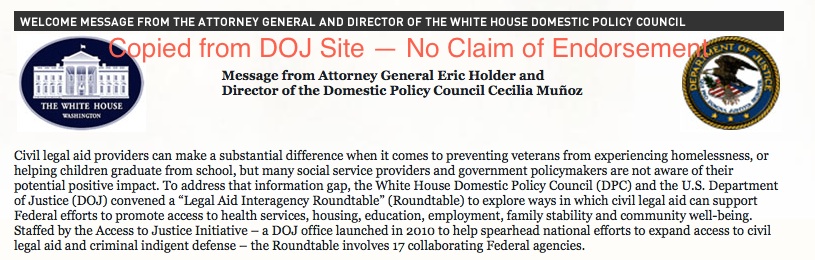
But perhaps even more important that the concrete resources in the toolkit is the message sent loudly by the presentation and framing.  The main intro includes this graphic:

wh-doj-2The message to the bureaucracy is very clear.  The administration is on board with this approach.  That the Civil Legal Aid 101 document starts with a quote from the President, “[civil legal aid is] …central to our nation of equal justice under the law,” hardly undercuts this message.  While, of course, funding decisions are made on the merits, affirmative statements of the value of programs by such leaders help make sure that programs are given appropriate attention, where often in the past they have not been considered beyond LSC. Continue reading

Posted in Dept. of Justice, Funding, LSC, White House | 1 Comment

Justice Earl Johnson’s Remarkable Book on the History of Legal Aid

I am proud to be able to share with the readers of this blog the Prologue of the remarkable recently published book by Justice Earl Johnson Jr. (ret).  The three volume work is a history of legal aid since the very beginning (1876).

In the Prologue, Earl places himself, and the history, firmly on the side of a comprehensive and change-oriented view of the movement:

This book tells the story behind our nation’s tardy and as yet unfinished effort to make those people unable to afford lawyers equal to those who can—and thus for the first time establish justice for that segment of the population. That effort is usually called “legal aid” or “legal services for the poor.” “Legal aid” is not exactly a term that conjures up images of turmoil and controversy in most peoples’ minds. It sounds so much like “first aid,” and “band aid,” and similar help for those in trouble it is difficult imagining why anyone would oppose it. Yet for most of the last half century, legal aid for poor people has been a major political and ideological battleground, a target of nearly constant assaults from the right wing of U.S. politics as well as some powerful politicians and wealthy campaign contributors.

In a sense it has been a contest over two visions of what poor people deserve in the way of legal aid. To analogize to health care—should the government only provide them a network of first aid stations or should it also give them access to specialists and hospitals when they have serious illnesses. The code words for the first aid station approach in the legal aid context is having offices that limit their mission to just taking care of poor people’s “everyday” or “routine” problems. The language describing the broader vision started with the very first legal aid society, which included in its mission “promoting measures for their protection.” During the war on poverty it was called “law reform” and later was labeled “impact work” or “high-quality legal services.”

Earl also describes in the Prologue the range of his exploration:

The book is divided into six parts published in three volumes—each part consisting of several chapters and covering a different historical era. Volume one contains two parts—first, the Charitable Era from 1876 through 1964, when civil legal aid depended entirely on the generosity of private donors, mainly wealthy ones; and second, the war on poverty era, from 1965 through 1974, when civil legal aid became part of the war on poverty as the OEO legal services program when it earned headlines and enemies aplenty.

The second volume also has two parts: first, the attempt to rescue the legal services program when the war on poverty collapsed by creating an independent Legal Services Corporation, a rescue effort that took nearly four years, 1971–1974, and second, that corporation’s first dozen years, 1975–1992, which early on brought great progress followed by a brush with extinction.

The third volume contains the final two parts. The first relates the congressional constriction of access to justice for poor people and how that has affected the nation’s civil legal aid system, 1992–2008. The final part contrasts the development of legal aid in the United States with its evolution in other industrial democracies, then speculates about its possible future in this country.

Earl is now disinterested observer — nor does he present himself as such.  He was very much “present at the creation,” deeply involved with Gary Bellow, Edgar and Jean Cahn, and Clint Bamberger in the development of the original OEO program.  Most recently, he has become the national guru of the civil Gideon movement, and one who understands the importance of making full use of the continuum of services.

This is written by someone who participated in some parts of that history—rather than a completely detached observer. I was at the center of events for a few years and active at the periphery for many others. I started as a poverty lawyer in the ghettoes of Washington, D.C., then became the first deputy director and second director of the federal government’s first program funding legal representation of the poor—the OEO’s Legal Services Program. Later as a member of the National Advisory Committee to the OEO Legal Services Program, I was one of a number of people involved in the legislative campaign that ultimately created the Legal Services Corporation. This independent public corporation took over from the OEO program and now continues to administer the federal government’s funding of legal services for the poor. Later I was appointed as an appellate judge in California, and remained interested but largely uninvolved in events affecting the Legal Services Corporation at the national level, while becoming active in access to justice initiatives at the state level in California.

Its a great book (Amazon link here).


Posted in Access to Justice Generally, History, LSC | Comments Off on Justice Earl Johnson’s Remarkable Book on the History of Legal Aid

Glenn Rawdon’s Visionary White House Speech is About 100% Access, And More, Not Just About Technology

Glenn Rawdon’s speech titled Everyone, Anytime, Anywhere at the April 8 White House Forum on Increasing Access to Justice was about far more than technology.  After describing how Bill gates talked in 1999 about technology convergence, the history of the TIG program, and the recent LSC Technology Summit Process, Glenn went on to talk about how the vision went beyond the tools to the access vision.

This is a vision for the convergence of the technology — for unified systems to achieve the ultimate goal enunciated in the Summit’s Mission Statement, that is, to provide some form of effective assistance to 100% of persons otherwise unable to afford an attorney for dealing with essential civil legal needs.

I want to home in on the phrase “some form of effective assistance.” This doesn’t mean a lawyer for everyone for every matter; that’s just not realistic. What it does mean is not turning anyone away with no assistance at all, which is what happens all too often today.

How do we achieve this? By providing three different levels of assistance:

Information – for those whose problem lends itself to self-help and who have the ability to do it themselves if they have the right tools and information

Advice – for those who can still help themselves but need guidance and advice to get there

Representation – for those who, because of the nature of the case, the stakes, and their circumstances, need a lawyer

The technology tools we need to deliver these different levels are already under way through projects of LSC’s grantees; projects to further vision of the Summit.

Triage pilots in New Mexico, Montana, and Maine. These systems will ask questions of the users and use the answers to direct them to the most appropriate resource, be that information, advice, or representation.

The LawHelp Interactive document assembly project, with over 3000 documents from more than 40 states that produced over 450,000 documents last year.

Mobile-friendly website redesigns in Louisiana, text messaging reminders in Virginia, and redesign of the A2J Author tool for mobile devices. If you are not familiar with it, A2J Author is a tool developed with funding from the State Justice Institute and LSC that is used by many legal aid programs and courts to do the interviews needed for automated forms, online intake, and triage.

Our challenge is to be sure that, when these tools are built, the pieces that technology cannot provide are there. It would be futile to build a system to direct users to the appropriate resource when that resource is missing. This means that, in addition to our traditional resources, we have in place robust websites, instructional videos, actual court forms to be automated, attorneys who do unbundled advice, and court self-help systems.

We make this happen by convergence — Legal aid, the bench, the bar, law schools, libraries, and anyone else who cares about justice, coming together so all the pieces are there. No more each building our own systems, but a cooperative approach to provide the information, advice, and representation needed so that access to justice is there for Everyone, Anytime, Anywhere.

Let me urge that not only is this speech being about more than technology, it is also about more than access to justice.  This is because what Glenn is talking about is how technology offers the opportunity to help an organization or group re-think the potential reach of its own mission.  To be blunt, without the technology components, it would be impossible to be talking about “some form of effective assistance” to all.  Here is the question:  How many other fields might benefit from thinking in the same way about the broadening of overall potential through technology components.  How many have been focusing on the (admittedly valuable) social media opportunities to tell their story better, rather than thinking aobut how they might be investing in a better story.

The access to justice world has a lot to teach the rest of the nonprofit and service communities.  Lets start sharing it.

Update:

The video is now posted here.

Posted in Access to Justice Generally, Communications Strategy, Document Assembly, Mobile Technology, Systematic Change, Technology | 4 Comments

New York Law Journal Reports on Navigator Program

The New York Law Journal has just published an excellent article on the Navigator program (full article accessible for free) in part of the Brooklyn Housing Court and part of the Bronx court dealing with consumer credit matters.  As described in the article:

The pilot program permits trained nonlawyer volunteers to help litigants fill out paperwork, organize documents and even accompany litigants to court appearances where, upon court direction, they can answer factual questions such as which benefits a person has applied for and whether a building is rent regulated. They may also direct litigants to legal service programs or help centers where court-employed attorneys give legal and procedural information to unrepresented parties.
Navigators are prohibited from giving legal advice.

After describing the help given to one individual, the article reports on the anxieties of certain of the bar, and the state bar president’s quote that:  “If navigators can be helpful to people who don’t have, and can’t afford, a lawyer and are not engaged in practicing law” as the administrative order instructs “then we’re open to see how it works in practice,”

I encourage everyone to read the full article, that explores the questions the bar has in more detail, is specific about what navigators are permitted to do, explores the reaction of tenant advocates, and discusses Deputy Chief Administrative Judge Fern Fisher’s long term perspective and willingness to learn from the pilot.

The overall sense I took is that the program seems to be working, but that certain of the profession are anxious.  In short, the article is well summarized by the headline:  Navigator’ Program Launches; Skeptics ‘Wait and See’.

Disclosure: I am on the  Committee on Non-Lawyers and the Justice Gap, established by Chief Judge Lippman, that recommended the pilot.  On a personal level, I am very encouraged by the apparent success of the launch, and confident that as so often with access to justice innovations, the skeptics will find the changes much less disruptive than they fear.  I hope that more detailed evaluation of such programs will let us craft them for optimum effect.

Special thanks to the New York Law Journal for making this important article generally available to all.


Posted in Non-Lawyer Practice | 1 Comment

April 8 – Another Important Day for Access at the White House

It’s becoming a wonderful tradition.  A White House Forum on Increasing Access to Justice, at which the administration’s commitment to access to justice is highlighted, hardworking partners are honored, and stakeholders get to network about future ideas.

I plan to blog in more detail abut some aspects of the Forum in the next few days, but want quickly to get out a summary of the headlines.

As before it was great to hear senior administration officials highlight the President’s and First Lady’s commitment.  This time it was Solicitor General Donald Verrilli, White House Counsel, Kathy Ruemmler, Tina Tchen, Assistant to the President and Chief of Staff to the First Lady, and Tony West, Associate Attorney General.  Interestingly Verrilli put the issue in the context of the debate about income inequality (and sounded more radical than the legal aid folks.)  He urged what he carefully called an “expectation” of lawyers giving 10% of their time to pro bono, and reported that he had always tried to so so when in private practice.  I have to admit it was great to hear Ms. Techen talk of what the President was focusing on “this afternoon in the Oval.”  It was like being in West Wing.

Counsel Reummler announced the very important seventeen agency Legal Aid Interagency Roundtable and its Toolkit.  The Toolkit includes various materials on potential federal funding sources for legal aid, broadly defined, including court and community based access services.  Much more on this later.  Note now the critical importance of the fact that the Toolkit is introduced with a Message from Attorney General Eric Holder and
Director of the Domestic Policy Council Cecilia Muñoz. This is much more than a message to the reader, it is a signal of administration policy priorities to those who labor in the funding agencies, and its long term importance can not be overstressed.

A panel expertly chaired by LSC President Jim Sandman on corporate pro bono partnerships brought out the lessons of pro bono and highlighted the need for additional research into those lessons.

Glenn Rawdon, LSC’s Program Counsel for Technology, building on Board Chair John Levi’s introduction talked brilliantly of the coming “Access to Justice Convergence, and how the technology strategies adopted at the Summit would help guarantee that all who could not afford access services would obtain “some form of effective assistance,” a phrase that I expect we will be hearing much of in the future.

Finally Tony West, Associate Attorney General, remembered earlier remarks by prior Attorneys General on legal aid (described at link), and underscored the administration’s commitment.

I will follow up with more detail and reflections in the coming days.  Remember, if you want to get e-mail notices of my blogs you can sign up in the right panel of the blog site.  You can get twitter notifications by subscribing to my @rzorza feed.

Posted in Dept. of Justice, Funding, Legal Aid, White House | 5 Comments

Suggestions for an Expansive and Popular Definition of “Civil Legal Aid”

Given that on Tuesday April the 8th there is an invitational event at the White House described as “White House Forum on Increasing Access to Justice,” it seems a good time for reflections on how best and most effectively to talk about our work.

Indeed, as readers of this blog are well familiar, we now know, thanks to the work of Voices for Civil Justice, that the phrase “civil legal aid” is highly effective as communicating our core goals and identify.  As readers are also aware, for many voters, their support of additional funding for “civil legal aid” is conditioned on their being convinced that it is available to all who need it, i.e. not only the very poor, but also middle class folks.

This obviously means that it is important that we include in our definition of “legal aid” services and programs that are not vigorously means tested, including the many that are provided by courts, libraries and others.

While this might feel a bit counter-intuitive to those of us steeped in decades of using the term “civil legal aid” to mean LSC and IOLTA funded programs, (although actually till about the year 2000 we used “legal services”) in fact thinking about the words themselves, “legal” as relating to the law, and “aid” as being “help,” there is no need for them to be viewed so narrowly, and no reason that to think that they are thought of so restrictively by the public.  On the contrary, the public is pretty confused about distinctions like this that are very important to insiders.

Which means that we can put our energy not into worrying about mis-interpretation of the phrase legal aid (except possibly in our immediate court and ATJ communities) and rather focus on what words can be most effective in underlining the breadth of the concept to all constituencies.

I like the idea that we start using the phrases “community-based legal aid,” and “court-based legal aid,” to describe such services, and even “bar-based legal aid” when provided by a bar organization.  Similarly, phrases like “legal aid, including community and court-based legal aid” underline the breadth and unity of the concept.

This also means that phrases like”legal aid forms”, “legal aid self-help programs,” legal aid clinics,” all of which are very popular, work perfectly.  In some contexts “non-profit legal aid,” “public-private partnership legal aid” and “pro bono legal aid” may also be both clear and helpful.

It is important that we keep focused on the words that work.

Disclosure:  I am on the Advisory Committee of Voices for Civil Justice, but these are my personal, although not necessarily unique, opinions.


Posted in Communications Strategy, Forms, Legal Aid, Self-Help Services | 5 Comments

Progress in Three States on Non-Lawyer Access Innovations

There is now a lot to report on non-lawyer practice — with much of it not yet getting the attention it deserves.

First development.  In New York Housing Court (Brooklyn) non-lawyer “navigators” are now actually in place helping litigants day-to-day.  Its a revolution now happening.  As announced by University Settlement on their website:

Our court navigators are trained non-lawyers that assist unrepresented litigants in housing cases. These navigators accompany litigants to court and respond to questions from the judge, providing moral support and information to litigants. Navigators can also help tenants keep paperwork in order, assist them in accessing interpreters and other services and, before they even enter the courtroom, explain what to expect.

This program represents a partnership with two other groups that serve different levels in the process. First, Housing Court Answers will be at the court during the early petition stages – before a date is set – to answer any questions about forms and determine if additional help is needed. Representatives will refer tenants needing additional assistance to either a New York State Access to Justice Navigator – who is on-site the day of hearings – or, in cases where individuals need additional preparation and help, the Housing Court Answers representative will direct them to us.

Our program is the first of its kind in NYC. We’re here to level the playing field and tackle the threat of eviction head on, and we’re not alone. New York’s Chief Judge Jonathan Lippman led the charge to establish this program, and we even received support from the editorial staff of the New York Times. (Note: first link modified to blog summary)

Second Development:  In Washington State, seventeen students are now taking the classes that will enable them to be Family Law Limited License Legal Technicians.  I understand that the expectation is that those of these who pass the exam, to be held early next year, will be in actual practice in the spring of 2015.  Information about the enrollment is announced here at the March 26, 2014 meeting of the Washington State Board for Community and Technical Colleges, with video here, at one hour and three minutes and 54 secs.  There is lots more info here.

Third Development: In California, as reported by the Bar Journal, the State Bar Civil Justice Strategies Task Force held a hearing which included extensive testimony by Gillian Hadfield, an advocate of dramatic change in the structure of the market based delivery system.  Professor Hadfield’s work has been highlighted before by this blog. As the Bar Journal reported Hadfield:

She said the typical hourly rate for lawyers must be reduced from more than $200 an hour to about $40 so low- and middle-income people could afford them. “The thing we have to come to grips with is, the problem is cost,” Hadfield said.

The California Daily Journal piece on the hearing, sadly behind a paywall, discusses her advocacy of non-lawyer practice in more detail.

At the same hearing, as reported by the Bar Journal, Associate Justice Laurie Zelon, spoke of a variety of approaches that include an expansion of the role of non-lawyers:

Among solutions showing promise, she said, are using non-lawyers in legal self-help centers and as “navigators” in courtrooms, and “unbundling” legal services, so a lawyer would represent a client for only part of a case. Court rules, forms and processes also must be greatly simplified, she said.

This all suggests that things are really starting to move, and that we are getting to the place that success with one idea in one state will be useful to those moving forward in other states.

Disclosure:  I am on the New York Task Force on this topic, and have had a number of conversations with people in states and in the access movement.  I am particularly concerned that we are able to do good evaluations that are built on a common approach, at least asking the same questions, and using data that is sufficiently similar that real comparisons of the costs and benefits of different approaches can be made.

Posted in Non-Lawyer Practice | 5 Comments

Public Welfare Foundation Funds Alan Houseman to Explore Research About How civil Legal Aid Helps Reduce and Eliminate Poverty

The Public Welfare foundation is funding legal aid elder statesmen Alan Houseman, now retired from the Center for Law and Social Policy, to explore the research and evidence about how civil legal aid reduces and eliminates poverty.  In a way this goes back to the original vision of legal services under OEO in the War on Poverty.

The project announcement says that the project will review the following:

  1. Research on the delivery of legal services including that catalogued on the NLADA maintained website legalaidresearch.org.
  2. Studies of Social Return on Investment (SROI) for civil legal aid.
  3. Research on cost savings to states from civil legal aid.
  4. State outcome reports in the five states which do them.
  5. Studies on key civil legal aid cases and their impact.
  6. To the degree relevant, Social Science and evaluation research on anti-poverty policies and programs.

It aims to “distill from this research what can be learned about how civil legal aid helps low-income people”

  1. Obtain greater income and financial security including wages from work, government benefits, tax credits and consumer protections
  2. Obtain safe and habitable housing and prevent homelessness;
  3. Improve access to mental and physical health care;
  4. Prevent or help people escape domestic violence;
  5. Obtain critical services that help stabilize individuals and families and prevent child abuse and neglect;
  6. Obtain early education and child care, k-12 education and post-secondary education;
  7. Improve the communities in which they live; and.
  8. Other indicators from anti-poverty impacts.

The description adds: “Finally, if feasible, the project would suggest what additional research would be helpful to understanding the anti-poverty impact of civil legal aid.”

This does indeed provide a great opportunity to bring together and synthesize the emerging work in this area.

Some thoughts:

  • I hope the work will, as the communications research urges, use a broad definition of “civil legal aid” to include not just traditionally government funded community based legal aid provision of counsel, but also such organizations work in pro bono, unbundling, self-help etc, as well as court-based legal aid services such as selfhelp, caseflaw management, and judicial education.
  • I also hope that Alan will find a way to think about longer term and broader impacts of such interventions — i.e. what is easy to measure is the first order effect such as benefits won, homelessness prevented, etc., but what is much harder to assess and calculate is the extent to which these short term benefits actually impact even on the beneficiaries’ long term poverty status, let alone aggregate poverty. (For example, does intervention in family support merely move poverty around, or do we see an aggregate decrease — I expect so, but the case needs to be made.)
  • Measuring the impact of systemic advocacy — changes in policy, beyond cases won — is hard but important.  The Massachusetts study, for example, attempted to do so.
  • An ideal output would be a design for a software driven system that could pull the underlying data out of national databases, and produce the impact statement, or at least part of it.  A project for TIG?
  • One byproduct will be seeing which states are moving forward with this kind of research — they should be scored up in the Access to Justice Index Innovation Sub-Index, if and when it is created.

Creating not just inventories of research, but of methodologies would be very useful.  Examples of methodologies that might be gathered include ways that case numbers and short term outcomes can be multiplied into economic impacts (see the Mass study again.)

These are perhaps unfairly ambitious ideas, but at a minimum this project will stimulate this discussion in our community and hopefully law the groundwork for research, funded by organizations such as NSF, that can help find answers to these questions.  Onward!


Posted in Access to Justice Generally | 2 Comments

Thoughts on Engaged Neutrality Triggered by Supreme Court Apparant “Gotcha” Question

It’s every appellate advocate’s nightmare, an apparently “gotcha” question that you have not anticipated or prepared an answer for, and it happened on Wednesday at the Supreme Court.  As the Times reports it, in a case dealing with the relative positioning of pro and anti-Bush protesters:

Chief Justice John G. Roberts Jr. asked Mr. Wilker to put himself in the agents’ shoes.

“You’re the head of the Secret Service detail,” the chief justice said. “You’ve got to evacuate the president right away. Do you go through the anti-Bush crowd or through the pro-Bush crowd? You’ve got to decide right now, quickly.”

Mr. Wilker hesitated. Chief Justice Roberts said: “It’s too late. You’ve taken too long to decide.”

Mr. Wilker said he was the wrong person to ask. “I truly don’t know the answer to your question,” he said, “because I’m not a security expert.”

Justice Scalia said that much was true. “You’re the farthest thing from a security expert if you don’t know the answer to that one,” he said, to laughter.

My first reaction was to try to think up a good answer (see below), but my more analytic response was to go back to thinking about the difference between judicial neutrality and judicial dis-engagement, and the need not to assume that the two are the same, or that bias and engagement are the same.   Rather many of us believe that a judge can be both neutral and engaged, but that engagement can also come with lack of neutrality.  While of course, perceived “gotcha” questions always raise questions about intent, this is are far less the case when thrown to experienced advocates who should be able to go with the flow, than when such questions are thrown to the self-represented, who may find it harder not to jump to conclusions about the judge’s intent.

In any event, the question could surely have been asked in a way that seemed more consistent with a neutral search for truth (“Counsel, isn’t the problem with your argument that you fail to recognize.  .  .”)  (Scalia certainly showed that he felt he knew the answer, and thus assumed that it was a “gotcha” question.)

As to a better answer, well, its far easier after the event to come up with the perfect language, but how about:

Actually, it may well be that the risk of a person with truly dangerous intent hiding themselves in a pro-presidential group might well be greater.  On the other hand the risk of minor disruption might be greater with the anti-protesters.  Its the job of the government to develop protocols that maximize security while maintaining the neutrality that we all agree the First Amendment requires.

Improvements and alternatives much appreciated in the comments.

Posted in Judicial Ethics, Supreme Court | 2 Comments

Thoughts on the Special Value of the Upcoming Conference on Enhancing Social Justice Through The Development of Incubators & Residency Programs

This post is much later than it should be, but I think it is still important to draw attention to the upcoming Conference on Enhancing Social Justice Through The Development of Incubators & Residency Programs on Thursday, April 3, 2014 and Friday, April 4, 2014, at Touro Law School.

Among the impressive speakers will be Fred Rooney, Judge Fern Fisher (NY), Bonnie Hough, Luis Herrrara, Richard Granat, Bill Tanner, Will Hornsby, Justice Daniel Taubman (CO) and Justine Goodwin Liu (CA).

The conference is important because it reminds us that incubators can be, and must be, much more than an avenue to get young lawyers better prepared for the job market.

Rather, we must see incubators as, and direct our investments in the direction of, an opportunity to recast the role of the legal profession.  In some ways that is going back — back to Anatamony of a Murder and To Kill a Mockingbird — and in some ways it is going forward, to a world in which lawyers are embedded in change organizations and in a market that services all classes with the legal access services they need.  To do this, the incubator-conference brochure talks in terms of a “Longitudinal Law School.”

Some ways to do this:

  • Integrating incubators with technology designed to serve middle and low income people,
  • Integrating incubators with unbundling, with its potential to help get us to 100% access to justice,
  • Thinking about the relationship of triage to the incubator — can it be a diagnostic center?
  • Exploring incubators as training centers for non-lawyer practice (the Washington State model requires 3,000 hours of attorney supervised work for certification.  This can be for pay
  • If there is to be any association  (or certification system) of incubators, making sure that a strong public service and public interest component is a membership qualification,
  • Partnering with the kinds of community organizations that can provide long term sustainable positions and/or bases for incubator graduates,
  • Working with ATJ Commissions on the 100% access agenda.
  • Research on what happens to graduates
  • Remembering, particularly for publicly supported law schools, that what the public wants is access for ALL, not just rich and poor, and that their support for increased funding for access is conditioned on this.

In any event, it is an exciting time.

The online registration link is here.

Posted in Incubators, Law Schools, Middle Income | Comments Off on Thoughts on the Special Value of the Upcoming Conference on Enhancing Social Justice Through The Development of Incubators & Residency Programs

California Chief Focuses on Self-Help Centers in State of Judiciary Speech

We all know that under former CJ Ron George, California was a pioneer in access to justice and self-help services.  So it is wonderful to see that his successor, Chief Justice Tani Gorre Cantil-Sakauye shares that commitment and understands  the breadth of the value of the approach.  The subject was a major component of the Chiefs’s State of the Judiciary speech.  It is very significant that the Chief chose to focus on these services before the legislature.  I suspect that this reflects the political reality that self-help services are very popular, in part because they are available to everybody (see communications research here.)  Here is the Chief’s text on self-help.  Note that the state now has 100 centers!

Another collaborative project that the branch works on to achieve fairness are the self-help centers. Just like the name sounds, self-help centers are located in courts to help people who come to court with a problem, but without an attorney. These courts last year helped over a million people of all economic levels, cultures, ethnicities, and in their native language.

And 17 years ago, in 1997, there was only one self-help center in California.

But thanks to a collaboration with you, the Legislature, and the executive branch, and the Judicial Council, we now have over 100 of these kinds of courts. One in each of our 58 trial courts.

And self-help centers also make courts efficient, because they prepare a self-represented litigant for his day in court on critical issues. And what it means is that by the time that self-representative litigant gets to court his paperwork or her paperwork is in order, and they know what to expect.

So it permits the judge to focus on fixing the problem instead of fixing the paperwork.

And these only work because of collaboration, not only with government, but the self-help attorneys, pro bono and legal aid attorneys, as well as the volunteers who staff the self-help centers.

And speaking of the volunteers who help staff the self-help centers, I’d like to mention JusticeCorps. JusticeCorps is a unique national service program. It started when the AOC obtained a grant in Los Angeles to start JusticeCorps. It’s been so successful we’ve expanded it to San Diego and Bay Area courts.

And this is what JusticeCorps is and what it does: It goes to our state campuses, and it recruits students and graduates to staff and volunteer in the self-help centers. It takes about 250 of these recruits. Seventy percent of them are bilingual.

And they help people who have problems in court. They help prepare people for court, and last year helped 16,000 people in their native language actually navigate the courts.

So JusticeCorps is in its 10th year; it’s their 10-year anniversary. And I only want to say happy birthday, and that the fact that they’re called JusticeCorps makes them sound like they’re super heroes. Which they kind of are, in my view, because they help people understand the judicial system and find their way through it.

The speech also includes a description of the ambitious work the state is doing in the language access area and that:

[t]he next phase of self-assessment will be—funding allowable—a commission on the future of the branch. This commission needs to take a hard look at the dynamics of the legal system and how to improve them to make them more efficient, but also balancing due process.

It great to see California continuing to show the way.

Note:  This corrected version of the post includes the name of, and a link for, the California Chief.  My very embarrassed apologies.


Posted in LEP, Planning, Self-Help Services, State of Judiciary Speeches | Comments Off on California Chief Focuses on Self-Help Centers in State of Judiciary Speech

Critically Important Speech by NY CJ Lippman on “The Judiciary as the Leader of the Access to Justice Revolution”

On Tuesday, Chief Judge Jonathan Lippman delivered a very important speech.  While the whole speech is very valuable, two particular aspects stand out for me.

The first is the the very strong language, and examples, reflecting the speech title The Judiciary as the Leader of the Access to Justice Revolution.  Since taking on the role, CJ Lippman has guided the New York courts to an unprecedented role as spur and leader in both access innovation and access funding.  In this speech he lays out his clear view that this today this is a necessary part of the job desciption.  In so doing, he has paid credit to many other Chiefs who are playing a similar role.  This speech will surely help many of his colleagues take on this responsibility in their states.  Some of the language:

I want to talk about how the Judiciary, conceptually and in practice, should be and is in fact the leader of the access to justice revolution that is taking place in our state andin our country. It is no secret that our nation faces a crisis in access to justice. The distressing lack of civil legal aid for the poor is one of the most daunting challenges facing the justice system today, but all of the players – – the profession, the providers, the academy, and in particular the Judiciary – – are increasingly and dramatically confronting this crisis and taking action to even the scales of justice, to guarantee the rights and liberties of all, and to preserve the rule of law. . . .

After describing the access crisis, he goes on:

But in the face of such challenges, beacons of hope are emerging, fueled in large measure by state judiciaries who, on access issues, are uniquely suited to be theconveners of the discussion, the deliverers of the message, and the generators of large- scale change and innovation. Given our pivotal role in government, society and the profession, the Judiciary can and should be the agenda builders, pushing the envelope for the entire legal community when it comes to the pursuit of justice – – our historical task and duty since biblical times.

After describing the astonishingly successful — and very well thought through — strategy to support funding for community based legal aid, the Chief went on:

Such funding from the public fisc is and must be a fundamental pillar of any state’s efforts to promote access to justice. It has been a catalyst for us in New York, sparking numerous other new approaches to the problem, many of which I will discuss tonight including: efforts to spur pro bono work by the bar, the use of aspiring lawyers to provide legal assistance to those most in need, harnessing the legal talents of baby boomers and corporate counsel, and exploring new, creative methods of delivering legal services including the use of non-lawyers to provide assistance in and outside of the courtroom. Ours is an analytical, multifaceted, incremental approach to closing the justice gap in our state, built around the leverage and credibility that the Judiciary and its leadership have, and utilizing all of the financial and programmatic resources available to the Judicial branch – – along with the great talents and energy of our partners in the legal profession, academia, and the legal services communities.

The Chief then lists other states in which judicial leadership has played the critical role in access to justice innovation.

Texas, under the leadership of its Chief Justice, negotiated an increase in IOLTA interest rates from banks to rescue that program financing legal service providers in the state. Last year, Connecticut’s Chief Judge brokered an agreement with large corporate sponsors to hire recent law school graduates as fellows to do pro bono work through the LawyerCorps Connecticut program. The State of Washington’s Supreme Court has approved a new category of low-bono legal technicians to help close the justice gap. Chief Justice Rabner in New Jersey boldly addressed the foreclosure crisis in his state that has so impacted consumers and people of limited means, while the Delaware Judiciary has focused heavily on addressing language interpretation issues that have barred access to the courts for so many. Montana is adopting a variation of New York’s 50 hour law student pro bono rule, and California is experimenting with civil Gideon pilots funded with state monies. And in the federal courts, my friend Chief Judge Bob Katzmann has put together a wonderful program to provide legal representation to those most in need in immigration cases, that so affects the lives of human beings and their families. And, on and on – – the examples of judicial leadership addressing the crisis in legal services for the poor abound.  We get it – – access to the courts is a central ethical and constitutional responsibility of the Judiciary. If not us, who?

After an extensive discussion of the pro bono innovations, including the reporting, the easing of rules for corporate counsel, the Pro Bono Fellows, etc., the chief then came to the second area that I think will have the biggest impact — the exploration of non-lawyer practice. (Disclosure: I am a member of the Committee on Nonlawyers and the Justice Gap, established by the Chief last year — but views expressed here are obviously my own.)  In this area, this one speech has moved the dialog forward both in New York and nationally.  The speech stands for itself:

 [N]ot every new idea receives a universally, warm welcome – – especially if we think more creatively about ways to solve the justice gap. And that’s exactly what we are doing when we venture into areas that seemed off limits in the past. One such area for the New York Judiciary is the work of non-lawyer advocates in our courtrooms to support unrepresented litigants. We know that there are many functions that only a lawyer is qualified to perform. Only lawyers have the education, training, examination standards, and ethical mandates that go hand in hand with full legal representation. But there are people without a law degree who nonetheless are more than capable of assisting unrepresented litigants. At a time when millions of litigants can neither afford to pay a lawyer nor are fortunate enough to have the services of a legal services provider, we need to look to others to step in. This is already done in the medical profession. There is no substitute for a medical degree, but that community has recognized for many years that people with health care needs can be served in some measure by practitioners with lesser qualifications – like midwives or home health care aides — providing specified services at lower rates.

While the concept of non-lawyer assistance is not yet widespread in the U.S., there is extensive precedent for it in the common law world. Non-lawyer advisers have an important role in England and Wales. They can accompany litigants to court, provide moral support, help to organize papers, take notes, and quietly give advice on any aspect of the conduct of the case which is being heard. Outside of court, Citizens Advice Bureaus in the UK staffed largely with volunteers provide free, independent, confidential and impartial advice and information on housing, immigration, debt problems, issues with benefits and tax credits, and employment problems – problems that we typically identify as legal ones.

Here at home, non-lawyers who work daily in a particular area often develop expertise and knowledge that equip them to help unrepresented litigants very effectively. Housing Counselors are a perfect example of how people with strong knowledge and skill in a narrow subject area can provide real help. Housing Counselors are funded and regulated by the United States Department of Housing and Urban Development. They provide tools for making informed choices about housing to current and prospective homeowners and renters – – including those involved in foreclosure proceedings or in Housing Court. They have been invaluable to litigants in New York. It is time to capitalize on that kind of knowledge and expand the valuable support that non-lawyer professionals can provide to safeguard due process and access to justice, a dynamic that has been recognized by the United States Supreme Court in the 2011 case of Turner v. Rogers.

Beginning this year, specially trained and supervised non-lawyers, called Navigators, will begin providing ancillary, pro bono assistance to pro se litigants in Housing Court cases in Brooklyn and consumer debt cases in the Bronx. They will provide one-on-one assistance and give information, help litigants access and complete court do-it-yourself forms and assemble documents, and assist in settlement negotiations outside the courtroom. The Navigators will accompany pro se litigants into the courtroom and provide moral support and information. They can respond to factual questions directed to them from the judge, though they may not volunteer information. For unrepresented litigants overwhelmed and intimidated by the process, the help of Navigators will come as a great relief – – especially in the context of today’s reality – – 98% of these people are unrepresented. This is shameful!

I’m proud to sponsor these incubator projects, that will help to demonstrate how much non-lawyers can accomplish without crossing the line into practicing law. They can serve a population who cannot hope to pay even modest legal fees. They are in dire need of help,and helping them in no way takes business away from lawyers. And providethat help we must – – even at the sacrifice of our professional mantra that only licensed lawyers can facilitate the legal process. That thinking is outdated and must be changed.

Building on the use of non-lawyers who do not, in a real sense, practice law, we must look at our legal regulatory framework, first, to see if our unauthorized practice of law rules should be modified in view of the crisis in civil legal services and the changing nature of legal assistance needs in society; and, second, to identify if, short of full admission to the bar, there are additional skill sets, separate in concept from our incubator projects, that can be licensed to provide low-bono or less costly services to help those in need of legalassistance. The high cost of legal services is a real barrier to a growing part of our population gaining access to justice. If lay persons with training in discrete subject areas can dispense legal information or assistance expertly and more cheaply, we should be exploring how best to accomplish that, without diminishing the great legal profession in our state. Fern Schair and Roger Maldonado, the heads of our Committee on Non-lawyers and the Justice Gap, will next take a look at the legal regulatory framework in our state to see if adjustments need to be made to enhance our access to justice efforts.

The endorsement of the incubator pilots is obviously important in signaling the commitment of the New York Judiciary; the discussion of practices in other countries is a powerful potential rebuttal to any anxieties that might develop in the profession; and, finally, the charge to the Committee to “take a look at the legal regulatory framework in our state to see if adjustments need to be made to enhance our access to justice efforts,” creates an opportunity for thoughtful analysis and changes that will serve access.

Perhaps most of all, I like the following language:, which I repeat for emphasis

Ours is an analytical, multifaceted, incremental approach to closing the justice gap in our state, built around the leverage and credibility that the Judiciary and its leadership have, and utilizing all of the financial and programmatic resources available to the Judicial branch – – along with the great talents and energy of our partners in the legal profession, academia, and the legal services communities.

I think we are only just beginning to realize the true potential of this the multifaceted approach.  It is not just that the overall approach has many components, it is that done properly each component relies on and enhances progress with the others, and so should be deployed in a way that maximizes the leverage.  Thus, for example, unbundling needs good forms, and judicial engagement is far better when there is a self-help center to which the most complex situations can be referred.

Please spread this speech around.

Posted in Access to Justice Generally, Funding, Judicial Ethics, Legal Aid, Non-Lawyer Practice, Pro Bono | 1 Comment