Multi-Faceted Mobile App for Citizenship

The Immigrants Action Network and Pro Bono Net have launched a great mobile app (right now in beta on Android only; IOS to come) for citizenship applicants.

This is not just an info app, but a tool.  The features listed in the app description are:

  • Learn About Naturalization: An overview of all of the requirements for citizenship through naturalization.
  • Language Waiver Calculator: Determine whether you are eligible for a waiver of the English language requirement for naturalization or a simplified civics test.
  • Physical Presence Calculator: A calculator to help you record all of your trips abroad and determine whether you meet the physical and continuous presence requirements for naturalization.
  • Naturalization Test Study Tools: A complete set of the 100 questions on the civics and history test, as well as audio-enabled study tools to help you practice reading and writing in English.
  • Find Legal Help: A searchable directory of free or low-cost nonprofit naturalization app
  • ocument and Information Checklist: A customizable checklist of documents and information that you need to prepare to apply for naturalization.
  • Savings Calculator: A calculator to help you determine how much you need to save per week or per month for the naturalization application fee.

Let me suggest that this is a model for how we should be thinking about apps as problem solving assistants.  Let me also repeat the importance of remembering that smart phones have sensors including location and movement detectors, cameras, etc.,  making the it possible for the tools to be far more intelligent and helpful.

Posted in Immigration, Mobile Technology | 1 Comment

The year in “Access to Justice”: Claudia Johnson Reports on Some Statistics from this Blog

From Claudia Johnson:

Here I share with Richard’s permission some of the statistics behind the blog.

In early 2011, when the blog just got started, the blog was getting less than 500 views a month.  The 2012 peak was reached in June 2012 at 3053 views.  That year’s numbers then slowed down with about 2500 views in December. In 2011 the blog had 17,000 total views, and by end of 2012, this had increased by 11,000 to 28,000 views. There were about 30 more views per day in 2012 than in 2011 (from 47 to 76). And 2013 is staring out strong. So far, for January 2013, the average views per day are 93.

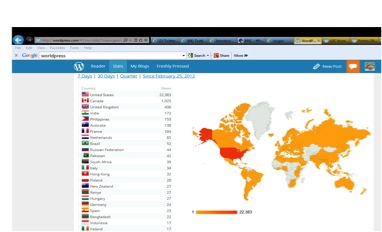
The top ten countries outside of the US reading the blog include: UK, India, Canada, Philippines, Australia, France, Neatherlands, Brazil, and the Russian Federation. However, the blog is read in almost all countries, which means that access to justice issues are a worldwide issue, and not just a local American conversation.

world

In terms of topics, forms is the most popular topic, followed by plain language, self help services, research and evaluation, and technology. Other popular topics include: Access to Justice Generally, court administration, and systemic change. The topics reflect what the main areas of interest are for the broad and diverse audience who follow the blog all of them crucial areas where change and innovation can have a significant impact on access to justice. In effect, the main topics are the building blocks toward improving access to justice for those states, courts, and legal aid service providers who are serious about removing unnecessary barriers.

I was feeling almost surprised to see that LEP related posts were not rising as top posts, but it turns out that May 21, 2012, was the most active day, and that was the day we blogged about the Supreme Court ruled on an interpreter/translation cost shifting statute, https://accesstojustice.net/2012/5/21/

The piece on Turner, posted by Richard in 2011 was the most commented upon blog. https://accesstojustice.net/2011/06/25/turner-and-the-self-represented-a-summary-of-its-very-broad-implications-and-the-begining-of-a-new-jurisprudence/ followed by the blog on Texas, https://accesstojustice.net/2012/01/23/for-texas-access-advocates-no-good-deed-goes-appreciated/

Right now, the blog has 245 e-mail followers, and about 150 twitter followers from many different communities, from policy to journalists, lawyers, court staff, and librarians. Many are sharing links through Twitter, email, and linked in.

We hope all who read the blog continue sharing and commenting on the posts. Creating of an online community of those willing to learn about serving those without lawyers in many different types of forum is hopefully a good outcome of the blog. We hope the international readers continue reading the blog and share new models and information on how their systems tackle similar issues, particularly since more and more the world is becoming smaller and our systems strive to serve many different cultures in a fair and equitable way.

Posted in This Blog | Comments Off on The year in “Access to Justice”: Claudia Johnson Reports on Some Statistics from this Blog

Some Reflections on a Foundational Access to Justice Technology Summit.

While LSC will in the future be releasing a full Report from this week’s Access to Justice Technology Summit, I thought it appropriate to share some of my own personal impressions and hopes.

It was a powerful event, with a strong consensus at the end in support of a transformative goal and a five component agenda in support of that goal.

The goal:  providing some access services to 100% of those unable to obtain access to justice because of financial barriers.

The five chosen components bring together the major themes and opportunities for the next few years.  The components (in my own words and my own order):

  • Distance services supported by a customer portal (hopefully integrating access to both legal and court services, if possible, and including ways for litigants to generate, e-file and save their own documents.)
  • Mobile access to such services with location aware tools.
  • Universally available and comprehensive document assembly services (this one is very much about making full use of an already significantly deployed innovation.
  • Checklists and protocols for optimization of both the effectiveness and efficiency of services to litigants.
  • Triage to tie all this together with data generated algorithms that route litigants and others to the most cost effective way of getting meaningful access.

For each of these components, we detailed a deployment strategy.  In the case of triage, for example, we agreed that we needed a court/legal aid laboratory to test and track triage rules developed by experts, tested by research, and then to use aggregated data to modify and improve those protocols.

Indeed, the need for cooperation with courts and other partners was a theme running though most of the Summit.  Few, if any, of the components can work properly if developed by legal aid alone (the exception may be the checklist/protocols component).

Part of the long-term implementation challenge is to develop the cooperative relationships with courts, bar and community partners that are required to make this interrelated system work.  The management of the initiative will need to include elements of regular communication and perhaps shared decision-making with leadership of all the stakeholder groups.  This alone could be transformative, and we need to start working on it now.

Congratulations again to John Greacen, the Summit consultant, and LSC and its leadership for committing to this initiative.  We now anxiously await the Final Report on the Summit.

Posted in LSC, Systematic Change, Technology | 6 Comments

The Highlight of the LSC TIG Conference

LSC President Jim Sandman’s lunch address on Wednesday was for me the highlight of the TIG Conference.  Why?

Not because of the clear commitment to the role of technology in the transformation of access to justice — important though that is.  Nor because he talked about the possibility of Congress funding a Pro Bono Innovation Grant Program, modeled in part on TIG.

But rather because he set as a goal having the legal services community becoming so good at what we do that that the private bar, and the non-profit sector generally, look to us as a model of the integration of technology into mission.  Jim’s point: that having that reputation will significantly help LSC with its overall budget advocacy.

That Jim believes that the work done in this community makes that a realistic goal is, in my opinion, a great vote of confidence.

Posted in Funding, LSC, Pro Bono | 2 Comments

Bloomberg Law Article on Impact on Law Student Pro Bono Requirement

Liz Tobin Tyler and David S. Udell have an article up on Bloomberg Law.  It discusses the impact of the New York bar application pro bono requirement.  Its a useful survey for those considering advocating for a similar requirement on other states, and includes a useful summary of the arguments in favor of such requirements.

For those not fully up to date, the article has a particularly useful section on recent developments (footnotes ommtted):

Initial reaction to the new rule was mixed in New York and nationally, with some critics applauding the goal but opposing the means and questioning the details.16 Yet, by the time the Court’s blue ribbon Advisory Committee issued its report (four months after the Chief Judge’s initial announcement), the focus in New York among deans, students, the Legal Aid Society of New York, and the State Bar, was on moving ahead with effectuation of the rule. The legal services bar and other stakeholders in New York have begun developing new concepts for structured placements able to accommodate the expanded number of students seeking to fulfill the 50 hour requirement.

In announcing the rule, the Chief Judge stated: “It is my hope that New York will serve as the trendsetter nationally in requiring pro bono service for admission to the bar and in recognizing that it is an essential part of what it means to be a lawyer.” Of necessity, courts, states, law schools and other stakeholders across the country are now considering the implications of the New York rule. For the first time, students, regardless of where they live, must complete the 50 hours and document their pro bono service if they are planning on bar admission in New York. Indeed, in at least two states, California and New Jersey, formal initiatives are underway to evaluate whether those states should, themselves, adopt their own statewide pro bono learning requirements. In an op ed in the National Law Journal (December 2012), Dean of the University of California Irvine School of Law, Erwin Chemerinsky, calls on all states to replicate the New York model.

And, in a related development, the ABA has been asked to incorporate a 50 hour rule into the ABA’s standards for law school accreditation. This approach would establish, as a nationwide expectation of law schools, that all students perform pro bono service as part of their legal education. If adopted, it would have the virtue, among others, of reducing, if not eliminating, the prospect of divergent state-by-state standard-setting, thereby reducing the compliance challenge that would otherwise confront every person unsure of where he or she might ultimately practice after law school. The ABA committee reviewing the ABA’s accreditation standards has so far declined to give serious consideration to the proposal for a national 50 hour standard, but the review process will move forward with next rounds in which it seems inevitable that the proposal will receive more attention.

It is particularly good to see CJ Lippman’s continued leadership and impact in this, as other, areas.

Other possibilities for reform are now in play. The New York Unified Court System, in steps that appear to flow naturally from the 50 hour rule, is recommending additional changes to strengthen law student pro bono and increase access to justice in New York.23 While the national impact of these new recommendations is difficult to gauge at this time, the recommendations are notable for such concepts as: i) ensuring the development of technology that will help to match students to open pro bono positions and that will systematize tracking and reporting of students’ pro bono service; ii) ensuring that schools offer coursework that will prepare students for their required pro bono service, and iii) ensuring that law schools and other justice system stakeholders (the legal services bar, courts, and others) meet together annually so that schools are apprised of areas of greatest unmet need in the justice system.

Posted in Law Schools, Pro Bono | Comments Off on Bloomberg Law Article on Impact on Law Student Pro Bono Requirement

Jim Greiner Asks For Help with SRL Courtroom Scripts

Harvard’s Jim Greiner, randomized study guru, asks for help identifying model self-represented litigant courtroom scripts.

Specifically, he is working on a project in which litigants would be given written scripts that they could use orally in court to help them articulate formal legal defenses in small claims cases.  An example might be a statute of limitations defense.

He wants to know if anyone knows of such scripts that might already have been drafted, or of any resources that might be helpful in drafting them.  Such materials can be sent to him at jgreiner(at)law.harvard.edu.

Posted in Judicial Ethics, Research and Evalation, Self-Help Services | 4 Comments

Maryland ATJ Commission Uses Useful Techniques to Report on Economic Benefits of Legal Aid Advocacy

The Maryland Access to Justice Commission has just released a Report detailing economic benefits to the state of legal aid.

As detailed in the press release, the benefits are as follows:

  • Brought $9.9 million in federal dollars into Maryland to benefit state residents. Those dollars translated into at least $12.6 million in economic stimulus for local economies.
  • Obtained $10.7 million in other direct financial benefits for Maryland residents.
  • Secured $161 million as a result of systemic advocacy on behalf of tenants at risk of eviction, vulnerable homeowners and low-income persons in need of emergency assistance.
  • Resulted in at least $882,096 in tax revenue by keeping Marylanders in the workforce.
  • Saved at least $3.7 million in state expenditures on shelter costs alone by preventing homelessness.
  • Saved at least $1.3 million in health costs and productivity by preventing domestic violence.

However, from the point of view of advocates in other states, the Report may be most useful for the innovativeness of the techniques used to calculate the economic benefit.  As a whole, the Report offers a template that other states could follow to generate a similar report with less effort — indeed, it would be wonderful if an LSC TIG grant could fund an online tool to generate estimates of economic impact from state caseload stats and other input data.

The basic methodology was to collect data on actual economic gains (benefits received for example, and then apply an appropriate multiplier to calculate full state economic benefit.  Using a variety of techniques, these estimated the economic impact of law reform achieved.  Finally, they calculated the revenue and expenditure savings from keeping people in jobs and reducing domestic violence.

Here are some of the more interesting techniques/tools used:

  • Use of multipliers calculated by others to show the full impact of various benefits obtained.  The cites to those multipliers are particularly helpful (see page 5.)  Multipliers vary from 2.23 in the health area, to 0.7 for federal housing benefits.
  • Taking number of foreclosure-evictions and calculated impact on total tenancies, and value of tenancies, based on number of such evictions, and change in law granting delay.
  • Estimated total value of increases in benefits from decision requiring timely decisions on applications.
  • Estimating value of reduced domestic violence by extrapolating from prior studies on lesser violent incidents against those with orders, and estimated medical cost of such victimization.  Adding estimate of productivity loss from reduction of victimization.

Congratulations Maryland.


Posted in Budget Issues, Domestic Violence, Foreclosure, Legal Aid, Outcome Measures | 1 Comment

Funded Technical Assistance on Access Availalbe to Courts from NCSC Center on Court Acces for All

Funded technical assistance on access to justice is now available to Courts from the NCSC Center on Court Acces for All.  This resource could be very helpful.  Here is the website  for  the assistance program.

The forms this assistance might take are described on the site as follows:

Technical Assistance
The Center . . . offers assistance to state and local courts interested in gaining specific expertise on implementing an access to justice program, practice or service. The assistance is flexible and typically involves a few days of an expert’s time on-site or through conference calls. The assistance also can take the form of sending representatives from one jurisdiction to another to learn first-hand how to implement a specific improvement program or practice. 

Examples given are as follows:

  • Simplifying & automating court forms
  • Training court staff on providing information to self-represented litigants
  • Making electronic filing user friendly
  • Developing judicial education on self-represented litigant issues
  • Using pro bono assistance to support self-represented litigants
  • Creating a self-help center
  • Establishing a statewide self-help hotline
  • Facilitating discussion among judges regarding unbundling issues
  • Using online chat to provide informational services
  • Developing volunteer programs to assist litigants

An attached document on the site gives more detail on such examples:

Build/Expand Self-Help Services

  • Developing easy-to-understand and easy-to-access online information
  • Establishing a self-help center
  • Setting up rules and standards to govern the operation of self-help programs
  • Establishing and funding a statewide self-help hotline
  • Using online chat to provide informational services
  • Serving self-represented litigants who face language access barriers

 Revise and Automate Court Forms for Easier Access

  • Simplifying Forms and using plain language
  • Automating forms and linking to e-filing
  • Making electronic filing user friendly
  • Using document assembly and co-browsing over the Internet to support self-represented litigants

 Provide Training and Education

  • Setting up a judicial education program on self-represented litigant issues
  • Setting up a lunch seminar on self-represented litigant issues for judges in a local court
  • Facilitating discussion among judges regarding barriers to access
  • Facilitating discussion among judges regarding unbundling issues
  • Training clerk staff on providing information to self-represented litigants
  • Helping all court staff understand the issues self-represented litigants face

 Enhance Case Processing and Management for Cases Involving Self-Represented Litigants

  • Addressing lines in the clerk’s office caused by confused self-represented litigants
  • Dealing with the problem of litigants who are unable to complete service
  • Dealing with adjournments caused by unprepared self-represented litigants
  • Ensuring litigants get the written orders they need following a judicial decision
  • Ensuring litigants know what they need to do to obtain enforcement of orders
  • Simplifying rules and court procedures
  • Complying with Turner v. Rogers and its due process requirements for the self-represented

The technical assistance provides a great opportunity for courts to jump start processes for planning or improving access services.  Note that many of these ideas are low cost items, not budget busters needing new line items or new staff.  Rather they involve stepping out of the day to day and thinking about how to be more efficient or effective with current resources.

I know that all of us associated with the project are happy to do what we can to help.  A very simple form to request assistance is on the site.

If you have a question about assistance, please contact Deborah Saunders of the Center for Court Access to Justice for All at dsaunders(at)ncsc.org..

Posted in Access to Justice Generally, Court Management, Funding, Self-Help Services | 2 Comments

Claudia Johnson on Plain Language Resources

Two new Plain Language Resources for Courts and Access to Justice Initiatives

In November 2012, the Maryland Access to Justice Commission released a plain plain language guide specifically for those writing instructions and materials for court users. The guide is full of practical guides, examples, and provides very clear rules on how to simplify instructions and court based materials. http://www.courts.state.md.us/mdatjc/pdfs/writingforsrls.pdf

Allison Parker, staff attorney and policy analyst at the Commission was the lead person behind the guide.  The guide is chokeful of helpful information, it even has a suggestion on how to check materials so that they are accessible to color blind readers!

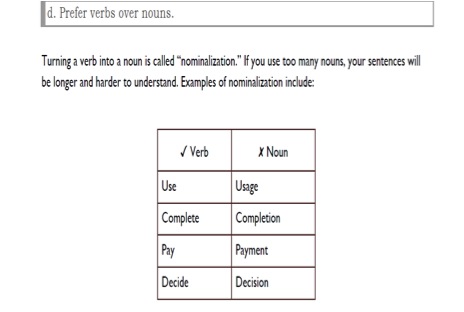
Here is an example of a section, that shows how easy to access the information here is:

plainAnother wonderful set of resources was released in December 2012. Jeff Hogue from LAWNY, released a new set of resources on plain language, available to all groups working on access to justice initiatives here http://www.writeclearly.org.

With funding from the Legal Services Corporation TIG grants and with Transcend Inc. LAWNY’s  http://www.writeclearly.org has become a great repository of examples of ways to provide legal information, concepts, and instructions using simple, non legal, non-jargon terms in plain language.

In my opinion, the cornerstone of these materials is the 96 page The Essential Plain Language Collection, that contains readable documents, before and after comparison of documents, and very good tips. But there is more than this very complete guide or collection here.

Writeclearly.org has a fantastic library that offers plenty of models in Spanish, English, and other languages of documents that courts and legal services will find helpful. There is also a “gadget” that lets you enter a word or phrase and the “gadget” tells you how readable or not your word work is, using well recognized standards.

For those who want to learn or teach others about plain language, the site offers an online course—that lets a person interested in improving writing for self represented or non attorney audiences go through an online course to improve.

New resources are posted on the site as they get completed, so this is a site to visit often to see what new tools or resources have been posted. A report  is coming up and will be shared on machine assisted translation.

If you have any questions regarding any of the resources available on http://www.writeclearly.org, please email jhogue(at)lawny.org

Posted in Forms, Plain Language | Comments Off on Claudia Johnson on Plain Language Resources

New Access Brief

The Center on Court Access to Justice for All, with which I am affiliated, has just released its second Access Brief, on Forms and Document assembly.

Given that this Brief has the imprimatur of the National Center for State Courts, it is particularly useful as a tool for persuading courts of the value of forms initiatives, which might include expanding the number of forms, working to make existing forms easier to use, or converting them into document assembly tools.

This introductory text gives a flavor of the document (footnotes omitted.)

Any program to assist the self-represented litigant must begin with the provision of court forms.1The courthouse can be a confusing and intimidating place for someone who is unfamiliar with its rules and procedures, technical language, layout, and deadlines. Terminology that is understandable to those who use the court on a regular basis can be incomprehensible to the self-represented litigant. Making information and forms clear and easily accessible can be an important part of breaking down these barriers. When forms and information are presented in an understandable format, both court users and court staff experience less frustration and delay. Many issues arise when forms are translated into other languages; these will be addressed in a separate Access Brief. Nearly every state has some type of court form online; and many, such as Alaska, California, Connecticut, and Idaho offer self-help Web assistance as well.

The conclusing section may be particulalry helpful.

Leadership from the justices of the court of last resort is an important component in
beginning a forms development program. Before beginning a forms or document
assembly program, it is important to collect data on the number of self-represented
litigants filing different types of cases and the effects of these cases on caseflow
management and access to justice for all  litigants. This information should be
disseminated prior to the start of the forms development project. Although at least one state met some resistance to the development of forms by the practicing bar,
other states have found the bar receptive because attorneys like the easy accessibility of the online forms. California, for example, has used forms for over 30 years, has over 1400 approved forms, and at least half are mandatory.

More Access Briefs are in the process of preparation.

Posted in Court Management, Document Assembly, Forms, Self-Help Services | Comments Off on New Access Brief

Turner Lives

An Ohio intermediate appellate court of appeals case, Crain v. Crain, 2012-Ohio-6180http://www.supremecourt.ohio.gov/rod/docs/pdf/2/2012/2012-ohio-6180.pdf correctly reads Turner v. Rogers, and reverses a contempt judgement in which counsel was denied.

The defendant had been found in civil contempt for failure to make child support payments, and had been refused an explicit request for counsel, with the magistrate purportedly relying on Turner as follows:

One thing I’m going to tell you, I’m going to deny your request for
counsel at this time.    There’s a recent U.S. Supreme Court decision that came down on contempt citations regarding child support, and the decision of the justices is that obligors that are facing jail time in civil contempts are not entitled to court appointed counsel. So we’ll proceed today without Court appointed counsel * * *. Crain at 3.

The Ohio Court of Appeals corrected this misreading of Turner as follows:

[W]hile Turner does not categorically require counsel to be appointed for persons facing criminal contempt convictions for nonpayment of child support, a reading of the opinion demonstrates that neither does it categorically require, as stated by the magistrate, the denial of appointed counsel. Instead, a court must determine whether there are procedural safeguards in place that adequately protect the obligor.    There was no such determination in this case. Crain at 5.

Aside from the unfortunate reference to “criminal contempt,” to which, of course, Turner does not apply, this is a powerful statement of the requirement that a court assess the sufficiency of the “procedural safeguards in place [to] .  .  . protect the obligor.”

The opinion goes further, however, excusing the lack of procedural objection to the ruling, both because the error is “plain and structural” and, in a comment of more general use outside the state, “In fact, the need to preserve error at the magistrate’s hearing by objecting to the magistrate’s decision is something that a layperson
would not be expected to know without the assistance of counsel.Crain at 9.

The opinion also correctly distinguishes Turner based on the facts that this case was brought by the state, and that counsel appeared for the state. Crain at 5.

The case might have been somewhat complicated by an unusual statutory structure — but the Court really did not rely on that.

It’s a strong and clear decision.

Updated P.S.

I was remiss in not giving credit for this information to the National Coalition for a Civil Right to Counsel, from which I received the information about this decision.  The Coalaition obviously play a critical informational and advocacy role.

Posted in Access to Counsel, Child Support, Supreme Court, Triage | Comments Off on Turner Lives

What Might a State Level Access Leadership Structure Look Like — and How We Might Move in That Direction

As states assume a larger role in the long term strategy for a national access to justice infrastructure, it might be a good time to start a discussion about what a comprehensive state level access leadership structure might looks like.  (A byproduct of this discussion might be a similar exploration of how a more integrating national leadership structure might be created.)

I start with some assumptions (many of which will surely not be universally shared):

  • We need to overcome in-state fragmentation of decision-making about priorities, strategy and funding.
  • We need to involve courts, bar and legal aid in joint decision making about administration of access to justice.
  • Distribution of available funds for access initiatives must be managed on a statewide basis that reflects statewide priority setting within a statewide strategy .  (This does not necessarily mean that priorities are the same throughout the state, only that the process and overall strategy is a statewide one.)
  • At a minimum, certain access to justice functions, like intake and self-represented access technology, must be managed and delivered on a statewide basis.  (Indeed, this may well apply to all self-represented services, regardless of the level of technology.)
  • Certain core advocacy functions, such as legislative advocacy and impact work, need to be managed in a centralized way.
  • Finally, while single integrated statewide programs may be impractical in some contexts, those states that persist in structures of fragmented programs will need to find ways for centralizing decision-making that would otherwise take place within programs.

A statewide leadership structure is therefore going to need the following elements:

  • An entity that brings together a broad range of committed stakeholders to establish broad policies and initiatives for access to justice to guide the various components of the system. Such a body should probably grow out of  the Commission model, but with an understanding of the need for greater power and strong connection to all stakeholders.
  • Staffing (including a strong director) for the above body to enable it to provide actual day to day leadership activity for its directions.
  • An entity that makes decisions about funding and priorities that reflect a broad consensus about need, capacity, service delivery.  This might be best placed in an Access Commission, or in a body appointed by, and responsible to the Commission.
  • A capacity for integrating court, bar and legal aid innovations, particularly in areas like triage and unbundling that require the participation of these stakeholders.  In other words, the Commission or other body needs to be focused on more than legal aid, and needs to have the capacity strongly to influence the behavior of courts and the bar.  The design of an appropriate structure for this remains a challenge, given the institutional needs for formal independence of those bodies.
  • Capacities for research, collaboration with other states and national capacities, both of which might be located in specialized units under the Commission.

Merely listing these capacities and elements underlines how far we have to go.  Yet, without them, we will retain an inefficient and fragmented system, guaranteed to fail in any search for 100% access to justice.  So, here are some strategic suggestions for how states might, within a real world political environment, move in this direction.

  • The IOLTA program might, on a pilot basis grant some of its money to the state Commission to sub-grant in a competitive manner in a particular area of innovation. (To the extent that the IOLTA statute mandates a formula distribution, programs could agree to a give-back of some of the grant for such a purpose.)
  • LSC might move towards a system in which a grant for self-help services were awarded on a statewide basis, with the Commission as the delivery partner (subject to legalities)
  • The Commission might take on responsibility for certain statewide functions, such as hotline/intake etc.
Posted in Access to Justice Boards, Legal Aid | 2 Comments

Boston Globe Does “Ideas” Piece on Randomized Studies of Legal Aid

The Boston Globe has just run a valuable and sensible piece on the Greiner et al randomized studies.  The headline sums it up:  Free legal advice—but does it work?.

The article will be very helpful in showing the value of these studies to a broader audience, and, above all, putting them in the context of the value and need for whatever it takes to provide access to justice in the real world.  A sample of the tone:

Given the noble intentions and tireless dedication of the individuals who staff legal clinics around the country, it feels almost indecent to question the effectiveness of the help they’re providing. But from where Greiner sits, the sanctity of these efforts—and the fact that the system provides for just two attorneys per 10,000 low-income people—is precisely why it matters. In particular, as he sees it, we know very little about how legal service providers ought to determine which clients to take and which to turn down; in many cases, he argues, they may be wasting precious time and money on cases where they’re unlikely to have an impact.

“Most folks have concluded that we’re never going to be able to give a full attorney-client relationship to every person who has a legal problem,” Greiner said last week. “The funding is just never going to be there. So you have to take steps short of that, in an attempt to meet the need.”

There is a good overview of the legal aid field:

What Greiner found when he began studying legal services was a complex, decentralized, and woefully underfunded endeavor that was helping only a fraction of the people in need. Across the country, hundreds of organizations worked more or less separately, without sharing information in any systematic way about the kinds of people who were coming to them for help and what exactly they needed. Most importantly, Greiner noted, no one had ever done any rigorous tests to see how much good these organizations were actually doing.

The article includes detailed discussion of the process that led up to the Harvard Legal Aid Bureau unemployment study, and a summary of the results and implications.

The overall conclusion:

Ultimately, Greiner and his allies hope to reform the legal services industry from the ground up. One thing Greiner suspects his work will ultimately show is that lawyers, per se, are not needed to handle all legal problems. Instead of trying to raise money to hire more lawyers, he said, we ought tackle the scarcity problem by identifying the types of cases that are less complex and thus could be competently handled by people whose time is less expensive—like paralegals.

Getting there will require a lot more randomized testing, Greiner said. And more testing will require an open mind on the part of the overworked, underfunded industry it is putting under the microscope.

“It really comes down to political will and the desire to find out the objective truth,” Greiner said. “It’s hard to persuade people who have invested so much time and money into constructing something that they think works…that it may not be doing what they think it’s doing.”

Some of us have long argued that these studies and this general approach not only have the potential to increase the efficiency of legal aid, but also its political viability in the funding area.  It will be very interesting to see how reaction and impact the Globe piece has, and in what environments.  Obviously Massachusetts is an environment in which one can be more optimistic about having a relatively rational discussion on these topics.   I would encourage readers of this blog to consider the potential value of spreading links to this article around.  It might be that journalists in other states might be interested in similar articles.

Such articles might help change the narrative from the current highly limited one of “we need much more money,”  and its discouraging subtext — “nothing you give us will ever be enough.”

Posted in Outcome Measures, Research and Evalation, Systematic Change | 2 Comments

Some Thoughts on the Recent Access to Justice Research Agenda Meeting

As expected, the meeting held December 7 and 8 on establishing a research agenda in access to justice was exciting and productive.  There were about 40 people there, half researcher and half practitioners from courts and legal.  The meetings on the first day, which consisted of a Poster Session and and Town Hall, were open to all, Here are some of my personal takeways:

The anxiety about research within the legal aid community is far less, and the Town Hall helped foster that change in mood (there was only one negative comment).  Indeed, there is now an unprecedented level of interest in both the practitioner and research communities.  One of the major goals of the gathering was to foster matching between researchers interested in answering questions, and practitioners, and my impression was that a lot of good conversations have started.  (I have to say that I got sick of the dating analogies in the discussion, however.)

We now have the beginnings of a research agenda, with interest in topics including the following:

  • Exploring what works (and for whom) (biggest area of interest)
  • Deciding what outcomes are important to use
  • Documenting economic impact

Personally, I was particularly interested in detailed discussion of research into particular innovations, such as legal aid brief service, document assembly, legal aid protocols, court self-help services, judicial education, etc.  I think there is a real chance that we will see much more research into these questions.  They are of course critical not only to decisions as to which innovations to deploy, but how to build triage systems that reflect real knowledge, not just program instincts.  Practitioner should note that the world really is full of researchers looking for topics to research — but, as was pointed out repeatedly, they need to become involved in planning and discussions before, not after, the data are collected.  (I am not getting into any possible dating analogy here!)

It is also likely that there will be a follow-up application to NSF for what is called a Research Coordination Network Grant, that would facilitate future networking.  While its form is far from clear, there was also a very strong interest in establishing some form of matching service. (Some wanted it on the web, my own view is that human credibility is also critical in the process.)  Also, an online information sharing space is on the agenda.

A concluding note:  I know that there were lots of people who wanted to be there, who deserved to be there, and who would have contributed had they been there.  It was hard enough to manage a conversation with the 40 or so that were there.  Please know that there was a commitment among those who were there to ongoing broader networking and participation.  To paraphrase Bill Clinton: “We haven’t a research resource to waste.”

For those who are interested, here is the Program Synopsis of the Research Coordination Network Grant Program:

The goal of the RCN program is to advance a field or create new directions in research or education by supporting groups of investigators to communicate and coordinate their research, training and educational activities across disciplinary, organizational, geographic and international boundaries. RCN provides opportunities to foster new collaborations, including international partnerships, and address interdisciplinary topics. Innovative ideas for implementing novel networking strategies, collaborative technologies, and development of community standards for data and meta-data are especially encouraged. RCN awards are not meant to support existing networks; nor are they meant to support the activities of established collaborations. RCN awards do not support primary research. RCN supports the means by which investigators can share information and ideas, coordinate ongoing or planned research activities, foster synthesis and new collaborations, develop community standards, and in other ways advance science and education through communication and sharing of ideas.

The grants do not fund research.

Posted in Meetings, Research and Evalation | 2 Comments

LSC Announces Chief Information Officer

A big step, and very good news, given the background of the person selected.

Peter Campbell has worked closely with NTEN (National Technology Enterprise Network), receiving an award from them in 2011. This is what the presenter said (pasted from the NTEN wesite):

 [T]he “NTEN Award,” [is] given this year to Peter Campbell, IT Director for Earthjustice.  Former NTEN Awardee John Merritt presented the award to Peter, and I’d like to share his words:

The NTEN award is given each year to a person who the lives the values of our community. At NTEN, we are all practical dreamers; we’re open and authentic with one another, we hold each other accountable and we share without asking anything in return. The best part is all the fun we have along the way. The NTEN Award is kind of like our “Spirit” Award: we give it to the NTEN community member who rallies this team by example and encouragement. Today we will honor a leader who has demonstrated selfless commitment, dedication, and loyalty to NTEN and all things NPTech.

Leader, mentor & NPTech catalyst – this is how I see this year’s NTEN award winner. I am inspired by his enthusiasm, wisdom and openness for NTEN and all the amazing work this community is accomplishing. He has inspired me, challenged me, & taught me to see amazing possibilities for technology supporting mission. There is no other individual I can think of who works as hard to ensure the technology we use is built to meet the dreams & mission we all carry in our hearts.  (Bold added).

Here, for example, is a report of a session he did on virtualization.  Here is his bio at Idealware, of which he is a member of the board.  This is his website.  This is some of what he has posted there about his enthusiasm for his new (not yet started) job.

Great Challenges:  Three things thrilled me as I interviewed for LSC.  First, data management is a critical work process.  Not only are grants based on data that communicates about the performance of the grantees’, but the organization is, in turn, measured by the effectiveness of the grantees.  There are compliance and communication challenges that will require some creativity to address. Data strategy is what I do best, and I can’t wait to get started on the work at LSC.

Second, the first thing we discussed in the first interview was the priority to move to the cloud.  As with any large org, that’s not a slam dunk, but as I believe that the cloud is where we’re all headed, eventually, it’s great to be working for and with people who get that as well.  It was a hard sell at my last job.

Finally, LSC does more than just grant funds to legal aid NPOs, they also support the strategic use of technology at those organizations. When I left a job in the early 90’s as a Mailroom Manager/Network Administrator, I did so because technology was my hobby, so I wanted to do it full time.  For the last six or seven years, my “hobby” has been supporting small and mid-sized NPO’s in their use of technology, through this blog, Idealware, NTEN, Techsoup and a number of other orgs that have provided me with the opportunities.  Once again, I can fold my hobby into my day job, which has to be as close to the American dream as it gets, right?

He is going to be a great, energetic, and creative addition to LSC, and particularly to its technology capacity.  I expect we will see much closer collaboration between the TIG team and the internal information operation.

This position reports directly to the President of LSC (see job description), an additional great sign for the future, not just of technology at LSC, but for the whole agency and its mission.  Its a new day there.

Posted in LSC, Technology | 1 Comment