How to — and How Not to — Talk about Increasing Resources for Access Services

In the last few days, I have been in three different conversations about how to talk about the need for resource for access advocacy.

There has been a common theme in these discussions — the unfortunate tendency for this to be structured as a conversation about raising money for legal aid, or for a particular program/project.

We have become trapped into appearing selfish, or rather self-centered.  We must always remember that what appeals to funders is not the need for lawyers or legal aid, but the critical role that access services play in protecting the safety net, in leveraging investments in health, education, social services etc., and in making sure that those services are delivered fairly.

During these conversations, an insight came to me.  Its actually been easier to get the editorials written about how terrible it is to cut legal aid funding, than it is to get opinion makers to focus on the broader value of access services to community, society and budget.  The plethora of those anti-cut articles — since about 1980 or so — means that that narrative of wrongful and politically motivated cuts is so well established that it is hard to replace it with the much more positive, constructive, and effective story of the high efficiency of leveraging investments in access advocacy services.

But, and this is the key point — it is only such a broader narrative that is going to build a broad funding coalition in which a far larger range of funders will support investments that provide access advocacy services to increase their general investments in areas such as education, health, housing, and community.

Let get the focus off ourselves and our needs.

Posted in Funding, Legal Aid | Comments Off on How to — and How Not to — Talk about Increasing Resources for Access Services

NCSC Launches New Court Access Center

Here is the announcement:

New Court Access Center

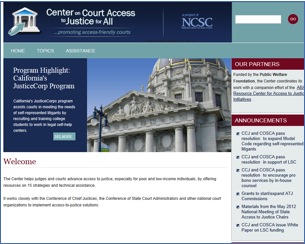
The Center on Court Access to Justice for All (Access Center), an initiative of the National Center for State Courts (NCSC), helps judges and courts advance access to justice, especially for poor and low-income individuals. It works closely with the Conference of Chief Justices (CCJ), the Conference of State Court Administrators (COSCA) and other national court organizations to implement access-to-justice solutions. The Access Center is supported with funding from the Public Welfare Foundation which also supports a companion project of the ABA Resource Center for Access to Justice Initiatives to expand Access to Justice Commissions. To learn more about the NCSC’s Access Center, visit www.ncsc.org/atj.

Technical Assistance Available

The NCSC’s Access Center will be offering Access Briefs and webinars on various access to justice topics to help judges and other court leaders learn about and better share effective tools (e.g., simplified forms, self-help centers, triaging services). In addition to these resources, the Access Center also will offer assistance to state and local courts interested in gaining specific expertise on implementing an access to justice program, practice or service (e.g., starting a self-help center or volunteer legal services program for self-represented litigants). This assistance is flexible and typically will involve a few days of an expert’s time on-site or through conference calls. The assistance also can take the form of sending representatives from one jurisdiction to another to learn first-hand how to implement a specific improvement program or practice. Jurisdictions interested in requesting assistance are encouraged to visit the Access Center’s Web site (www.ncsc.org/atj) and click on the “Assistance” tab for more information.

It’s going to be a great opportunity to move the field forward, particularly with the Best Practice Briefs, the website, and the technical assistance for courts.  The project will be working closely with the ABA Access to Justice Commission Expansion Project.

Here is a screenshot of the website of the Court Access Center.

I am proud to be a consultant to the project, which is being directed by Dr. Pam Casey of the National Center’s staff.

Posted in Access to Justice Generally, Court Management, Self-Help Services | Comments Off on NCSC Launches New Court Access Center

Payday Loans, Non-Payment, Default Judgement, Warrant, Incarceration — What About Due Process

This makes my blood boil.

As reported in the St Louis Post Dispatch, and picked up by the Brennan Center:

Still, people do go to jail over private debt. It’s a regular occurrence in metro St. Louis, on both sides of the Mississippi River.

Here’s how it happens: A creditor gets a civil judgment against the debtor. Then the creditor’s lawyer calls the debtor to an “examination” in civil court, where they are asked about bank accounts and other assets the creditor might seize.

If the debtor doesn’t show, the creditor asks the court for a “body attachment.” That’s an order to arrest the debtor and hold him or her until a court hearing, or until the debtor posts bond.

The practice draws fire from legal aid attorneys and some politicians. They call it modern-day debtors prison, a way to squeeze money out of people with little legal knowledge.

Debtors are sometimes summoned to court repeatedly, increasing chances that they’ll miss a date and be arrested. Critics note that judges often set the debtor’s release bond at the amount of the debt and turn the bond money over to the creditor — essentially turning publicly financed police and court employees into private debt collectors for predatory lenders.

Bottom line — people are going to jail for private debts they can not pay, and without a practical or meaningful opportunity to challenge their ability to pay.

The legal analysis is perhaps not simple as simple as it should be.  At each stage, let us assume, people are getting some form of notice and opportunity to be heard.  But, as in Turner, the procedures, taken as a whole, do not support fairness and accuracy, but allow imprisonment for failure to pay money that people can not pay. Maybe this is a right to counsel argument — if current procedures are resulting in frequent incarcerations for those who have not been meaningfully heard, either better protections have to be put in place to ensure that they are heard, or they have to be given counsel.  Something tells me we would get the protections.

As noted in the Post Dispatch article, Illinois has a statutory fix, Illinois Public Act 097-0848.

Illinois Deputy Attorney General for Child Support Enforcement, Diane M. Potts, has provided us with this summary of the new law:

For Citations to Discover Assets, creditors must now:
1)    Personally serve the debtor
2)    Use a modified notice form that more clearly articulates the possibility of incarceration for failure to appear
3)    Serve a new Income and Asset Form designed to show any exempt assets/income of the debtor
4)    Allow the debtor an opportunity at trial to assert his exemptions
And the Court must now dismiss the citation if the debtor does not possess any non-exempt income or assets.
 
For body attachments/warrants for arrest issued on a charge of indirect civil contempt, either for failure to appear or for failure to pay:
1)    The debtor must be personally served with an order to show to cause
2)    The body attachment/warrant expires one year after the date of issue
3)    The court must return the bond to the debtor unless the court finds that (i) the debtor has willfully refused to comply with the payment order and (ii) the bond constitutes non-exempt funds of the debtor.
 
The new law applies to all creditor/debtor situations, including child support debt.

Thanks both for the new law, and for the information about it.  A good model to consider.

Posted in Access to Justice Generally, Foreclosure | Comments Off on Payday Loans, Non-Payment, Default Judgement, Warrant, Incarceration — What About Due Process

A Step Forward: New York Times Endorses Judicial Candidate Based on Experience with the Self-Represented

Its nice to see, and good news for the self-represented, regardless of the merits (on which this blog is not here commenting).  The Gray Lady endorsing a judicial candidate based on experience dealing with the self-represented.

CIVIL COURT, THE BRONX, SECOND DISTRICT Eddie McShan is a special referee in State Supreme Court and adjudicates divorce cases. He has a good judicial demeanor and experience helping litigants who represent themselves in court.

While many of us try to avoid phrases like “helping litigants who represent themselves in court,” in favor of those like “helping make sure that all litigants are heard, regardless of whether they have a lawyer,” it is a step forward when such experience is explicitly valued.  Indeed, all judicial candidates in all systems, appointive, elected or mixed, should be asked about their experiences with, and attitudes to the self-represented.  It is a useful prism on judicial demeanor, values, and approach, even for those who have not yet sat on the bench.

Addendum:

A comment asks why we avoid phrases like “helping litigants who represent themselves in court.

In short, judicial neutrality, and the perception of neutrality, require that judges do not “help” either side.  Rather judges try to make sure that both sides are fully heard.  This means making sure that proceedings are understood, asking questions to get to the bottom of what happened, exercising their judicial discretion to ensure that issues get addressed, etc.

Here are links to a couple of my articles on how judges can do that:

http://www.zorza.net/JJ-Turner.pdf

http://www.zorza.net/Turner-2.pdf


Posted in Judicial Ethics, Self-Help Services | 1 Comment

American Judicature Society and Drake Law Review Offer Opportunity to Advance Analysis of Due Process

The tenth Symposium Issue of the Drake Law Review, co-sponsored with the American Judicature Society, will be on “Access To Justice: Where Is The Boundary For Due Process?

This is a great opportunity for the access to justice community to engage with academics and others on what is, after all, the key topic.  It is particularly timely after Turner, with its practical focus on accuracy and fairness, and its potential to impact other areas of access.

The Call for Papers specifies the following as possible questions, but any approaches to the general topic are encouraged:

 • How can judges determine the appropriate level of process in varying cases and circumstances?
• How is due process affected when the judicial process is not properly explained to pro se litigants?
• How is due process affected when criminal defendants plead guilty to felony-level offenses on paper only, without appearing before a judge?
• How is due process affected when litigants, unable to communicate effectively in English, elect to forego aid of interpreters due to expense or over-confidence in self-representation, with little or no explanation by a court officer?
• How is due process affected when judicial branch layoffs and budget cuts delay cases for months or even years?
• How is due process affected by the rise of alternative dispute resolution systems, which force consumers and borrowers into mandatory mediation or arbitration?
• How is due process affected by executive branch actions that take the lives of American citizens in the absence of judicial review?

I will probably be submitting a proposal, and would be happy to talk with folks about any ideas they may have.

All general topic proposals must be submitted by November 1, 2012 to the Editor in Chief of the Law Review. The Editor also welcomes queries about possible topics, etc.  The deadline for completed articles is February 1, 2013. Contact information is below:

Drake Law Review
2507 University Avenue, Des Moines, Iowa 50311
Phone: (515) 271-2930, Fax: (515) 271-4926
email: law.review(at)drake.edu, http://www.drakelawreview.org
Rachel Parker, Editor in Chief
rachel.parker(at)drake.edu

Note: an earlier version of the post incorrectly referenced a different law school.  My apologies to all.

Posted in Access to Justice Generally | Comments Off on American Judicature Society and Drake Law Review Offer Opportunity to Advance Analysis of Due Process

Two Perspectives on Standardization and Efficiency, and a Suggested Synthesis

A recent New Yorker article talks about possible lessons for the health care system from the highly efficient production and management system of middle range chain restaurants like Cheesecake Factory.

To show me how a Cheesecake Factory works, [the host] took me into the kitchen of his busiest restaurant, at Prudential Center, a shopping and convention hub. The kitchen design is the same in every restaurant, he explained. It’s laid out like a manufacturing facility, in which raw materials in the back of the plant come together as a finished product that rolls out the front. Along the back wall are the walk-in refrigerators and prep stations, where half a dozen people stood chopping and stirring and mixing. The next zone is where the cooking gets done—two parallel lines of countertop, forty-some feet long and just three shoe-lengths apart, with fifteen people pivoting in place between the stovetops and grills on the hot side and the neatly laid-out bins of fixings (sauces, garnishes, seasonings, and the like) on the cold side. The prep staff stock the pullout drawers beneath the counters with slabs of marinated meat and fish, serving-size baggies of pasta and crabmeat, steaming bowls of brown rice and mashed potatoes. Basically, the prep crew handles the parts, and the cooks do the assembly.

Computer monitors positioned head-high every few feet flashed the orders for a given station. Luz showed me the touch-screen tabs for the recipe for each order and a photo showing the proper presentation. The recipe has the ingredients on the left part of the screen and the steps on the right. A timer counts down to a target time for completion. The background turns from green to yellow as the order nears the target time and to red when it has exceeded it.

The article goes on to urge the same kind of efficiency and attention to detail for medicine.  The obvious question is whether there are lessons for the legal system too — and there must be.  I have long advocated protocols, outcome measures, and better managemnt.

But, here is the other perspective that must be integrated into any solution.  A piece in today’s New York Times on doctor burnout:

Now, in what is the first study of burnout among fully trained doctors from a wide range of specialties, it appears that the young are not the only ones who are vulnerable. Doctors who have been practicing anywhere from a year to several decades are just as susceptible to becoming burned out as students and trainees. And the implications of their burnout — unlike that of their younger counterparts, who are often under supervision — may be more devastating and immediate.

Analyzing questionnaires sent to more than 7,000 doctors, researchers found that almost half complained of being emotionally exhausted, feeling detached from their patients and work or suffering from a low sense of accomplishment. The researchers then compared the doctors’ responses with those of nearly 3,500 people working in other fields and found that even after adjusting for variables like gender, age, number of hours worked and amount of education, the doctors were still more likely to suffer from burnout.

.   .   .

The doctors’ burnout appeared to have little to do with hours worked or even the ability to balance personal life with work. Instead, the only factor predictive of a higher risk was practicing a specialty that offered front-line access to care. More than half of the doctors in family medicine, emergency medicine and general internal medicine experienced some form of burnout.

The study casts a grim light on what it is like to practice medicine in the current health care system. A significant proportion of doctors feel trapped, thwarted by the limited time they are allowed to spend with patients, stymied by the ever-changing rules set by insurers and other payers on what they can prescribe or offer as treatment and frustrated by the fact that any gains in efficiency offered by electronic medical records are so soon offset by numerous, newly devised administrative tasks that must also be completed on the computer.

In this setting, “doctors are losing their inspiration,” Dr. Shanafelt said, “and that is a very frightening thing.”

Can these two perspectives be integrated?

I think it is unavoidable that standardization, routinization, and lack of room for opportunity for human contact reward run risks of burnout, loss of critical staff, and bad outcomes.  I also think it is critical that we need to find ways to bring the lessons of data and efficiency to legal practice and the courts.

The synthesis has to include the following elements;

  • Using data to give tools to professionals, rather than to remove their discretion — protocols are critical, but they are the beginning of the discussion, not the end.
  • We must continue to allow for individual connection between advocate and client (I had a recent medical experience in which the doctor thanked me for being such a good patient — I am sure that propelled both of us into a much better rest of the day.)
  • Team responsibility — different skills are needed, and tasks should be assigned based on skill and cost, but the team must work together.  Shared achievement is a spur to improvement.
  • Outcome measures must be shared through the team and the institution to create a sense of shared learning and achievement.  I have always tried to abolish the phrase (and the concept) Management Information System — can you think of anything less likely to get staff support.

Other thoughts?

Posted in Medical System Comparision, Systematic Change, Technology | 2 Comments

The Terrifying Potential of the “E-Score” — And How to Turn it Inside Out

Recently, the New York Times, had an article on the new trend to e-scores.

Companies gather data on you, and make a calculation of your value as a customer.  As I have blogged before, and as the Times here notes, this can create a new kind of discrimination:

Federal regulators and consumer advocates worry that these scores could eventually put some consumers at a disadvantage, particularly those under financial stress. In effect, they say, the scores could create a new subprime class: people who are bypassed by companies online without even knowing it. Financial institutions, in particular, might avoid people with low scores, reducing those people’s access to home loans, credit cards and insurance.

The Times explains:

Here’s how eScores work:

A client submits a data set containing names of tens of thousands of sales leads it has already bought, along with the names of leads who went on to become customers. EBureau then adds several thousand details — like age, income, occupation, property value, length of residence and retail history — from its databases to each customer profile. From those raw data points, the system extrapolates up to 50,000 additional variables per person. Then it scours all that data for the rare common factors among the existing customer base. The resulting algorithm scores prospective customers based on their resemblance to previous customers.

EScores might range from 0 to 99, with 99 indicating a consumer who is a likely return on investment and 0 indicating an unprofitable one. But in some industries, “knowing the bottom is more important than knowing the top,” Mr. Meyer says. In online education, for instance, scores help schools winnow prospective students who are not worth the investment of expensive course catalogs or attentive follow-up calls — like people who use fake names or adopt the identities of relatives.

“If we can find 25 percent who have zero chance of enrolling, we can say ‘don’t waste your money on them,’ ” he says.

EBureau charges clients 3 to 75 cents a score, depending on the industry and the volume of leads.

Obviously, as time goes by, more and more online data, such as ones online use of social media, blogging, contributions to political parties, etc, will get fed into the algorithm, and no good deed will go unpunished.

Is there any ray of light in this?  Obviously such activity can be regulated — indeed the Times article describes the great lengths these companies go to develop algorithms that do not fall afoul of laws regulating credit reporting.

But, more optimistically, lets suppose a society in which we were serious about those under challenge from financial and other crisis.  The very algorithms that show who is undesirable as a customer probably show who is in need of help, and who, if government invested in helping them, might untimely have less need for governmental services.  Its surely hard to imagine such an approach being popular today, but it is at least one way of thinking.  Till that time we urgently need consideration of regulation.

Posted in Technology, Transparency | 2 Comments

“Own the Dream” is on the Ball with Screenng Tool for Deferred Action for Childhood Arrivals

This is wonderfully prompt.

Own the Dream has a simple online tool up to help people figure out their eligibility for the Deferred Action for Childhood Arrivals Program (this link is to the US Govt).

The tool walks users through a series of questions and answers that gives them a provisional answer as to whether they appear eligible for the program.  It also asks questions about possible criminal or other activity that might raises problems, and warns users in the summary about any areas in which they should consult with an attorney.  The summary can be printed out as a pdf for consultation with an attorney.

There is an introductory video.

In short its a wonderful tool to maximize the usage of this important US program, while minimizing the risk that people trying to take advantage of it will suffer adverse consequences.

Its a nice example of using the tools of document assembly (LawHelpInteractive) for triage/diagnosis, and hopefully will help many many folks.

If only we could be as prompt with all our access to justice initiatives.

Spread the word!

Posted in Document Assembly | Tagged | 1 Comment

AP and NBC Website Carrying Story on Need for Pro Bono

The NBC News Website is carrying a story on the increasing need for pro bono to help respond to the crisis of the self-represented.  The story is also running on the AP wire.

Sample:

Garcia is part of a crush of people who are representing themselves in the nation’s civil courts because they can’t afford lawyers, who typically charge $200 to $500 an hour. The boom has overwhelmed courts and sparked new efforts to get attorneys to meet what the American Bar Association says is its professional responsibility to offer free legal services to people in need.

And:

Pro bono work by large law firms has declined in the past few years amid downsizing because of the economy, according to the July and August issue of ALM’s The American Lawyer magazine. Average pro bono hours per lawyer in large firms dropped to about 54 last year, a 12 percent decrease from a 2009 peak, the magazine reported.

And:

In June, Connecticut Chief Justice Chase T. Rogers urged members of the Connecticut Bar Association to help address what she called her No. 1 concern: the increase in self-represented parties. Judicial officials also held a pro bono summit for lawyers and judges last fall.

The article is useful to quote in any attempt to increase resources and attention to access to justice, not just pro bono.  Its good to see mainstream attention to the problem.

Posted in Access to Justice Generally, Media, Pro Bono | Comments Off on AP and NBC Website Carrying Story on Need for Pro Bono

How to Prioritize Tech Projects for Access to Justice

I was recently asked for thoughts on how to prioritize technology and access to justice projects.  In case they may be of use, here are some of my ideas, not in any particular order.

  • Immediate increase in access
  • Overall transformative potential.
  • Foundational for future access expansions
  • Supportive/facilitative for transformation of non-tech delivery structure
  • Short term feasibility
  • Supportive of increases in collaboration between broad range of partners
  • Relies on existing skills/capacity
  • Recruits enthusiastic tech volunteer energy
  • Produces ongoing data for planning, research, assessment
  • Cost effective as to cost/access ratio

I think usually such lists focus on short term feasbility.  I hope this list adds transformative potential.  What am I missing?  Tell me in the Comments.

Posted in Technology | 2 Comments

Lessons from Launch of Michigan Self-Help Site

Michigan has launched its self-help site, michiganlegalhelp.org.

It is notable for its question-oriented menuing.  The top level menu is the traditional Family, Housing, etc, list, although it includes more cross cutting topics like Find a Lawyer, and Community Services.  But once you click on those, you are offered lists of questions like “I need a divorce and I do not have minor children.”  Many of these, after you select a county (as in this example) then take you to a toolkit that includes common questions, articles, forms, find a lawyer, court information etc.  This approach is much closer to the needed problem solving structure than many sites.

The site is also notable for the integration of online and “brick and mortar” services.  As the press release explains:

The website was created to make legal information easier to understand and to show people how to navigate the court system properly and efficiently. The website can also help users look for a lawyer or legal self-help center in their area if they need more assistance. New Michigan Legal Help self-help centers affiliated with the website are open in Oscoda and Allegan Counties and will be opening later in Oakland and Wayne Counties. Information about and links to these and other Michigan self-help centers are on the website.

This in its turn has been made possible by a broad planning group that has included a wide variety of stakeholders, through the Solutions on Self-Help Task Force,  established in April, 2010 by then Michigan Supreme Court Chief Justice Marilyn Kelly.  The site is funded by the Michigan State Bar Foundation and LSC.  The unusually strong leadership of the Bar Foundation in getting this project going must be credited, together with the cooperation of courts and legal aid.  (Disclosure: I have worked with the Foundation in various ways, particularly very early in the process.)

Posted in Self-Help Services, Technology | 1 Comment

The Age/Innovation Conundrum and Implications for Access to Justice

A fascinating post several months ago in the New York Times Economix blog, Getting More Liberal With Age, deals with the age-old conundrum as to whether people really become more conservative as they get older.

In contrast to received wisdom:

A 2007 study published in the American Sociological Review examined General Social Survey data from 1972 to 2004, looking specifically at beliefs within a given age cohort about: historically subordinate groups, like whether women should be breadwinners and why African-Americans are poorer than whites; civil liberties for groups outside the mainstream, like homosexuals, communists and atheists; and boundaries of privacy, related to things like premarital sex and divorce.

The authors found that a given age cohort’s attitudes changed over time — more often later in life — and that “the direction of change is most often toward increased tolerance rather than increased conservatism.”

Makes sense to me.   Certainly much of the impetus for change in our access communities is coming from people who have been around for a long time — although so is much of the opposition.

Of course, the attitudes of age cohorts are influenced by the times in which people grew up.  One explanation for the surge of innovation in courts is simply that the 60’s generation is coming to power in those systems.  What this paper shows is why the behavior of that cohort continues to reflect those experiences, rather than to reject them.

It is also certainly true that much of the hard work of innovation, particularly on the legal aid side, is being driven by those very recently out of law school.  Let’s hope they keep at it.


Posted in Access to Justice Generally, Court Management, Legal Aid | Comments Off on The Age/Innovation Conundrum and Implications for Access to Justice

Implications of News Report on Problems with Credit Card Debt Collections

The New York Times reports today that credit card debt collection practices have just the same problems that emerged in the foreclosure crisis:

The same problems that plagued the foreclosure process — and prompted a multibillion-dollar settlement with big banks — are now emerging in the debt collection practices of credit card companies.

The scope is beyond amazing:

“I would say that roughly 90 percent of the credit card lawsuits are flawed and can’t prove the person owes the debt,” said Noach Dear, a civil court judge in Brooklyn, who said he presided over as many as 100 such cases a day.

And the system is apparantly leting the credit cards basically get away with it.

The errors in credit card suits often go undetected, according to the judges. Unlike in foreclosures, the borrowers typically do not show up in court to defend themselves. As a result, an estimated 95 percent of lawsuits result in default judgments in favor of lenders. With a default judgment, credit card companies can garnish a consumer’s wages or freeze bank accounts to get their money back.

The Times article makes it sound hopeless:

Many judges said that their hands are tied. Unless a consumer shows up to contest a lawsuit, the judges cannot question the banks or comb through the lawsuits to root out suspicious documents. Instead, they are generally required to issue a summary judgment, in essence an automatic win for the bank.

“I do suspect flaws,” said Harry Walsh, a superior court judge in Ventura, Calif. “But there is little I can do.”

As they work through a glut of bad loans, companies like American Express, Citigroup and Discover Financial are going to court to recoup their money. But many of the lawsuits rely on erroneous documents, incomplete records and generic testimony from witnesses, according to judges who oversee the cases.

Not so fast.

Let me suggest that a system that produces error (or even the risk of error) in 90% of cases has to violate due process as explained in Turner v. Rogers See also this article.  After all, there was not objection at trial to the lack of adequate procedures in Turner,  but the Supreme Court reversed because of the lack of error minimization procedures.

And there are alternative procedures to reduce this risk.  As courts have found in the foreclosure situation, putting in place rules putting the burden of production of detailed evidence on the plaintiff, as well as requiring personal knowledge attestation by an identified and responsible individual, can have a major impact on forcing plaintiffs in these kinds of cases to more carefully assess their cases.  See here, and here.  It also has the potential to put greater penalties on those who seek to exploit the ignorance of those without the underlying knowledge.

While one might argue about what steps are best and fairest to deal with this problem, how can any access to justice commission, or the members of any court Rules Committee concerned about access, sleep at night unless they have investigated a system with a risk of 90% error?

Posted in Consumer Rights | Comments Off on Implications of News Report on Problems with Credit Card Debt Collections

Use of Data for Discriminatory Pricing

Back in 1998, for the first LSC Summit on Legal Services Technology, I wrote in a paper:

Moreover, corporations are as intense in their collection of data about their consumers as they are of information about their workers.  Corporations will engage in intense and hidden discrimination based on the desirability of the consumer, their own history of a relationship with that consumer, and whatever other information they can obtain about the potential consumer from the web of computer systems.  Already, car rental companies obtain driving records from state computers.

Just as airlines now practice demand and yield management, offering radically different prices for the same service, corporations, except where forbidden, will create invisible price structures that respond to the cookie on your computer and your predicted value to the company.  This value will correlate very highly with income and assets, information already effectively available notwithstanding privacy concerns and prohibitions. . . .

Now, maybe I underestimated the potential scope of problem.  the New York Times reports on analysis of the use of buying habits to set prices in supermarkets — even when people are not buying through their mobile devices.

Airlines, hotels and rental cars have offered variable prices for years. Those prices, however, are almost always based on capacity and timing, or are given to groups — seniors get one discount, frequent users another.

Now grocers like Safeway and Kroger are going one step further, each offering differing methods to determine individualized prices. Hoping to improve razor-thin profit margins, they are creating specific offers and prices, based on shoppers’ behaviors, that could encourage them to spend more: a bigger box of Tide and bologna if the retailer’s data suggests a shopper has a large family, for example (and expensive bologna if the data indicates the shopper is not greatly price-conscious).

The pricing model is expected to extend to other grocery chains — and over time could displace standardized price tags. Even though the use of personal shopping data might raise privacy concerns among some consumers, retailers are counting on most people accepting the trade-off if it means they get a better price for a product they want.

“If our consumer information is right, personalization is really a consumer desire right now, not so much a consumer fear,” said Michael R. Minasi, president for marketing at Safeway.

It not a step much further to decide who the desirable customers are, based on address, purchasing habits, credit rating, status as purchasing leaders, etc.

Hardly good news for poor people.  We need to be much more proactive about long term economic distributive effects of technology.

P.S. the full 1998 paper can be read here.

Posted in Technology | 1 Comment

Telling the Online Forms Story — NY DIY Video

The New York Courts have long been a leader in the creative integration and promotion of online forms and document assembly.  They call them DIY Forms.

Here is a great video now up on YouTube.

It shows people why the system is useful.

Posted in Document Assembly, Forms, Technology | Tagged | 1 Comment