Research into Medical Procedures and Outomes in War Zones (A Model for Us?): Washington Post Article

For those of us advocating more systematic research on innovations and outcomes, an article in today’s Washington Post may  be helpful.

The article describes the relative success of the military in figuring out what new treatments work and getting them adopted quickly.

The article contracts a study done at Harvard Med in the 1990s, showing how it took a decade or more for new heart treatment innovations (aspirin and clot-dissolving thrombolytic drugs) to be widely used.

The US military maintains a 40.000 entry database of injuries, treatments and, most crucially outcomes.  Here is one example of how it is used:

“The registry is a data mine that, excavated properly, can yield nuggets of insight.
Consider “abdominal compartment syndrome,” a rare condition most often seen in burn patients, in which internal organs swell and essentially choke each other.  The registry allowed doctors to correlate the syndrome with the amount of IV fluid given. Guidelines for fluid resuscitation of burn victims were rewritten and the problem “went to zero overnight,” said Col. Brian J. Eastridge, an Army surgeon who helps run the registry.”

Just think how pathetic is our investment into research on civil justice interventions and outcomes.  Special kudos to the California AOC and the Hennepin County MN Court for having their own dedicated research departments.  Please let me know of other courts that should be added to this list.  Cutting research in tough times is like eating your seed corn over the winter.

Posted in Research and Evalation | 1 Comment

Three More SJI Board Nominees Confirmed.

The US Senate has confirmed three more people to the SJI Board.

This is pasted from the SJI website:

Chase Rogers has been the Chief Justice of the Connecticut Supreme Court since 2007.  Prior to that, she served as a judge in the Connecticut Appellate Court from 2006 to 2007, and as a judge in Connecticut Superior Court from 1998 to 2006.
Wilfredo Martinez is currently a County Court Judge in the 9th Judicial Circuit Court of Florida.  He was initially appointed to the Court in 1998.  Previously, Judge Martinez was a sole practitioner in Orlando, focusing on real estate and business law.
Isabel Framer is the founder and principal partner of Language Access Consultants, LLC.  Since 1998, Ms. Framer has worked as a consultant to defense attorneys, prosecutors, law enforcement, state and federal government agencies, including the U.S. Department of Justice, and advocacy firms on language access for limited English proficient communities in the court system.

More information on Chief Justice Chase Rogers

More information on Judge Wilfredo Martinez

More information on Isabel Framer

Posted in Funding | Tagged | Comments Off on Three More SJI Board Nominees Confirmed.

UK Legal Aid Cuts

As many of you know, the UK legal aid system is far better funded than that in the US, with Earl Johnston, for example, estimating that the per capita spending on civil legal aid in the UK is ten times what it is in the US.

So the news of heavy cuts can not be ignored.

Some of us have made the argument that the use of private lawyers, and the provision of services up the income scale has helped UK legal aid get into its relatively well funded position.  Others believe that the far higher UK funding is merely a function of a more generous welfare state.

As a general matter, the UK government is cutting costs across the board by about 25-30%, so in that context, the UK legal aid budget numbers are not particularly targeted.

Note that the Guardian article says that 62% of all applications for UK legal aid were for women.  The full article is well worth reading.

By the way, on a totally personal note, my father wrote for the Guardian for many years. Here is a review of a book about him in the Observer,  Victor Zorza: an inspiration remembered (bottom of linked area).  Here is the book itself, written by Rev. Michael Wright.

Posted in Funding, Legal Aid | Comments Off on UK Legal Aid Cuts

SJI Funding Deadline and Information: Reengineering is Priority Area

The next deadline for SJI scholarship and grant applications is February 1, 2011.

Note that the special interest areas for Project Grants this year include:

  • Immigration Issues in the State Courts,
  • Courts and the Media,
  • Elder Issues, and
  • Court Budgeting and Reengineering

I also draw your attention to the Technical Assistance Grants.

As SJI says in the above-linked page (emphasis added):

“Technical Assistance Grants are limited to no more than $50,000 each, and may cover the cost of obtaining the services of expert consultants; travel by a team of officials from one court to examine a practice, program, or facility in another jurisdiction that the applicant court is interested in replicating; or both.  Technical Assistance Grant funds ordinarily may not be used to support production of a videotape.  Normally, the technical assistance must be completed within 12 months after the start date of the grant.  A cash and in-kind match must be provided equal to at least 50% of the grant amount, of which 20% of the match must be in cash.”

How this works is explained in the Grant Guideline as follows:

“Applicants for TA Grants will be required to contribute a total match of not less than 50 percent of the grant amount requested, of which 20 percent must be cash. In other words, an applicant seeking a $50,000 TA grant must provide a $25,000 match, of which up to $20,000 can be in-kind and not less than $5,000 must be cash.”

Information about the requirements for all types of grant is in the description of the Grant Guideline.  The full Guideline, was in the Federal register.

For planning purposes, here are the deadlines for the rest of the FY 2011 cycle.

By the way, there has been a lot of change on the Board.  Here is the current listing on their website.

Posted in Funding | Tagged | 2 Comments

An Idea on How to Calculate the Cost of Full Access to Justice to the Courts

There has always been a methodological problem in estimating the costs of access to justice.  While the needs studies give us a count of how many people are in need of access services, we never know how much they need.  The method of multiplying current average cost of counsel with number in need is profoundly inadequate because many of the needs could surely be met with a less costly service, anything from an unbundled service to a reference to a web tool.

So here is the idea for getting a much better number, at least for the litigation portion of the system.

Take a court and give everyone who comes a free unbundled consultation on their situation and on what they need to resolve it.

This consultation would be under the privilege, and take, say, half an hour.  The litigant would explain the issue they faced, and the attorney would probe and explore and ultimately make recommendations, give advice, and offer referrals.  While this would not be the same as a right to counsel, it would surely increase access to justice.

The research part of the project would be that the attorney would then complete a report form that would give certain data about the litigant and case, and identify what the litigant would need to obtain access to justice, including in the case of need for an attorney, the amount of time.

This would lead easily to a cost estimate for the case, and thus to a tool that could be used to estimate the total costs of a court’s caseload based on objective demographic data.

Obviously the attorneys performing the assessment would have to be carefully trained and assessment validation performed.

This would be a relatively cheap project, and would yield very useful data for the future.  It is even possible that it could be conducted by pro bono attorneys, or those waiting for their delayed jobs at law firms.

Posted in Access to Counsel, Access to Justice Generally, Research and Evalation, Unbundling | Tagged | 2 Comments

Good News on IOLTA FDIC Fix — Passes Senate and Goes to the President for Signature

As reported on the Legal Times Blog, the Senate has passed the IOLTA fix, which would ensure continuing full FDIC insurance for IOLTA deposits.

The legislation now goes to the President for signature.

Had this not passed (and there had been a hold placed by one Senator) IOLTA programs would have been thrown into legal chaos.

Posted in Funding, IOLTA | Tagged , | Comments Off on Good News on IOLTA FDIC Fix — Passes Senate and Goes to the President for Signature

This blog now is at www.accesstojustice.net

Richard Zorza’s Access to Justice Blog is now accessible through the unique domain http://www.accesstojustice.net.

So feel free to share with your friends and lists.  Here is a description of the blog:

Richard Zorza’s blog, at http://www.accesstojustice.net, is about access to justice, and is designed for those in who in the field to obtain and discuss new ideas.  He defines access to justice broadly to include innovations in courts, the bar, legal aid and community that make it easier for people to obtain access to justice institutions, and to just results within those institutions.  The blog may also contain material from unrelated fields that is thought relevant to work in this area.

Recent posts on the blog include:

  • Justice Corps News from Cook County — a Great Foreclosure MediationSupport Model
  • Wonderful New Historical Analysis Tool from Google — Shows Changing Views of “Courts,” “Justice,” and “Fairness”
  • Dept of Justice Access Initiative Website and Foreclosure Mediation Resource
  • Justice Laurie Zelon Gets Award –Take a Look at the Powerful and Innovative Elkins Task Force Report
  • Foreclosure and Credit Cases — What is to be done?
  • Center for Budget and Policy Priorities Analysis of State Budgets — And Some Suggestions

You can use the e-mail button at the bottom of the full version of this post, which you get by clicking on it, or can paste the above description into e-mails directly.

Thanks, welcome, comment and enjoy.

Posted in This Blog | 2 Comments

Justice Corps News from Cook County — A Great Foreclosure Mediation Support Model

As many of you know, I have been a big advocate of the Justice Corps Program, which uses AmeriCorps students to assist people in courts.  Los Angeles has piloted the concept with great success.

Now comes news from Cook County Illinois, where they are using the idea to enhance services in the County Foreclosure Mediation Program.   Danielle Hirsch, of the Chicago Bar Foundation, writes: “In Justice Corps news, we are finally launching our first formal pilot program this January. We are working with the Circuit Court of Cook County’s new Mortgage Foreclosure Mediation Program to put law student Justice Corps volunteers outside of mortgage foreclosure courtrooms and the chancery advice desk to help pro se litigants seeking information about the mortgage foreclosure process, court process and to help complete answers, appearance forms and, where relevant, fee waiver petitions. Our Justice Corps pilot students will be working with the legal aid lawyers that are already staffing the legal advice desk to increase capacity and leverage their resources to that the lawyers can be providing legal advice and the law students will be providing legal information. So far, we have recruited about 15 students to participate, and they speak Arabic, Spanish, Russian and English and several of them either have personally experienced the foreclosure process or have loved ones and friends that have. I am hopeful that this will be a really great way to demonstrate to the larger Court of the value of a Justice Corps program.”  Contact Danielle at dhirsch@chicagobar.org. Here is the link to the Foreclosure program.

For more information on the Justice Corps concept, contact Martha Wright at the California AOC, Martha.Wright@jud.ca.gov.

The Self-Represented Litigation Network Court Leadership Package (launched at the 2008 Court Solutions Conference, includes materials on establishing such a Justice Corps program.  These are on www.selfhelpsupport.org, which is a free membership site for access to justice practitioners hosted by the National Center for State Courts and the Self-Represented Litigation Network.

Posted in Foreclosure, Self-Help Services | Tagged , | 2 Comments

Chicago Bar Foundation Has New Report on Legal Aid Including Brief Service Stats, and Citing Useful 2009 Report on Effectiveness of Self-Help Services

The Chicago Bar Foundation has released a new Report, Legal Aid in Cook County
A Report on Basic Trends in Need, Service and Funding.

Lots of interesting stuff, but I want particularly to highlight these stats on the percentage of legal aid cases that are brief services (and these numbers exclude the CARLPS, with its Hotline.  Many of us think of brief services as the exception, but really they are the norm.  We need to talk about the policy implications.  This graphic is from page 19:

The Report also cites to the very useful Evaluating the Effectiveness of Services
to Self‐Represented Litigants: A Report to the Illinois Equal Justice Foundation
(2009).

I would encourage folks to read this, if only for the survey questions that are used — lets start to get some standardization on these questions, so we can compare innovations!

Key Findings in Brief:

Web‐Based Services

• Many users of the web‐based assistance in court houses and libraries have
extremely low reading levels and very limited technical ability to move through
the legal services website on their own.

• IEJF pays for “navigators” who help the web users access the information.  These
navigators are essential to the viability of the service.

• Current capacity of navigators is fairly adequate, but increased use of the
websites will cause stress on the system; navigators often spend about 45
minutes with each user, and this limits the number of persons they can help.
• In a survey of web users there were 271 responses to questions.  The average
score for the user‐friendliness and satisfaction of the website service was 4.0 of
5.0.  This score amounts to the service being “very” user friendly and satisfying.

Attorney Services

• The attorney advice is extremely helpful and on target in terms of being focused
on areas of law that have the greatest demand and being provided in a way that
meets users’ needs.

• Users of the attorney assistance appear to have a higher degree of satisfaction
with it than with the web‐based assistance.

• Attorney assistance can be limited by high demand; some persons in need are
not able to see an attorney on the day they arrive at the courthouse.
• In a survey of the users of attorney assistance there were 255 responses to
questions.  The average score for the user‐friendliness and satisfaction of the
attorney service was 4.6 of 5.0.  This score amounts to the service being close to
“extremely” user friendly and satisfying.

Posted in Funding, Legal Aid, Self-Help Services | Tagged , | 1 Comment

As To Really Important Question: Folks did NOT Like the Old Top Graphic, Now Replaced

Update:  The photo is now replaced.  Almost everyone hated the photo, and no one really like it.  Thanks for your feedback.

+++++++++++++++++++++++++++++++++++++

I am experimenting with the poll tool that is included with the blog platform.

Since I am getting conflicting views about the graphic and its pixilated style I thought this would be a good opportunity to test the poll feature.  So, vote!

Seriously, this poll tool might have worthwhile uses.  It might be used, for example to gauge interest in possible workshop topics while planning a conference, or exploring whether there might be interest in working on a new project, etc.

Posted in This Blog | Tagged | 1 Comment

Wonderful New Historical Analysis Tool from Google — Shows Changing Views of “Courts,” “Justice,” and “Fairness”

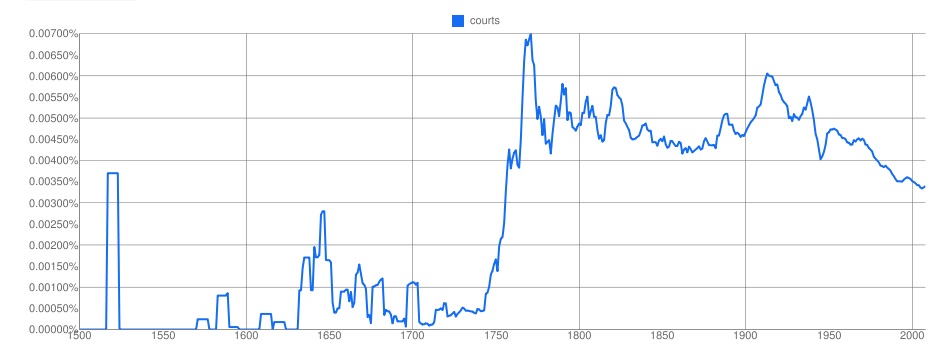
Google has another mind expanding tool out. They have scanned millions of books back to 1500, and created a tool that lets you analyze the frequency of use of a word since then.

I tried running the history of the word courts and got this graph.

Note the relatively steady decline since WWI.  Remember this is a measure of the percentage use of the word, so in some ways one might expect “old” words to be swamped out as there are more words and ideas around.

This is the link to get that info from Google to play with it.

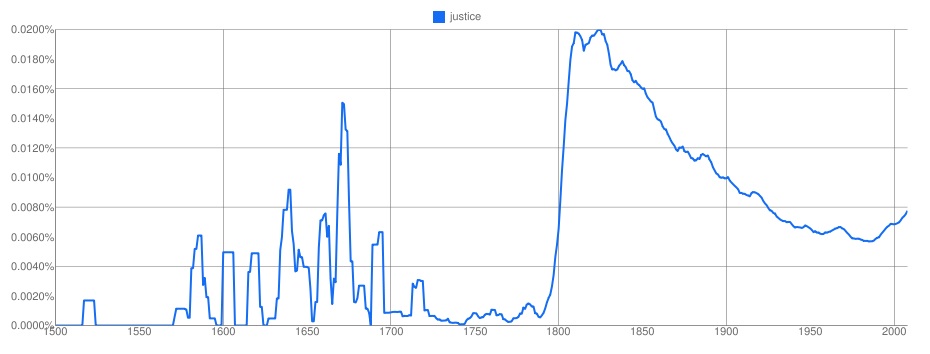
Then I tried justice:

Huge growth in the period of the Revolution and after, steady fall after that, and then renewal of interest since about 1990.

Here is the link for justice:

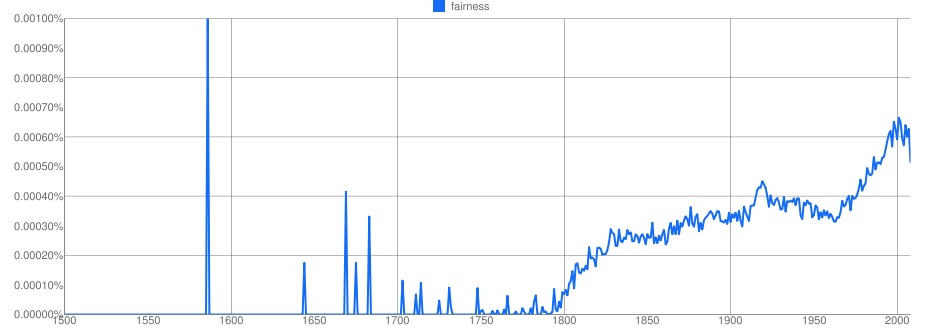
Then I tried fairness.

This is done with less smoothing, showing a steady rise from 1800 to 2000, when there is stabilization and apparent drop in 2008 (although this might be an artifact since it is at the end of the data.)

So fairness is the word of the century!

Anyway, this tool is cool.

Feel free to experiment and share in the comments (or pass on to me for possible posting if unable to post directly.)  The tool lets you compare the history of more than one word.

Posted in Tools | Tagged | Comments Off on Wonderful New Historical Analysis Tool from Google — Shows Changing Views of “Courts,” “Justice,” and “Fairness”

Dept of Justice Access Initiative Website and Foreclosure Mediation Resouce

Too little attention has been paid to the recently launched website of the Department of Justice Access to Justice Initiative Website.

While it is somewhat bittersweet to view, given that Prof. Tribe is leaving, it is still important to see that the Initiative remains and will continue, with examples of its work listed here.

An important publication is listed:  EMERGING STRATEGIES FOR  EFFECTIVE FORECLOSURE MEDIATION PROGRAMS.

Posted in Access to Justice Generally, Foreclosure | Tagged | Comments Off on Dept of Justice Access Initiative Website and Foreclosure Mediation Resouce

Justice Laurie Zelon Gets Award –Take a Look at the Powerful and Innovative Elkins Task Force Report on Family Courts in California

Many of you know Associate Justice Laurie Zelon of the California Court of Appeals. Given how hard she works for access to justice, and how much she contributes, I know hat you will be as pleased as me to hear that on Dec 14 she received the 2010 Aranda Access to Justice Award.  The award is sponsored jointly by the State Bar, California Commission on Access to Justice, Judicial Council and California Judges Association.  As Earl Johnston, longtime activist for access, and now retired from the same court on which Justice Zelon continues to serve, put it “As someone who received the Aranda Award a few years ago, I can truthfully say no judge ever has done as much to merit this honor as Justice Laurie Zelon.”

I would particularly urge you to take a look at the so-called Elkins Task Force Report, a comprehensive set of recommendations for overhauling family justice in California.  Justice Zelon chaired the Task Force.  The Report is now in the implementation phase.

Here is a California Court Video profile.  Really nice.

Posted in Access to Justice Generally, Systematic Change | Tagged , , | Comments Off on Justice Laurie Zelon Gets Award –Take a Look at the Powerful and Innovative Elkins Task Force Report on Family Courts in California

Foreclosure and Credit Cases — What is to be done?

I find myself more and more embarrassed that those of us in the access to justice movement have not been able to figure out how to do more to help particularly the self-represented deal with these cases. see. e.g. New York Times, A Happy Ending to a Raw, But Common Tale.  It is not just about the potential for individual injustice, but also that the distortion in the system are perpetuated when one side’s position is neither challenged nor reviewed properly.

Some questions for consideration:

What help do courts need in figuring out how to better inform litigants of their rights?

What help do courts need in figuring out how to more completely consider cases, including processes to encourage solutions (mediation)?

What research needs to be done to get a better handle on the problem and what its consequences are?

I would very much appreciate thoughts and ideas on these and related question.  I would also appreciate hearing about innovative programs that might be shared and replicated. Comment, or e-mail me, direct, richard@zorza.net.

Here is one example, the Consumer Assistance Project, operated by Legal Services of Northern California, in cooperation with the Superior Court.  Here is the leaflet.  The project provides consultations on legal rights and self-representation, by appointment.

Another:  Ohio Foreclosure Mediation Program, organized by the courts, and IOLTA program participation in overall effort.

Posted in Access to Justice Generally, Foreclosure, Pro Bono, Self-Help Services | Tagged , | 3 Comments

Center for Budget and Policy Priorities Analysis of State Budgets — And Some Suggestions

The Center for Budget and Policy Priorities (proud disclosure — where my son works!) has a well-earned reputation for the integrity of its projections and analysis.

Recently they issued this Report on just how bad the state budget situation remains going forward.  Headline:  “States face [:] Sharply constrained budgets in 2011. . . . No diminishment in budget problems in 2012. . . . Declining federal assistance.

Lots of charts included in the Report.

To try to cheer you up, here is an article that I wrote with Frank Broccolina, the State Court Administrator for Maryland, on En$uring Access to Ju$tice in Tough Economic Times.

Folks, please feel free to share other ideas for cost-effective innovation in the current environment.

Posted in Access to Justice Generally | Tagged | Comments Off on Center for Budget and Policy Priorities Analysis of State Budgets — And Some Suggestions