How Not To Bring The Litigant Voice Into the Legal System

Richard Moorhead of University College London has a brilliant blog post here, on a recent attempt by the Solicitors Regulatory Association to impact the process of reforming (or not) the exam process for qualifying as a solicitor. (By the way, those of you who have forgotten what London is, it is the capital city of the now largely forgotten country, the United Kingdom, that voted to leave Europe.)

The SRA’s new consultation on the solicitors qualifying examination (SQE) is now out. I will read it with interest. I note with a little frisson of amused dismay that the SRA is praying in aid of its proposals polling from the general public. It appears, the general public were asked all of three questions:

  • As part of the process of qualifying as a solicitor, solicitor should have some training in the workplace. (87)
  • Everyone should pass the same final exam to become a solicitor, regardless of the type of training they do. (79)
  • I would have more confidence in solicitors if they all passed the same final exam. (76)

To spell it out they have commissioned polling with leading questions, and which the public can be expected to have very limited insight into or informed view on. It’s not that the public’s voice is unimportant, it is just that if we asked a random group of strangers these questions we would almost always expect them to answer in the affirmative.

I have put the actual reported percentages after each offered statement.

Cute, and surely an inspiration to us in our equivalent research brining the litigant voice into the discussion.  How abut the following questions?

  • I would be more comfortable being represented by someone with full legal training rather than someone who has had only limited training.
  • Only lawyers should be allowed to give out information about the law because otherwise people will get wrong information and get badly hurt.
  • It is important that lawyers are not allowed to leave from representing someone in the middle of the case.
  • Court staff must not act like lawyers
  • If a judge asks a question that changes the result of the case, the judge is not being neutral.

Now, I am not sure how some of these might come out, but you see the picture.


Posted in International Models, Legal Ethics, Non-Lawyer Practice, Political Support | Comments Off on How Not To Bring The Litigant Voice Into the Legal System

Serving Self-Represented Litigants Remotely A Resource Guide Is a Must Read

Serving Self-Represented Litigants Remotely A Resource Guide, prepared by a team led by John Greacen and including SRLN members from across the country, has just been published by SRLN.  It is a “Must Read,” to use a much over-used word.  Anyone considering integrating remote services into their access delivery system, anyone convinced that they should not do, anyone involved in thinking about how to respond to the Conference of Chief Justices 100% access resolution, and indeed anyone already delivering any such services, and interested in expanding needs to read it fully very soon.

The SJI Newsletter (SJI provided funding) summarizes the Guide and Executive Summary as follows:

Delivery of services using telephone and internet-based technologies is an effective and efficient means of providing information and assistance to self-represented litigants, and should be a part of the service delivery strategy of every entity interacting with this customer group.

Use of multiple remote services (e.g., telephone, e-mail, live chat, videoconferencing and text messaging) is advantageous to the service provider and the user.

Service providers save resources in these ways: 1) remote services delivery staffing can be centralized; 2) staff/customer interaction time is shorter using most remote methods than face-to-face communications; 3) it easier for staff to establish boundaries for a re- mote conversation; 4) staff are better able to control the pace and demands of their work; 5) facilities costs are reduced; 6) security issues and costs are minimized, but not eliminated; and, 7) how merging technologies used in limited jurisdiction courts, such as those identified in Nebraska and Orange County, California, continue to maximize underutilized staff resources.

Benefits to customers and the ways in which remote services are exceeding internal and external expectations are described. The SRLN, conducted extensive in-person interviews, observational analysis, focus groups, and assisted each contributing state partner in completing a program characteristics spreadsheet. The Guide contains information from state-level programs in Alaska, Idaho, Maryland, Minnesota, Montana, and Utah ,and county-level programs in Butte, Lake, Tehama, and Orange Counties in California.

While the Report is careful to emphasize that there is no one size fits all approach, the practical reality is that the Report effectively answers most if not all of the worries and reluctance about these ways of providing services.

The Report includes detailed findings, comparisons, and descriptions of the programs studied, and any summary will fail to do it justice.  It has to be read.
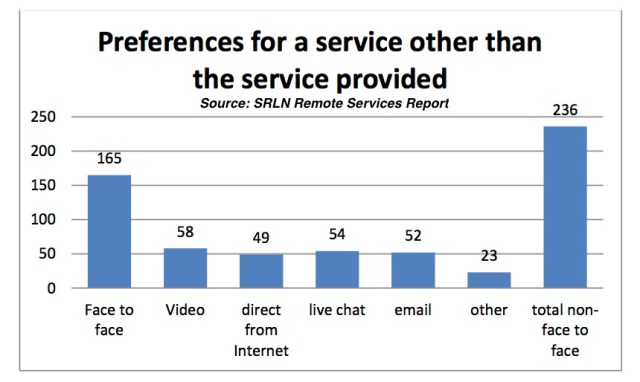
However, perhaps most dramatic to me is the following chart, which shows the views of surveyed users about alternatives to the remote systems they were using.  While some people, from 10% to 47 % depending on location, would have preferred a different service than the one they received, even among that number, many more would have preferred a different non face to face service than a face to face service.  Indeed, almost half as many again.  So much for the idea that remote services are seen as second best.
preferences

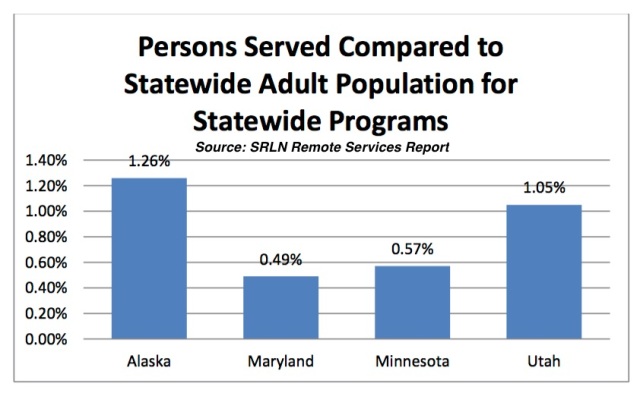
The following chart is perhaps even more dramatic in terms of the potential breadth and impact of these programs.  It shows the percentage of state residents served each year by the four statewide programs.

percentag

Now, these numbers are indeed somewhat inflated because some people will be double counted.  But, remember that the base is not poor people, not middle income people, not the self-represented, not all litigants.  No, it is the entire adult population.  In other words, these programs are having a statewide impact, measured not just in terms of the legal system, but in terms of the whole population.

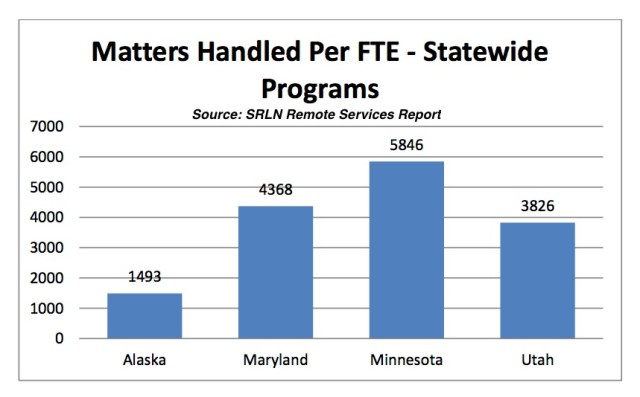
What about cost?

Well, on average, close to 4,000 people a year are served by each full time equivalent.

fte

That is an astonishing number, and underlines that these services have huge potential to make the difference in getting to 100%, perhaps in a shorter term than many of us have feared.

Finally, the efficacy results, based on two programs, are impressive, and will be the subject of a future blog post.

At the risk of stating the obvious, this is all very highly relevant to the leveraging of the triage idea, and to strategic choices to be made in Justice for all strategic planning processes, pursuant to the Chiefs Resolution.

SRLN, whose coordinator Katherine Alteneder is arguably the leading national expert on delivering remote services for self-help services, is available for consulting.  Katherine played the major role in setting up the remote self-help services system in Alaska.


Posted in Access to Justice Generally, Budget Issues, Court Management, Forms, Metrics, Remote Services, Research and Evalation, Self-Help Services, SRLN, Systematic Change, Technology, Triage | Comments Off on Serving Self-Represented Litigants Remotely A Resource Guide Is a Must Read

Harder and Harder to Separate Access to Justice and Election Politics

It is getting harder and harder to separate access to justice and politics.  So I feel that it is not inappropriate to share a link to my politics and humor blog, in which I ask those Republics who might, in the event of a Trump victory, consider joining the administration to think through very carefully, given Trump’s unpredictability, what their red lines would be.

Of course, such thoughts are relevant to anyone considering any job about which they have doubts of any kind, but they are just particularly important here, both for the person and the country.

Please share with anyone these thoughts might become relevant to.

Posted in Access to Justice Generally, Judicial Ethics, White House | Comments Off on Harder and Harder to Separate Access to Justice and Election Politics

More Dramatic Statistics on Representation Imbalance for Collection, Landlord/Tenant, and Small Claims

Recently, I blogged about some numbers derived from NCSC data for representation status and imbalance.  The numbers are stunning, here, and here.  As I put it then:

We Now Have the Data That shows That The One-Side-Self-Represented Case is the Dominant Case Situation in US Civil State Courts and That We Need a Fundamental Rethink of The State Civil Justice System.

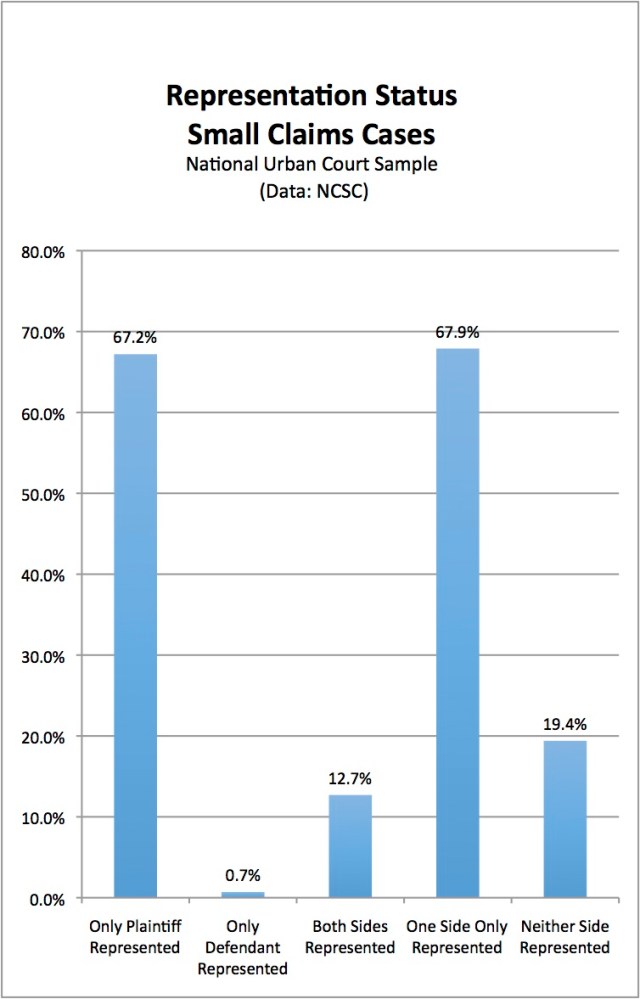
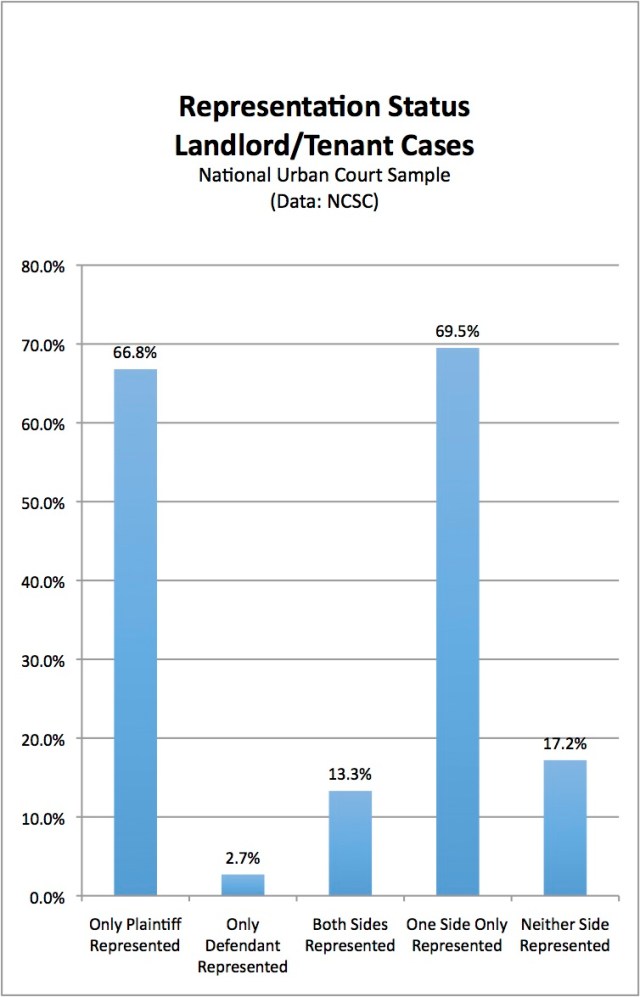
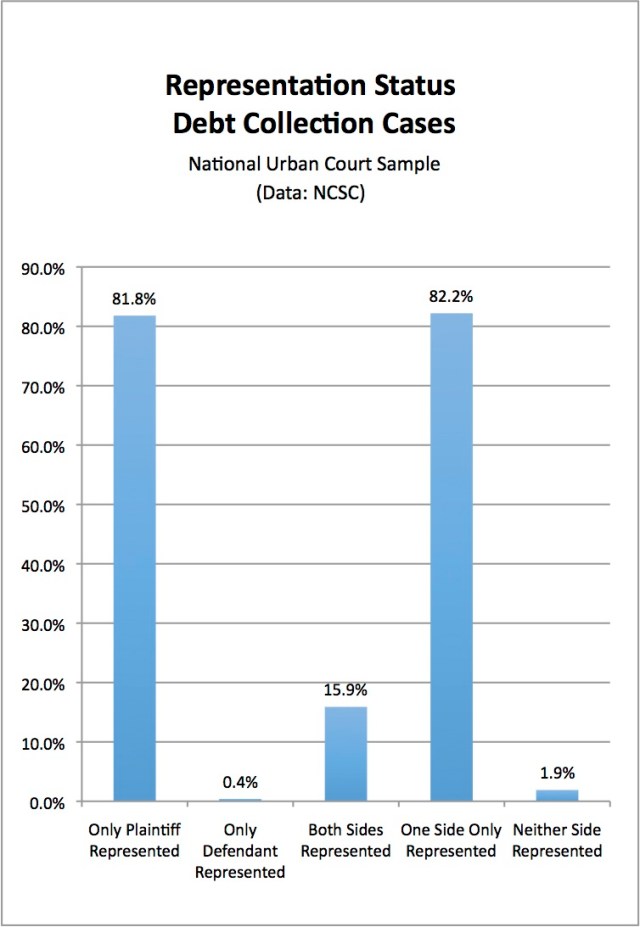
With some additional data generously provided by NCSC, I can now break this out further (methodology here) and show, with this broad urban court national sample, how this imbalance works out in certain case types.  This will surely help prioritize strategic planning priorities.  These three charts are shockingly self-explanatory:

smallclaimstenantdebt

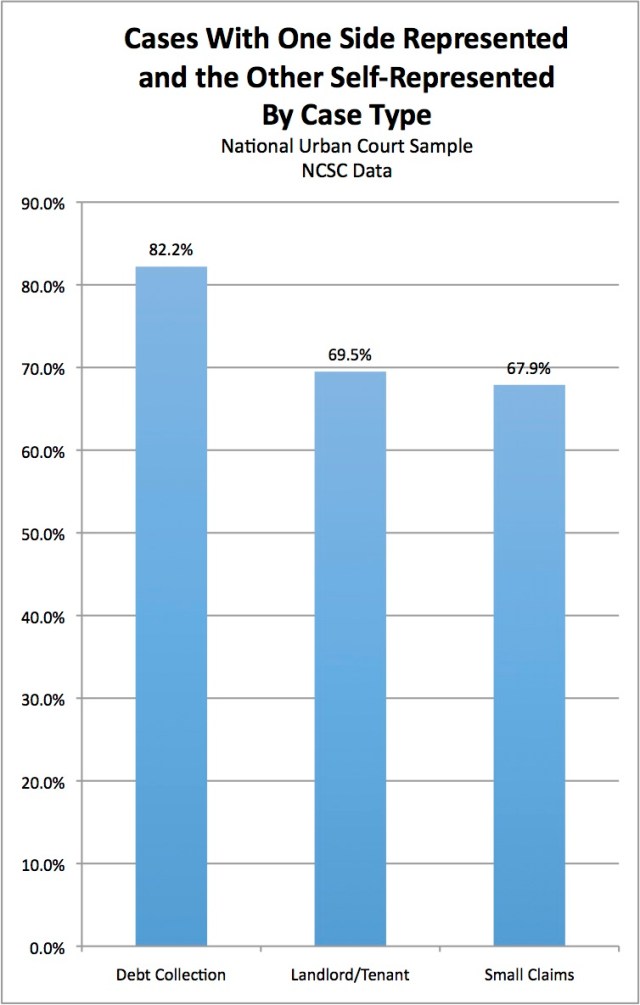
As an aid to strategic planning here is a blunt comparison of the percentage with an unrepresented person going against a represented one:

repnbycasetype

Case closed as to need for intervention, redesign, etc.

Posted in Bankruptcy, Chasm with Communities, Debt Collction, Evictions, Small Claims, SRL Statistics | 3 Comments

Integrating “Roles Beyond Lawyers” into Court Improvement Strategies

A recent paper by Colleen F. Shanahan, Anna E. Carpenter and Alyx Mark makes a very important point that, as the abstract puts it:

Access to justice interventions that provide a little representation, including nonlawyer representation and various forms of limited legal services, may be valuable solutions for low- and middle-income Americans. However, a thoughtful approach to improving access to justice efforts should recognize that a little representation may have risks. In particular, one potential risk of a little representation is that while it provides assistance with a discrete legal need in a specific moment, the nature of the assistance is incompatible with challenging the law. As a result, individual litigants do not have the benefit of legal challenges in their own cases, and our legal system develops devoid of law reform that reflects the needs of low- and middle-income litigants. (Links added by this blog.)

The core idea, based on detailed analysis of hearings in the Washington DC unemployment insurance system, focuses on the actual evidence techniques used in the hearings, and the costs of lack of strategic judgements.  The more detailed analysis is in this parallel paper from the same authors.

To me, this suggests a two pronged approach to improving courts that thinks about the system as a whole, rather than individual cases.  In the first phase, you make heavy use of experienced counsel who can essentially “clean up” the court’s practices, including where necessary taking up the appeal to change the law or make sure that it is followed in the court.  When that process has been successful, then you move in with nontraditional services, in which those providing them are trained in the skills needed to make sure that facts and law are presented to the court.  You keep traditional legal representation in a small number of cases, and make sure that referral is both available, and known to be available for those having to rely on those without full legal training.

A sophisticated triage system would actually be designed to adjust recommendations based on an analysis of where the court or forum was in this reform and support system.

Similarly, a sophisticated access to justice strategy would be designed to develop such a multi-state approach, test and modify it in a few forums, and then apply it statewide.

Different stakeholders would play different roles, with advocacy organizations providing representation, and the courts providing parallel staff training and perhaps support systems for the new forms of assistance.

Let’s think strategically here.

P.S. I should note that it was reading these papers that also got me going on the analysis and suggestions in my earlier post here about the relationship between triage and court simplification redesign.

Posted in 100% Access Strategy and Campaign, Access to Counsel, Court Management, Non-Lawyer Practice, Referral Systems, Research and Evalation, Triage, Unbundling | 2 Comments

Data Maps Come to Access to Justice Planning

This is an important step in ensuring that strategic planning is informed by underlying indicia of need.

The Self-Represented Litigation Network has just launched a national, but highly granulated online tool for looking at national county by county level statistics for fourteen critical driving factors in understanding need and developing the strategies for meeting them.

Those factors are:

  1. Population density
  2. Children
  3. Young Adults
  4. Adults (30-44)
  5. Midlife Adults (45-99)
  6. Seniors (60 +)
  7. High school graduates
  8. Rentals
  9. Vehicle access
  10. Active Duty Military
  11. Veterans
  12. Racial Diversity
  13. Foreign Born
  14. Language Other Than English Spoken at Home
  15. Poverty
  16. Where Is Mobile Broadband Available?
  17. How Fast Is Mobile Broadband?
  18. Where Are Homes Connected to High-Speed Internet?

How might this be used?

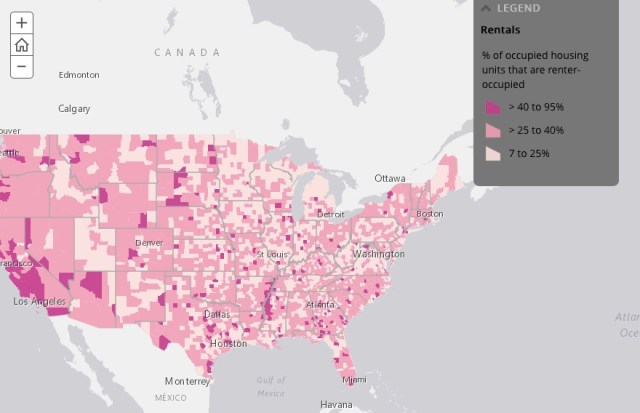
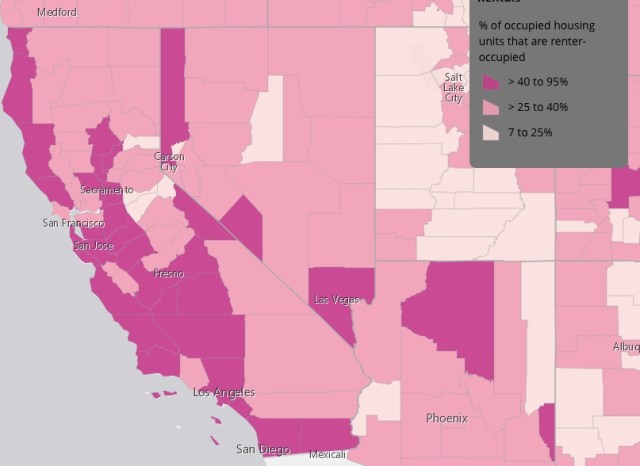
Think for example, of the rental data.  The extent of rentals is obviously likely to predict the number of evictions and thus of the need for access to justice services.  Here is the national map:

rent-nat

A huge variation.  Lets zoom in on a state.

rent-ca

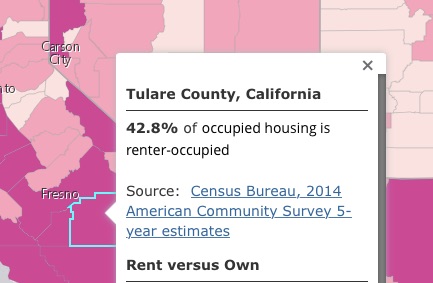
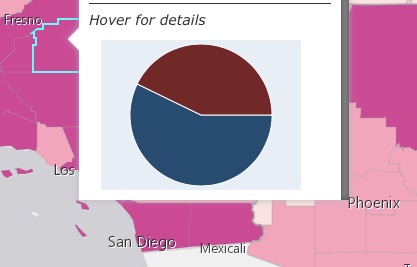
Now one county.

rent-countyrent-pie

At the next level, rental units alone are not the only driver of this need.  Poverty, age, etc., are obviously such predictors.  If those together suggest more evictions than are actually occurring in the court systems, then that probably means that more of them are occurring as “informal evictions.

Moreover, evictions are not the only ATJ need that will be impacted by rental levels.  Rentals are usually associated with frequent moves.  That means need for assistance in obtaining the right to education.  More rentals surely mean more need for emergency shelter.  The list and interplays go on for ever.

This is a fine start, and I very much hope that as states move forward on planning for strategic planning, they will make full use of this amazing resource.

Posted in 100% Access Strategy and Campaign, Access to Justice Generally, Evictions, Housing, Metrics, Poverty, SRL Statistics, SRLN | Comments Off on Data Maps Come to Access to Justice Planning

Getting ATJ Statistics Into Census Data Collection — The Eviction Example Highlighted on fivethirtyeight.com

The wonderful fivethirtyeight.com, which many of us obsessively check multiple times a day for its magnificent (and frightening) election projection results, has just put up a very important article on the under-counting of the eviction problem.  The title tells it all: How We Undercounted Evictions By Asking The Wrong Questions.  It has to be great that this is now getting public attention through a website very popular with the policy and political folks.  (Overall, this is the 188th most popular website in the US.  That puts it slightly less visited than American Airlines and T-Mobile, but better than icloud.)

As the post explains:

Millions of Americans are forced to leave their homes every year, and experts see housing instability as a major contributor to a host of other problems that poor households face. But getting more precise than “millions” is impossible because of a lack of good data. The federal government does a poor job of tracking evictions, and the sources that do exist, such as court records, are incomplete and lack detail.

Then the really good news, describing a door to door survey project that aims show how to fill the gap.

But that may be starting to change. The survey that Williams was part of, the Milwaukee Area Renters Study (MARS), may be the first rigorous, detailed look at eviction in a major city. Interviewers like Williams spoke to about 1,100 Milwaukee-area tenants between 2009 and 2011, asking them a battery of questions on their housing history. The survey has already fundamentally changed researchers’ understanding of eviction, revealing the problem to be far larger than previously understood. Now the survey is going national: The Census Bureau recently agreed to add some of the MARS questions to its massive, biennial housing survey.

As to methodology and results:

Informal evictions were twice as common (48 percent of all forced moves). In these off-the-books evictions, a landlord might, for example, give a tenant $200 to move out by Thursday. Or they might take the door off. Regardless, it happens without a legal paper trail. (To round out the other reasons, the MARS survey found that about 23 percent of forced moves were because of landlord foreclosure and 5 percent because of a building condemnation.)

No matter the reason, the MARS researchers found that when people were forced to move, they often didn’t see it as an eviction. So instead of just asking, “Have you ever been evicted?” the MARS survey posed a roster of questions about a tenant’s housing history — when and where they had lived and why they left. This “moving module” was the centerpiece of the MARS study. By asking more than 250 questions, interviewers like Williams gathered data on every place a respondent lived for at least 30 days over the previous two years. Small wording details made a big difference. Rather than “Where do you live?” people were asked, “Where do you spend most nights?”

In the aggregate:

In the two years before being surveyed, more than 1 in 8 Milwaukee renters were forced to move, whether because of a formal or an informal eviction, foreclosure or condemnation. Also, Desmond’s follow-up research using MARS data has found a strong connection between eviction and subsequent residential instability, even after factoring in the tenant’s income and race. Eviction is linked to substandard housing conditions. And eviction also has serious negative health consequences, particularly for children.

As to the involvement of Census and HUD:

“It’s fair to say we have not collected good data in the past on evictions,” said Shawn Bucholtz, the director of the division that runs the biennial survey at the Department of Housing and Urban Development, which administers the survey in conjunction with the Census Bureau. The results of the 2015 survey — which will be released next month — won’t contain much data on evictions, but starting with the 2017 survey, things will change. That’s because HUD is adopting the MARS questions “pretty much verbatim,” Bucholtz said. “It was a pretty easy decision to make.”

Its just impossible to overstate the impact act starting to incorporate true access to justice need and other measures into the census and beyond.  I will soon be blogging about an overall analytic model that might measure access to justice using numbers like this as the start of the analysis, and then moving through the process all the way to compliance with orders, and then impact on outcomes such as economic mobility. Looks like we should start with housing security.

Posted in Access to Justice Generally, Census Bureau, Court Management, Evictions, Federal Agencies, Foreclosure, Housing, Outcome Measures, Poverty, Research and Evalation | 1 Comment

Article on Incentives in Access to Justice

My paper on incentives in access to justice has now been published in the Georgetown Journal of Legal Ethics.  Here it is.

Here is the full text of the abstract:

Most of the current deregulation discussion focuses on permitting both non-lawyers and lawyers to do more than currently authorized. While such changes would presumably contribute to solving the problem of increasing access to justice while maintaining quality and consumer protection, such discussions alone are unable to offer any realistic hope of achieving the 100 percent access to justice services for all envisioned by the recent Resolution of the Conference of (State Court) Chief Justices and the Conference of State Court Administrators. This Article discusses the potential for fully achieving that 100 percent goal by integrating broad regulatory changes with largely positive economic incentives on courts, bar and legal aid designed to increase efficiency and reduce costs, and with politically achievable ways of bringing in additional resources.

The five proposed solutions are:

A.  Releasing non-profit legal-serving entities from almost all regulation, while moving the subsidy system of legal aid to a genuinely competitive model;

B.  Deploying a mix of more limited de-regulation on the bar as a whole, combined with inter-related mandated sliding fees and broad tax incentives, for both litigants and providers;

C.  Maintaining almost all regulation, but placing the obligation of ensuring and providing 100 percent access to justice services on the bar as a whole, while giving the bar the authority to tax its members to fulfill that obligation and modify regulation;

D.  Internalizing all costs of access to justice into the court system, in order to incentivize court simplification and some appropriate deregulation; and

E.  Allowing for broad National Technology Limited Practice Licenses on condition of free services for the poor and reasonable ones for middle income, and with appropriate regulatory relaxations.

This Article proposes and applies a seven question conceptual framework for assessing these approaches and their long-term utility:

  • Does it ensure that everyone with significant legal need would be appropri- ately served, regardless of financial or other barriers?
  • Does it provide the resources to fill the resource gap?
  • Would it meet the political and economic requirements of being highly cost effective
  • Would services be varied, flexible and matched to need?
  • Would the solution incentivize changes in the system as a whole?
  • Would the solution protect the consumer, either through the relevant traditional formal values of the profession or through some other means such as a structuring of market incentives?
  • Could one be sure that any new resource mechanism would not introduce or exacerbate any additional general non-neutrality into the system?

These are pretty controversial ideas.  I very much look forward to your reactions and suggestions.

P.S. The ideas and questions are applied in a grid that is part of the article.  I hope it makes it easier to separate out the ideas.  Go to page 712-13.


Posted in ABA, Access to Counsel, Alternative Business Structures, Anti-Trust, Bar Associations, Medical System Comparision, Middle Income, Mixed Model, Non-Lawyer Practice, Outcome Measures, Planning, Political Support, Poverty, Pro Bono, Referral Systems, Research and Evalation, Rules Reform, Self-Help Services, Simplification, Systematic Change, Tax Policy, Technology | Comments Off on Article on Incentives in Access to Justice

Triage Should Guide Court Simplification and Non-Lawyer Role Expansion, Not the Other Way Round

I think I may have been guilty of thinking about the relationship of triage, court simplification and expansion of non-lawyer roles the wrong way round.

I have basically been saying something like this:

For each case, we should do triage, look at the tasks the person has to do, decide what kind of expert, if any, is needed to do them, and then route the case appropriately.  We may then seek to simplify the system so that this works better.  We may also then ask if a less trained person could do the job, and who that might be.

But maybe what we should be doing, is deciding what kind of skills and training (if any) we want we think should be need to handle particular kinds of situations, and then simplify the courts, and train the helpers, so that that becomes viable.  Some processes for some situations should be designed to have minimal help in most factual circumstances. Others to provide whatever additional is needed at particular steps in the process.

For example, uncontested equal-power divorces really should need no help.  So the processes should be designed so anyone can navigate them.  But significantly unequal power divorces need processes that lay the groundwork well for the use of the ongoing monitored coercive power of the state.  They also need the mechanisms to ensure that all the facts are gathered and presented properly.  A lawyer maybe, but certainly those with the skills to manage their clients on both sides of the dispute (very different skills), and a process that works with and supports those skills.  Each of these roles may be designed very differently from the traditional lawyer.

Our  general mistake has been thinking about triage on the assumption that the court’s process is fixed and unchangeable.  We have also thought about new legal assistance roles as being defined by particular situations, rather than designing the processes so that they can work best with the skills really needed.

The basic idea is simple.  Do not treat the court process as a given.  Do not treat the roles as given. Design them so they can work with whatever skills and help would be most appropriate in the situtation.

Posted in Access to Justice Generally, Family Law, Non-Lawyer Practice, Referral Systems, Simplification, Systematic Change, Triage | 5 Comments

On Waking Up From a Nightmare that was About Trying to E-File in the Supreme Court– Maybe We Can Use the Idea!

I just woke up this morning in a panic from a nightmare that would be funny if it were not so scary.

There I am in the dream trying to e-file a pleading with the Supreme Court.  Naturally it is very close to the deadline.

Every time I click the “File” button, up comes a bunch of windows of grids of yellow boxes highlighting all the grammatical and other errors in the brief.  Page numbers are across the top axis, and error descriptions down the side. What is scariest is that it seems like, but it not really clear, that the system will not let me file anything until they are all corrected.  And, as in any well-designed nightmare, time is ticking by.

I try closing all these windows, since there, of course lots of them, and then new ones start to appear.  And time is still ticking by.

Finally I wake up, and of course, since its 25 years since I was a litigator, no brief is really due anywhere, thank god.

But buried in that dream are two really great ideas.

First, no electronic system should prevent one meeting a deadline because of good faith technical (in the legal writing or pleading sense) errors.  Any attempt to file should be regarded, as a matter of law, as sufficient.  Moreover, the attempting filer should immediately be told that fact and given proof of the attempt to file.

Second, maybe there should be advanced online tools that help the self-represented make sure that their pleadings meet technical requirements.  This could be done both by use of document assembly, still rare in the appellate context, and by just the kind of diagnostic intelligence that my nightmare featured.  Like grammar and spellcheck, only much more.

The US Supreme Court could start with with a “Cert Petition Preparation System.”

What a way for courts to show that they are making efforts to be open and accessible.

p.s.  It’s perfect.  I go to my e-mail to check for the e-mail that proves to me that this post has really been filed on this blog.  Nothing there.  I keep clicking the “get mail” button, and nothing happens.  Again and again.  And, of course, the clock is still ticking.  Finally the e-mail appears.

Posted in Document Assembly, E-filing, Supreme Court | Comments Off on On Waking Up From a Nightmare that was About Trying to E-File in the Supreme Court– Maybe We Can Use the Idea!

DOJ/NSF White House Legal Aid Interagency Roundtable Report on Access to Justice Research

I have been much remiss in not blogging earlier about this important and very timely Report from the Department of Justice (NIJ and ATJ) and the National Science Foundation on Research in Access to Justice.  Formally titled White House Legal Aid Interagency Roundtable Civil Legal Aid Research Workshop Report, this Report represents a major milestone in one of the ATJ Office’s most important initiatives.  It is no accident that since the Office was created, and particularly since LAIR was set up, we have seen an explosion of research interest in access to justice.  Prior recommendations to create research capacity in this field went unheard ever since the 1980’s when this capacity at LSC was closed down.  (By the way, I think it is safe to say that the definition of “legal aid” is a broad one, reflecting research on the many many ways and places that people get help, and broad popular support for this concept as a goal.)

As the Executive Summary of the Report explains of the Workshop that led to the Report:

First, it assisted NIJ to identify a civil legal aid research agenda in anticipation of possible dedicated funding of this work. By its current authority, NIJ is called to “engage in and encourage research and development to improve and strengthen the criminal justice system and related aspects of the civil justice system.” The 2017 President’s Budget requests $2.7 million for a proposed Civil Legal Aid Research Institute housed at NIJ.  If the funding request is approved by Congress, this Civil Legal Aid Research Institute would be tasked with coordinating the U.S. Department of Justice’s efforts to develop a better understanding of the policy issues related to civil legal aid, to improve research and data collection, and to provide policy makers with more timely and detailed data to support their efforts to improve the nation’s civil legal aid programs.

Second, the workshop enabled WH-LAIR agencies to hear from civil legal aid experts on the effectiveness of civil legal aid at the intersection with public safety and criminal justice and the critical need for research and evaluation in this arena. This is important because WH-LAIR has been encouraging research and evaluation with respect to existing federal programs involving civil legal aid. In addition, President Obama explicitly mandated the WH-LAIR to “advance relevant evidence-based research, data collection, and analysis of civil legal aid and indigent defense, and promulgate best practices.” Furthermore, the September 2015 Executive Order on Using Behavioral Insights to Better Serve the American People encourages executive departments and agencies to “strengthen agency relationships with the research community to better use empirical findings from the behavioral sciences.” The workshop and this report assist WH-LAIR in fulfilling these obligations.

Finally, the workshop helped spur domestic activities to implement the United Nations’ (UN) call for indicators on access to justice as a development and anti-poverty goal. On September 25, 2015, the UN unanimously adopted the 2030 Agenda on Sustainable Development (Agenda), which included 17 Global Goals to end extreme poverty. Among these goals, Global Goal 16 calls on countries to: “Promote peaceful and inclusive societies for sustainable development, provide access to justice for all and build effective, accountable and inclusive institutions at all levels.” To track progress on these goals, the Agenda calls for the creation of global, regional, and national indicators that will be in place for the next 15 years. In anticipation of the UN’s inclusion of Global Goal 16 in the Agenda, the Expert Working Group (EWG) considered how to track access to justice and which indicators could be used for that purpose. (Footnotes omitted).

As identified in the Report, these were the general themes of the recommendations that came out of the individual substantive working groups:

  1. Increase support for civil legal aid through increased federal funding and programs that partner with civil legal aid;
  2. Fund research on the delivery of civil legal aid to grow the evidence base and identify what works;
  3. Expand private-public collaborations around civil legal aid;
  4. Improve data collection on the issues impacting civil legal aid and make available information on relevant federal databases and studies;
  5. Create greater transparency regarding the federal government’s research capacity around civil legal aid; and
  6. Develop access to justice indicators to measure the United States’ implementation of Global Goal 16 of the UN’s 2030 Agenda on Sustainable Development with civil society input. (Bold added)

It is a measure of the achievement of those working on these issue that these are by now, hardly controversial.  They are obviously useful as providing an overall guidemap for the future.

In addition, as I went through the Report, i found a number of multiple resonances that might be programmatically helpful.

Economic Impact.  Everyone was in favor of research on the broad economic and return on investment impact on services.  The fundraising motivation is obvious, but hopefully such data would also serve broader goals of the integration of different systems.  Ultimately it would be nice to think of a system in which budget-making incentivized spending money where it would have the most impact overall.

Service Co-Location.  There seems to be broad interest in looking at the impact of integrating at least the physical aspects of service delivery.

Training for of Referral and Information Training Partners.  Lots of people suggested research into training partners such as first responders, medical professions, and others who could make referrals.  I would go further and think about training them as legal information providers and navigators into online legal information.

Research Inventory.  Not surprisingly, lots suggested research inventories.

Integration of Feds with legal aid.  Everyone wanted integration of legal aid and Federal policy and statistics.

Those who share this approach might be particularly interested in the nuances and new ideas in some of the individual group recommendations.  I have tried to pull them out below, divided by the workgroup.

Developing Indicators in the Civil Legal Aid Context

  • “Collect data or commission a census of unrepresented litigants.”
  • Support for funding to “research on the benefits of early intervention by legal aid,” and for nonlawyer innovations.
  • Encouraging the creation of a national self-help portal.

Re-Entry

  • Examine whether existing rules, regulations, and practices on reentry need to be revised
  • Research on the consequences of sealing or expunging criminal record
  • Compare automatic expungment and expungement by application
  • Integration of civil and criminal services

Trafficking

  • Establishing referral pipeline
  • Seeking restitution orders

Consumer Protection

  • Study default rates
  • Integrating with military-based legal aid
    Mandatory arbitration minimization

Elder Issues

  • Explore medicare reimbursement of legal aid type services.
  • Program medical software to identify legal issues and generate referrals

Domestic Violence

  • Support alternatives to traditional dispute resolution

I would particularly urge everyone to take a good look at Appendix D, which lists existing research and existing data collection capacity.


Posted in Access to Justice Generally, Consumer Rights, Dept. of Justice, expungement, Family Law, Foreclosure, LAIR, Legal Aid, Medical System Comparision, Non-Lawyer Practice, Outcome Measures, Reentry, Referral Systems, Research and Evalation, Self-Help Services | Comments Off on DOJ/NSF White House Legal Aid Interagency Roundtable Report on Access to Justice Research

Table Comparing Three New Different ATJ Sets of Recommendations Should Help Move Collaboration Forward

It is quite amazing that within a few weeks we have had three major sets of specific recommendations for national access to justice strategies come out.  They are, in order of appearance, the Guidance for NCSC Grants for Strategic Planning funded by Public Welfare Foundation to implemented the CCJ/COSCA Resolution, the Report of the ABA Commission of the Future of Legal Services, and the  NCSC/IILS Civil Justice Initiative Report also endorsed by CC/COSCA Resolution.

What is even more amazing is how parallel they are.  I have guilt this table, both to illustrate it, but more importantly to provide a tool to foster the collaboration that all call for one, one way and another.

This new Table compares three sets of ideas, an earlier one did it for only two of the three.

While there are many ways to use this Table, I would encourage everyone involved in any way with access to justice to start with the column for the group with which they work, go down to find the innovation areas they are working on, then move across on the table to find the recommendations made by the other groups, and then figure out how to use that parallelism to build collaboration.  (The links to the three documents are in the table near the top, and also in the first para of this post.)

This graphic below, on Triage, gives one example of how the different recommendations relate. (Click on it to expand)

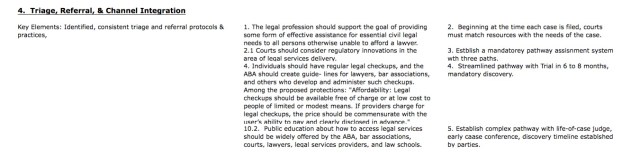
Triage Comparision

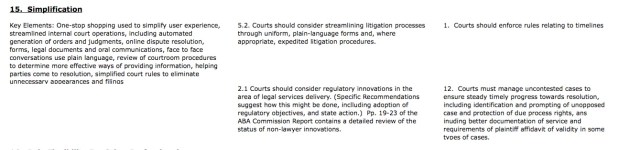
Here is another on simplification.

Rec-simple

The full Chart in pdf is here.  It is in Excel here.  I encourage you to edit and modify for your situation, but please credit the source and changes and send to me.

As you read the Table, please marvel at how much the agendas are coming into congruence, and what that means for the future, not only in terms of what is achievable, but what systems we need to put in place, nationally as well as at the state and local level, to make the most of this moment of opportunity.  When, in 2010, I was writing a paper on the Access to Justice: The Emerging Consensus and Some Questions and Implications for Judicature, the evolving parallelism was much more tentative.  Back then, the four key elements of the consensus were described as “court simplification and services, bar flexibility, legal aid efficiency and availability, and systems of triage and assignment.”  There was, however, absolutely no mention of the potential of expanding the roles of nonlawyers in the access system.  I encourage folks to take a quick look at the Emerging Consensus paper to see how far we have come.

Obviously, this Table does not explicitly include the legal aid agenda.  It may be that once the LSC strategic plan, with the draft now open for comment, is finalized, we may we able to add a new column.  Indeed, would it not be wonderful if LSC were to include such a table in the final Strategic Plan, thereby highlighting both the force of the consensus and LSC’s contribution to leveraging the resources of other groups in support of progress?  (Comments are due by Sept 6, so move it if you have anything to say.)

Everyone who wants to enhance collaboration should internalize these three sets of recommendations and the relationships between them.

Posted in 100% Access Strategy and Campaign, ABA, Access to Justice Generally, Court Management, Rules Reform, Simplification, Systematic Change, Technology, Triage | Comments Off on Table Comparing Three New Different ATJ Sets of Recommendations Should Help Move Collaboration Forward

Estimating Impact on Economic Mobility From Court Fees System

Today’s Times has a highly pertinent piece on the dramatic effect of court fees and costs on those caught in the juvenile justice system.  Obviously it relates deeply to all the economic burdens that the legal system is imposing on those least able to bear them.

What I am wondering is this: would it be possible to build an economic model that showed the impact on downward economic mobility of families of these “interventions.”

Its a hard hard question, but for a couple of decades we have tried to think of the court and legal system as at least a potential protector against poverty.  What do we do when and where it becomes a driver of downward economic mobility, even for the middle class?


Posted in Access to Justice Generally, Chasm with Communities, Court Fees and Costs, Metrics | 3 Comments

We Now Have Data To Help Prioritize ATJ Strategic Focuses

Yesterday, when I blogged about the first good national sample data on numbers of self-represented cases, and particularly on those who face a lawyer alone, I promised additional more broken down data.

These numbers, taken from the same NCSC Landscape of Civil Litigation, of  all civil cases in state courts except “domestic,” in a representative sample of all urban courts, are a powerful tool for identifying areas of greatest possible injustice.

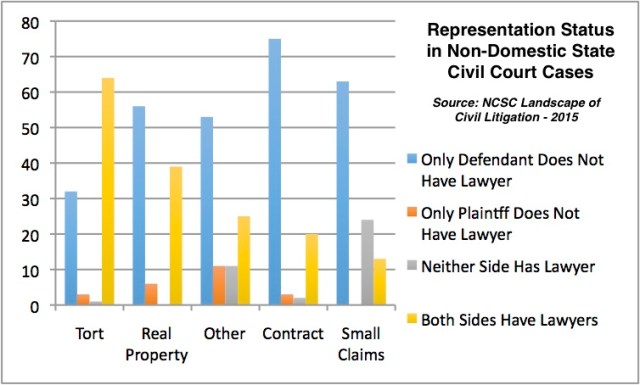
Here is the chart showing the data by type of case (methodology is described in the prior post):

Repn-Case-Type

The numbers are as stunning at the case type level as they are when given overall.

In state court contract cases, 75% of defendants have no lawyers, and face a lawyer. 2% of plaintiffs are in that situation, 3% have no lawyers on either side, and 20% have lawyers on both sides. Small claims cases are hardly any better, with 63% facing a lawyer alone.

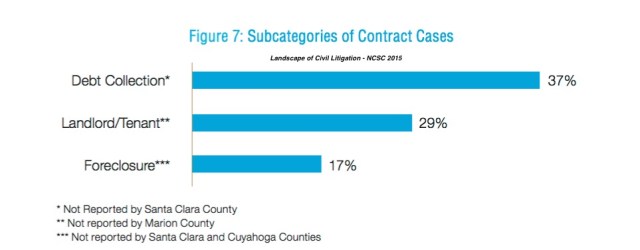
What kinds of cases are these really?  The Landscape Report answers the question with this chart for those contract cases, drawn directly from the Report.

Contracts.jpg

Silly me, after law school indoctrination, I really still thought that “contract” meant movers being sued for not delivering machine parts and cows turning out to be pregnant.  Actually it is vulnerable people losing their homes or money they probably do not even have.

While we do not know from this data exactly where the “one side only represented” cases fit between the above categories, it really does not matter exactly, because the simple answer is “most of them.”  Its not hard to draw conclusions for access to justice case type priorities.

Obviously, other factors play a major role in prioritization, see chart here, but this data should make a real difference to, and be integrated into any state strategic analysis.


Posted in 100% Access Strategy and Campaign, Attorney-Client, Court Management, Housing, Legal Aid, Metrics, Non-Lawyer Practice, SRL Statistics | 4 Comments

We Now Have the Data That shows That The One-Side-Self-Represented Case is the Dominant Case Situation in US Civil State Courts and That We Need a Fundamental Rethink of The State Civil Justice System

Some data from NCSC should be helpful in relating access to justice strategy to overall legal system changes.

This is because this data simply blows away the way we think about the courts.

The dominant analytic mode has always been that cases involving self-represented litigants are the exception in state civil courts, deserving of special educational programs for judges, perhaps a self-help center and online forms, and, in a really progressive state, even some form of assistance in the courtroom.

Well and good.  But now we not only know, but have the data to show that it is all completely inside out.

Last year, NCSC’s Civil Justice Project issued its Landscape of Civil Litigation of State Courts, and this data has been made use of in the chart on page 11 of the Project’s Call to Action.  The chart shows percentages of plaintiff represented, defendant represented, and both represented in a variety of situations and contexts.

I have played with the percentages data, which comes from ten urban counties, randomly selected from counties that had participated in prior such studies.  The list and analysis is at page 14-15 of the Landscape.  Over 650,000 cases for which full representation status data was reported are included.  The only civil cases not included in the data collection are those described as “domestic” (Landscape at iii This is a critical fact for self-represented litigant analysis, and likely leads to significant under-inclusion of cases with no lawyer on both sides in the number.

So, at the general level, this is the Civil Court “Scope of the Problem” chart.

rep-overall

At a minimum, this chart shows that the problem, in civil court at least, is far more the cases with only one side having a lawyer (70%), than the very different problem of the situation of where neither side has a lawyer, and that these cases swamp both-sides- represented cases.  In contrast to our world view, the one-side represented situation is the modal one, and heavily so. As the Landscape Report Executive Summary puts it:  “At least one party was self-represented (usually the defendant) in more than three-quarters of the cases.”

What a shattering change to the self-image of courts this requires, and what a challenge to access to justice, and what a rethink of our whole court management, indeed whole civil justice system, challenge.

Given the total mismatch between the design assumption that almost everyone has a lawyer, and the reality shown by these numbers, its hard not to think that this is the core of all courts’ problems, and that other issues, like funding, delay, prestige, and private sector alternatives, are a directly or indirectly the product of this underlying force.

Among the immediate system design implications.

  • Clerks offices are now much less important than self-help centers.  It is not even clear that clerk’s offices should exist.  Probably they should be absorbed into self-help services.
  • Judicial education should be completely restructured, with the majority of courtroom training components focusing on cases with one self-represented litigant.
  • Judicial selection should be changed to ensure that we get judges with the right skills, and that those who think they want to be judges know what they are signing up for.  An unhappy judge is a bad judge.
  • Technology projects, and particularly e-filing, should be built so that they work as well for the self-represented as they do for lawyers.
  • Every court, and almost every court committee, needs individuals and senior managers with a primary focus on self-represented cases.
  • Rules should assume that the dominant mode of cases is the dominant mode.
  • Caseflow management must be focused on those who need help, rather than attorneys.  No wonder it fails now.

Thanks so much to NCSC for the very hard work of bringing this data together (we know how hard it is) and making it accessible.

More to come in future posts on the more detailed data, and its potential use in access to justice strategic planning.

A short note on methodology — let me know if you find a hole.  NCSC very kindly send me the percentages in the representation chart in the Landscape report in a spreadsheet, and I just played with them. The full sample represents about 5% of cases nationally, and the cases with representation data involve a bit more than two thirds of that.
  1. The “plaintiff only represented” percentage is derived by subtracting “both represented” from “plaintiff represented.”
  2. Similarly for “defendant only represented.”
  3. “Both represented” comes directly from the chart itself.
  4. Then “other than both sides represented” is derived from subtracting “both side represented” from 100%.
  5. Similarly, “Either only plaintiff represented or either only defendant represented” is derived by adding “only plaintiff represented”  and “only defendant represented.”
  6. Finally, “no representation for either side is derived by subtracting “either only plaintiff represented or either only defendant represented” from “other than both sides represented.”
Maye if I were better at Boolian algebra I could have made this simpler, but this way the logic is at least relatively clear.
Posted in 100% Access Strategy and Campaign, Access to Justice Generally, Attorney-Client, Self-Help Services, SRL Statistics, Systematic Change | 3 Comments