Former NY Chief Judge Judith Kaye, Who Just Died, Not Only Changed What it Means to be a Chief Judge, But Was a Profoundly Authentic Human Being

The New York Times is reporting the sad death of former Chief Judge Judith Kaye.  It’s a great loss, and the Times obituary accurately recounts her enormous contributions to New York Law and its courts.

I feel compelled to add two perhaps less obvious things.  Judge Kaye, perhaps more than any Chief Justice in the country, transformed how Chiefs, and indeed other judges, think about their roles.  She showed that one could continue to be a strongly neutral judge in applying the law, while being a powerful advocate for changes in the legal system at all levels.  I remember watching her at a Conference of Chief Justices Meeting personally buttonholing Chiefs (who respected and loved her deeply) to come to a national summit on children’s issues.  It was, as anyone who has dealt with her must know, a hard request to reject, no less for the gentleness with which it was made.  This change in the perception of what Chiefs can do will have an ongoing impact for many many years, and make possible much change.

Secondly, part of why she was able to be so effective was her absolute personal authenticity.  You always knew where you stood with the Chief, and she made no effort to conceal how much she cared about things, and about how important it was to take full advantage of any opportunity to make things better for those at the bottom.  When her beloved husband died, she kept going, but you did not have to know her very well to know how very hard it was, and how she felt no alternative but to do so.

Chief, we salute you, your achievements, your humanity, and your memory.  We will miss you.

P.S.  Please note that a fund in honor of Judge Kaye has been set up, the Judith S. Kaye Scholarship Fund.  As their website explains:

To honor Former Chief Judge Judith S. Kaye’s commitment to improve the lives and life chances of the children who come before the New York State Courts, a scholarship fund has been established at the request of the family. The Scholarship will support youth in foster care who are attending college.

Donate here:

Posted in Appreciations | 2 Comments

Five Transformative Bar Reform Ideas To Get to 100% to Justice — Paper Abstract

A few months ago, the Georgetown Journal of Legal Ethics invited me to submit a paper on the relationship between access to justice, commercialization of the legal practice, and judicial ethics.  The paper will be published in the summer of 2016 in their Symposium issue, and it will be discussed with other papers on the relationship between legal ethics and commercialization at the associated Symposium to be held on March 18, 2016, an event I am very much looking forward to.  With the Journal’s kind agreement, I am today posting a two page abstract of my paper.

The reason that I cam doing this is that I hope very much that it will stimulate discussion in the community about these issues.  I suppose that what I have tried to make worthwhile about this paper is to “think outside the box” and offer ideas that have not previously been widely aired about how we could make use of the ferment about the possibility of deregulation to focus on the most important goal, access.  In other words, how can be not just deregulate while minimizing harm (which is the focus of much of the current discussion), but rather how can be change everything to get 100% access together with quality.  There are five suggestions that hopefully might increase confidence that that might be achieved.  Many would work through changing incentives, as generally proposed in an earlier blog.

ABSTRACT (click here for pdf of abstract)

An Introductory Exploration of Five Broad New Ideas on How to Cut Through the Access to Justice-Commercialization-Deregulation Conundrum

Richard Zorza, richard@zorza.net

In editing process for 2016 Symposium Issue of the Georgetown Journal of Legal Ethics

Most of the current deregulation discussion focuses on permitting both non-lawyers and lawyers to do more than currently authorized. While such changes would presumably contribute to solving the problem of increasing access to justice while maintaining quality and consumer protection, such discussions alone are unable to offer any realistic hope of achieving the 100% access to justice services for all envisioned by the recent Resolution of the Conference of (State Court) Chief Justices and the Conference of State Court Administrators. This paper discusses the potential for fully achieving that 100% goal by integrating broad regulatory changes with economic incentives on courts, bar and legal aid to increase efficiency and reduce costs, and with politically achievable ways of bringing in additional resources.

The five proposed, albeit potentially controversial, solutions are:

  1. Releasing non-profit legal-serving entities from almost all regulation, and moving the subsidy system of legal aid to a genuinely competitive model,
  2. Deploying a mix of more limited de-regulation on the bar as a whole, combined with inter-related mandated sliding fees and tax incentives, for both litigants and providers,
  3. Maintaining almost all regulation, but placing the obligation of 100% access to justice on the bar as a whole, and giving the bar the authority to tax its members to fulfill that obligation,
  4. Internalizing all costs of access to justice into the court system, in order to incentivize court simplification and some appropriate deregulation,
  5. Allow for National Technology Limited Practice Licenses on condition of free services for the poor and reasonable ones for middle income, and with appropriate regulatory relaxations.

The paper proposes a conceptual framework for assessing such solutions, as follows:

  • Does it ensure that everyone with significant legal need would be appropriately served, regardless of financial or other barriers?
  • Does it provide the resources to fill the resource gap?
  • Would it meet the political and economic requirements of being highly cost effective?
  • Would services be varied, flexible and matched to need?
  • Would the solution incentivize changes in the system as a whole?
  • Would the solution protect the consumer, either through the relevant traditional formal values of the profession or through some other means such as a structuring of market incentives?
  • Could one be sure that any new resource mechanism would not introduce or exacerbate any additional general non-neutrality into the system?

The solutions are then compared in detail under the framework, with the conclusions summarized below in this table from the paper (click here for pdf version of chart).

chart

p.s.  I can not resist adding that, since this paper ends up suggesting fundamental changes that perhaps impinge on every institutional interest, I have been calling it the “Life of Brian Paper”.  I so named it to a friend in the UK to whom I sent it, and he immediately replied “You are not the Messiah, you are a very naughty little boy.”  My response: “That is why I am on Ritalin.”  Seriously, I have been very encouraged by the positive response that I have gotten from stakeholders when I have offered these ideas.  This suggests that there is a broad openness to some fundamental rethinking.


© copyright reserved 2015


Posted in Attorney-Client, Bar Associations, Funding, Legal Aid, LSC, Middle Income, Mixed Model, Non-Lawyer Practice, Outcome Measures, Political Support, Systematic Change, Tax Policy, Technology, Triage, Unbundling | 2 Comments

Asking About the Role of Pro Bono in Responding to the Challenge of the Chiefs’ 100% Resolution Could Help Pro Bono Regain Momentum

There has been some good news on pro bono in the last couple of years: the LSC Pro Bono Grant Program has been launched and LSC has revised its PAI 12.5% set-aside rules.  However, beyond this, it has been a bit of a mixed time for the pro bono movement.  The ABA Pro Bono Summit (another link)  seems not to have released a report (a big pity, if what I heard about the topics explored was right), and the other proposals in the the LSC Task Force Report seem not to have gone as far as one might have hoped.  In addition, the transition at the Pro Bono Institute while surely very hard, brings the potential for important new initiatives.)

It is important that the Chiefs’ 100% Resolution does include a reference to “pro bono assistance” as one of the “significant advances in creating a continuum of meaningful and appropriate services to secure effective assistance for essential civil legal needs.”

So the challenge is this, what should the pro bono movement do to respond to the challenge of the Resolution and figure out how it and the bar can play their fair role in getting us to 100%.

As with so much of the growing follow-up to the 100% resolution, I think the key is the triage component of the vision in the Resolution (“triage models to match specific needs to the appropriate level of services.”)

I would suggest that pro bono folks should focus on how they fit into each of the components of the continuum of services, and think about how they might expand their contributions by building out those that match best the capcities and needs of the lawyers themselves..  In other words, this is not just about increasing pro bono, but about focusing it.  In particular, and just for a start:

  • Providing triage services.  Why not envision pro bono lawyers as routine providers of triage services.  They could do regular shifts at self-help centers, community outreach locations, etc., engage in confidential conversations with litigants, and make appropriate referrals.  A side effect could be obtaining much better data not just on need, but on what is needed to meet need.
  • Unbundled services generally. For many pro bono lawyers, the limited nature of unbundled commitments would be very appealing. I do not know how many states explicitly promote that option.
  • Attorney of the day.  Some states have had great success with attorney of the day programs, using unbundlng to provide services to a large number.
  • Resolution calendars.  Other states have used self-help center and court staff to focus such assistance on cases that are “resolution-ready” and need only a little assistance from attorneys to get them over the hump.  Again a particularly focused use of pro bono.
  • Supervision of, and backup of, nonlawyers.  As nonlawyers are permitted to provide more and more services, pro bono lawyers may be able to provide a unique role in the limited supervision that will be needed (often not in the courtroom), as well as in providing the advanced representation occasionally needed in these cases.
  • Incubators.  With over 50 incubators helping young lawyers build sustainable practices, surely there are roles of experienced attorneys to mentor and help.
  • Beyond formal access.  Its always been a tricky point how far. government-guaranteed and funded access to justice programs can go in confronting injustice-producing institutions.  As triage does a better job of focusing tasks and resources, the need for this element will become even more clear, and the role of pro bono more critical.

Let me then ask this question:  Where in the community  pro bono community is the discussion about the relationship of the Resolution to the pro bono resolution happening? Remember, with the 12.5% set aside every state has in place a bureaucracy to facilitate this discussion, and there is nationally in place an innovation grant program which can be used to focus on, and test, new approaches to the role of pro bono in 100%.

Indeed, I would ask the same question of the many organizations listed in David Udell’s excellent analysis of the different initiatives in the whole broader access to justice field, and the roles that those organizations are playing.  What are you doing to implement the Resolution, what role do you see yourself playing, and how are you planning with others to do so?

For at least two decades we have been asking for judicial leadership in access to justice.  Now that we so clearly have it, are we taking advantage of the moment, or are letting it slip away?

Posted in 100% Access Strategy and Campaign, Access to Justice Generally, Pro Bono, Systematic Change, Triage, Unbundling | Comments Off on Asking About the Role of Pro Bono in Responding to the Challenge of the Chiefs’ 100% Resolution Could Help Pro Bono Regain Momentum

The Need for Economic and Regulatory Incentives for Access to Justice

I find it remarkable that there so few regulatory and economic incentives towards access to justice built into our system.

It is now true that you have to do a certain number of pro bono hours to get to be a member of the New York Bar, that you can jump ahead in the NY admission process if you pledge six months of pro bono access service, again in NY, and attorneys in NY and a few other states actually have to report their pro bono hours (albeit now anonymously in NY, what a relief!).  But that is about it.

To be more specific:

  • As a general matter, the possession of a bar card, with all its enormous financial and prestige advantages, and all its monopoly benefits, is conditioned by no access to justice obligations or requirements, beyond the rhetorical.
  • There are no economic or other incentives for those who do make pro bono or low bono contributions, beyond the reputational ones.
  • Even those attorneys who become more efficient, such as by use of technology or nonlawyers, often reap little benefit if they remain on an hourly billing model.
  • Courts which become better or even just more efficient at providing access to justice, such as through simplification approaches or service redesign, receive no concrete benefit from doing so, except possible media attention.  (Because of the lack of metrics, the fact that they are doing so is probably largely unknown.)
  • Legal aid programs that do a good or efficient job similarly derive no benefit, given that in most states most of the funds are distributed by formula.  Again, the absence of comparability metrics makes the rational distribution of funding largely impossible.

So, is it any surprise that the underlying access to justice systems are changing much more slowly than they should?  The problem is not a lack of models, or even a lack of resources to deploy models (provided it is done sensibly), it is a lack of energy and planning to integrate those models into the delivery system.

So, I would urge that we start to think about the kinds of economic and regulatory changes that might provide the incentives that would make getting to 100% access to justice a more realistic possibilities.  I will be blogging in the next few days about how this might be done in the bar deregulation context.

Suggestions and ideas always welcome in the comments.


Posted in Access to Justice Generally, Court Management, Outcome Measures, Research and Evalation, Systematic Change | 4 Comments

Two Resources on Innovation and a Chance to Vote

The ABA Delivery Committee makes annual awards for innovation.  Now one of the awards is voted on by the general public.  Obviously, I encourage everyone to take a look and vote for the one you think is best.  But, I also urge you to look through all of the nominees as a way of seeing the huge range of innovation that is occurring, and as both a celebration and a challenge.  A celebration of momentum, and a challenge to integrate, improve, and expand.  Looking thoguh the list, some of the themes that jump out, perhaps reflecting the delivery Committee’s focus, are nonprofit law firms, incubators, crowdfunding, and, of course, technology.

Here is the list of nominees, and here is the voting page.  Voting ends noon, Central, on Jan 8.

As many of you know,Alan Houseman prepares an annual report on US access to justice of ILIG, the International Legal Aid Group.  Here is the 2015 Report, which also conveys a strong sense of how much is going on.  While the Report starts with a focus on “traditional” legal ad funding, in fact it also includes updates on a broad range of activities, including research, White House engagement, the Chiefs’ Resolution, etc.  The Report is an important tool, particulalry for those who need to get an overall sense of US activity..


Posted in Access to Justice Generally, Funding, ILAG | Comments Off on Two Resources on Innovation and a Chance to Vote

Add Access to Justice As A Criteria for “Just Companies” An Idea Urged By Paul Tudor Jones II, hedge-fund billionaire

Under the wonderful headline, A Plan to Rank ‘Just’ Companies Aims to Close the Wealth Gap, Alexandra Stanley has a great article in today’s New York Times.

Like all the best ideas, this one is simple:

Paul Tudor Jones II, the hedge-fund billionaire, has a plan to reduce income inequality. He wants to rate companies on their probity, not their profits.

“The wealth gap, that’s the single most important issue in this country,” he said in September while unveiling Just Capital, a nonprofit organization that he created with Deepak Chopra, the spiritual self-help author and wellness entrepreneur who taught Mr. Jones how to meditate.

Just Capital will rank corporations on how well, or “justly,” they treat employees, society and the environment. The idea is to laud companies that offer better pay, happier workplaces and greater transparency — and perhaps shame others to follow suit.

Surely that would be a perfect way to move forward the idea of corporate access to justice good citizenship, discussed in this blog previously.  As I said in that post:

Such Principles might include general statements such as a committement to support access to the courts for all, and support for adoption of procedural rules at the court and legislative level that would ensure that all were heard.  It would also commit those adopting them to follow practices in their dealings with stockholders, employees, customers, suppliers, and the public that would ensure that factual and legal disputes dealing with legal issues were decided by decision-makers that were neutral and fully informed.  That would mean not using their marketplace power to compel others to waive such rights.

Examples, some of which might be specified in the principles, would include not requiring mandatory arbitration, not opposing the use of class actions to ensure appropriate resolution of cases involving large numbers of cases, and not placing arbitrary or needlessly burdensome conditions upon resort to courts to achieve resolution of disputes. 

I am sure that experts like Judith Resnick of Yale could add many more procedural and substantive examples of ways that corporations could change their behavior in the direction of access to justice and thus less inequality.  See, e.g. Diffusing Disputes: The Public in the Private of Arbitration, the Private in Courts, and the Erasure of Rights, 124 Yale Law Journal 2804 (2015), link here.

In the paper, Resnick describes the combined effect of the decline of negotiated contracts and recent Supreme Court decisons as follows (from the abstract):

The result has been the mass production of arbitration clauses without a mass of arbitrations. Although hundreds of millions of consumers and employees are obliged to use arbitration as their remedy, almost none do so—rendering arbitration not a vindication but an unconstitutional evisceration of statutory and common law rights. The diffusion of disputes to a range of private, unknowable alternative adjudicators also violates the constitutional protections accorded to the public—endowed with the right to observe state-empowered decision makers as they impose binding outcomes on disputants. Closed processes preclude the public from assessing the qualities of what gains the force of law and debating what law ought to require. The cumulative effect of the Supreme Court’s jurisprudence on arbitration has been to produce an unconstitutional system that undermines both the legitimacy of arbitration and the functions of courts.

It hard to imagine that a corporation willing to take advantage of all this as a corporate good citizen.  At the same time, those of us advocating court reform can urge that this kind of denial of rights of access is made easier to justify by the complexity and lack of accessibility of our current dispute resolution systems.

I hope experts will start to suggest more criteria for “just” companies, while reform advocates work on making the system accessible to those seeking justice.


Posted in Access to Justice Generally, Consumer Rights, Federal Courts, Rules Reform, Supreme Court, Systematic Change | 1 Comment

Guest Blogger Jim Burdick Blogs on Nieghborhood Legal Centers, Medical Partnering and Beyond

The recently described Neighborhood Legal Information Centers in New York (Posted on December 4, 2015 by Richard Zorza) represent a major step forward in helping the disadvantaged. Proximity of help from advocates for common legal problems offers a big advantage. This concrete action in poor areas shows a demonstrable commitment to justice for everyone.

From my medical viewpoint, I was struck by coincidental recommendations in my book that is due out soon: Talking About SINGLE PAYER. During interviews for the book, several authorities stressed to me the importance of education as a contributor to good health, in addition to access to medical care. Thus, I recommended that schools and local medical clinics would do well to associate in the same setting. Moreover, the burden of social inequality that limits practical capacity to address financial and legal matters in many neighborhoods could also compromise the benefits of access to education and health care. So I proposed in the book that services for routine legal problems could be co-located with public schools in addition to facilities for education and everyday minor health care.

Having the Neighborhood Legal Information Centers described by Chief Judge Lippman situated as part of a school and medical clinic complex could be helpful for routine logistics, perhaps lower overall expenses for the facilities, and provide easier access for more than one service for different friends or family members in the same visit. Co-localization in the same complex could benefit each service and might help maintain the underlying financial support for that is critical for all three efforts.

And the advantages will go beyond simple logistics.

These three programs serve parallel, potentially interrelated, needs. Improving successful cost-effective solutions for any one of them is likely to mutually facilitate improvement in the other issues.

In addition, educational part-time jobs for older students could be made available in these multi-purpose units, which would provide them experience in being a constructive part of the community. The analogy is to school shop and “home economics” classes, which, sadly, may now provide less commonly useful preparation for today’s job market. Skills learned by students in the schools in these complexes, perhaps as interns to the volunteers, may help keep more teen-agers on track to finish high school and provide some interest and background for continuing education.

Grouping education, health, and legal support recognizes their special character. Other public programs, such as roads, bridges, buildings, and general financial help (food stamps, SCHIP) are generally all impersonal.   Education, health care and legal services all entail intrinsic personal human involvement by program personnel with the individuals being helped. The power of a joint commitment to help in all of these ways will boost neighborhood morale and further understanding of problems and solutions for effective use of social support resources.

Editor’s note:  Jim retired Professor John Hopkins Medical School and retired Director Health Resources and Services, Division of Transplantation, HHS.

Posted in Chasm with Communities, Medical System Comparision, Self-Help Services, Technology | Comments Off on Guest Blogger Jim Burdick Blogs on Nieghborhood Legal Centers, Medical Partnering and Beyond

Some Thoughts Triggered by the Maryland Law Help Mobile Apps

Maryland is helping set the pace on mobile apps for access to justice.  The press release lists the impressive list of tools and resources included:

  • Access to the legal help pages maintained by the Maryland Judiciary with detailed information about which court handles a particular type of matter, available court resources, services, and forms for a wide range of legal topics.
  • Quick mobile access to the People’s Law Library of Maryland, the state’s legal information website.
  • Short self-help videos on topics designed to help those who do not have a lawyer.
  • One-page tip sheets that summarize the topics featured in the Judiciary’s self-help videos.
  • Information about the courts’ many self-help centers, including walk-in sites as well as phone and live-chat online services.
  • A direct link to call or connect via live chat with attorneys at the newly expanded Maryland Courts Self-Help Center.  Clicking the “chat button” will connect the user directly with an attorney at the Center for brief legal help on a broad range of civil (non-criminal) topics.
  • Court locations and directions.
  • A search function to find free or low-cost legal help using the People’s Law Library Legal Services Directory.  This feature also provides access to information about the many local bar association referral programs that can be used to find a private lawyer.
  • A “form finder” interactive program that searches for court forms based on case type and other specifics within a comprehensive directory of forms in both English and Spanish.  (This feature finds forms; however, completing and printing the forms still requires access to a computer.)
  • Locations and directions to Maryland’s many public law libraries.
  • Access to information about how to find a mediator, a consumer guide to mediation, and information about community mediation centers across the state.
  • Free access to Westlaw and Lexis versions of the Maryland Code and Maryland Rules.
  • Information about how to request an American Sign Language or foreign language interpreter for a court proceeding or program.  (This information currently is available in English and Spanish.)
  • Information for court users on how to request a special needs accommodation.

I hope that the comprehensiveness of this list will remind other states of what can be done.

I hope states will also remember how important it is to fully convert the content so that it can be easily read on devices with small screens (obviously more important for phones than tablets).  This is particularly important when there is a search window.

I also hope that designers will think of the huge benefits that can be obtained by using the geolocation capacities, so that people may not have to select the part of the jurisdiction they want  help with (such as courts, legal aid, etc).  Indeed hopefully this can be expanded to help people find the right courtroom or office (ideally through linkage to the case database.)

Finally, I hope states will be thinking about offering mobile triage tools, rather than a menu of information.

Congrats again.


Posted in Mobile Technology, Technology | Comments Off on Some Thoughts Triggered by the Maryland Law Help Mobile Apps

Utah Moves Limited License Legal Technician to Mainstream

It seems only yesterday that limited license legal technicians were a weird outlier, subject of much suspicion and even hostility.

The Utah Supreme Court has just changed that by accepting a Report from its Task Force urging that the Court should establish such a program.  The Report itself is a model of such studies.

  • It carefully analyses the needs, and recommends the areas that should be addressed
  • It includes a listing of the status of the idea in other states (with much more going on than I had realized)
  • It discusses alternative strategies for solving the access to justice challenge incuding such things as unbundling and self-help
  • It proposes draft rules
  • It very carefully defines what the LLLT can do, and indeed, that does include a broad range of advice, but not anything in the courtroom (In other words it is narrower than McKenzie Friends, but broader than some concepts.)
  • It uses the already developed framework for evaluation, funded by the Public Welfare Foundation, of these innovations, which will be very helpful for all approaches moving forward.

This has to be a major breakthrough.

Posted in Access to Justice Generally | Comments Off on Utah Moves Limited License Legal Technician to Mainstream

UK Court Divorce Software Made Obvious Math Errors, Not Noticed For Almost 20 Months, Till Nonlawyer Caught it

The Guardian has a story that should cause terror to those who design legal software without properly testing it, as well as those who say we have to limit practice to fully trained lawyers.

As the Guardian reports, the online version of Form E has been in use for divorces in the UK since April 2014.

One particular paragraph, numbered 2.20, which is suposed to produce totals, fails to reflect the minus figure of final liabilities entered earlier on, producing a simple mathematical error. If a party had significant debts or liabilities, they were not recognised or recorded on the electronic form, potentially inflating their true worth. Distorted net figures of applicants’ assets were therefore being produced.

God only knows how many lawyers, supervised paralegls, judges and court staff have used the form in the last 20 months, without any of them noticing what should really be an obvious failure, like failing to deduct prior payments on a bill.

And, guess what, the error was not caught by a barrister, or a solicitor, or any of those listed above.  Rather it was caught by a McKenzie Friend, a lay expert who under the law in most of the Commonwealth is allowed to help litigants, even in court.  For more info on the concept (which has been influential in the US in reducing anxiety about nonlawyer practice, see here.

The first obvious point is that legal software should be tested and tested and tested. I remember back when we were doing some of the first online legal forms, it was really hard to get programmers to understand just how bad errors could be.  Maybe we need to put in place appropriate standards for automated forms that include rigorous testing and certification.

The second is that we have to get over our idea that lawyers are best for everything.  As CJ Jonathan Lippman put it: “sometimes an expert non-lawyer is better than a lawyer non-expert.”  Although here is seems that an expert nonlawyer was better than an entire expert lawyer profession.

I hope that this episode will not slow the adoption of these online tools, merely help make sure that they are done right.  The irony is that in the long term such forms and processes should reduce math errors, rather than increase them — but only if the programmers and testers know what they are doing.

Posted in Family Law, Forms, Non-Lawyer Practice, Simplification, Technology | 4 Comments

Important Case on Failure to Recognize Existence of Discretion to Provide Information to Self-Represented Litigant

The California Court of Appeals has just entered a procedurally complex, but very important case on how a judge should deal with an uninformed self-represented litigant.

The bottom line is that an incarcerated self-represented landlord repeatedly tried to win a summary judgement against tenants, and failed to do so.  In reversing the ultimate denial by the trial court, the California Court of Appeals explained:

“The court here was certainly patient with [the landlord], giving him multiple opportunities to prepare and file the necessary papers for entry of his default judgment against [the tenants]. And because he was incarcerated, the court could not suggest that Holloway visit one of the self-help centers located at the courthouse. But the court appears not to have recognized its discretion to give neutral (and accurate) guidance to [the landlord] about the requirements for entry of a default judgment—“reasonable steps, appropriate under the circumstances, . . . to enable the litigant to be heard.” (Cf. Austin v. Valverde (2012) 211 Cal.App.4th 546, 550 [“[f]ailure to exercise discretion is itself an abuse of discretion”].) Doing so would have served the interests of justice as well as conserving the resources of the court and its personnel. Accordingly, we reverse the judgment and remand with directions to give [the landlord] a reasonable period of time attempt to file [needed documents listed].” (Bold added)

Put simply, this means that trial courts that seem not to understand that they are allowed to be necessarily helpful are at risk of reversal.  While the optics of this seem in stark contrast to the endlessly stated trope that “self-represented litigants are held to the same rules as those with counsel,”  of course it is not only fully consistent, but required.  Both self-represented and lawyer-represented litigants are entitled to have a judge who understands the scope of discretion that he or she has under a particular rule, and who is willing to take all relevant factors into account in employing that discretion.

While the case is under California Rules, and the California judicial ethics code, it may be useful that the appellate judge cited the ABA Model Code as follows:

(See also ABA Model Code of Jud. Conduct, canon 2, rule 2.2, comment 4 [“[i]t is not a violation of this Rule [regarding impartiality and fairness] for a judge to make reasonable accommodations to ensure pro se litigants the opportunity to have their matters fairly heard”].)

I anticipate that this opinion will have broad reach.

Posted in Judicial Ethics, Self-Help Services | 2 Comments

NCSC Study Finds Public Support for Technology and Self-Represented Accessibility, Implications for 100% Goal

The National Center for State Courts recently conducted a public opinion survey about the courts.

Probably the most important findings:

Public demand for more self-sufficiency highlights a path forward. Our last survey found a clear demand for greater use of technology to enable those dealing with the court system to find information they need on their own and to conduct more business with the courts remotely. This survey finds more of the same across multiple measures:

  • 56 percent agree that ‘if at all possible, I would prefer to handle a problem myself rather than have a lawyer represent me.’
  • But, by more than 2-to-1, Americans say the courts are not doing enough to empower regular people to navigate the court system without an attorney (63 to 29 percent)
  • A plurality believe courts are not effectively using technology to improve their own operations or how they interact with people.’ (47 to 40 percent)

. . . [A]s courts seek to be more responsive to public concerns while also dealing with increasing caseloads and tight budgets, technological advances offer clear potential to alleviate demands on court employees and resources over time, as well as address customer concerns about costs and the hassle of interacting with the courts.

Continue reading

Posted in Access to Justice Generally, Communications Strategy, Funding, Self-Help Services | 1 Comment

Who Will Be the Last Person Executed in the US?

Testifying against the Vietnam war in 1971, John Kerry famously asked “How do you ask a man to be the last man to die for a mistake?”

Now its getting to be time to ask who will be the last person to be executed in the US.

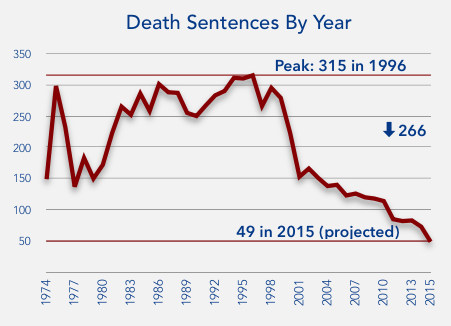
New statistics from the Death Penalty Information Center highlight how realistic this question is becoming.  As reported, there were only 28 executions in 2015 (projected).  But much more dramatic in its implictations, is the decline of sentences, as shown in this graph, from the Center’s Report (with permission).

Given that only 16% of those sentenced between 1996 and 2013 were actually executed it may well be that none of the 49 sentenced will be executed.  Statistically it would be somewhat more than eight people, given that about a third of those sentenced are still on death row, but with the declining rates, who knows?  (A better statistician than me could make a more reliable prediction as to when this will all end.)

I cannot tell you who the last person executed will be, but I can tell you this: the last person executed will be someone who killed a white person, and he or she will very possibly be black.

Posted in Death Penalty | Comments Off on Who Will Be the Last Person Executed in the US?

A Review of Possible Elements of Deregulation of Law, Gleaned From Current Conversations

As the legal profession discusses the possibility of deregulation, it might be useful to think about the regulatory areas that are most frequently cited as barriers to increasing accesses.  Such a listing may help us decide if the kinds of deregulation being talked about would actually help increase access to justice for those most in need of it, or serve other interests. In turn that analysis would help us decide if more radical changes were needed.  I offer the following, based on a wide variety of conversations.

Moreover, some very suggestive research appears to indicate that it is not issues such as these that concern typical practitioners day to day, but rather issues relating to money and billing, and the tensions between those concerns and the desire to provide clients with the help and services that they actually need.

Removal/Relaxation of Unauthorized Practice of Law Restrictions

Full removal of these restrictions would allow anyone, regardless of skill or qualification to perform tasks traditionally required to be performed only by licensed lawyers. It is argued that this will radically increase competition and thus reduce prices for such tasks with the market being relied upon to provide quality. Newly available technologies are often argued to now provide higher quality of work from the non-trained and to allow for sufficient aggregated information to legal consumers to ensure quality. A more moderate deregulatory approach would be to remove from all regulation certain tasks, environments, or situations from any or all of the restrictions below. Indeed, the establishment of certain court based service systems and the distinction of “legal information” from “legal advice,” are just two such steps.

Reduction of Qualification Requirements

Assuming, on the other hand, that it is appropriate to maintain a privileged group given a monopoly license to perform certain tasks, it might be decided that the barriers to entry to that group might be much lower in terms of education, professional qualifications, and the requirements of the certification process.

Of course, the primary argument against such moves would again be based on quality and consumer protection. I very much doubt that these requirements have been significantly validated.

Removal of Ownership Restrictions

Ownership restrictions, which prohibit ownership and control of lawyers’ services by non-lawyers, other than in certain limited situations, are defended as required to ensure the quality, client loyalty, and service values of the profession. The primary argument that such ownership rules changes would result in a massive expansion of available services at lower costs depends on the assumption that capital investment, technological innovation, and management efficiency are all dramatically reduced by the exclusion from ownership of non-lawyers.

Interestingly, these restrictions do not enjoy the support of all sectors of the bar. Rather some in the corporate and international sectors fear that these prohibitions put limits on their ability to compete with international accounting firms. There are also those who see these rules as inhibiting partnerships with social workers and others who might improve the quality of services.  Finally, some argue that they act as a major barrier to what is sometimes called “Tesco Law,” named after a UK supermarket chain that was at one point envisioned owning and operating law offices in their stores. It may be generally important that the study that showed that most practical day to day ethical concerns were not those addressed by the code, but rather the money/service/billing tensions also showed that such concerns were greatest in large firms. To the extent that this is generally correct, this would suggest that it is not so much the formal institutional structure of the owner, or their professional qualifications, but the size of the operation.

Removal of Promotional and Marketing Restrictions

There has probably been more activity towards “commercialization” in this area than any other. A number of US Supreme Court opinions, dating back decades, have relied on the First Amendment to restrict states in their efforts to control lawyers advertising, promotion, and client recruitment. Notwithstanding these decisions, and not withstanding that law firms at all levels consider marketing an important part of their task, it appears that few attorney-client relationships are commenced through forms of marketing standard in all other sectors. Serious efforts are being made through technology to change this.

The argument for significant liberalization is that marketing would result in choice, and choice would result in lesser prices, and thus more access. The argument against is that promotional freedom would lower quality, result in a race to the bottom and lower the tone of the profession. Nor is it hard to find examples of excessive (and perhaps tasteless) promotion that flourish under current rules that would illustrate at least the last of these arguments.

Removal of interstate practice prohibitions

Creating a single national legal market, regardless of action on any of the other de-regulatory activities listed here would remove some but not all of the geographic barriers to entry into service delivery. It would make organizing national high technology delivery systems much easier, and by forcing higher priced local providers to compete with more efficient ones over the state line, or in a national delivery system. It would not, however immediately reduce the cultural barriers to non-local practice. Even in a high tech environment, knowing the clerk and the judge all too often make all the difference.

Removal of conduct regulations (conflict, zealousness, quality, confidentiality)

Finally, bar regulatory bodies impose a variety of expectations for conduct by attorneys. While there are minor differences between the states, all draw heavily upon the ABA Model Rules of Professional Conduct. At least formally, these are designed to ensure the loyalty of the professional to the client, and the quality of his or her work.

Completely removing these requirements, while maintaining the legal monopoly, would mean that expectations for quality and loyalty in matters such as conflict of interest, zealousness, and confidentiality would be left to the market and to the interests of the lawyers in maintaining their reputation in the market. A monopoly without any limits on conduct would be hard indeed to justify and leave us with the worst of both worlds. Moreover, notwithstanding the additional information made available through technology and crowdsourcing,  it is hard to imagine that most potential low and middle clients would be able to assemble enough information to make good choices.

But to conclude that there is value in identifying at least the floor of expectations of attorney conduct (and in the real world the Model Rules probably set a very low ceiling indeed, except when it comes to issues easy for the public to understand like client asset theft) is very different from concluding that the current conduct rules are in fact over or under inclusive.

To the extent that they restrict flexibility, these rules increase prices and thus reduce access to justice. To the extent that they help ensure that a client obtains meaningful access to justice, that may be worth the cost. An economic analysis of the burdens of each imposition would require comparing the extent to which lower prices would increase access and the extent to which the regulation would ensure that access was meaningful.

This calculus may well change rapidly with emerging technology, partly because the quality problem may be reduced by technology, and partly because the costs of inflexibility may be increased dramatically.

I hope this analysis is helpful

Posted in Bar Associations, Judicial Ethics, Rules Reform, Systematic Change, Technology | 2 Comments

John Naughton In the Guardian Calls for Code of Ethics For Those Who Write Algorithms

A fascinating article in the Guardian is of relevance to anyone who builds or uses technology in the justice system.

After highlighting the range of decisions made by algorithms today, and their potential consequences, the writer, John Naughton, moves to the following challenges:

First of all, who has legal responsibility for the decisions made by algorithms? The company that runs the services that are enabled by them? Maybe – depending on how smart their lawyers are.

But what about the programmers who wrote the code? Don’t they also have some responsibilities? Pasquale reports that some micro-targeting algorithms (the programs that decide what is shown in your browser screen, such as advertising) categorise web users into categories which include “probably bipolar”, “daughter killed in car crash”, “rape victim”, and “gullible elderly”. A programmer wrote that code. Did he (for it was almost certainly a male) not have some ethical qualms about his handiwork?

His answer is an ethical code of conduct for those who develop algorithms. It’s a potentially powerful idea.

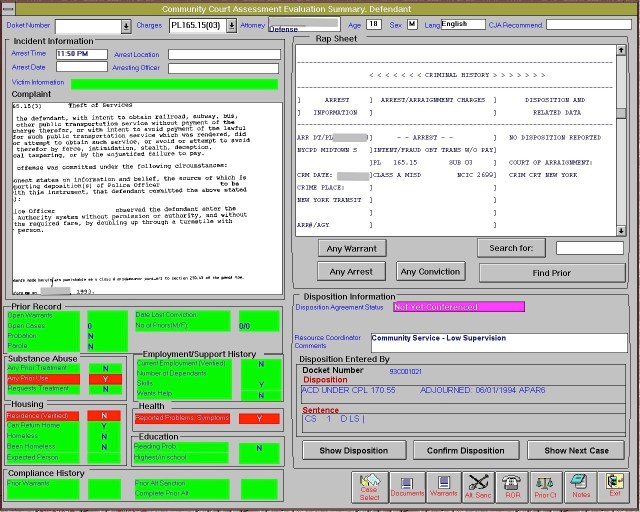
The first examples  of the issue that I ran into were in Midtown Community Court, 20 years ago.  We build the screen below:

MCC-2

Midtown Community Court Judge Screen — Rights Reserved

It was designed to focus judges, using color coding, on what were perceived to be the most important facts about the defendant.  Those who know me will not be surprised to know that I recommended  design that focused on social service and community ties needs and capacities, with the judge having to click to get such data as arrest detail and criminal record.  Those who know judges will not be surprised to hear that judges wanted to see those at the same time.  Indeed, the Chief Judge of Manhattan Criminal Court at the time suggested getting a big monitor on which all could be seen at the same time.

That was a simple one, with the intent, methods, and effect relatively transparent.  It got trickier when judges asked us to developed individualized predictions as to compliance with the various available alternative sanctions, which we were able to do, using the statistically validated factors that we proved in already completed research.

Now, it is far far more complicated, with plans being discussed to apply algorithms to make triage decisions as to how courts put cases into tracks, and to make decisions as to how community based self-help programs decide what resources litigants need in order to have their claims heard.

Moreover, thought is being given to “self-learning” algorithms that will change based on outcomes achieved.

So, let’s try to take a cut at what a code of ethics might look like.

  1.     Every algorithm that makes decisions likely to have a significant impact upon the lives of human beings should be accompanied by a plain language explanation of the purpose of the algorithm, the factors and data considered, and how they are processed by the algorithm.
  2.      The plain language algorithm explanation should be made available to and considered by the policy decision-maker for the project.
  3.      If the use of the algorithm raises or may raise legal issues, it should be referred to counsel for review.
  4.      In governmental and nonprofit organizations, the plain language document should be made available to the general public, unless a showing is made that publication would lead to harm such as gaming of the system.
  5.      In the case of self-adjusting algorithms, the plain language explanation of the algorithm should explain how the adjustments will occur, as well as any safeguards that have been included to prevent excessive or overly focused adjustments.  The system should include periodic reporting and human review of these adjustments.
  6.      Algorithm designer should either use only scientifically validated factors, or should build into the operation of the algorithm feedback systems that minimize the risk that significant decisions are based on speculative factors.
  7.      Algorithm designers should take particular care that their algorithm assumptions do not operationize either intended or unintended human bias, or act to reproduce or solidify patterns that are themselves the result of such bias or unfairness.  Such efforts should be described in the plain language description.
  8.      Should supervisors knowingly require algorithm developers to deploy algorithms that fail the test described in (7) above, and those algorithms negatively impact individuals protected under anti-discrimination law, such acts should be considered as in violation of those laws.


Posted in Access to Justice Generally, Court Management, Metrics, Outcome Measures, Research and Evalation, Software Developers, Technology, Transparency, Triage | Comments Off on John Naughton In the Guardian Calls for Code of Ethics For Those Who Write Algorithms