A Fascinating Opinion by Judge Jack Weinstein (EDNY) Raises New Questions and Opportunities About the Relationship between Civil Gideon and Judicial Engagement

Senior Judge Jack Weinstein of the Eastern District of NY recently recused himself sua sponte after engaging in a colloquy with a self-represented litigant about evidnce relating to the possibility that his claim in an employment discrimination complaint was time-bared.

As the New York Law Journal reported:

During a hearing earlier this month on the dismissal motion filed by restaurant chain Cosi in Aikiam Floyd’s racial discrimination case, Weinstein said he asked “leading questions” that prompted Floyd to give testimony showing his claim was not time-barred.

While recusing himself in Floyd v. Cosi, 14-cv-3772, Weinstein denied Cosi summary judgment but gave it permission to renew the motion before another judge, after discovery was conducted “under close supervision of the magistrate judge.”

Weinstein said, “While no partiality could be construed in rejecting defendant’s motion for summary judgment based on timeliness, recusal now is desirable to avoid the appearance of partiality by the undersigned judge in future decisions in the case.”

Some of the more detailed facts, as also reported in the article, are as follows:

At the Jan. 6 proceedings, Weinstein said he posed a “series of leading questions” that caused Floyd to testify the last discriminatory actions took place in July 2013 and were “part of a continuing series of related actions.”

Weinstein observed that July 2013 fell within 300 days of the EEOC complaint filed in September 2013. “As thus construed, plaintiff’s Title VII claims are not time-barred,” said Weinstein.

Noting his repeated intercessions, Weinstein said Floyd was “probably not capable of adequately representing himself.”
Still, the judge said, there were “no satisfactory means, through statute or otherwise” to provide Floyd with counsel.

The Judge then preceded to discuss the need for a counsel in certain circumstances as well as discuss the benefits of pro bono programs:

“If the plaintiff were to proceed pro se, the court would probably be forced to intervene and, in effect, advocate on his behalf, possibly prejudicing the defendant’s case,” Weinstein said, adding, “In many cases, pro se justice is an oxymoron.”

The National Coalition for a Right to Counsel website has more of the text of the opinion, including citation to authorities..

While this case had been used by some to underline the need for a right to counsel, others have offered what may be a more nuanced opinion. Professor Paris Baldacci, of Cardozo is worried that this approach might emphasize the right to counsel argument at the expense of underlining the discretion and flexibility that judges do indeed have to ask appropriate questions to get at the facts:

I am concerned that going down this analytical path will undo so much progress that has been made by those of us who have advocated for an impartial, but more active role for judges in dealing with pro se litigants.  As you all know, protocols have been adopted by many jurisdictions and the ABA has made clear in a comment on the impartiality rule (2.2) that judge’s making reasonable accommodations to ensure that the pro se litigant has the opportunity to have her case fairly heard does not violate impartiality, including asking questions.  There is lots of literature regarding how this can be done without asking leading questions or becoming an advocate.  Have not seen the transcript in this case, but did Judge Weinstein have to resort to leading questions?  And what is the prejudice to the other side that required recusal?  That relevant facts came out through the judge’s questioning?  Ah, truth as prejudicial!  So, I’d be concerned about using this analysis to support RTC, which would have the collateral effect of reinforcing so many judge’s desire to remain passive, which results in the denial of access to justice to pro se litigants.

Linda Rexer, head of the Michigan State Bar Foundation, has commented that:

I agree with Paris’ concerns and hope we can navigate a more nuanced path. Several states, including mine, have developed curricula to help judges learn best practices for handling pro se cases.  California led in developing and requiring this kind of training (and MI followed the CA model) with comprehensive judicial curricula including video practice sessions for judges who can delve into what appropriate questioning, neutrality and reasonable accommodation means in practice; without training, judges may resort to unnecessary passivity, as Paris notes, in the mistaken belief that is the only way to maintain neutrality.

I would like to hope that this debate will result in the following:

  • A deeper understanding of how far judges can go in being engaged and asking neutral questions that get to the facts and the constitutional authority for this judicial role (Turner v. Rogers.)
  • An understanding of the importance of research and education on these matters
  • A realization that much of the current analysis circular — that judges fear being seen as non-neutral when they ask a particular kind of question, when the real reason for that risk is just that it is not usually done.  Were such questions routine when needed, then they would not necessarily be viewed as non-neutral
  • Insight into the importance of a nuanced view of when it is in fact — as it indeed can be — impossible even for a careful judge to get the needed facts out without either counsel or the risk of the perception of non-neutrality.  It is at this point, I believe that Turner should be read, at least at certain levels of stake, as requiring counsel in civil cases.

Let the debate begin.
Posted in Access to Counsel, Access to Justice Generally, Judicial Ethics, Triage | Comments Off on A Fascinating Opinion by Judge Jack Weinstein (EDNY) Raises New Questions and Opportunities About the Relationship between Civil Gideon and Judicial Engagement

Sue Talia and Practicing Law Institute Partner for Free Jan 30 Program on Unbundling –It Will be Available Online Then and Afterwards

On Jan 30, 9 AM Pacific, Sue Talia will be presenting a three hour online program through PLI on unbundling. The  program is free, and will also be available online afterwards.

Here is the link to the information.  You can find out there if it is approved for continuing legal information in your state — it appears to be approved for many states, and even in some non-US countries.

Sue, of course, is a real leader in this field, and particularly in presenting the concepts in ways that show how appealing the approach can be for lawyers in the market.

This is an extract from the promotional materials:

Why You Should Attend

This program will provide an introduction to the rapidly changing practice of limited scope representation (often called “unbundling”) in a family law context, including all of the fee agreements, forms and other materials you will need to practice limited scope representation competently, safely and profitably.

What You Will Learn

The ethical rules governing limited scope representation
How to limit risk, including malpractice and insurance coverage issues
How to identify the cases which lend themselves to limited scope representation
How to reach a currently untapped pool of paying clients
How to market your limited scope practice
How to use limited scope to expand pro bono recruitment, lawyer for a day programs, and stretch legal services budgets farther

Who Should Attend

Solo and small firm family lawyers who serve middle class and moderate income clients, any family lawyer who wants to expand their client and referral base, and pro bono recruiters and legal services providers who want to learn how to help more clients with limited funding would benefit from attending this program.

Congratulations to all.  Please spread the word in your states.

Posted in Unbundling | 1 Comment

Guest Post From Elizabeth Arledge: #LegalAid Voices “Storm” the Twitterverse

Elizabeth writes as follows:

Well, THAT was fun.

Something amazing happened last week on the way to tonight’s State of the Union address. When Voices for Civil Justice invited members of our JusticeVoices network to participate in a “Twitter storm” organized by TalkPoverty.org, civil legal aid advocates from 26 states responded with a torrent of tweets – 545 by our count – calling on President Obama to include legal aid in tonight’s address. TalkPoverty.org organized the online event as a vehicle for individuals to tell the White House that the President should focus on solutions to poverty.

The 545 tweets promoting civil legal aid were posted from 65 different Twitter accounts and represent fully one third of the 1,600 tweets posted by anti-poverty advocates during the storm. Let me say that again – one third of the tweets told President Obama that civil legal aid matters.

Put simply: Legal aid rocked it.

How fitting is it that there’s a word cloud for a tweet storm? Look here for a visual representation of civil legal aid’s visibility in the Twitter storm.
 
What’s so amazing about this? The level of participation (with only three hours of lead time, no less) is a clear indication that advocates are eager to talk about why civil legal aid matters, and are increasingly capable of using new platforms like Twitter to do so.

The impact of online engagement / social media can often seem fuzzy, but legal aid’s showing in last week’s Twitter storm proves that we can use our voices strategically, combining our efforts to deliver a common message to high-priority audiences. And, working with allies such as TalkPoverty.org leverages our efforts.
 
Two opportunities:

If you are on Twitter, your next opportunity to participate in a joint event is tonight. Join TalkPoverty and other online activists who will be live tweeting during the State of the Union address. Offer your thoughts using #LegalAid, #TalkPoverty and #SOTU, and ask your friends to join in.

Are you a member of the JusticeVoices network yet? If not, you can learn more and join here.

Thanks and congratulations to all.

Posted in Access to Justice Generally, Communications Strategy, Funding, White House | Comments Off on Guest Post From Elizabeth Arledge: #LegalAid Voices “Storm” the Twitterverse

The Power of the Pen and Phone — Exploring Opportunities for Access to Justice in the Next Two Years

Recent executive actions in immigration, and now asset forfeiture underline just how great is the President’s “power of the pen and phone.” — his ability by regulation or other executive action to make very significant changes in the way government deals with the people.

Surely we in the access to justice world should be thinking about whether there are actions that this administration can take before January 20, 2017 — now just over two years away.

To be a viable candidate for such action, a federal regulatory change should probably be:

  • One for which is there is little real focused opposition, or one which it would be hard to repeal in the future
  • Not be too obviously expensive
  • Build its own constituency over time

Some possible areas in which advocates might look are:

  • Funding formulas set by regulation rather than by statute, in which access to justice might be made either a priority or included more explicitly as available — DOJ has already had very significant impact in this area.
  • Federal administrative agency procedures that impact poor and middle income people (a huge category from the VA to Social Security)
  • Oversight of future changes in Federal and federally supervised quasi judicial agencies that have an impact on access to justice — such as by setting up an “access to justice impact statement” requirement for all changes in such agencies.
  • State administrative agency and quasi-judicial procedures that are funded and regulated by Federal agencies (such as unemployment, food stamps, TANF, etc.)
  • Use of nonlaywers in such Federal or Federally-supervised contexts — an area in which there is already substantial precedent.  Could, for example, the Federal section 8 housing regs be modified to allow non-lawyers to appear on behalf of tenants in cases in which the judge found a need under Turner?  And what about child support enforcement, a major area of federal investment?
  • Federal funding of state courts, including data collection — a big budget item on which conditions could be met, and which might provide leverage on forms and accessible electronic filing
  • Things being done by state Commissions that might be adopted as Federal standards.
  • Leverage provided by funding of law student loans and other forms of assistance to law schools.

These, and others, are surely areas on which advocates and policy advocates should be brainstorming about how to take advantage of this short and rare moment of opportunity — we may not get another for a generation or two.  Let’s think big.

We should also be asking how we can facilitate such discussions within our communities.

I would add this situation and opportunity to the list of ideas that demonstrate the need for more intentional and focused leadership capacity in our field.

A final, if controversial, thought. It may be that some of the most appropriate changes would be ones that some of the President’s more traditional stakeholders might oppose, and with respect to which it might therefore be easier for an outgoing administration be willing to do the right thing.

I would very much appreciate any thoughts on these and related topics.


Posted in Access to Justice Generally, Administative Proecdure, Budget Issues, Dept. of Justice, Document Assembly, E-filing, Funding, Law Schools, Non-Lawyer Practice, Veterans, White House | Tagged , , | Comments Off on The Power of the Pen and Phone — Exploring Opportunities for Access to Justice in the Next Two Years

The Expanding Role of ATJ Commissions — Florida and California

As we build out state level access to justice leadership that does beyond information sharing to project leadership and the building of an integrated system, it is great to see two new state level initiatives that are building the needed foundation.

Demonstrating the leadership power that comes with grant-making, the California ATJ Commission has recently announced the awarding of four grants worth $185,000 in total.  They were the first in a new Modest Means Incubator program that funds groups to train lawyers to create sustainable law practices providing affordable legal services.  The guidelines for the RFP process are here.  Reading them will show how such an RFP process can guide collaborations, evaluation and other important aspects of access innovation.

I believe that all Commission should be exploring such competitive and guideline-driven grant-making, even it it means going out and raising the money to do so.  (In this case the funding came from the Ford Foundation, the Public Welfare Foundation and the California Bar Foundation).  For Commissions to become real leaders, they have to get beyond the idea that they just help raise money that then gets distributed on formula.  Such a system is one of the ways we discourage leadership through our institutional structures.  Local as well as national money will be needed.

Similar good news out of Florida.  The State Supreme Court has not only given broad publicity to the creation of its new ATJ Commission, reflecting its commitment, it has also announced plans to broadcast over the Internet its first meeting at this link.  The meeting will be this Friday Jan 16 at 12:30 PM, Eastern.  The agenda is here.  While the whole agenda is important, particularly interesting will be the keynote, given by Texas Chief Justice Nathan Hecht, scheduled to be delivered at 1:10.  Those interested in the expanding role of Commissions may also be particularly interested in remarks by Melissa Pershing to be given at 1:40, immediately following CJ Hecht.

It should be noted that I understand that Florida found that the announcement of the ATJ Commission got more media attention that any prior Florida Supreme Court release.  This suggests that Voices is getting through in changing the thinking of media folks.  It is also particularity nice that NCSC is using its communications systems to spread the word about Commissions, legal aid, and access to justice.  I very much hope that we will soon see the same increase in media attention to court-based legal aid that we are already seeing to community-based legal aid.  This is something we can all help happen by suggesting stories to Voices for Civil Justice, and by making sure that local court media people are aware of, and connected to, its activities.

Posted in Access to Justice Boards, Communications Strategy, Incubators | 1 Comment

Analysis of Proposed Regs on HHS IV-D Child Support Money — Comments Due Jan 16 — Opportunity to Help Finance Self-Help Infrastructure

I have long been urging states to take advantage of the IV-D program, which through uncapped matching, triples state investment in child support activities, to help finance self-help services.  Several states such as California do so, and California has used it as the foundation for building a broader self-help infrastructure.

Now, HHS has issued draft regulations for comment on the program, and this is an opportunity to help make sure that this program is as helpful as possible to all, including the self-represented.  Comments are due on Jan 16 to HHS.  I encourage folks both to comment, to engage others in commenting, and to consider how they can best move forward to take advantage of this program.

To help with the comment process, SRLN has engaged Lee Mohar, who was instrumental in California figuring out to to make use of this stream, to prepare an analysis of the proposed regs.  The analysis  is here.

Please spread this around so that HHS can have the benefit of as many comments as possible.

Also, to assist states to plan for and adopt the use of IV-D money for self-help and related child support services, SRLN with funding from SJI, has prepared this Manual.  Here is the link  to the companion Webinar, featuring Lee Mohar and John Greacen, hosted by the National Center for State Courts.  If your state is already providing self-help services to litigants in Title IV-D child support cases, you may be able to seek federal reimbursement for 66 percent of your costs going forward — thus tripling your money in the future! Continue reading

Posted in Access to Justice Generally, Child Support, Court Management, Funding, Self-Help Services | Comments Off on Analysis of Proposed Regs on HHS IV-D Child Support Money — Comments Due Jan 16 — Opportunity to Help Finance Self-Help Infrastructure

Updated Post with Recent Stats: Will NYC Cops Prove that Most Arrests — and Indeed Most Cops — are unnecessary? Taking Advantage of a Natural Experiment

More careful reading of the NYT leads me to update the post of a few minutes ago to include recent bolded police stats that would appear to support the contrarian hypothesis below.

The news that arrests in NYC have fallen 66% as an apparent result of an unofficial and informal job action by the police sets images of research sugar plum fairies dancing in my head.  (For a more detailed story on the stats, see here.)

Setting aside the tendentious questions of whether police who stop enforcing the law can be said to be complying with their oaths, and thus whether they can be said to be generally trustworthy (a good question for cross examination on the stand), and indeed whether it is appropriate under civil service rules for them to keep their jobs, this job action offers a remarkable natural experiment.

We will soon know if reported crime rates rise or fall.  We could do rapid victimization surveys to find out if unreported rates rise or fall.  We might even find out the relationship between broken windows policing and serious crimes, and whether the alleged practice of arresting to get information actually has an impact.

Indeed, the first weeks stats seem to suggest that the serious crimes are falling.  From the Times:

Yet reports of major crimes citywide continued their downward trajectory, falling to 1,813 from 2,127 for the week, a nearly 15 percent drop, according to Police Department statistics.

This might have a major impact on understanding of the relationship between policing and crime.  My own suspicion is that heavy enforcement may help get rates down in the short term, but is not needed in the long term, but rather may increase criminal behavior in the long term, through increased alienation, particularly when people are released. But that is only a suspicion.

It would be a supreme irony if the job action were to show that we have too many arrests and too many cops.  I just hope someone is out there looking for the data, and that research groups are sufficiently independent to look for it.


Posted in Criminal Law, Policing | 1 Comment

Will NYC Cops Prove that Most Arrests — and Indeed Most Cops — are unnecessary? Taking Advantage of a Natural Experiment

An updated version of this post is here.


Posted in Criminal Law, Policing | Comments Off on Will NYC Cops Prove that Most Arrests — and Indeed Most Cops — are unnecessary? Taking Advantage of a Natural Experiment

Wayne Moore’s Comments to the ABA on the Future of Legal Services for Moderate Income People

As you know, the ABA Commission on the Future of Legal Services recently requested comments to use in its work.  While there are many worthwhile comments posted, I thought it useful to share this one in both longer (attached-linked) and shorter versions (see below).   It analyses criteria and services that might be provided, as well a a suggestion as to how a system might be launched.  I have included some comments in italics, with Wayne’s responses.  The longer version includes Wayne’s bio.

+++++++++++++++++++++++++++++++++++++++++++++++++++++++++++++++

Moderate income Americans have the least access to legal services. By moderate income, I mean those with incomes between 125 and 300 percent of poverty. While various delivery methods are being tried (low bono; post-graduate law school programs; virtual law practices; unbundled services, and reduced-fee, referral panels), none have reached scale. Therefore, it is useful to begin by identifying the criteria that a delivery system would have to meet to reach scale. Continue reading

Posted in Middle Income, Systematic Change, Technology, Unbundling | 2 Comments

Important Step Forward and Model Approach for ATJ Commission with Best Practices In Administrative Area Issued Jointly with the Governor

The Massachusetts ATJ Commission has scored another important first with the issuance together with the Governor of Best Practices for State Agencies to Enhance State Administrative Justice.

The full text is reproduced below:

Recognizing that administrative justice is a vital component of ensuring the overall access to justice, state agencies that provide public benefits (1) shall adhere to the following best practices:

  • If a benefits application lacks information necessary for the agency to make a proper determination of benefits to which the applicant might be entitled, the agency shall provide each applicant with a reasonable opportunity to obtain such information;
  • If a benefits application contains inconsistent information that hinders the agency’s ability to make a proper determination of benefits to which the applicant might be entitled, the agency shall provide each applicant with a reasonable opportunity to correct such inconsistencies before the application is denied;
  • If the agency denies an application for benefits, the agency shall provide the applicant with timely notice in writing of such denial, which shall include the basis for the denial and a description of the administrative process to appeal the agency’s determination;
  • If the agency terminates or suspends benefits for any reason, the agency shall, before such termination or suspension is effective, inform the impacted beneficiary in writing of the reason(s) for the proposed action and provide the beneficiary an opportunity to respond. Once the termination or suspension of benefits becomes an agency determination, the beneficiary shall be provided a description of the administrative process to appeal the determination;
  • Any communication between the agency and an applicant for benefits or current beneficiary shall be done in a clear manner and in a language understandable to the applicant or beneficiary, all in compliance with Executive Office for Administration and Finance Bulletin 16;
  • Any applicant or beneficiary may bring a representative to assist them during any review hearing and that representative need not be an attorney;
  • Agencies shall take any and all steps to ensure that their “client services” or “problem resolution” offices act in accordance with these practices;
  • The Executive Office for Administration and Finance, in collaboration with the Governor’s Office of Legal Counsel, shall ensure compliance with these practices.Client services and problem resolution offices:
  • Shall make available to beneficiaries or applicants a list of these best practices;
  • Shall make available to beneficiaries or applicants a list of pro bono legal service providers and bar programs in the surrounding area;
  • Shall distribute their office contact information to key legal services and social services agencies and providers;
  • Shall have the authority to take all steps necessary to ensure compliance with the best practices for state agencies;
  • Shall monitor both individual and systemic problems (i.e., problems that affect individual beneficiaries and thematic problems that affect many beneficiaries) and report such problems inconsistent with the best practices directly to agency leadership.

(1) The following agencies provide public benefits and, as a result, are subject to these best practices: Department of Transitional Assistance; MassHealth; Department of Unemployment Assistance; Department of Housing and Community Development; Department of Veterans Services; Department of Public Health; Massachusetts Commission for the Blind; Massachusetts Commission for the Deaf and Hard of Hearing; Massachusetts Rehabilitation Commission; the Department of Early Education & Care.

This all speaks for itself, I particularly like the the ongoing requirement of self-monitoring at the “client services and problem resolution” offices.

It is a huge achievement to get the Executive on board with such a statement – and is the result of a long period of work.  It represents the Executive taking responsibility for the quality of procedures in a way that they had never done before, and was essentially impossible given the fragmentary administrative agency structures, often forcng advocates to push in individual case after individual case, and never getting the underlying problems solved.

Moreover, while they are labeled “Best Practices,” the language is all drafted in mandatory terms.  People in Massachusetts tell me that they hope that the inter-agency approach will help lead to real institutionalization and ongoing progress, with agencies meeting to discuss their implications.  Moreover, there is hope that this will help the Commission develop a broader agenda on the issue, hopefully in collaboration with the agencies and the executive.  Maybe this is yet another response to the prodding of Turner v. Rogers, with its focus on access-friendly procedures.

A final thought as states start to move toward similar enactments– we need a national version of this, which, like the state ones, will hopefully set a floor rather than a ceiling.  Maybe SRLN can work on it.

As other states move — do let me know.


Posted in Access to Justice Boards, Administative Proecdure | Comments Off on Important Step Forward and Model Approach for ATJ Commission with Best Practices In Administrative Area Issued Jointly with the Governor

Press Clips Section of Voices Website Helps Create Momentum About Communications and More

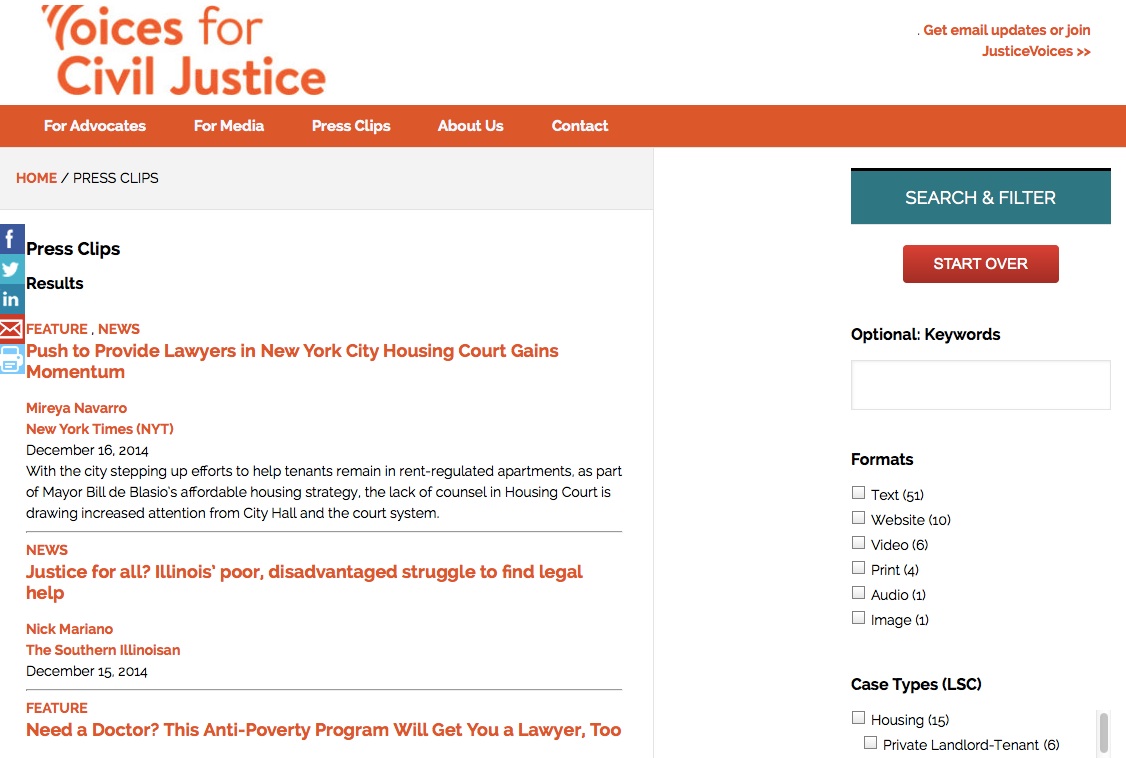
The Voices for Civil Justice website now includes a “Press Clips” section.

This tool lets you see all the significant press coverage about legal aid (broadly defined).  It also lets you filter and sort based on a number of criteria including keywords, formats, casetype, who served, how served, geography, topics, and housing types.

Here is a screen shot:

VCJThis tool has huge potential not just to help us all keep up with the latest news, but for local and statewide programs to track their own coverage and see how it relates to other programs and states.

The tool will also make it possible to make sure that all the segments of the legal aid community, including pro bono and court-based, as well as court-based, are getting appropriate coverage.

Folks are encouraged to send reports of media to Voices.


Posted in Communications Strategy | Comments Off on Press Clips Section of Voices Website Helps Create Momentum About Communications and More

Sony Could Make “The Interview” Available For Free and Turn Its Story From a Disaster Into a Triumph for Freedom of Expresion and Access

Supposing Sony, instead of giving in to intimidation and exercising self-censorship, announced it would now make the film available for free to any streaming or distribution system that would make it available to the public without any cost (perhaps acknowledging that it could not guarantee security for a traditional movie-house release). I understand that there is already one online suggestion of Sony using its own streaming platform (mention free pricing possibility).

This would sent out an unbelievably strong message that those who seek to intimidate will only guarantee maximum exposure of that which they wished to suppress.  The film would have a massive audience and overwhelming publicity and momentum, no matter its merits.  It might shame reluctant platforms into following suit.

Sony could also encourage those who see the film to contribute their ticket savings to a fund for democracy, and could start the fund off with its own donation.

It has already been suggested that the film could be screened at the White House — maybe a launching pad for this distribution.

Sony could also say that yes, it might be hurt by future data dumps from the hack, but that is a risk that all have to take.  Transparency and standing up to bullying are more important.  (Almost) all would rally around Sony.

Obviously I do not know the contract arrangements for payment for those who worked on the film, but surely they would be no worse off than they are now — and Sony could really reap the moral  high ground by offering to compensate those who lost — and were not willing to waive their losses as their contribution to this movement.

How much better if Sony had taken this approach from day one.  Its leaders were asleep at the switch, and Sony has not yet been well served by its PR folks (they have now brought in a person who helped HW Bush and Monica Lewinsky).


Posted in Freedom of Expression | 2 Comments

Illinois LegalAidOnline Shows Gives Wonderful Example of Online Fundraising

Like all of us, I get many online fundraising pitches.  And I get occasional requests to use this blog for fundraising.  I almost never do.  But this graphic, from Illinois LegalAidOnline is so wonderful as a model that I can not resist passing it on — as well as the donation link.

ILAO_HereWhenItMatters

Note the creative analysis of how news impacts on usage of data, making us all appreciate the value of this work.

We should surely be doing the same analysis nationally.

Remember too, that good data mining might let us work the other way — using changes in usage to predict changes in need for community-based legal need, something our community has been very poor at, partly because we feel so overwhelmed that it does not matter if need is going to increase in some area.

It is only fair to include the rest of the pitch, and the donation link.

Illinois Legal Aid Online has been #HereWhenItMatters for over 13 years, helping people who can’t afford a lawyer solve their legal problems on their own.

In times of crisis, Illinoisans turn to ILAO to understand their legal options, make informed decisions, and represent themselves in court.

In 2014, over 2 million of your neighbors went to IllinoisLegalAid.org for answers.
 
For example, when the NFL recently changed its policy and suspended a player who assaulted his fiancé, the number of visits to our domestic violence resources more than doubled.

But there’s more to ILAO than reliable legal information –

After this incident, there was a 62% increase in the number of people who took the next step to secure their safety by completing our interactive Order of Protection form.

We’re here when it matters, providing the necessary tools for people to protect themselves and their families whenever a lawyer is out of reach.

Here is the donation link.

Posted in Funding, Self-Help Services, Technology | 1 Comment

A Fabulous Job Opportunity at Voices for Civil Justice

As most folks know, Voices for Civil Justice has been remaking the way we think about civil legal aid and access to justice.  While on one level it has merely been seeking the best way to talk to policy makers, the public and the profession, at a much deeper level, what it has been finding has put us at the forefront of an unprecedented process of change in how we think about, and indeed organize our movement.

Among the key ideas have been the value of thinking about “legal aid,” as a broad phrase that includes “court-based legal aid” services such as self-help centers and forms, as well as the new phrase “community-based legal aid,” which some of us think is the best way to describe the traditional nonprofit legal services community.  Similarly, the initiative has found the great value of focusing on the needs of middle income as well as poor, and a variety of services beyond traditional “full service” lawyering.

So the opening for a Communications Associate at the project, more details of which appear below, is a wonderful opportunity not only to work with some of the most highly regarded experts both in access to justice and in media and communications (BerlinRosen), but also to be a very significant part of this re-conceptualization process.

For a person in the court world, this would be an even more exciting opportunity, in my personal opinion, because while the project has been absolutely phenomenal in getting media coverage about the traditional legal aid sector, it has, so far, found it somewhat harder in the court-based legal aid area.  A wonderful exception is here in this NYT article that covers the whole combined filed.  So the person who has the experience and contacts that can help bring it all together would be a find indeed.

Here is the description of responsibilities and skills required for the position:

Responsibilities and Tasks

  • Develop story ideas and sources for pitching to the media by working with Voices’ extensive national network of legal aid lawyers, court personnel, pro bono attorneys and others
  • Increase the circulation and amplify the impact of successful media placements by using social media, email and other outlets
  • Assist with developing and drafting blog posts, op-eds, social media posts and other written communications
  • Grow and maintain a robust network of legal aid lawyers, court personnel, and other experts and spokespeople by optimizing Voices’ use of Salesforce and integrating it with Voices’ website and MailChimp account
  • Track Voices’ media placements and other significant legal aid media clips and post them to the Voices website
  • Perform other duties as required to accomplish Voices’ objectives of heightened media presence and communications capacity for civil legal aid

Required Education, Experience, Knowledge and Skills

  • Excellent written and verbal communication skills
  • Strong news sense and knowledge of the media
  • Proficiency in Word, Excel and PowerPoint, as well as facility in Salesforce (or comparable constituent relationship management software) and WordPress (or comparable web platform);
  • Adept at social media
  • Familiar with and interested in the issues that concern the legal aid sector and the civil courts, including problems of poverty and income inequality, as well as access to affordable housing, employment, health care and education
    Bachelor’s degree or experience in a communications-related field

Its the perfect opportunity for someone.  I hope they take it.  Please spread the word.

Posted in Communications Strategy, Systematic Change | Comments Off on A Fabulous Job Opportunity at Voices for Civil Justice

A Fascinating Access to Justice Day in Pre-Op for Cataract Surgery

Recently, I went through the pre-operative procedure for very minor surgery (cataract removal) at Johns Hopkins.  Two fascinating things happened.

First,, the person told me to expect on the day of the procedure that the nurse would ask me just before surgery to describe what surgery I was there for, and on which eye.  I realized this is just what access advocates urge judges to do, to ask litigants to describe in their own words what has been ordered.  There is then much less chance of error. (The goal is slightly different in the two contexts; in the medical system they are trying to avoid the one with the doctor getting the procedure wrong; in the courtroom, we want to make sure than the litigant really does understand what they are expected to do.  But the issue in both cases is working to remove errors in communication.)

Secondly, and this raises some interesting possibilities, I was told that if the nurse were to fail to ask the question that way — i.e. that the nurse were to ask “are you having cataract surgery in you left eye”, I should in any event explicitly reply with the actual detailed information stated by me.

I loved the acknowledgement that the protocol might not be perfectly followed by the staff, and that, if it was not, it was in my interest to follow it correctly myself — thus also hopefully educating the nurse.  This makes me both a partner in my care, and a partner in ensuring that the best practices are followed.

I am not sure I am comfortable telling litigants to tell judges that when they are asked “do you understand what you are supposed to do,” or “did you understand me,” that the litigants should say “well judge, it is better if you ask me to repeat what you ordered with its details so that you can see if I got it right.”  But maybe it is going to become OK if litigants are suggested that there is the value in saying something like “Judge, can I tell you what I think I am meant to do, so that you can tell me if I have it right?”  It certainly suggests good faith, as well as reducing the risk of error.  And, actually, it is roughly what I do when doctors give me instructions.

Moreover, at a minimum, the litigant might later have a better defense if they failed to understand the order right, the judge failed to catch it and then the order were violated.  On the other hard it would be harder in the future for a litigant to claim lack of understanding as a defense for non-compliance.

There’s a lot to learn from comparing the two systems,


Posted in Court Management, Judicial Ethics, Medical System Comparision | 2 Comments