Bi-Partisan Support for Senencing Reform and Re-Entry Programs

The ACLU as a nice report out, highlighting how even the more conservative states are embracing sentencing reform as a way of saving money on incarceration.  It highlights reforms in Texas, Mississippi, Kansas, South Carolina, Kentucky, and Ohio.

The NYT expands on the issue, including analysis of support from traditionally right wing figures such as Reagan’s AG Edwin Meese.

The movement has attracted the support of several prominent conservatives, including Edwin R. Meese III, the attorney general during the Reagan administration. He is part of a campaign, called “Right on Crime,” which was begun last December to lend weight to what it calls the “conservative case for reform.”

“I’d call it a careful refining of the process,” Mr. Meese said. “Most of us who are involved in this are very much in favor of high incarceration of serious habitual offenders. The whole idea is getting the right people in prison, and for those people for whom there is evidence that chances of recidivism are less, to work with those people.”

Other Republican affiliates of the group include former House Speaker Newt Gingrich; Grover Norquist, an antitax activist; Asa Hutchinson, a former director of the Drug Enforcement Administration; and William J. Bennett, a former White House “drug czar.”

The idea that the system should be designed to incarcerate those for whom it is appropriate, but only those, is a powerful one, and is, in my opinion, perhaps the most persuasive argument for effective public defense.  It is far from clear that effective defense reduces the total number of sentences in a system, but it does help make sure that the system is making decisions about how to allocate scarce incarceration resources based on as much information as possible.  (And, of course, keeps the system honest and minimizes incarceration of the innocent.)

But overall this perspective would suggest greater resources being put into pre-sentence investigation, social work by defense programs, addition of incarceration alternatives, etc.

It also suggests that discretion should be put back into transparent institutions such as courts, rather than hidden in the non-transparent prosecution function, where it is put by mandatory sentencing schemes.


Posted in Budget Issues, Criminal Law | Tagged | Comments Off on Bi-Partisan Support for Senencing Reform and Re-Entry Programs

LSC Improves Data Gathering

In a move that should enhance its ability to make the case for the effectiveness and impact of its funding, LSC has announced several changes to its grantee reporting.  The highlights:

  • Grantees will be required to report total numbers of people in households served. (This is an obvious enhanced measure of total human impact.)
  • Grantees will be reporting the total number of cases involving domestic violence. (This expands on prior data collection of actual domestic violence vases.  Cases may well involve domestic violence without actually being correctly categorized as primarily a DV case.)
  • Grantees will also be reporting the number of those served who have served in the military, reflecting an increasing focus on this constituency.
  • They are simplifying online services reporting, collecting only unique visitors and “the number of actual downloads of web items, separated into downloads of Community Legal Education items and downloads of Pro Se items. “
  • There will be a distinction in the data between pro bono and compensated private attorney involvement cases.
  • In order to make the changes less burdensome, they are eliminating certain data collection, including of media outreach.
  • These changes are being rolled in on a schedule designed to be realistic and minimally burdensome for grantees.

I note that there has been some in the community some desire for clarity about some of these changes, and am confident that LSC will be forthcoming with this.

Overall, LSC should be praised for its focus on data that is meaningful and useful.  I am hopeful that this presages a commitment to making this a more data-driven community.

Posted in LSC, Pro Bono, Research and Evalation, Technology | Tagged | 2 Comments

Order in LegalZoom Case

See August 23, 2011, update at end of post for links to reports of proposed settlement in this case

The District Court has issued an order in the Missouri LegalZoom Case.

Bottom line:  The District Court rejects LegalZoom’s Motion for Summary Judgement, ruling that the software and associated services could be found by a reasonable juror to be the practice of law under Missouri law.  The Court regards the software as more like a legal service than a pure scrivener or the sale of a forms book.

In the description of what the software does, the Court describes the discretionary role (beyond the writing of the software) as highly limited.  In fact the court basically says that two users who answer the forms the same way would get the same document.  It did not help LegalZoom that their promotion says that after you use the software “Legal Zoom takes over.”

The court points out that the software design was not done by a Missouri lawyer.

Two points:  One.  There is little if anything here to worry legal aid and court-based services, since they are overseen by state-licensed lawyers.

Two:  The real issue is the writing of the software.  That is where the debate about whether it is the practice of law should be.  Some say that writing software is more like writing a book or a paper form, but I am not yet sure where I stand on that.  That certainly is where the issues of quality and the need for consumer protection most arise.

The ultimate conclusion may well be that current regulatory definitions just do not work, and that we need a new form of regulation of the the drafting of interactive court assistance software, one that protects the consumer against fraud in marketing and incompetence in execution.  Given the interstate nature of the services, Federal consumer protection regulation might be the answer.

Update — August 23, 20110 — AP and the Wall Street Journal report a proposed settlement in this case.  We’ll comment in more detail if and when enough more is known.

Posted in Document Assembly, Forms, Technology | Tagged | 2 Comments

Updates on ABA Langauge Access Standards — No Action by ABA

A somewhat complicated picture is emerging about the progress of the ABA language Access Standards.  The bottom line is the ABA House of Delegates has postponed consideration of the Standards to the February 2012 meeting, following a resolution from the Conference of Chief Justices (CCJ) and the Conference of State Court Administrators (COSCA).

As I understand it, there are going to be ongoing discussions to try to develop a modified document by the November deadline for matters to be considered in February 2012.

This action follows the passage by CCJ and COSCA last week of a Joint Resolution opposing passage of the Standards in their current form, and suggesting a Summit and a Roundtable on the topic.

The Conferences’ opposition to the passage of the Standards in their current form focused particularly on arguments expressed in the Resolution that:

“The proposed standards are based upon unsettled fundamental legal premises;”

“The proposed standards place the entire responsibility for implementation on the state courts without placing corresponding responsibilities on the federal judicial system or state administrative adjudicatory agencies;”

“The unprecedented fiscal crisis facing state courts places severe constraints on the ability of courts to provide services that are not constitutionally mandated;”

“The proposed standards do not sufficiently recognize the limitations on state court authority and the requirements of separation of powers;”

“The proposed standards mandate providing interpreters in such non-court settings as depositions, witness interviews, and the like;”

However, it is very important to note that the Conferences:

“Reaffirm[ed] their commitment to access to justice for limited English proficient individuals and urge[d] their members to take a leadership role to identify and to address gaps in language access services in their respective jurisdictions.”

Speaking strictly only for myself, I would like to observe that while the delay may be disappointing to language access advocates, the support of the courts is critical to giving any real meaning to the Standards, and so the wait should turn out well worthwhile.  Conversely, it is very important to the courts to have Standards that are practicable and provide useful guidance.

My own view is that there are two main inter-related issues that need to be resolved in these discussions.  The first is whether the Standards are mandatory or aspirational.  The Standards attempted a compromise by describing the only mandatory Standard as Standard one:

As a fundamental principle of law, fairness, and access to justice, and to promote the integrity and accuracy of judicial proceedings, courts shall develop and implement an enforceable system of language access services, so that persons needing to access the court are able to do so in a language they understand, and are able to be understood by the court.

However, other language seems to create ambiguity.  Here, for example is the Structure and Organization discussion from the Commentary to Standard One.

“Standard 1 establishes the imperative that courts must “as a fundamental principle of law, fairness, and access to justice” provide language access services so that courts will be accessible to LEP persons. Standard 1 is therefore stated in mandatory terms. Standards 2‐10 set out different and essential components of a comprehensive system to address the needs of LEP persons in court and court‐related services, and are subdivided to address specific matters included within the overall subject matter of the particular standard. They provide a blueprint for courts to design, implement, and enforce a system adapted to the organization and administration of their court systems and the type of court proceedings they handle, and to discuss the relative benefits and burdens of different approaches, in light of the composition and needs of the LEP communities they serve. Standards 2‐10 are therefore phrased in terms of “should” in order to denote that they are to be adapted to specific courts and communities. However, each of Standards 2‐10 is an essential component of a comprehensive and effective system of language access services, and courts will need to implement all of them in achieving the overarching access to justice imperative of Standard 1.” (Underlining added.)

The second issue relates to “reasonableness” and cost.  It seems to me that there is in the Standards a rigidity as to issues of cost that is making life very hard for the courts in a time of shrinking resources and competing demands.  I hope that the ultimate product will be more respectful of these pressures, while maintaining the clear and appropriate focus on the ultimate issue: accessibility, regardless of language status.

But the bottom line remains the same:  the state courts are deeply committed to language access, and this is surely excellent and important news.  Let’s hope that a period of discussion will result in Standards that retain the force and urgency of the access vision, and show how it can be achieved, while being respectful of the real world needs of the courts.

Posted in LEP | 1 Comment

A New One — Talk to Computer/Phone by Bending it — A Tool for Preventive Law

This video is cute.

We’ve heard of bendable, and rollable screens, phones and computers.  This is actually something different and goes beyond it.

It’s the idea that you communicate with the screen/phone/computer by bending it.  I guess this has 3-D input opportunities beyond simple touch.  People who neurotically fold paper smaller and smaller might have to watch what they are “saying.”

Seriously, as with all portability innovations, it has huge implications for access to justice, because it helps move the help and information we can give from after the problem occurs to before it happens.  Preventive law.


Posted in Technology | Comments Off on A New One — Talk to Computer/Phone by Bending it — A Tool for Preventive Law

DOJ Posts List of Funding Resorces for Court LEP Improvements

With the ABA proposed Language Access Standards coming up for ABA approval, it may be worth noting that DOJ has posted a listing of possible funding resources for courts as they move to address LEP issues.

The listing is here.

The listing includes programs adminisered by U.S. Department of Justice (DOJ), Office of Justice Programs (OJP), U.S. Department of Justice (DOJ), Office of Violence Against Women (OVW), and U.S. Department of Health and Human Services (HHS), Administration on Children, Youth and Families (ACYF).

It spans 5 pages. Here is the header to the table, which shows data included:

Listings include footnotes with additional information.

I am sure that readers of this blog would love to hear from their colleagues about their experiences with these programs.

Posted in Budget Issues, Dept. of Justice, Funding, LEP | Comments Off on DOJ Posts List of Funding Resorces for Court LEP Improvements

Important New Report/Compilation on Self-Representation Resources in the States from John Greacen and Michigan State Bar Foundation

We have long needed a compilation of what the states have in place to assist the self-represented, and the Michigan State Bar Foundation recently contracted with John Greacen of Greacen Associates to prepare such a document to assist the state in moving forward.  It is now posted.

Particularly useful are:

A discussion at pages 8-29 of the National Report of forms and information available on court websites.  This will be helpful for states as they decide how to improve their online services.

A discussion of different other types of assistance (page numbers are of the national version):

What rules of professional conduct for lawyers authorizing and encouraging the provision of unbundled or limited scope representation legal services have been adopted by state court? .. 29
What judicial ethics rules or commentary (or the issuance of court rulings or advisory committee opinions) have state supreme courts promulgated to encourage judges to provide more assistance to self-represented litigants in the courtroom? ……………….. 35
Are there appellate court rulings approving self-represented litigant-friendly policies or striking down self-represented litigant-unfriendly policies?……………………………41
Do states provide, or do the courts allocate, funding for self-help centers or programs to assist self-represented litigants to prepare documents for filing and to prepare for court appearances? .   .  41
Do self-help centers provide certified or other interpreters for self-represented litigants whose primary language is not English? ……………………………………..44
Are there guidelines and policies for staff on what they can and cannot do to assist litigants? . .  . .. 45
Has the state judicial branch adopted principles governing the adoption of advanced technology by courts to ensure that such technologies can be accessed by self-represented litigants? ……. 47
Has the judicial branch implemented other statewide practices to support the participation of self-represented litigants, or having a beneficial impact on them?……………………………………. 47
Are there any other policies or practices designed to improve the experience of self-represented litigants, or having a beneficial impact on them? ………………………49
Do state courts have mechanisms other than appellate review for ensuring compliance with state judicial branch rules and policies affecting self-represented litigants?……………………….. 51

A Chart of state form and website information availability

A Matrix of state website information

A set of recommendations for Michigan, but of much more general use too.

A chart of the Triage/Continuum of Services Concpt:

(Note that the Report is under Creative Commons Copyright)

It is particularly useful that this is all becoming available just when states are absorbing the implications of Turner v. Rogersand starting to think about how to meet due process standards for the self-representedI would also point to the SRLN Best Practices as offering detailed suggestions and resources that can be helpful in deploying the innovations discussed in the Greacen Associates materials.

Kudos to the Michigan State Bar Foundation for conceptualizing this work, and to Greacen Associates for bringing it to fruition.

Posted in Document Assembly, Forms, Judicial Ethics, Self-Help Services, Technology | Comments Off on Important New Report/Compilation on Self-Representation Resources in the States from John Greacen and Michigan State Bar Foundation

Public Defender Versus Assigned Counsel, Implications for Mixed Model Advocacy

Thomas Cohen, at the NIJ Bureau of Justice Statistics, has published an interesting study on who is most effective at criminal defense.

Bottom line, from the abstract:

Specifically, this paper examines whether there are differences between defense counsel type and the adjudication and sentencing phases of criminal case processing. Results show that private attorneys and public defenders secure similar adjudication and sentencing outcomes for their clients. Defendants with assigned counsel, however, receive less favorable outcomes compared to their counterparts with public defenders.

A multi-variate aakysus was included:

Other independent variables include extra-legal and legal covariates measuring defendant demographics, most serious arrest or conviction charges, criminal justice status and history, monetary bond amounts, case processing time, and type of conviction.

With the multi-variate analysis:

According to the probit models, defendants with assigned counsel were significantly more likely to be convicted and sentenced to prison, net of controls, compared to defendants represented by public defenders. For example, the Z-scores measuring the likelihood of conviction and state imprisonment for defendants with assigned counsel were .232 and .305 higher, respectively, than for defendants with public defenders. The only outcome in which assigned counsel garnered similar results to public defenders was for incarceration. Defendants represented by assigned counsel were just as likely to receive some form of incarceration as defendants with public defenders. Despite similarities in incarceration outcomes, the combined models provide evidence that defendants represented by assigned counsel received significantly worse outcomes in terms of being convicted and sentenced to prison compared to their counterparts who were represented by public defenders.

The author is cautious however.  From the text:

The inability to account for all factors associated with felony case processing outcomes opens the possibility of selection biases explaining some of the differences between assigned counsel and public defenders. For example, many SCPS jurisdictions employ both public defenders and assigned counsel to represent indigent defendants and in these counties, it is possible that the public defenders are able to select cases where they are more likely to prevail or produce outcomes entailing less severe punishments for their clients. In these jurisdictions, a selection process where assigned counsel are provided the worst cases in terms of conviction and punishment probability, rather than inferior legal advocacy, could explain why public defenders produce better outcomes for their clients. Selection bias could be especially problematic in jurisdictions where heavy caseloads necessitate the utilization of assigned counsel as a means of alleviating public defender workloads. Unless random assignment is applied, public defenders could offload their less favorable cases into the assigned counsel system.

Does this mean that a mixed model using private lawyers for some of a “civil Gideon” or legal aid caseload would result in worse outcomes?  Maybe, maybe not.

Public defenders are a very special case, appearing often in a very major part of the cases in a system, developing both a deailed knowledge of the system, and the personal relationships that are often key to good outcomes.  This is far less the case with legal aid models.

On the other hand, the salaried model allows for far closer supervision than the assigned counsel model, and that should result at least in a lower floor in practice skills.  (Although it must be acknowledged that such supervision and skill development varies hugely within both public defender and legal aid models.)

So, as so often, the conclusion is that more research is needed.  But this data is certainly something that we must keep in mind.


Posted in Criminal Law, Metrics, Mixed Model, Research and Evalation, Systematic Change | 1 Comment

Unauthorized Practice of Law Issues and the “Not Malpractice” Test

The Forbes blog has an interesting post collecting a number of recent developments in UPL.  It includes a Missouri lawyers’ class action against Legal Zoom, and cases from Kentucky and Ohio.  The post takes a generally anti-regulatory tone, with a particular stress on the vagueness of the regulatory structure, concluding as follows:

For document-preparers . . . determining the fuzzy line they can’t cross over is difficult. One lawyer struggled to come up with a definition and finally told me the practice of law is giving advice that two lawyers can disagree upon, with neither one committing legal malpractice. That goes to the heart of any profession, which is exercising judgment honed by specialized education and experience. The judicial branch has a particular interest in insuring that people who collect fees to represent clients in court are qualified to be there.

But if even lawyers have trouble delineating the boundaries of the legal profession outside of court, how are non-lawyers expected to figure it out?

Actually, while I was not a source for the Forbes post, I have used a version of this definition for over five years, initially humorously, something like as follows:  If two lawyers can give you different answers to a question, and both are right, and neither is committing malpractice, that is the practice of law.  I do not think that is really that difficult a definition to apply, because if you know what you are doing, regardless of whether you are a lawyer, you know whether your answer is a matter of fact (not requiring professional skill), or one or judgment (indeed at the heart of the professional role.)  Maybe a more sophisticated version of the test is that if you need professional legal judgment to decide if something requires information or judgment, that does make it the practice of law.  What is nice about the test is that it discourages non-lawyers from providing information about which they are not certain, rather than from giving out any information at all.

I should add that one person I respect a lot, John Greacen, hates the test I have been proposing, because he says it tells court staff that they need to be a lawyer to decide whether they can answer a question from court users.  That’s not the intent, but it might be the atmospherics.  I think my answer is that this test is just the opposite and does just what it should do, tells court staff to answer questions to which they know the answer, and know that there is only one answer.  Then the only problem is ignorance.

John suggests the following:

I think an easy test today for court staff (and legal aid, library, domestic violence advocates, etc.) is the “if it is on the website it is information” test.  If the court or legal services has set forth information about the substantive law, the legal process, statutes of limitation, etc. on a website – where readers will have access to the information without having to go through a lawyer intermediary – then staff of courts and other helping institutions can provide the same information to their customers without fear of UPL

It may ultimately be that the UPL definition and the definition of what court staff can do need not be the same, although they are often discussed together, and assumed to be the same question.  But really the issue for court staff is neutrality and competence, while that for non-lawyers helping people is protection from incompetence, exploitation, and abuse.  The standards are related, but given the different supervisory and regulatory structures, and different relationship to the neutrality issue, I am coming more and more to feel that the inquiries are different.

One expert in the field told me that he thought a problem with the “not malpractice” definition was that there were some areas of law so complicated that even though there was only one “right” answer, it was reasonable to have in place a regulatory system that assured the public that only those with the skills to find and provide the answer (i.e lawyers) could do so.  There is some force to that position, and it highlights the fact that when UPL laws were put in place, that category was probably a large one.  This was partly because of the non-transparency and indeed counter-intuitive nature of much of the law back then (think about procedure before the Federal Rules), and partly because the public as a whole knew far less about everything, including the law, and had access to far fewer information finding tools.   This would suggest that these categories are inevitably in movement over time.

Posted in Document Assembly, Legal Ethics | Tagged | 4 Comments

NCSC Issues Compilation of Re-Engineering Ideas

The National Center for State Courts has issued an eleven page complication of ideas for re-engineering.

Lots of good stuff.  Here is the summary chart: Continue reading

Posted in Document Assembly, Forms, Systematic Change, Technology, Triage | Comments Off on NCSC Issues Compilation of Re-Engineering Ideas

Foundations for Effectve Innovation in the Justice System

All of us interested in innovation (and I hope that means all of us) should find this paper both interesting and a useful tool to challenge our institutions to lay the foundations for enhanced innovations.

Maurits Barendrecht, at Tilburg University in the Netherlands,  has taken two prior literature reviews of facts encouraging public sector innovation generally, and started to analyse their applicability to innovation in the justice system. Continue reading

Posted in Research and Evalation, Systematic Change | Comments Off on Foundations for Effectve Innovation in the Justice System

LSC Releases 2010 Annual Report — Emphasises New Leadership and Collaborations

The new LSC report for 2010 is here.

Note the following:

From Jim Sandman’s President’s message, the emphasis on innovation and collaboration (page 3)

My goals as LSC President are to increase funding for civil legal services; to maximize the efficiency, effectiveness and quality of LSC and of the legal aid programs that receive LSC grants; to promote innovation and entrepreneurship within LSC and among the programs it funds; and to enhance collaborations with judges, state Access to Justice Commissions, the organized bar, private attorneys, foundations, law schools, IOLTA programs, and others involved in serving the needs of low-income Americans.

Collaboration across the access to justice community is particularly important in an era of reduced resources and increased demand for civil legal services. By coordinating with and reaching out to others, I hope to increase the efficiency of service delivery to clients, avoid unnecessary duplication of effort, and streamline LSC’s dealings with the programs it funds.

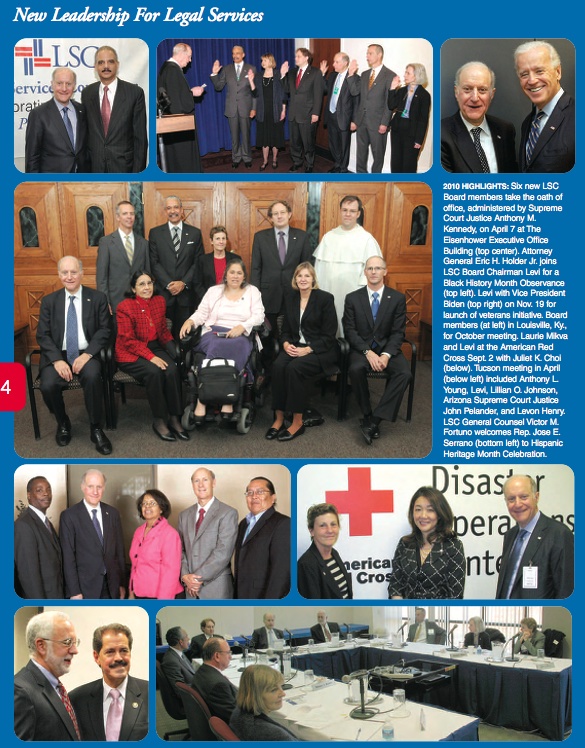
Pictures of Board and others, underlining potential of collaborations  (at 4-5).

Chart on page 7 on case closings showing importance of family law — raising a question for those programs that do very little.

Examples of programs helping people keep their homes (at page 10)

Short article on Increasing Efficiency and Access to Legal Aid — here discussing pilots for technology-supported intake (at page 12)

Article on page 13 on Strengthening Oversight of Fiscal Matters — a response to problems that can divert LSC from its mission.

Posted in Legal Aid, LSC, Technology | Tagged | Comments Off on LSC Releases 2010 Annual Report — Emphasises New Leadership and Collaborations

Legal Services at the Mall — the UK Model

As you probably know in a general way, the UK is deregulating certain aspects of the legal profession.

But you may not know how fast things are changing.  Here is one big consequence reported on the Legal Futures Blog.  The blog breaks the story of how a network of solicitors QualitySolicitors is opening up access points in Smith’s Stores.  For those who have not wandered down a British “high street,”  Smith’s is an ubiquitous bookstore etc chain going back a very long time.  And the “high street” still plays much of the role of the US Mall (Often the street itself is closed to traffic).

QualitySolicitors’ (QS) tie-up with WHSmith goes live next week, with “Legal Access Points” (LAPs) going in 130 stores in the first wave, we can reveal – along with first sight of how they will look.

Dozens more law firms are set to join the network this autumn, hand in hand with their LAPs in local branches of the retailer.

They make it sound like a a mobile phone sales booth:

Uniformed staff at the LAP will be able to book appointments, provide conveyancing quotes, sell wills packages and fixed-fee advice sessions, and sign up people to the QS loyalty card scheme, called Legal Privilege.

OMG, is that really a frequent flier card for using a lawyer?

This is what the Legal Access Points will look like:

The LAPs are 2m wide and 2.75m tall, featuring plasma TVs and big signage. Non-lawyers have been recruited and trained to staff them. Mr Holt said it was an “express advantage” to use non-lawyers as it is likely to make the initial contact with consumers more relaxed.

At a minimum, this story shows how far behind we in the US now are in thinking about delivery systems that work for middle income folks.  It will be fascinating to see how it works out, and what we can learn from the results.

Posted in Legal Ethics, Middle Income, Systematic Change | Tagged | 4 Comments

First Reports of Survey of Federal Court Self-Represented Litigation Services

As the Federal Court blog puts it: “The Judicial Conference Committee on Court Administration and Case Management (CACM) asked the Federal Judicial Center (FJC) to survey chief district judges and clerks of court on the assistance their district courts provide to pro se litigants.”

I do not believe that the Report has been published yet, but here are some of the highlights, as reported by the blog, Third Branch.  The data generally shows a broad range of recognition by District Courts of the need for such services, and indeed of steps to address the need — this is a very good sign for the future.

Continue reading

Posted in Federal Courts, Pro Bono, Self-Help Services, Unbundling | Comments Off on First Reports of Survey of Federal Court Self-Represented Litigation Services

E-Filing Assistance for the Self-Represented: Seattle Law Library Shows the Way

One day we will have integrated customer friendly e-filing linked to document assembly software on the one end, and court case management software on the other.

Till then, kudos to those self-help oriented programs that are trying to make access to the system as user-friendly as possible.

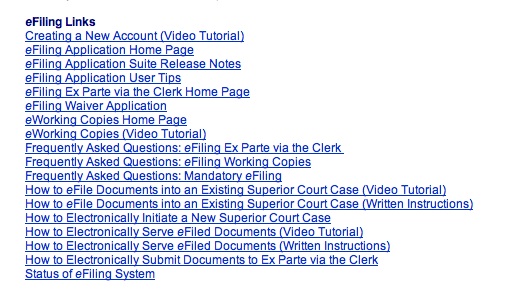
King County (Seattle) Law Library (key menu), working with the clerk is one such.  Here is a screen grab of that key menu.

Note particularly the videos on creating an account— which is on the court’s server, and I assume created by them.  Watching it is recommended as a way of thinking about these issues.

I understand that the library will scan documents for folks for $2 each (up to 30 pages per document), so they can be filed form the libraries public access computers, and also allows computers to be used to generate pdf documents for use in the e-filing system.  For scanning you have to have a USB drive, or buy one from the library.

A for effort in a difficult and challenging area.

Posted in Forms, Libraries, Technology | Tagged | 2 Comments