This Might be Fun — Games for Change

Games for Change will have its Festival June 20-22, in NYC.

From the Website

Games for Change Annual Festival
Often referred to as “the Sundance of Video Games”, the Games for Change Annual Festival is the biggest gaming event in New York City. It brings together leaders from government, corporations, civil society, media, academia and the gaming industry to explore the increasing real-world impact of digital games as an agent for social change. The Festival is also a showcase for some of the most innovative new games in production. The 8th Annual Festival will be held in NYC on June 20-22 2011. Last year’s festival was headlined by The Honorable Supreme Court Justice Sandra Day O’Connor and U.S. Chief Technology Officer Aneesh Chopra. It attracted over 600 participants.

I can certainly imaging various forms of court simulation games, games to share legal information, games to practice presentation of evidence, games to learn analyzing data, etc.

Categories of games on the wesbite are:

Human Rights
Economics
Public Policy
Public Health
Poverty
Environment
Global Conflict
News
Politics

Here is a game about the Bill of Rights (I have not tried it, no warranty!)

Suggestions?

Posted in Technology, Uncategorized | 2 Comments

Quick Budget Update — 2011 Continuing Resolution Detail

Here is a quick access to justice update (to the best of my understanding) of the implications in the Continuing Resolution agreed to by the President and House and Senate leadership.  It has not yet been passed in either chamber.

  • LSC field programs take a $15 million hit, compared to 2010.
  • The LSC TIG program (funding upcoming grants) has taken only the across the board 0.2% rescission.
  • The SJI budget has taken only the 0.2% across the board cut.
  • At least according to the Washington Post, the apparent $4.9 billion cut in victim programs does not represent a real cut.  ” The legislation includes $4.9 billion from the Justice Department’s Crime Victims Fund, for instance, but that money is in a reserve fund that wasn’t going to be spent this year. Crime victims would receive no less money than they did before the deal.”


The CR text is here.

Posted in Access to Justice Generally, Budget Issues, Legal Aid | Comments Off on Quick Budget Update — 2011 Continuing Resolution Detail

Quick Clarification on Post About Judicial Discretion

I have updated the prior blog about judicial discretion to include clarification from one of the co-authors on the frequency of releases at the end of sessions.  It is not quite as dramatic as in the quoted language — but still dramatic.

On the Predictabilty of Judicial Discretion — Implications for Judicial Education

If forwarding, please use the version below:

The Guardian is running a potentially very disturbing study about judicial decisions at parole hearings in Israel.  The study finds strong correlations between when in a session (relative to food breaks) a case is heard and the outcome.  The paper has been peer-reviewed, and is based on a study of 1,000 cases.  The correlations are very strong.

The research, which examined judicial rulings by Israeli judges who presided over parole hearings in criminal cases, found that judges gave more lenient decisions at the start of the day and immediately after a scheduled break in court proceedings such as lunch. Jonathan Levav, associate professor of business at Columbia University, who co-authored the paper, said: “You are anywhere between two and six times as likely to be released if you’re one of the first three prisoners considered versus the last three prisoners considered.”

The authors of the peer-reviewed paper looked at more than 1,000 rulings made in 2009 by eight judges. They found that the likelihood of a favourable ruling peaked at the beginning of the day, steadily declining over time from a probability of about 65% to nearly zero [actually, according to one of the authors, usually down to more like 20% to 30%, see note below — RZ], before spiking back up to about 65% after a break for a meal or snack.

Levav said the paper had implications for British judgments. He said: “What we’re finding here is a basic psychological effect, and there’s nothing different between the psychological effect on a British judge and an Israeli one.”

The only other variables that influenced a judge’s ruling were the number of times a prisoner had been to jail and the presence of a rehabilitation programme. Other factors, such as the severity of the prisoner’s crime, prison time, sex and ethnicity tended not to exert an effect on the rulings, according to the paper, which is published in the Proceedings of the National Academy of Science (Abstract free; text behind paywall.

Note:  co-author Jonathan Levav notes that “One little thing: although sometimes the probability drops to zero release, this is only occasionally true.  Most of the time it drops to about 20%-30% down from 65%, still enormous, but not zero.”

Now, parole hearings are very highly discretionary, perhaps more so than any other decision (at least in the US, where sentencing itself is constrained), and, of course, parole decisions here are made within parole systems and not by trial court judges. (The Guarddian story and the abstract uses the word judges to describe those making decisions about parole.  I understand from Jonathan Levav, one of the authors of the paper, that these are trial judges who were presiding over parole boards and that the judge makes the decision on the release, with the benefit of avaiable advice from a criminologist and social worker.  What’s really scary is that this is a system that many of us would consider almost ideal.)

But the study at a minimum suggests that judges need to find ways to make sure that they are not falling into similar patterns, particularly in areas with broad discretion.  Most of the suggestions I have seen in this area have dealt more with safeguarding against unconscious racial and ethnic bias.  It is probably easier to guard against dangers of which we are aware, than the less obvious ones, and this is surely a less obvious one.

It would also be interesting to try to find out what is the underlying dynamic — it may be, for example, that when judges are tired and hungry, they are less likely to take risks — and releasing someone on parole always feels like a riskier decision that denying parole — although from a long term point of view, a denial of parole may do more damage in the long term, it is just not damage to which attention will be drawn.  (ABC News has a speculative piece on what could be causing the effect, focusing in part of the food part of the equation.)

On the Predictabilty of Judicial Discretion — Implications for Judicial Education

Posted in Access to Justice Generally | 1 Comment

On the Predictabilty of Judicial Discretion — Implications for Judicial Education
The Guardian is running a potentially very disturbing study about judicial decisions at parole hearings in Israel.  The study finds strong correlations between when in a session (relative to food breaks) a case is heard and the outcome.  The paper has been peer-reviewed, and is based on a study of 1,000 cases.  The correlations are very strong.

The research, which examined judicial rulings by Israeli judges who presided over parole hearings in criminal cases, found that judges gave more lenient decisions at the start of the day and immediately after a scheduled break in court proceedings such as lunch. Jonathan Levav, associate professor of business at Columbia University, who co-authored the paper, said: “You are anywhere between two and six times as likely to be released if you’re one of the first three prisoners considered versus the last three prisoners considered.”

The authors of the peer-reviewed paper looked at more than 1,000 rulings made in 2009 by eight judges. They found that the likelihood of a favourable ruling peaked at the beginning of the day, steadily declining over time from a probability of about 65% to nearly zero [actually, according to one of the authors, usually down to more like 20% to 30%, see note below — RZ], before spiking back up to about 65% after a break for a meal or snack.

Levav said the paper had implications for British judgments. He said: “What we’re finding here is a basic psychological effect, and there’s nothing different between the psychological effect on a British judge and an Israeli one.”

The only other variables that influenced a judge’s ruling were the number of times a prisoner had been to jail and the presence of a rehabilitation programme. Other factors, such as the severity of the prisoner’s crime, prison time, sex and ethnicity tended not to exert an effect on the rulings, according to the paper, which is published in the Proceedings of the National Academy of Science (Abstract free; text behind paywall.

Note:  co-author Jonathan Levav notes that “One little thing: although sometimes the probability drops to zero release, this is only occasionally true.  Most of the time it drops to about 20%-30% down from 65%, still enormous, but not zero.”

Now, parole hearings are very highly discretionary, perhaps more so than any other decision (at least in the US, where sentencing itself is constrained), and, of course, parole decisions here are made within parole systems and not by trial court judges. (The Guarddian story and the abstract uses the word judges to describe those making decisions about parole.  I understand from Jonathan Levav, one of the authors of the paper, that these are trial judges who were presiding over parole boards and that the judge makes the decision on the release, with the benefit of avaiable advice from a criminologist and social worker.  What’s really scary is that this is a system that many of us would consider almost ideal.)

But the study at a minimum suggests that judges need to find ways to make sure that they are not falling into similar patterns, particularly in areas with broad discretion.  Most of the suggestions I have seen in this area have dealt more with safeguarding against unconscious racial and ethnic bias.  It is probably easier to guard against dangers of which we are aware, than the less obvious ones, and this is surely a less obvious one.

It would also be interesting to try to find out what is the underlying dynamic — it may be, for example, that when judges are tired and hungry, they are less likely to take risks — and releasing someone on parole always feels like a riskier decision that denying parole — although from a long term point of view, a denial of parole may do more damage in the long term, it is just not damage to which attention will be drawn.  (ABC News has a speculative piece on what could be causing the effect, focusing in part of the food part of the equation.)


Posted in Access to Justice Generally, Judicial Ethics, Research and Evalation | Tagged | 3 Comments

Poetry, Law and Songwriting

A challenging thought in a book review in yesterdays NYT Book Reivew.

The writer of the review, of a book on poetry notes:

The poetry columnist for the Book Review, Orr is also an attorney, which makes sense: a good poem, like a sound legal argument, puts the right materials in the best order so as to convince an audience. A lawyer doesn’t want his listeners to say, “I wonder what he meant” any more than a poet does.

But just as you can’t predict the outcome of a trial, so, too, does poetry work in mysterious ways.

The book is called Beautiful and Pointless: A Guide to Modern Poetry, and it has as at least one of its points that poetry needs to be understandable, but that its impact is often unpredicatable.

I have noted how good legal writing and good folk song writing combines the general and the very particular.

Think of Holly Near’s song referending Karen Silkwod, It Could Have Been Me:

THERE’S TALK OF NUCLEAR SAFETY AND THERE’S TALK OF NATIONAL PRIDE
BUT WE ALL KNOW IT IS A DEATH MACHINE AND THAT’S WHY KAREN DIED,

And, compare that with a good brief (not a real one here):  “The judge repeated violated the defendant’s right to be heard (“No, Sir I am not going to listen to that — its nothing to do with me.” (Tr V-3).

Anyway, maybe we are all poets at heart, and should allow ourselves more often not to hide it.

Posted in Uncategorized | Tagged , , | 1 Comment

British Columbia: Chief Judge says Lower Legal Rates or Give Up Monopoly; Legal Aid Commission Report Makes Innovative Suggestions

As reported in the Vancouver Sun the Chief Judge of the British Columbia Court of Appeals:

“has suggested lawyers either significantly lower their fees — now averaging about $340 an hour — or agree to give up their monopolistic hold on legal services.

Paralegals and others could do some of the donkey work presently done by high-priced talent.”

Other suggestions in the speech include treating legal aid as an essential public service:

In Justice Finch’s opinion, Doust [author of a recent report by the Public Commission on Legal Aid] in his report makes a compelling case for treating legal aid as an essential public service:

“In a society governed by the rule of law, access to legal advice and representation is at least as important as access to an education and to health care. He has, I believe, challenged the profession to make that case to the public, and to our policy-makers. However, we know we are not yet there and have a long way to go.”

The Legal Aid Commission Report is very interesting in its own terms.  Its Recommendations are as follows, and are very innovative.  I hope that the LSC strategic planning process takes a good look:

  • Recognize legal aid as an essential public service
  • Develop a new approach to define core services and priorities
  • Modernize and expand financial eligibility
  • Establish regional legal aid centres and innovative service delivery
  • Expand public engagement and political dialogue
  • Increase long-term, stable funding
  • The legal aid system must be proactive, dynamic, and strategic
  • There must be greater collaboration between public and private legal aid service providers
  • Provide more support to legal aid providers

The delivery system recommendations are particulalry interesting:

1.    Establishment of Regional Legal Aid Centres across the province to serve as the point of entry hub of legal aid service delivery for all core services to facilitate early intervention in resolving legal problems;
2.    Mobile outreach services to individuals who cannot access the Centres due to geo- graphic, cultural and/or other barriers;
3.    Enhanced team approach to the delivery of legal aid services with greater empha- sis on the role of community advocates and legal advocates acting with adequate support, training and supervision by lawyers;
4.    Gradual expansion of the role of duty counsel and staff lawyers where monitoring and evaluation demonstrate the effectiveness of these modes of service delivery in meeting client needs;
5.    Greater integration of legal aid services with other support services to meet client needs in a more holistic manner;
6.    Enhanced case management of large criminal cases and in other situations, where warranted;
7.    Targeted strategies to meet the needs of under-served communities including Aboriginal communities, women leaving abusive relationships, individuals with mental or cognitive disabilities, migrant workers and the elderly;
8.    Re-establishment and expansion of LawLINE; and
9.    Cautious expansion of information technology in delivering legal aid services bear- ing in mind the proven barriers to accessing and using legal information, particu- larly by the most disadvantaged.

The full report is here.

Posted in Access to Counsel, Access to Justice Boards, Middle Income | Tagged , | Comments Off on British Columbia: Chief Judge says Lower Legal Rates or Give Up Monopoly; Legal Aid Commission Report Makes Innovative Suggestions

Do We Have Too High a Tolerance for Error in the Justice System?

One plane pops a hole, no one is seriously hurt, and, as there should be, there’s saturation media coverage, immediate inspections of a portion of the fleet, and deep soul searching about our preventive systems.

But DNA exonerations suggest that we are making serious mistakes — with deep impacts on many lives — all the time — and are not doing much to find of prevent them.

Assuming this is true, why do we allow this to happen, and what should be done?

One answer as to why has to do with the inevitably relativistic nature of the decisions — there are always two sides, so nothing seems right or wrong.  Moreover, precisely because there are two sides, the desire for finality is great.  Just think about the narrow scope of review in most appeals, not really looking for the right result, only the right process.

But maybe the time of acquiescence in such low expectations should be long past.  It is certainly the case that the DNA exonerations have shown that finality and infallibility are not necessarily the same thing.

Some thoughts on ways we might be able to raise our own expectations of the system.

  • Measurement. Developing much better ways of tracking and counting outcomes so we can at least know what happens — including follow up for recidivism, returns to court, etc.
  • Outcomes. Thinking about acceptable rather than optimum outcomes.  One of the reasons analysis is so hard is that it is hard to decide what the “best” outcome is — particularly cases that involve judicial discretion.  It might be that we need to be more willing to think about reviewing cases as to whether they are outside the acceptable range, rather than the “right” decision.  This standard has been described as the “Oh My God,” standard, and as the “substantial risk of a miscarriage of justice” standard.
  • Data Mining. Using new analytic tools that allow one to find underlying patterns in masses of data — are we seeming patterns or changes in child custody decisions, such a differences between states, courts, judges?
  • Rethinking Appellate Review. Many states look at only very narrow issues on appeal — and require contemporaneous objection — a practical impossibility for most of the self-represented.  How often does the word “objection” get used in a self-represented hearing?
  • Routine Review of Decisions.  If litigant-led, objection-driven appellate review is not providing the safeguards that are needed, maybe we need to think of other (quieter and more efficient) review systems.  Most work in the world is improved by a second set of eyes.   The trick is finding a way to do it that does not further denigrate the role of the judge.
  • Interlocutory Appellate Review. As an apellate practitioner in Massachusetts, I was very impressed by the broad availability of immediate interlocutory review in that state.  As a practical matter, almost any lower court decision or ruling can be brought up for (highly discretionary) review by one or other of the two appellate courts.  The world does not end when judges are second guessed — actually it gets better when they learn from mistakes and avoid potentially much more public reversal later on.  Mass statute granting general superintendence power to state supreme court. Mass Appeals Court Guide with statutes.
  • Extension of Concept of Fatality Review. Many states now have systems of fatality review, in which, after a domestic violence death, the performance of all the system is looked at to see where the failure of prevention occurred.  Maybe we need to expand this to other areas of social failure.  (One would be where abuse happens after a custody grant.)
  • Consideration of Relationship of Caseflow Management to Errors. Individual assignment calendars are usually considered a good thing — and they surely are — as ensuring continuity of understanding by a judge.  But if and when a judge “gets it wrong” then they tend to lock in the error.  Thought should be given to ways to minimize this, and to other ways that caseflow management should go beyond speed to error reduction.

In the end, however, we have to build self-assessment systems that treat every problem as an opportunity for system improvement — not blaming on or another player.  That is the way the airline safety system works.  This is much harder to do in a system such as the legal system, that has historically been about the assignment of blame.

Posted in Access to Justice Generally, Domestic Violence, Research and Evalation, Systematic Change, Technology | Tagged , | 1 Comment

Pro Bono By Governmet Employees During Shutdowns — Not So Simple — Potential Ethics Problems and Need for Prior Approval

I have just received heard from Laura Klein, Pro Bono Program Manager at the U.S. Department of Justice and the Chair of the Federal Government Pro Bono Program, on the issue of pro bono participation by attorneys during the possible shutdown, as suggested by my prior blog.

Attorney Klein points out that pro bono participation by Federal Government attorneys requires prior ethics approval for those working in most (although not all) federal agencies, and that this applies even to short term work such as that suggested in my prior blog post, or research roles.  Inevitably, the ethics offices will be closed, so it will be impossible to get such approval during the shutdown, although there is nothing to stop attorneys seeking and obtaining such approval prior to the shutdown taking effect.  Doing such work without prior approval would subject Federal attorneys to potential problems.

I guess the obvious moral is, find out your agency’s rules and follow them.

Attorney Klein is happy to answer any questions so long as she is at her desk (i.e. till any takes effect!)  This offer to answer questions or to make referrals of questions covers those working anywhere in the Federal Government, not just DOJ.  Thanks to attorney Klein, both for this timely caution, and for her willingness to be of help.  Her e-mail is Laura.F.Klein@usdoj.gov.

Maybe this will at least provide some stimulus to expanding federal employee pro bono in the future.

Posted in Access to Justice Generally | 2 Comments

Government Shutdowns — Pro Bono Expansion Opportunity — But Subject to Federal Agency Prior Ethics Approval Under Ethics Rules

APRIL 8 UPDATE:

With the threat of immediate shutdown apparently averted, I have updated the language below slightly to be potentially relevant if the threat returns.  It might be a time for pro bono programs to consider contingency planning, and for those who might want to do pro bono work during a shutdown to get contingent approval from those with jurisdiction over ethics rules in their agencies.  See below.

APRIL 7 UPDATE:

As this post highlights. the original version of this post failed to alert readers to the need, in the case of most Federal agencies, for attorneys to obtain prior ethics approval before participating in pro bono activity.

Please make yourself fully aware of your agency rules before participating in any pro bono activity.  Laura Klein, Pro Bono Program Manager at the U.S. Department of Justice and the Chair of the Federal Government Pro Bono Program, Laura.F.Klein@usdoj.gov, is happy to answer questions, both about this issue at DOJ or any Federal agency.  Her e-mail is Laura.F.Klein@usdoj.gov.

ORIGINAL POST

Calling all pro bono coordinators.

Has it struck you that there are going to tens of thousands of bored and Blackberry-deprived lawyers starting on Monday?

If and when there are future shutdowns, there might be pro bono expansion opportunities.  While those on shutdown  could not take on long term cases, they could surely step in to do attorney of day roles, such as at self-help centers, or informational and brief services provided by legal aid.

How about offering special pro bono trainings next week.  The shut down might last long enough to be able to put them to use, but even if not, this is probably not the last shut0down we may be seeing.  And some of them, consistent with government rules, may continue in a pro bono role after the shutdowns end.

This may also be a good time to note that DC has a rule Rule 49 (c) (9) (c) that allows pro bono participation by federal employees with non-DC bar memberships — provided it is with “an organization that provides legal services to the public without fee” and under supervision of a DC licensed lawyer.  Great model.

Posted in Access to Justice Generally | 1 Comment

Computer Analysis of Politicians Press Releases — A Model for Court Transcipt Analysis?

A recent Harvard study, reported in the Washington Post, used computer analysis tools to deconstruct how Senators used their press releases.  In addition to the categories of use they were expecting, they found something they were not;  the researcher, Prof Gary King, “learned, to his amazement, that modern members of Congress spend about 27 percent of the time just taunting each other.”

I write here not to join the general gloating further revealing the emptiness of politicians, but rather to laud the tool.

These days, with digital transcripts prepared in so many cases, and with the capacity to use voice recognition for research purposes at very low cost even in those cases with only audio or video tape, it might be possible to use similar technology to analyze the patterns of interaction in the courtroom. (Remember, a few word errors in this kind of research do not matter, in contrast to the obvious risk in an appeal.)

We might be able in this way to get a much clearer picture of the forms of judicial engagement that occur in the real world, such as whether judges are asking questions, providing information etc., or whether they are cutting off litigants, and if so when.

In cases with lawyers, we might be able to detect patterns of objections, and even the rulings on those objections.  In a more advanced stage, we might be able to correlate with court outcomes.

I would like to think that this would help show the increasing accessibility of modern courtrooms, and perhaps provide a public contrast to the unfortunately highly visible reality show hostility of the likes of Judge Judy.  Over time, such research would help show the impact (or lack of impact) of judicial education programs.

In any event, the general point is that in the past, courtroom research has proved hard to do, partly because of the need to observe, and partly because of anxiety that it would focus on particular judges.  This research would be comprehensive, making it easier, I would hope, to overcome anxiety and objections.

I would love to see Prof. Jim Greiner at Harvard Law cooperate with Gary King in the Faculty on arts and sciences, in a combined study of randomized outcomes with statistical analysis of the underlying proceedings.  This would be particularly helpful because it may be that Greiner’s research on outcomes is best explained by the accessibility of the underlying proceedings — something that King might be able to measure.

Posted in Research and Evalation, Science, Systematic Change | Comments Off on Computer Analysis of Politicians Press Releases — A Model for Court Transcipt Analysis?

Simplification — NYT Article on Suggested Process

Simple article in NYT on how to make processes easier.  While aimed at the private sector, the lessons may be helpful to those trying to make forms simpler, and the processes of courts simpler to navigate.

The simple solution for just about any bureaucratic roadblock is to assemble your teams and ask a series of questions: What are we trying to accomplish here? Why does it matter? How does our current process help our goals? How does it hinder them?

If you add your customers and your suppliers to the inquiry, you may discover all kinds of ways to eliminate wasteful, inefficient work requirements.

By starting a review process that focuses on those questions, you stand a good chance of finding roadblocks before they take on a life of their own. By adding a simple “start-stop-continue” assessment, you may find a way to keep your rules and processes relevant: What do we need to start doing? Based on what we are learning, what do we need to stop doing? What do we need to keep doing?

As you go through your review, you are also quite likely to notice which processes or procedures need adjustment. When in doubt, ask those on the front lines what’s in their way: Is there anything that no longer seems to make sense?

If you’re really feeling courageous, try asking your customers or suppliers what hurdles you’ve put in their path. What makes you difficult to do business with? Beyond conducting just another customer satisfaction survey, you may risk actually discovering what matters. Just be careful that you don’t wind up creating another bureaucracy in the process. about how to simplify processes.  While aimed at the business world, the suggestions might be considered by those trying to simplify court processes and forms.

The lesson is simple:  look at every element and whether it is really still needed.  Make sure you have the people at the table who can tell you.  Include consumers as well as the processors.  There is an argument that the right place to start is with forms — not just what they contain, but how many of them are really needed.  Another way is to make a list of all the steps that have to be gone through, and then see how many can be combined or eliminated.

Posted in Access to Justice Generally, Forms, Systematic Change | Comments Off on Simplification — NYT Article on Suggested Process

We Are Visitors in Litigants’ Lives — More on Medical Analagies

I have to share an extract from Dr. Bach’s final NYT article about his wife’s cancer.  His reflections about how the experience of him and his wife, Ruth, with their cancer has changed his own behavior should challenge all of us to think more about how we deal with the lives we impact.

But I did change one small part of my routine, so small I doubt my trainees even noticed. Sometimes going into a patient’s room, I would position myself to face the other doctors. I’d ask to sit on the bed beside the patient, or walk around it to the other side.

Until now I had always stood with my fellow physicians, just far enough into the room that we would all fit. We’d form a kind of cabaret line, minus the high kicks. Stoop-shouldered, all in our white coats, stethoscopes variously hanging around necks or out of lab coat pockets. All in a line.

Sometimes, I’d even cross my arms. Ruth calls it my doctor pose.

In that pose, I saw myself as a consultant, an expert coming in to scope out the problem and make decisions. But by positioning myself so I can see both the patient and the other doctors, I can focus not only on my own concerns but theirs — on what they are hearing and seeing and feeling.

The shift in perspective matters. I’d always viewed patients as visitors in our hospital. But after a year of being on the other side of the desk, I’ve realized that we are the ones who are visitors in their lives.

Of course, its different in law than medicine, and dfferent for a court staffer or judge than a hospital staffer or doctor.  But our ideology of neutrality is less different than we think from the medical professions theory of distance. See my prior blog on resources for being engaged and present without creating an implication of non-neutrality.

One possible thought — in designing and operating self-help centers, there has been an understandable conscious use of open public space  to emphasize that there is no attorney client relationship between staffer and litigant — with the counter between them emphasizing this further (see SRLN Leadership Package Module on design).  Maybe there is a physical way to keep the message of lack of confidentiality from open space, while showing engagement — one way might be going to the end of an open counter to talk so that both are on the same end, rather than opposite sides.  Moreover, as people become more used to self-help services, they will understand the limits on the relationship, and we may have to be less vigilant in that area.  Anyway, I hope we will think and talk more about this.  We may have a lot to learn about this from library and social service design and processes

I hope the idea by analogy of being visitors in the lives of those who some to legal aid or court will stay with me, and inform my thinking about the subtleties of these interactions.

Posted in Libraries, Medical System Comparision, Self-Help Services | Comments Off on We Are Visitors in Litigants’ Lives — More on Medical Analagies

NewsMaker Interview: CJ Lippman on New York Foreclosure Settlement Representation Project

This blog is proud to present our second NewsMaker Interview, which is with Chief Judge Jonathan Lippman of New York.  It focuses on the recently announced Foreclosure Settlement Representation Project.  C.J. Lippman has long been a national leader in access to justice, so it is no surprise to see him focusing the New York Courts on this critical issue.

Richard Zorza: I think your new foreclosure project to provide legal assistance or representation at all foreclosure settlement appearances is a wonderful idea. How important is this and why?  Where did the idea come from, and how were you able to develop it into a concrete plan?

C.J. Lippman: Thank you, Richard, for saying it’s a wonderful idea. The conferences, which became mandatory a couple of years ago in foreclosures of one- to four-unit owner-occupied dwellings, have become the first opportunity for many homeowners to learn about their rights and protections, settlement options, and the foreclosure process itself.

For a homeowner who cannot afford a lawyer, it is a frightening and distressing experience to appear in an unfamiliar courthouse alone with so much at stake, especially when the adversary has an attorney (and the plaintiffs always do).  So providing representation at these conferences is extremely important to the homeowner, but it is also important to everyone else involved:  foreclosing plaintiffs, the court system, and ultimately the community.

During the hearings I conducted last fall around the state to assess the unmet need for civil legal services, I heard compelling testimony about the negative impact of homeowners appearing without a lawyer.  Perhaps surprisingly, some of that testimony came from the other side.  The general counsel of a major bank supported the provision of civil legal services to homeowners in foreclosure.  He said that the large numbers of unrepresented litigants were making the settlement process extremely inefficient, because the cases take longer to settle, and delays are a burden on the parties and the court system and add to the expense of the foreclosure.  With representation, not only is the homeowner better prepared for meaningful discussion but also the outcome is likely to be fairer.

Continue reading

Posted in Access to Counsel, Budget Issues, Foreclosure, Legal Aid, Newsmaker Interview, Pro Bono, Self-Help Services | Tagged , | Comments Off on NewsMaker Interview: CJ Lippman on New York Foreclosure Settlement Representation Project

Questions about the Model Code of Judicial Conduct and the Self-Represented

If the Supreme Court, in its upcoming decision in Turner v. Rogers, addresses the issue highlighted by the Solicitor General’s Brief, and discussed significantly at oral argument —  whether due process requires in some cases affirmative steps by judges such as exploratory questioning of a self-represented party (see blog posts on the SG brief and oral argument), there may be far more discussion among the judiciary, the profession and even the media than ever before about the appropriate parameters of the judge’s role when people are self-represented.

As I hope most of you know, back in 2007, when the ABA updated the Model Code of Judicial Conduct, it addressed the issue.  specifically in added comment language to the (renumbered) Rule 2.2, which now reads as follows:

Rule 2.2

Impartiality and Fairness

A judge shall uphold and apply the law,* and shall perform all duties of judicial office fairly and impartially.*

Comments

[4]    It is not a violation of this Rule for a judge to make reasonable accommodations to ensure pro se litigants the opportunity to have their matters fairly heard.

Reporters Explanation of Changes (which seems to be very rarely discussed)

[4]    Throughout the life of the Commission, some witnesses urged the Commission to create special rules enabling judges to assist pro se litigants, while others urged the Commission to disregard calls for such rules. This Comment makes clear that judges do not compromise their impartiality when they make reasonable accommodations to pro se litigants who may be completely unfamiliar with the legal system and the litigation process. To the contrary, by leveling the playing field, such judges ensure that pro se litigants receive the fair hearing to which they are entitled. On the other hand, judges should resist unreasonable demands for assistance that might give an unrepresented party an unfair advantage.

I think it is far to say that these are not regarded as the final word on the matter.  Some, for example, think that the issue of engagement with the self-represented should be in the language of the Rules, not just the Comments.

My questions are these:

  • How is this working out in practice?  As we may be entering a new period of debate it would be useful to know if this language is proving helpful in judicial education and in changing the judicial culture.
  • Are there any ways in which this language is proving inadequate in encouraging judicial engagement, and are there any ways in which it might be improved to meet this goal?
  • Are problems cropping up about such judicial engagement that need to be addressed in the Model Code, or in training materials (see, e.g. the SRLN Judicial Education Curriculum)
  • Is there anything in the language which is making adoption harder than it might be (not all states have completed the process.)

I would very much appreciate reactions to these (or indeed any related) questions.  Thoughts can be posted as blog comments (you do not need to be logged in), or you can e-mail them to me, either for my private use, or for posting without attribution — let me know how you want any thoughts treated.  My e-mail is richard@zorza.net.

Posted in Judicial Ethics, Supreme Court | Tagged | 1 Comment

Wordle Tool and More

We have all seen those maps of words — indeed this blog uses one to display tags used in this blog.

I have now found the free tool you can use to create your own.  Here it is (Wordle). You can paste any text into the tool, or “[e]nter the URL of any blog, blog feed, or any other web page that has an Atom or RSS feed.”  There are also lots of color and layout options to get the right effect.

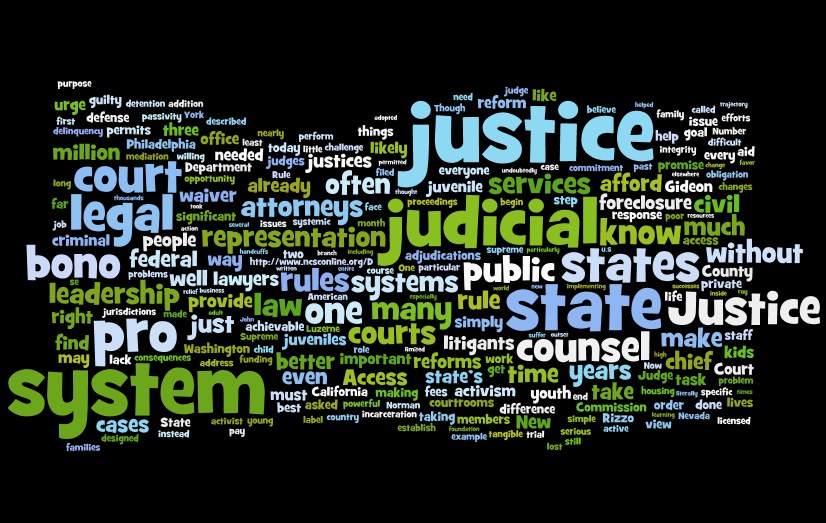
As a demonstration, I ran Prof Tribe’s speech to the Conference of Chief Justices through it.

Here is what came up.

Not surprising that “justice,” “system,” and “judicial” seem to be the biggest.

Update:

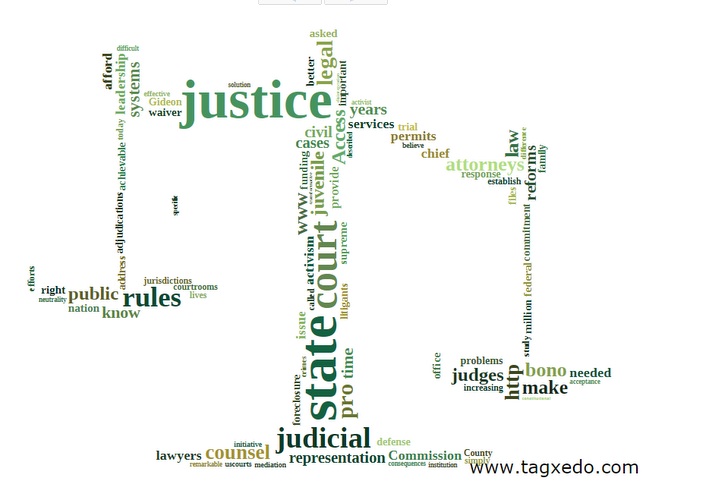
Kate Bladow, at Technola has used Tagxedo to create the same kind of cloud in the shape of the scales of justice.  (see her Comment below for more information.)

Not sure what it means that “judges” come down on the right, and “rules” are on the left.  Or that it tilts down to the right?

Now try this at home!  Have a fun time.

Posted in Access to Justice Generally, Tools | 2 Comments