Meet Claudia Johnson’s Daughter Scarlet Johnson, Now Blogging Too

Everyone in our network knows Claudia Johnson, who frequently guest blogs in this space.

But I bet you did not know that her daughter Scarlet Johnson is now a blogger too, launching her blogging with this contribution, which exudes her mother’s warmth, intelligence, and humor.  Her topic is being bi-racial.

Being biracial is one of the most unique, complicated, exciting and confusing experiences one could ever have the opportunity to experience. Those of us that are biracial get to experience a diversity of cultures, food, music and language. While it is absolutely incredible, there are plenty of annoying situations we find ourselves in. Usually, attributed to the innocent ignorance of our non-biracial friends and family. Some of these, we can look back and laugh at, some of these are nothing short of obnoxious. Either way, most biracial people can relate to the following 15 things.

Number 1: People who use the word “Halfie”

One of my biggest pet peeves, as a biracial person, is when someone calls me a “Halfie.” I mean, I don’t know about other biracial people, but I at least feel pretty whole.

I do not know if I should be embarrassed or proud never to have heard the word.

Congrats to the whole family — welcome, Scarlet, to blogging.

Folks, read, enjoy and follow.


Posted in Access to Justice Generally, Discrimination, Guest Bloggers, This Blog | Comments Off on Meet Claudia Johnson’s Daughter Scarlet Johnson, Now Blogging Too

Twenty First Century Strategic Planning and Innovation Deployment — Lessons From the 2016 Campaigns

A fascinating article and followup chat in the Washington Post may well lead us to a wiser and more effective strategic planning and innovation process for access to justice.  The general approach applies to any such process, and to a certain extent, at any level or size of entity.

Basically, unlike Trump,

As [Clinton] has reoriented her campaign for the general election, her team has devised a structure that reflects not geographic contiguity, with its common weather patterns or vernacular music traditions across neighboring states, but instead the different type of campaigning she will need to win each one. Most importantly, the structure acknowledges the increasing importance of early voting, which offers Clinton the potential to lock in an early lead when ballots begin to be cast in late September.  .  .  .

In Clinton’s Brooklyn headquarters, states with major opportunities for early voting—such as North Carolina and Colorado—are in their own pod, while the remaining states are divided into two. One pod has large, diverse states like Ohio and Pennsylvania, where mobilizing minorities and young whites will be essential to her victory. The other pod contains smaller, mostly white ones like Iowa and New Hampshire, which present fewer opportunities to identify and turn out new voters but a major need for persuasion.

To put it another way, the campaign recognizes that different things need to be done in different places, and planning for and managing places with different challenges and different opportunities together makes sense.

In access to justice we have long toyed with an approach that thinks differently about states in different situations.  Katherine Alteneder of SRLN has been a particularly forceful advocate and analyst of this general approach, making the case that a state has to know where it is before it can know what to do.  One possible set of  category names, for which she should in no way be blamed, is “advanced states,” “foundational service states,” and “emerging states.”

I personally read the Justice of All Strategic Planning Guidance as in general accord with this philosophy, although not necessarily with categories and labels.  In particular, the Chart of components, at page 4 of the Strategic Plan Action Guide, and the Component  Assessment Compilation in the Appendix to that document at page 14, help states and groups at all levels think in an overall way about where they are.  My dependencies doucument, discussed and linked here may also be helpful in this process.

I would reiterate that these materials can be very helpful indeed to states, counties and courts that are not necessarily thinking of responding to the Justice for All RFP.  They are a tool for all, and, in my humble and biased opinion, represent a significant step forward in thinking about strategy and action.

Posted in Access to Justice Boards, Access to Justice Generally, Court Management, Systematic Change | Comments Off on Twenty First Century Strategic Planning and Innovation Deployment — Lessons From the 2016 Campaigns

A Dependencies Tool To Assist in ATJ Strategic Planning and Use of the JFA Guidance

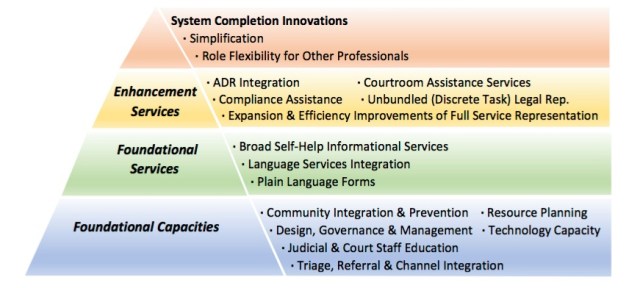
I am sharing, in the hope it may make the process of access to justice strategic planning both for the community at large and specifically those participating in the Justice for All RFP and associated processes, this document that is my personal take for SRLN on the relationships between the different components in the JFA Guidance.  The document clusters the components the same way the Guidance suggests at page 4 of the Strategic Action Planning Guide, which is part of the Guidance pack.  Here is the chart showing that clustering.

cluster

I am attaching the document in both docx and pdf formats.  While I would encourage people edit this to reflect their own thoughts, and their state situation, I would ask that those modifications be noted and credited separately.

These are totally my own opinions and judgments, and no other else should be tarred with them.

Posted in 100% Access Strategy and Campaign, Access to Justice Generally, Court Management | 4 Comments

Integrating the ABA Futures Report and the Justice For All Components

Its finally here, the ABA Future of Legal Services Report.

As expected, it covers a lot of ground, and is a lot to read.

As an aid to speedy integration into other projects, I have prepared this table that compares the Components analyzed in the Justice for All Guidance, with the Recommendations in the ABA Futures Report.

I very much hope that this table will:

Help those working in each and both groups find support in the different documents for moving forward on both the agendas.

Encourage thinking about the kinds of specific collaborations that the many parallels between the documents could spur.

Strengthen the feeling that this is all in support of a broad consensus in support of not only the goal of access to justice, but also about how to get here.

Encourage people whose primary current engagement is in one of the silos of bar, court, legal aid, to think about how they could help those in other silos do their work.

Encourage other groups developing agendas, strategic plans to think about including in their analysis and reports just this kind of table.  It would be interesting, for example, if the current LSC strategic planning process included such a chart (in this case with three columns) in their final document.

Here is the chart.  Comments and suggests very much appreciated.

Posted in 100% Access Strategy and Campaign, ABA, Access to Counsel, Access to Justice Generally, Alternative Business Structures, Attorney-Client, Bar Associations, Court Fees and Costs, Court Management, Document Assembly, E-filing, Incnetives, Law Schools, Legal Aid, Legal Ethics, LEP, Mediation, Middle Income, Mixed Model, Non-Lawyer Practice, Outcome Measures, Plain Language, Planning, Referral Systems, Research and Evalation, Rules Reform, Self-Help Services, Simplification, Systematic Change, Technology, Transparency, Triage, Unbundling | 2 Comments

A Blockbuster Recommendation In the ABA Futures Report Is for A National Commission on Uniform Court Forms

The Recommendation, at page 46 , of the Report, reads as follows:

“The ABA, the National Center for State Courts, the Conference of Chief Justices, and the Conference of State Court Administrators should collaborate to create a National Commission on Uniform Court Forms, similar to the National Conference of Commissioners on Uniform State Laws. The purpose of the Commission would be to generate model forms to be used by both represented and unrepresented litigants on a multi-state basis in ways that create consistency and accommodate simplified technological document preparation.”

Given that part of the reluctance of some courts and judges to move towards standardization has been a fear that such a step would antagonize the bar, this has to be a critical recommendation for the future.

Imagine the impact upon the Texas forms debate if such a Commission had been in place, and Texas had merely been asking for comments on the proposed modifications to the Uniform Form to account for Texas law and practice.

I see no intelligent reason that this can not move forward as soon as possible.

Posted in ABA, Access to Justice Generally, Forms, Plain Language, Self-Help Services | Comments Off on A Blockbuster Recommendation In the ABA Futures Report Is for A National Commission on Uniform Court Forms

Fascinating Parallel Between Rule Against Diagnosis Without Examination By Psychiatrists and Legal Information/Judgement Distinction

Here is the link to the recent statement by the American Psychiatric Association President drawing attention to the so-called “Goldwater Rule”:

On occasion psychiatrists are asked for an opinion about an individual who is in the light of public attention or who has disclosed information about himself/herself through public media. In such circumstances, a psychiatrist may share with the public his or her expertise about psychiatric issues in general. However, it is unethical for a psychiatrist to offer a professional opinion unless he or she has conducted an examination and has been granted proper authorization for such a statement. (Bold added.)

Interestingly, the Washington Post puts it this way:

The short version: It’s okay to talk about psychiatric issues — but not okay to diagnose people you haven’t treated.

Of course, there is a lot of daylight between “shar[ing] with the public .  .  . expertise about psychiatric issues in general” and “offer[ing] a pofessional opinion.”  Most of that uncertainty derives from the wiggle room in the phrase “in general.”  Note also that the Post short version above does not include the qualification, and I have to feel that the Post article overall, while quoting extensively, feels less restrictive than the APA statement.

In any event, I note that there is a lot of parallel with our issues about legal information.  I would suggest that the no opinion from shrinks rule might help us say that the information only rule can seen as simply a “no opinion” rule.  In other words, the simple explanation of our rule is “just the facts, m’am.”  Of course, some would argue that there are no facts in psychiatry — or law.

As to the practical impact on psychiatrists however, I do recall the lovely line in House of Cards, when the FU character drops a hint, the naive young journalist asks the intended follow-up and FU replies:  “Now, you might well think that, but I couldn’t possibly comment.”  That phrase has passed into English, at least in English politics.

Posted in Legal Ethics, Self-Help Services | 1 Comment

More on the Proposed Single Measure for Access to Justice

The more I think and talk with folks about the proposed single measure for access to justice, the more I think we might be on to something that could tell us what we want to know, would allow for comparison of innovations and even of the state of access in a wide variety of contexts, procedural systems, and cases.

The measure, to put it simply, would be:

The percentage of people for whom the facts and law are sufficiently before the decision-maker that the case can be decided on the facts and the law.

For steps prior to completion of the consideration by the decision-maker:

The percentage of people for whom, assuming the remaining steps function appropriately, the previously completed steps have been such that the case will ultimately, if completed, have had the facts and law sufficiently before the decision-maker that the case will have been decided on the facts and the law.

The primary method for calculating this score would be to interview the person and come up with a yes/no assessment.  That interview, remember, would be very like a normal intake interview conducted by an attorney, exploring the same areas, and with the same thoroughness.

So, for cases decided after hearing, the review would be whether the decision-maker actually heard the evidence needed to make an appropriate decision.  For cases decided without hearing, the review would be of whatever paperwork (or tech equivalent) had been gathered.

For measuring the ATJ score of earlier steps, the reviewer would compare the information that had been gathered, with that needed to provide a sufficient chance that the information would ultimately be gathered.  (This is slightly flexible, because it might be, for example, that judges in one court were known to be really good at exploring matters.  In such a court, lack of completeness in forms would have less on an impact on the scoring.)

Notwithstanding this, the forms example helps show how powerful this measure could be for assessing innovations and changes.  A new form draft would be tested by being given to half of a group, and comparison of the scores for those using the new form and the old one would be a simple measure of its impact.

Indeed, in this example, one could measure both the actual form alone, and the access score of the combination of the form and the hearing.  The comparison of the after hearing scores would be a measure on the impact on access a whole, and therefore ultimately more important.  (The study protocol would require that different test and control groups would be needed, because the research interview would distort subsequent results.)  The post-form research result would be completed more quickly, and could be used in the ongoing development process.

The measure is intentionally simple, and as such runs risks, fixable actually, of lack of consistency.  But the simplicity is a very important feature and researchers have many methods for ensuring consistency among reviewers.  Moreover, the simple yes/no conclusion could be supplemented or even replaced by a more precise assessment tools, but all leading to that final encasement.

What this process does not measure is the percentage of people with justiciable issues who in fact do seek redress and get into the funnel above.  Nor does it measure the “justice” of the ultimate result, or ultimate compliance.  But the point is that these will need to be measured differently,and then all three integrated.

p.s.  I am sure that a process like this would provide very useful information to use in improving judicial education.


Posted in 100% Access Strategy and Campaign, Access to Justice Generally, Outcome Measures, Series: Outcome Measures | 6 Comments

The Guidance for the Justice For All Strategic Planning Process Will Help In Many Ways Beyond The Development of Planning Project Proposals

The Justice for All Strategic Planning Guidance Materials are now published here.

They will be very helpful for the states that are in the process of putting together the proposals for strategic planning money that are due on October 5, as described in the RFP.  (Disclosure: I have been involved in the planning process for this project, including as one of the expert group.  Obviously, in this post I speak very much only for myself.)

However, the tools can be used in a wide variety of ways to promote access, and I strongly encourage all to look at them carefully from the point of view their own work.  The role of this synthesis of experience is potentially far greater than its use for strategic planning, critical thought that is.

The complete Guidance packet consists of three sections each of which includes a number of resources that will be of broad help to access advocates and planners:

I.    An Introduction to the Effort

This section describes the history and goals of the project, and the key suggested components of access and therefore of planning, the importance of the user perspective and the role and makeup of a planning group.

Perhaps most importantly, at least in planning terms, it contains a a detailed Appendix describing the sixteen components for suggested planning:

  • Design, Governance & Management
  • Resource Planning
  • Technology Capacity
  • Triage, Referral, & Channel Integration
  • Community Integration & Prevention
  • Judicial & Court Staff Education
  • Broad Self-Help Informational Services
  • Plain Language Forms
  • Language Services Integration
  • Alternative Dispute Resolution Integration
  • Compliance Assistance
  • Courtroom Assistance Services
  • Expansion & Efficiency Improvements of Full Service Representation
  • Unbundled (Discrete Task) Legal Assistance
  • Simplification
  • Role Flexibility For Other Professionals

The component descriptions follow a common format, and, in my opinion, represent the first comprehensive bringing together of all these elements, at least in such a common format.

For each of these sixteen, the Appendix details:

  • The rationale and need
  • The key elements for the component
  • General approaches to  building the component
  • Additional comments on matters such as problems, prioritization, risks, and current knowledge status.

I believe that these single page descriptions in the Appendix will prove a highly useful tool for stimulating discussion in almost any forum.  The reflect perhaps 20 years of experience in almost every state, and can be a foundation for much activity.

II.  Inventory Assessment Guide

The inventory assessment guide has been drafted to assist state planners take the measure of the state of access to justice in their state.  This is intended both to help them make the wisest possible choices in their ultimate plan and to lay the groundwork for the measurement of achievable outcomes envisioned in the CCJ/COSCA Resolution.

The overall approach recommended is to follow state customized versions of tools designed to measure the state of play for each of the components, grounded in the elements and descriptions in the Appendix to the Introduction.

The draft assessments for each of the components (which are included in the Guide) suggest standard questions about status, penetration,sufficiency, and scaleability of current deployment.  The answer grid allows for choices all the way from “no” to sustainable, and also for notes.  There is space for additional component notes on each assessment.  My thought it that many states may find it useful to use these note options for begin the analysis of differences by case area, which will have major strategic implications.  The assessment questions incorporate the individualized key elements of each components.

III.  Strategic Planning Guide

The Planning Guide is the key document that brings together all the data and knowledge gathered about the specific state environment with the planning experience integrated from throughout the country.

Firstly, it discusses the development of the planning team, including the importance of including a broader than usual range of stakeholders.  Then, it discusses the different focuses that planning might take, including case type or regional, for example.

With respect to key issue of prioritization, the Guide offers a cluster approach, as shown in the chart below.

cluster

As a general matter, work starts at the bottom, and moves up, and many of the higher ones require components in lower parts of the pyramid to be at least partially completed before they can be moved forward effectively.

After discussing reasons that such prioritization might be modified, the document offers an action plan checklist, suggests how to integrate the component assessment into a general assessment, and provides a very general component plan template.

All in all, this is a powerful toolbox.

I urge all involved in the access movement to study it carefully for ways it can help them in their work.  I urge all to share it, talk about it, and pull from it.  It is about far more than the RFP, or even strategic planning.  It is a major distillation of knowledge.

I hope in future blogs to be able to contribute to thinking about ways that this can all be as much help as possible.

Posted in 100% Access Strategy and Campaign, Access to Justice Boards, Access to Justice Generally, Planning, Tools, Triage | 1 Comment

Thinking About a Single Quantitative Measure for Access to Justice

Recent Guidance issued by the White House to all Federal agencies on the process for estimating environmental impact, as required by law, may well point the way for how to we think about access to justice indicators, as envisioned in the UN goals process, and as called for in the Chiefs 100% access Resolution.

Specifically, the Guidance, instructs all agencies, as reported in the Washington post, to:

.  .  .   [N]ot only include climate change in these considerations but actually quantify the climate impacts of their decisions, when possible, in the context of the environmental reviews that are already required by NEPA. (bold added).

.   .   .  “From the public standpoint, we are now going to know what all of our decisions add up to in terms of impacting climate change,” said Christy Goldfuss, managing director of the Council on Environmental Quality. “You can think of all the different federal decisions, and how they all add up. We have numbers where we can actually say, ‘this is a huge decision, given the amount of greenhouse gases coming out of it.’

“And that gives the public a chance to really weigh in on decision-making,” continued Goldfuss, whose office was actually established by the original NEPA.

 The Guidance itself is at https://www.whitehouse.gov/sites/whitehouse.gov/files/documents/nepa_final_ghg_guidance.pdf.

The moral for the access to justice world. We should be building a system in which changes to the legal system are analyzed, prior to adoption, for their impact on access to justice, and that assessment, whenever possible should be quantitative.  This is just as important in the administrative law context.

What quantitative measures might we use? There are some obvious measures. Federal forms are already required to include access to information on how long they take to fill out. But that information does not include whether a person can fill it out without a lawyer.

Generalizing, I would suggest that any change in the legal system would need to be analyzed in terms of what percentage of people could reasonably be expected to participate meaningfully and sufficiently in the process, as changed in comparison to before the change, and only with assistance from free and actually available resources. For there to be “sufficient meaningful participation” it would be necessary that the case has been sufficiently presented that the decision-maker was able to accurately make a decision on the facts and the law.

For example, if 95% of people would require a lawyer, and the system only provided them for 10%, while the others required nothing, then the score would be 15%.

In a different hypothetical, if 25% percent needed a lawyer, 5% were available, and for the remaining number self-help would be needed but not available, then the score would be 5%.  In the same hypothetical, if 40% would be able to get self-help and that would be sufficient, then the score would be 45%, and so on.

For some changes, such as new forms, I think there might be objective testing, asking people to fill in the form, then interviewing them to find out if information was missing.  The same could be done after hearing — in both court and administrative agency contexts.

Other changes might require subjective assessment, and the question of who would do such things would be critical.

The impact would need to be on the process as a whole, not just the measured step.  For example, if a redesigned form alone went from 60 to 50, but the score for the  number whose information got in the record of the  hearing went from 70 to 80, then that would be progress.  Such a result could occur because a longer form was successfully used by fewer people but the additional information provided by those who did complete it led to better results.

At a minimum, such a requirement would force consideration of mitigation – the ways to reduce any bad impacts on the score, such as providing additional self-help services, providing more training to judges, and the like. (Interestingly, mitigation is considered in the environmental Guidance.)

Such an approach, used to establish baselines, might be very helpful in the UN process and for establishing the measures called for in the Chiefs’ Resolution.

Posted in 100% Access Strategy and Campaign, Access to Justice Generally, Planning, Series: Outcome Measures, Transparency, White House | 1 Comment

Politico Report on Agency Planing for Next Administration Underlines Importance of Laying the Groundwork Now — But We Have to Ask

An interesting story in Politico reports that Federal agencies are continuing to move forward with regulatory-type initiatives that could only be completed in the next administration, implicitly assuming a Democratic victory.

The Obama administration is seemingly so confident of a Hillary Clinton victory in November that it’s pumping out rules and other executive actions that won’t be completed until the next president takes office on politically sensitive issues like climate change and student loans.

And, for example:

“The effort you are seeing from the president and his team will help ensure when Secretary Clinton enters the Oval Office, she and her team will have a running start when it comes to advancing climate and energy issues,” said Tom Reynolds, a former White House climate aide who stepped down in April.

So, this highlights that the staff and committement are in place to do everything that can be done to lay as much of the groundwork as possible for access to justice-friendly regulations.  But we have to ask.

Has any civil access to justice group, as of now, made ANY ask of the White House, or any agency for  such action during this time.  The courts, the traditional legal aid community, the access Commissions, the bar?  (Actually, it seems to me that the only asking that is being done is within the administration itself, through the DOJ program on Access.  That and LAIR and follow-up provides an opening and leveraging point.)

Unless I am really missing something, the implications of this lack of ask could only be justified by the belief that there is no regulatory language that acts as a barrier to access innovation or delivery, no potential regulation or executive action that would improve access, no regulation, executive order or policy that would benefit from an access friendly interpretation explanation, or urging.  In other words, that all the possible work has been done.

In an attempt to suggest that that can not be the case, I am pasting in some suggestions and thoughts from a prior post.

Surely we in the access to justice world should be thinking about whether there are actions that this administration can take before January 20, 2017 — now just over two years away.

To be a viable candidate for such action, a federal regulatory change should probably be:

One for which is there is little real focused opposition, or one which it would be hard to repeal in the future, not be too obviously expensive, and build its own constituency over time.

Some possible areas in which advocates might look are:

Funding formulas set by regulation rather than by statute, in which access to justice might be made either a priority or included more explicitly as available — DOJ has already had very significant impact in this area.

  • Federal administrative agency procedures that impact poor and middle income people (a huge category from the VA to Social Security)
  • Oversight of future changes in Federal and federally supervised quasi judicial agencies that have an impact on access to justice — such as by setting up an “access to justice impact statement” requirement for all changes in such agencies.
  • State administrative agency and quasi-judicial procedures that are funded and regulated by Federal agencies (such as unemployment, food stamps, TANF, etc.)
  • Use of nonlaywers in such Federal or Federally-supervised contexts — an area in which there is already substantial precedent.  Could, for example, the Federal section 8 housing regs be modified to allow non-lawyers to appear on behalf of tenants in cases in which the judge found a need under Turner?  And what about child support enforcement, a major area of federal investment?
  • Federal funding of state courts, including data collection — a big budget item on which conditions could be met, and which might provide leverage on forms and accessible electronic filing
  • Things being done by state Commissions that might be adopted as Federal standards.
    Leverage provided by funding of law student loans and other forms of assistance to law schools.

These, and others, are surely areas on which advocates and policy advocates should be brainstorming about how to take advantage of this short and rare moment of opportunity — we may not get another for a generation or two.  Let’s think big.

We should also be asking how we can facilitate such discussions within our communities.

I would add this situation and opportunity to the list of ideas that demonstrate the need for more intentional and focused leadership capacity in our field.

A final, if controversial, thought. It may be that some of the most appropriate changes would be ones that some of the President’s more traditional stakeholders might oppose, and with respect to which it might therefore be easier for an outgoing administration be willing to do the right thing.

Posted in 100% Access Strategy and Campaign, Court Management, Non-Lawyer Practice, White House | Comments Off on Politico Report on Agency Planing for Next Administration Underlines Importance of Laying the Groundwork Now — But We Have to Ask

Anne Holton, VP Nominee Tim Kaine’s Wife, was a Legal Aid Lawyer for Thirteen years, and a Judge for Seven

According to Wikipedia:

Following graduation from law school, Holton served as a law clerk for Judge Robert R. Merhige, Jr. of the Richmond-based United States District Court for the Eastern District of Virginia. From 1985 to 1998, she worked as an attorney for the Central Virginia Legal Aid Society, where she helped create an award-winning volunteer lawyers’ program in Richmond. From 1998 to 2005, she served as a Judge on the Juvenile and Domestic Relations District Court for the City of Richmond. Holton was chief judge of the court from 2000 to 2003. She resigned from the bench following her husband’s election as Governor in December 2005.

That sure sounds like an ideal resume for a person near the top of the Executive Branch.  Sounds like she brings experience with the three core pillars of the ATJ triad.

  • Experience as a line attorney,
  • Experience as a judge, including with administrative duties
  • Experience working in pro bono administration.

While others, like Hilary Clinton, have experience in one or more of these roles, Holton must be unique in this combination.

Holton is ideally positioned to be an advocate for not merely for funding, but for the range of innovations that can only happen with insight into the needs of all these sectors — and beyond.  Her current experience as Virginia Education Secretary, and her connections to the Anne E. Casey Foundation, suggest an openness to comprehensive and innovative approaches, that are designed strategically, often with a long term pilot state focus.

Lets hope that this will make it easier for us to start to think earlier rather than later about the transition to an even more ATJ friendly administration, and thinking about how the outgoing administration might be able to help lay the groundwork for such a major focus.  Hilary Clinton, after all, was the Chair of the LSC Board as far back as 1978-1980.

As the quote below from a 2011 interview prior to her giving the Commencement Address at the Univ of Richmond School of Law shows, she has stayed deeply interested in access:

Why did you decide to focus your work on helping families?

The focus on families and children came about through my legal aid work and as a judge in juvenile court and it’s such challenging and important work. … One of the things I learned in legal aid is the importance of treating people with respect and dignity — that means a lot to people, particularly those who haven’t been treated that way, even if you don’t get the results you hoped for. One of the most gratifying aspects about legal work in any capacity is that you are serving a client, you are a servant leader, and it is rewarding.

What has been your experience working with students from the University of Richmond School of Law?

They are a terrific group of students who are all very committed, enthusiastic, interested and eager to be out doing things in the community and getting their hands dirty in legal work. Back during my legal aid days, we had a non-credit clinical program where UR students volunteered under my supervision, representing clients in administrative hearings before the Virginia Employment Commission. Later on the law school had clinical law students working in for-credit positions at my court. I’ve also been an occasional guest speaker at the law school.

What’s your advice for students who want to work in public service careers?

There are lots of ways to do public service and that’s one fun thing about our careers, so it’s important to think broadly about what constitutes public service. No one will get rich being a public defender or a prosecutor or working in the commonwealth attorney’s office, but they are good positions and they pay decently and they offer a terrific learning environment. Also, in private sector law some people do pro bono work from within firms. There are so many ways to do public service law — we don’t all have to be legal aid attorneys.

More on Virginia Education Secretary Holton here.


Posted in Access to Justice Boards, Access to Justice Generally, Legal Aid, Vocation, White House | Comments Off on Anne Holton, VP Nominee Tim Kaine’s Wife, was a Legal Aid Lawyer for Thirteen years, and a Judge for Seven

Claudia Johnson Guest Post: Appellate Courts show willingness to reverse decisions where due process and decisions are not explained in SRL cases—Are DV cases the canary and a natural for innovation?

Multiple decisions have come to my attention where appellate courts are reversing trial courts on cases where one of the parties did not have a lawyer. All cases come from Domestic  Violence dockets. Is this a new trend for DV pro se dockets? T ime will tell.

The first case hails from NJ—C.H. v. J.S come from New Jersey, a case when a self-represented litigant (defendant) was not allowed to present his case at trial while defending a domestic violence order. The decision is not precedential and not published; nonetheless it is an interesting decision.

The second case hails from California, Michaels v. Turk, 15 @.O.S. 4195, and the issue on appeal was whether the pro per litigant had consented to have the case heard by a Commissioner. The case also comes from a domestic violence court.

Another case in California that went to the highest court in California, Nakamura v. Parker, a California case from 2007 was the first pro se case I saw where a trial court decision was vacated on appeal in a DV case where the victim was a pro se litigant. Originally this case came through Bay Legal through our hotline and was litigated by Susun Kim and Minouche Kandel. This case dealt with a local judge denying a protection order despite the facts entered in the record. The trial court did not explain its summary ruling and that was the basis for the appeal. On appeal, the order was reversed and the case was remanded to the trial court. In Nakamura, multiple DV advocacy led by the Partnership to End Domestic Violence had filed an application for leave to file an Amici Brief. Their petition read:

“These trial courts are denying domestic violence victims protective orders and hearings in cases where they have presented prima facie cases of abuse. Additionally, courts should not deny a protective order based solely on the fact that there has been a lull in the physical violence.”

The willingness of appeal courts to reverse trial court decisions should remind judges to be attentive to what the party without a lawyer is asking for and to not go on with “business as usual” mode where moving the cases becomes an objective in and of itself and the implicit bias by the judge or process is not checked.

If judicial training on how to manage self-represented litigant cases is not enough reversal by trial courts might get the attention of judges working in large SRL dockets. Becoming careful and observant of what the statutory and procedural requirements are will improve the outcomes for SRLs and reduce the risk for reversal, and improve outcomes for the litigants. Integrated assistance and information in these dockets that help those without lawyers submit strong pleadings and helping them understand their rights prior to hearing will also go a long way in promoting strong orders based on the merits.

Providing SRL friendly forms and assistance, is congruent with the Turner Supreme Court decision, where the interpretation is that Courts should provide those without lawyers meaningful ways to present their information through helpful forms and to the courts. The expansion of services in SRL and the provision of litigant friendly high quality forms that pull out all the relevant facts and defenses might reduce the risk of reversals in Turner-like cases.

Forms alone however are not enough. The forms need to have buy in from all the groups that work with the same population, and need to be easy to use and easy to find, and free. If legal advice and representation are not available in the locality due to limited funding , pro bono assistance , clinic based help, or limited/unbundled assistance are also key in making the protection afforded by the law meaningful and real to vulnerable groups. A great model of pro bono assistance is the NY Courts DV e-filing project, recently the recipient of the Law and Technology Award.
http://www.connectingjusticecommunities.com/ny-courts-honored-with-ltn-innovation-award-for-the-most-innovative-use-of-technology/2015/08/
http://www.nycourts.gov/ip/nya2j/news.shtml#news
http://at.law.com/dJpoT2

Another model is the established DASH Clinic in Los Angeles.

The Domestic Abuse Self Help Project is run by Neighborhood Legal Services of Los Angeles County, and has since 2006 assisted more than 1 Million self-represented persons. At the DASH clinics (it has 4 locations) they provide one on one guidance completing the forms in the morning and then they assist with filing in the afternoons. They have a devoted volunteer attorney in each location for assistance and review of the forms before being submitted. The online forms are created by the AOC and hosted through LawHelp Interactive. In addition to the 4 locations, they have a clinic in a shelter in Santa Clarita Valley, and also at the Develonshire Police Station. DASH does an outstanding job in working with those who have limited English Proficiency, and is a model worth considering for those thinking about improving outcomes for those without lawyers in DV, and other high volume areas of need. http://www.connectingjusticecommunities.com/commemorating-domestic-violence-awareness-month-with-tools-by-lawhelp-interactive/2015/10/

If others know of appeal cases with similar rulings as they relate to SRLs, please share them. If anyone wants to brainstorm on how to use modern tools to increase services for DV victims/sexual assault victims, or knows of other holistic meaningful assistance projects that include forms, but don’t stop there please share and feel free to reach out to me at cjohnson@probono.net.


Posted in Access to Justice Generally, Appellate Practice, Document Assembly, Domestic Violence, Family Law, Guest Bloggers, Judicial Ethics, Self-Help Services | 1 Comment

Would Having Famous White Actors Re-Enact Being the Shooting Victims Help Change White Attitudes?

It is great that celebrities are being used to draw attention to the wide variety of situations in which Black people can be shot by cops in the US.

But surely it would be more of an opinion changer if videos were made, exactly re-enacting recent shootings, in which the victims were played by white actors with whom very broad swathes of the American public strongly identify?

That might cause some of those who always put themselves in the position of the whites in such interactions to see the interaction differently — perhaps, to them, shockingly so.

Who could lead such an effort?


Posted in Chasm with Communities, Constitution, Criminal Law, Policing | 2 Comments

The Legal System Continues, per Ginsburg, J., To Protect the Constitutional System Against Trump

Yesterday morning the New York Times published a precedent-shattering interview with Justice Ruth Bader Ginsburg.

Unless they have a book to sell, Supreme Court justices rarely give interviews. Even then, they diligently avoid political topics. Justice Ruth Bader Ginsburg takes a different approach.

These days, she is making no secret of what she thinks of a certain presidential candidate.

“I can’t imagine what this place would be — I can’t imagine what the country would be — with Donald Trump as our president,” she said. “For the country, it could be four years. For the court, it could be — I don’t even want to contemplate that.”

It reminded her of something her husband, Martin D. Ginsburg, a prominent tax lawyer who died in 2010, would have said.

“‘Now it’s time for us to move to New Zealand,’” Justice Ginsburg said, smiling ruefully.

At the risk of belaboring the obvious, these are remarks beyond imagining in anything other than frightening times.  They simultaneously communicate who she wants to lose the election, her feelings about the depth of the impact on the country were Trump were to win, the fact that it would have a huge significance for the court, the fact that this impact would last for a very long time, and the sense that at least for her family, watching it up close would be unbearable.

That is heady stuff.

Yet, almost a day later, no rebuke from a fellow justice, no statement of limitation from the Court press office, no statements of outrage from Republican senators, no demands for impeachment from the right.

Some of these will surely come, and perhaps part of the apparent quiet can be explained by the heavy focus on the shootings last week, and by Trump’s managers trying to keep him under wraps, which may also have inspired them to try to keep the surrogates quiet too.  Moreover, that Scalia and Alito have been somewhat loose in their comments too — but not nearly as much as Ginsburg was here — may have inhibited reaction somewhat.

But it is hard not to imagine how the media (and many of us) would have reacted  if, for example, Justice Alito had implicitly threatened to leave the country if Clinton became president, or if Justice Thomas had said he did not want to think about the decades long impact on the Court of a Clinton presidency.

I think the explanation for the silence may be that it reflects the quiet conspiracy of the elites that a Trump presidency just can not be allowed to happen.  Who knows, maybe Ginsburg even cleared her remarks with Chief Justice Roberts, or more likely gave him the opportunity to dissuade her.  Can you imagine the Chambers or Conference discussions among the Justices about the election?

In any event, this has to be a hint of what more might be to come, from everyone from the Chamber of Commerce to retired senior military officers, to our former presidents,  if in late October a Trump victory seems a real possibility.

Posted in Access to Justice Generally, Constitution, Judicial Ethics, Supreme Court, White House | 1 Comment

Advocate System Versus System That Does Not Need Advocates

A recent conversation with my friend Peter Fielding, a doctor who lives at our retirement community about patient/client advocates led to some interesting conclusions for both the medical and legal worlds.

When Peter and I discussed the fact that some medical patient and family caregivers councils have set as a goal having a patient advocate for each patient, he said, in effect: “No, you want the system to be so good that nobody needs an advocate.”  His point was that if you give everyone an advocate you take away the incentive to improve the system.  You just fix each problem as it occurs.

We in the legal system, are in a very different place.  We have build a system that assumes that everyone has an advocate, but then made it so that only a small minority can afford one.  That’s the worst of all worlds.

So, we are trying to do four things:  change the system so that as few people as possible need advocates, find the resources to pay for those who need them even in the transformed system, build ways that less highly trained, and therefore less expensive people, can perform some of the advocacy, and, critically, design good systems that decide who really does need an advocate, and what kind of advocate, even in a reformed system.

Back to the medical system, therefore, the questions become:  How can one design a system that behaves so that as few people as possible need an advocate, how can one identify the tasks and situations in which patients still need advocates, how can we provide advocates, with what skills in those situations, and how can those advocates be trained and connected to the system so that they provide the feedback and information that allows the system to even further reduce the need for patient advocates.

In a way, the analog to the last point would be, in the legal system, having part of the role of lawyers be to support the reduction of the need for lawyers.  It’s sort of like the role of dentists in promoting fluoride.

In a way, it is what the legal self-help services movement, and the Self-Represented Litigation Network do.

_____________________________________________

Peter adds:

This is a thought starter piece. If we were to pursue the topic we would need to define Advocate and why / for what purposes they may be needed: Technical issues; emotional support ; checking function about treatment details and timing; hotel functions in hospitals; violations of individual autonomy; poor doctor /patient relationship issues and so on. This list of the  “ Surveillance Domains” could be quite long.

Clearly we would need a “Systems approach” to mitigate the need ( or some of the need) for Advocacy: probably the most important being the setting of standards which would form the basis of education:  self-correcting / self-flagging  methods of data recording ; blame free cultural development ;  putting patient needs first ; policy and procedures for Quality Improvement ,  error correction ,and in more critical issues methods and experience in conducting Root Cause Analysis.

Assuming that there will continue to be a need for Patient Advocacy should such a person come to the event/situation on the arm of the patient or should it be the institution which provides independent patient navigators and advocates in support of the usual declared aspiration of “ providing the highest standards of care “.

In practice most hospitals , PCP groups, and other health care organizations have a hard time just keeping up with clinical and bureaucratic demands which are currently placed on their shoulders.

So how can we get enough “ blue sky” to think about ,implement, and then manage such a big task ? A challenge indeed.

Peter Fielding


Posted in Access to Justice Generally, Attorney-Client, Medical System Comparision, Systematic Change | 6 Comments