What Happens When a Federal Court Pays Attention to the Self-Represented — the Central District of California Bankruptcy Court Is A Model for Us All

The Central District of California Bankruptcy Court has released its report on the self-represented.

Self-represented, or pro se, litigants comprise over one quarter of the debtors filing in the U.S. Bankruptcy Court for the Central District of California. In early 2011, the Court identified serving this population as one of its key strategic issues, focusing on ensuring proper access to justice for self-represented parties and measuring their impact on the Court’s resources. Since that time, we have embarked on a careful review of the Court’s approach to assisting self-represented parties, and expanded and implemented programs and systems to be more effective in this area.

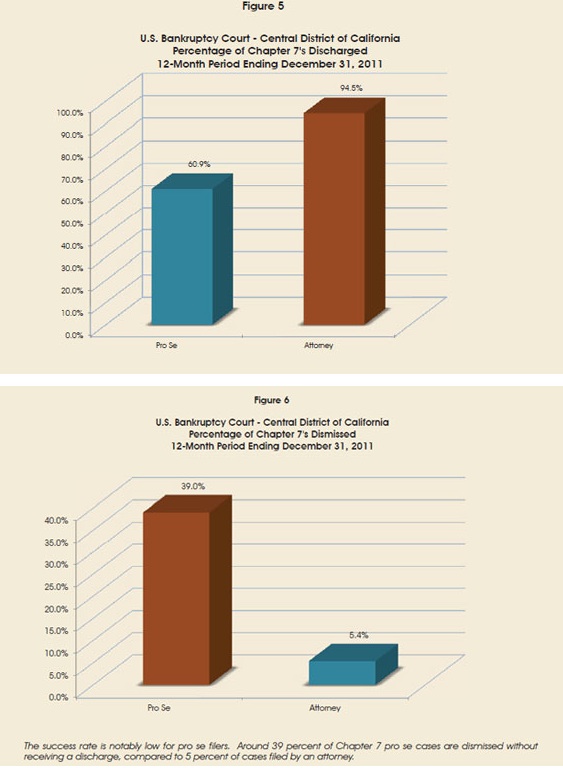
They have the numbers:  “The Central District of California led the nation in bankruptcy filings in 2011 with 134,501 filings.  About 28 percent of our filings are filed without an attorney, compared to about 9 percent nationwide.”

They have the impacts on actual cases and the court — see the charts:
They have the programs — including staff training:

Despite efforts to direct more Court users to the website for the breadth of information provided there, it would appear that the majority of the self-represented still seek personal assistance from Clerk’s Office and Chambers staff. The Court has tried to address this by training staff to be as effective as possible in answering questions without providing legal advice. In 2011, the Court’s annual Winter Education Seminar included a presentation to staff on distinguishing between questions that ask for legal advice and those that ask for procedural advice. A presenter from the Federal Judicial Center led the discussion, and attendees were provided electronic polling handsets to weigh in on each of the 50 most common questions from the public that were submitted by the Clerk’s Office. The presentation encouraged staff to improve their customer service skills by answering as many questions from the public as possible, provided that the questions are procedural in nature.

And, perhaps most important of all, they are moving forward with new projects, including new instructions on proof of service (a huge problem in many courts), video instructions, and the possibility of a call center/live chat approach.

They are one of the pilot sites for the e-filing for the self-represented project:

The Pathfinder Electronic Filing Project seeks to:

  • Provide an online option for self-represented parties to file bankruptcy.
  • Increase the number of resources available to self-represented parties (e.g., literature, website, onsite computer terminal support, etc.) and ensure that the public is made aware of the resources.
  • Broaden customer service to assist and complement pro bono organizations and their self-represented debtor clinics.
  • Reduce fraud by BPPs.
  • Provide outreach to educate self-represented parties, while reassuring attorneys that their client base is not being targeted.

For the link to the NJ Bankruptcy Court self-represented pilot itself, go here. Comments from a blogger here.

This summary only scratches the surface, and I urge all to read the Report in full.  Its not only a model for solutions; much more importantly, it shows what a court can do when it makes the decision to focus leadership and resources on this problem.  Kudos for all, and let’s hope that we see more of this, not just in Bankruptcy Court, not just in Federal Court, but throughout the system.

Posted in Bankruptcy, E-filing, Federal Courts, Self-Help Services | 2 Comments

Lawyer Referral Services Are the Key Gateway to Unbundled Services and Calfornia Leads the Way

It is impossible to overemphasize the importance of lawyer referral services (LRS) in opening up unbundling to the millions for whom it is the key to access to justice, and the tens or hundreds of thousands of lawyers who might finally find a financially viable way of practice through providing such service.

Now the California State Bar’s Standing Committee on the Delivery of Legal Services Moderate Means Working Group, chaired by Christine Page, has produced a brochure aimed at LRS, and it has been sent to the all certified Lawyer Referral Services on the California LRS listserv.

Here is some of the key language.

DOES LIMITED SCOPE WORK AND CAN IT MAKE MONEY FOR MY LRS AND ATTORNEY MEMBERS?

Yes!  There are hundreds of attorneys practicing limited scope representation in California today, and many thousands across the country.  After initial resistance in family law courts, most family law judges in California now both understand and embrace unbundling.  In time, civil court judges will also become more familiar with limited scope representation and appreciate its advantages over self-representation.

LRS’s with established limited scope panels, such as the Contra Costa County Bar Association, report that the panels are inexpensive to administer and bring valuable added revenue.  Most attorneys who practice limited scope report that it comprises between 15-30-% of their practice and, for many, it has enabled them to stay in business during the recession.

Many attorneys who first learn of limited scope fear they will be exposed to malpractice claims or that they will be “stuck” with a client after the limited services are provided.  These fears are unfounded if attorneys practice limited scope according to the guidelines set forth in the risk management training materials.  A recent survey of limited scope practitioners in California revealed that they have been able to provide meaningful assistance to low and moderate income clients exactly as set out in the limited scope engagement.  These attorneys also reported a great deal of satisfaction in educating and coaching clients on what aspects of a matter they can handle on their own  so that they can resolve a dispute without being crushed by legal fees.

WHAT CAN MY LRS DO TO OFFER THIS TRAINING?

In addition to referring interested attorneys to the free training programs on the PLI and ABA websites, your bar association may wish to sponsor a training seminar for attorneys in your community in order to publicize and generate interest for a limited scope panel.  These seminars offer MCLE credit, including one-hour of ethics credit.  For assistance in setting up a training seminar, contact Rodney Low, Program Developer of the State Bar’s Office of Legal Services, atRodney.Low@calbar.ca.gov.

WHAT CAN MY LRS DO TO EDUCATE THE PUBLIC ABOUT LIMITED SCOPE REPRESENTATION?

The easiest way to educate the public about limited scope representation is to post a link on your website explaining what it is and how a client can be referred to a limited scope practitioner.  Examples can be found on the websites of the Contra Costa County Bar Association and San Fernando Valley Bar Association, both pioneers in promoting limited scope in California.  A sample pamphlet answering frequently asked questions regarding limited scope can be found at http://www.sfvba.org under the FAQ’s for their Attorney Referral Service.

Most clients, however, will only learn about limited scope as an option if you educate them during the intake screening.  Callers who have been referred by Self Help Centers and other court-based programs are among the best candidates for limited scope representation and should be routinely informed about the limited scope option.

HOW CAN I SET UP A LIMITED SCOPE PANEL?

For those interested in establishing a panel, there are materials providing step-by-step instructions on how to identify prospective panelists, provide needed training, and screen callers for referrals to limited scope panelists.  The article “Establishing a Limited Representation (“Unbundling”) Lawyer Referral Service Panel” is posted on the ABA website and can also be obtained from Barbara Tillson, LRIS Coordinator for the Contra Costa County Bar Association.  Feel free to contact Ms. Tillson at btillson@cccba.org.

If your LRIS is too small to justify a separate panel, there are still a number of things you can do to promote limited scope:

  • Encourage attorneys to add limited scope to their practice by advertising limited scope on your website and providing a link to the PLI and ABA programs that provide free training.
  • Send a survey to your current panelists to identify who has received training and/or is currently offering limited scope and maintain that information in your database for potential referrals.
  • Educate your intake staff so they can “triage” referral clients and direct them to a limited scope practitioner.
  • Remind your panelists to educate their clients regarding the limited scope alternative.

Any other questions?  Contact Rodney Low at Rodney.Low(at)calbar.ca.gov.

These are great ideas.  Its fabulous to see the LRS community stepping up to the plate.

Posted in Unbundling | Tagged | 4 Comments

Non-Lawyer Practice — Moving the New York Discussion Forward

I blogged recently about testimony at the New York Access to Justice hearings about the potential of non-lawyer practice.

I am now able to post the actual testimony that was briefly referenced in the Reuters story.

Professor Gillian Hadfield of USC sums it up with absolute clarity:

Being both a lawyer and an economist, and an academic to boot, I’m at triple threat of hiding behind “on the one hand, on the other hand” statements when it comes to addressing public policy problems.  But I am here today to make a clear unequivocal statement:  there is no way to solve the crisis of civil access to justice without fundamental change in the way the judiciary regulates the practice of law.  More precisely, there is no way to generate the kind of legal help that ordinary New Yorkers need solely through the expenditure of public money on legal aid and the provision of pro bono and other charitable assistance.  No way.  Any solution that makes a dent in the problem will also have to involve expanding the types of people and organizations that are authorized to provide legal help.  I realize that is a statement that is at odds with almost everything lawyers talk about when they talk about access to justice.  But it shouldn’t be.  It should be the main topic of conversation:  how will we expand access by expanding the range of options available to ordinary people when they face the ordinary legal needs of everyday life?  This is not a scary option.  It is not an unethical option.  It is, in my view, the only responsible option. 

Using New York numbers, Professor Hadfield makes clear that the current approach can not even begin to meet the need:

Suppose you wanted to provide every household experiencing civil legal problems just one hour of legal help with each problem they faced. What would that cost?  The average hourly rate for a general practitioner working in solo or small firm practice in New York—the kind of lawyer who provides services to ordinary folks rather than corporations—is about $200.  A little more math: 1 million households times 1.5 problems times $200 per hour equals $300 million.  That’s for one hour for each problem.  Even if you think you could find enough lawyers willing to work for, say, $150 an hour (which no survey of lawyers that I’ve seen suggests is possible), you’re still talking $225 million.   Of course, for very few legal problems is one hour of help much help at all.    

She also applies New York numbers to the potential for pro bono to fill the gap:

And if you didn’t want to pay hourly rates for that assistance?  It would require every one of the approximately 150,000 New York licensed attorneys to work an additional 10 hours pro bono a year for each hour of help provided for all those facing a legal problem.  To put this number in perspective, in the 2008 ABA Pro Bono survey, American lawyers provided an annual average of 28 hours of pro bono services to persons of limited means.[1] The average time spent on a single pro bono case was 24 hours—meaning that on average, American lawyers are helping the equivalent of one person or household a year with a legal problem.  If this average applies in New York, it means 150,000 households receive pro bono help—that’s 10% of the 1.5 million legal problems low-income households tell us they are facing. (footnote omitted.)

The Professor goes on to discuss the medical analogy, the potential of non-lawyers appropriately licensed to perform certain tasks including explanation and advice giving, the successful experiences in the UK, and the Washington State limited experiment with “legal technicians,” now being launched.

She concludes:

But New York should not wait to see how Washington turns out.  It should act now to evaluate its options for expanding the supply of legal assistance to New York’s citizens.  And it should do so in a firmly policy-oriented and evidence-based way.  For too long this issue has been allowed to become buried under the intuition-based objections of existing members of the legal profession.  (These are often sincerely held worries about the capacity to help those with legal trouble, although they are also, one must admit, sometimes plainly motivated by protectionist fears of competition.)  If we treat this, as we absolutely must, as a matter of serious policy and we put our intuitions to the test of theory and empirical evidence, I guarantee we will find that the traditional fears are unfounded.  There are numerous ways to ensure levels of quality and care in legal matters that outperform our current situation by substantially decreasing cost and increasing access.  How about an RFP—a request for proposals—from a wide range of possible providers and policymakers, not merely the current members of the legal profession? I think New York, given your energy and devotion to this question, could turn the corner on innovation in legal services and take a major leadership role in a matter that is of desperate need of fresh thinking both here and throughout the country.

Hear, Hear!


Posted in Access to Justice Generally, Legal Ethics, Pro Bono, Self-Help Services | 5 Comments

American Judges Association Adopts White Paper on Implications of Science for Judging

This White Paper, MINDING THE COURT, should be read by all judges and those who appear in front of, or talk to (professionally or personally), judges. It focuses on the lessons of recent neuroscience and their implications for fair and effective judging.

The core take-away is in the recommendations:

Several techniques can help judges to be more mindful and aware of the decision- making process so that they make better decisions. First, focus on the higher purpose of the proceeding—hearing and properly deciding a case with a real impact on someone, not just processing a court docket. Second, formalize and critique heuristics used to make repetitive but important decisions. For example, a judge might consider what factors are leading to bail decisions or probation conditions: Are they based on accurate information? Third, be mindful and periodically “read the dials.” Are you tired? Is noise in the hallway a distraction? Is a break in order? Taking a break or engaging in even brief meditation can restore awareness and reduce stress. Fourth, decision aids, like checklists, can help. Doctors and pilots have shown that even well-trained professionals can improve performance by following checklists. Fifth, seek feedback and foster accountability. Judges often operate in isolation and without feedback. Competitive athletes improve performance through constant coaching and feedback, and judges can improve performance by getting objective feedback too.

These recommendations are based on analysis of heuristics (falling into unconscious patterns), implicit biases, mindfulness, fatigue/depleted resources.

The paper is by Dr. Pam Casey, and Judges Steven Leben and Kevin Burke.

Posted in Judicial Ethics, Science | Comments Off on American Judges Association Adopts White Paper on Implications of Science for Judging

An International Perspective on Access to Justice Strategies

A 22,000 Mile High View of Access to Justice.

In the US, we like to think of access to justice innovators as broad overview thinkers.  But, from Hiil in the Netherlands, comes a reminder that we too are grounded in our particular culture and obviously available options.  At http://www.hiil.org/, the Report titled Strategies for Basic Justice Care for Everyone, tries to generate a world overview of ways that justice can be provided for all.

In overview:

Our Trend Report shows how 10 problems are responsible for most of the injustice experienced by individuals. In many places, less than half of these problems are solved in a fair way. When best practices are used, solving over 70% is possible. Globally, the estimated “access to justice” gap consists of 200 million unsolved problems. Each year. That is a lot of injustice. (at page 3)

The strategies for Basic Justice Care:

1. Legal Information Targeted on Needs of Disputants

2. Facilitators and Paralegals Working Towards Fair Solutions

3. Sharing Practices, Evidence Based Protocols

4. Choice of Third Party Adjudication Processes

5. IT Platforms Supporting Negotiation and Litigation

The Strategies for Courts and Judges (“Putting people first”):

Open up

Focus on fair solutions that work for the people

Work evidence based

Specialise and offer choice

Be rewarded for solutions and well monitored

For Innovators — I have pasted in the whole section:

Keep pushing the envelope
For some the urge to change things is born of anger and frustration about traditional thinking and its lack of results. For others it starts with an idea, born out of curiosity and a professional ‘what if’ question. Whatever your motive, it can’t be strong enough. People who want to change the world are always met by the sceptics, the traditionalists, the ones who benefit from the existing situation. It is not enough to come up with innovative solutions to court procedures, mediation or a slow, lawmaking process. The hard part is getting people to embrace those innovations. To get them to make it really work, to scale it up, to elevate it to common practice. Pursuing change is the hardest road to travel. But it can be done, especially when you’re not alone on your journey. Innovators are likely to become even more successful if they:
Strengthen what is available
For every type of dispute, there are already ways in which people talk, negotiate and work towards decisions. The most promising innovations strengthen these processes.
Are ready for scaling up
If an innovation depends on continued external funding, or can only work in a very specific setting, it is less likely to have a lasting impact. Every innovation needs a good “business case.” For the clients and for every person in the supply chain, the value proposition needs to be clear. All services need a revenue stream that matches costs. Innovative services in the justice sector are no exception to that.
Succeed in bringing the defendant to the table
Access to justice is most needed when one party is in dire need of a solution, while the other party hesitates to listen, to give in, to pay or to take a particular action. Successful innovations reach out to the defendants, making it safe, secure and necessary for them to cooperate. If they do not cooperate, they should be worse off.
Ask for integration in court procedures
Courts solve this “submission problem.” They give an enforceable decision even if the defendant does not cooperate and do this in the name of the state. This gives them a privileged position, which makes it hard to compete with them. Courts should be urged that they try, test and buy the best available methods for solving the most urgent conflicts.
Demand a level playing field
Many innovators in, around and outside courts, can make a strong case that they solve disputes faster, more effectively and/or more fairly than happens in existing procedures. It is not unreasonable for those innovators to claim access to similar resources. Existing court interventions and innovative procedures should be evaluated according to the same, independent standards, based on what works best to solve problems for people.

There are also strategies listed for social investors, law professors and policy makers.

I encourage folks to read this, and assess our own state of play against this global perspective.  These generalizations can reinforce some of our strategies (legal information) and underline how far behind we are in others (non-lawyer roles).

P.S. Thanks to Bonnie Hough for bringing this to my attention.

Posted in Access to Justice Generally | Comments Off on An International Perspective on Access to Justice Strategies

Advocacy at New York Hearing for Non-Lawyer Access Innovations

This may be a straw in the wind.

Reuters, in their report of the second of this year’s New York State hearings on Access to Justice included the following:

But money alone will not solve the problem, according to testimony submitted by Gillian Hadfield, a professor of law and economics at the University of Southern California. [link added]

With approximately one million low-income households facing legal problems, according to a court system survey, it’s simply impossible for the state’s 150,000 licensed attorneys to provide enough pro bono hours to help all of those people, the testimony said.

Hadfield suggested the state “allow people and organizations other than lawyers and law firms to provide some forms of legal assistance,” much like the medical profession, where a host of non-doctor personnel handle many healthcare problems.

In the past the content of these hearings has been somewhat predictive of future directions in New York state, so perhaps this means that we should all be thinking about creative ways to move forward to lower barriers to access inherent in the legal monopoly, such as the UK example blogged about here.

As soon as the transcript of the hearing is available, I will post it, and make more comments on the specifics of this approach, which I personally believe is a critical part of the overall solution.  All kudos to New York and CJ Lippman for putting the issue generally on the agenda, and helping make sure that the conversation begins.

Posted in Legal Ethics, Self-Help Services | 5 Comments

Child Support Agencies’ Interest in Access to Justice

Last week I attended the Western Interstate Child Support Enforcement Council Conference in Jackson Hole Wyoming.  I was part of a session on the implications of Turner v. Rogers.

I talked to people from many states (Wyoming, California, and Colorado among them), and was impressed by the level of interest in closer collaboration between courts and child support enforcement agencies at the state and local level.  Most of the people I talked to really see their work as access to justice work, and they see themselves not primarily as collection agents, but as a gateway to financial stability for the families they help.  In fact, the vast majority of their caseload is not collecting reimbursement for welfare payments, but rather trying to get non-custodial parents to pay their fair share of the costs that custodial parents bear.  Moreover, they realize the importance of both sides being heard, of not imposing impossible orders, and of being flexible and sensitive when parents are unable to make their payments.

Which is all by way of encouraging those concerned with access to reach out an include state and local IV-D agencies in your planning processes.  Indeed, in some states, the costs of self-help services provided in child support cases are now reimbursed under the federal IV-D program, pursuant to collaborative agreements between the IV-D agency and the courts.  As a general matter, 66% of child support and establishment and collection costs are potentially reimbursable, and there is no state or per capita cap on total IV-D reimbursement.  As some of you know, I have funding to work on developing materials to encourage such collaboration, and would welcome thoughts on how best to do so.

Posted in Funding, Self-Help Services | 2 Comments

Law and Internet Conference to Stream Two Transformative Speakers Monday and Tuesday Morning This Week.

The Law Via the Internet Conference, being held at Cornell Law School this year this week will feature two important Speakers.  The Conference is being hosted by the Legal Information Institute, which all readers of this blog should know and use.  The Institute is twenty years old this year, which gives a sense of how much they were and are pioneers.  Now, how many of us can say we honestly were thinking about open online access to legal information in 1992?

On Monday, October 8 @ 9am EDT, legal technology innovator Richard Susskind will speak on “Liberating the Law Yet Further.”

On Tuesday, October 9 @ 9am EDT, social media visionary Clay Shirky will speak on “Authority in an Age of Open Access.”

Both speeches will be online live here.  Full conference agenda here.

Posted in Meetings, Technology | Comments Off on Law and Internet Conference to Stream Two Transformative Speakers Monday and Tuesday Morning This Week.

Branding Right to Counsel

I am, with his permission, sharing something that John Pollock, of the Civil Right to Counsel Coalition, found out and shared on the group’s list.

He points out that there has been debate about whether to talk about “civil Gideon” or “Civil Right to Counsel’

As he describes it:

“So just out of curiosity, I tried googling both “civil right to counsel” and “civil gideon”.  For “civil right to counsel“, the first 10 Google hits were all positive references.  For “civil gideon“, 5 of the 10 were negative articles about the issue.”  

As John suggests, “Gideon” has acquired a lot of baggage.

Personally, I tend to think about a “right to access,” often requiring counsel, but that does not necessarily have the same ring.

Posted in Access to Counsel | Comments Off on Branding Right to Counsel

LSC Pro Bono Task Force Report Now Out

It’s out and here. It was well worth waiting for, with many recommendations that go way beyond the traditional formulaic praise of pro bono to engage what needs to be done.

I thought it might be worthwhile to highlight and comment on just a few of the things that stood out for me — reading this is not a substitute for reading the whole Report, or at least the Executive Summary, which is three (large) pages long.

Creation of an organization of pro bono professionals who work at LSC funded program. (at p 3.)  This could go a long way to creating a stronger culture of quality within the pro bono world.

Pro Bono Incubation Fund (at page 3).  We have learned from TIG that competitive discretionary grant programs can be highly successful not just at developing new models, but at facilitating adoption systemwide.  It is important to recognize that TIG has been brilliantly led, and has had a clear vision to guide that leadership.  As anyone who has been to a TIG Conference knows, TIG gas always been much more than a funder and the Pro Bono Incubation Fund would need the same kind of leadership.

Evaluation of Pro Bono Programs (at page 4).  The report is honest that such evaluation efforts are in the “early stages.”  I have felt that the strong political resonance that pro bono has may be a contributing factor in the relative lack of evaluation of pro bono.  In fact, however, this support should make it all the more urgent.  The uniform support for pro bono means that the (to my mind wrong) argument that we should be cautious about evaluating pro bono just does not apply.  Moreover, were evaluation to show that significant investments in pro bono would yield dividends, it would be much easier to raise additional funds for expansion of such approaches, that it would be in other areas of innovation.

Using Pro Bono Lawyers to Support Self-Help Services. (at page 12).  The report details several examples, and this is indeed a powerful area of collaboration, in part because it allows lawyers to make small controllable commitments of time.

Technology/Pro Bono Website. (at page 14).  This is in part “back to the future,” since early in the history of TIG there was a greater emphasis on ensuring that all states included pro bono in their advocacy sites.

Revision of PAI Regulations.  The current regs are needlessly restrictive, and the Report makes a number of good suggestions about allowing use of the PAI set-aside for things such as “supervising and training law students, law graduates, deferred associates, and others.”  Not everyone realizes that PAI is a regulation, not in the statute or appropriation language, so can be changed relatively easily.  A word of caution, it is important that the regulation not be so relaxed that the 12.5% support functions that are really part of the non-pro bono system.  (I personally do not think that 12.5% of management should automatically be billed to PAI.)

Hiring LSC staff person. (at page 28).  This person would work to strengthen grantee pro bono efforts, and would have a major impact on the other elements recommended in the Report.

Posted in LSC, Pro Bono | Comments Off on LSC Pro Bono Task Force Report Now Out

NCSC Summit on Language Access Now Going On

Those interested in the Summit on Languge Access in the Courts that is now going on can see the Agenda here.

Self-represented advocates will be particularly interested in the session on Providing Services Outside the Courtroom, which is listed as follows:

Workshop: Providing Services Outside of the Courtroom  (Post Oak)

Moderator: Mr. Arthur W. Pepin, Director, New Mexico Administrative Office of the Courts

Hon. Audrey J. S. Carrion, Associate Judge, Baltimore City Circuit Court, 8th Judicial Circuit of Maryland
Ms. Hanna Sanders, Access to Justice Coordinator, Maine Judicial Branch
Mr. David W. Slayton, Administrative Director, Texas Office of Court Administration

When the teams return to their states, this may provide a good opportunity for self-represented advocates to talk to team members about integrating language access and self-represented services.

Posted in LEP, Meetings | Comments Off on NCSC Summit on Language Access Now Going On

LSC TIG Grants Announced — The Year of Mobile and Beyond

They are out, the new TIG grants and it is a great list. In this post, I briefly summarize one significant area, mobile, and how we might take the innovations even further.

This is clearly the year of mobile.  Grants include:

  1. To create mobile versions of LawHelp and websites (Southeast Louisiana and Western New York [Spanish], Lone Star [DisaterLegal]),
  2. Provide mobile-optimized pro bono tools (Northeastern Minnesota and Colorado), remote services at partner locations (Montana),
  3. Farm worker time records and attorney communication (Georgia),
  4. Integrating websites with text messaging (Georgia for multiple organizations),
  5. Develop “responsive mobile Drupal theme” (Idaho),
  6. Build appointment reminder (Northern Virginia).

Taken together, this significantly moves the community towards better use of mobile access.  As I have blogged before, with suggested examples, the key is not just to convert existing content, but to think about how the constant availability of mobile tools can empower people in the immediate moment.

One trick is to always keep in mind the sensors in the mobile units — location (allowing full information about the location and people, events, situation there), movement and acceleration (allowing inferences about what the person is doing or having done to them), orientation (to optimize display, and to use the unit as a motion tool), code reading (allowing ANY data from the Internet to be pulled), camera (allowing picture to be analyzed digitally, and almost anything to be inferred, including who you are talking to, what they are saying [digital lip reading anyone? etc., etc.]).

Remember, too, that the information from these sensors can be integrated with each other, and with any information on the unit (i.e about the user) and on the Internet.

If you include the sensors in the picture, you see that the mobile revolution is as transformative as the universal access revolution (as well as being part of it.

While the LSC Technology Summit Process provides some opportunity for this kind of analysis, let me suggest that we need a separate brainstorming process to really push the envelope on this one.  Could it be funded as an add-on to one of the mobile grants?


Posted in Mobile Technology, Technology | 3 Comments

ABA Sets Up Juvenile Collateral Consequences Site

This site is  nice clean example of using technology to alert people to problems that they might otherwise ignore.  It is designed to let juveniles think about the possible consequences of juvenile pleas that go beyond the obvious.

I also see it as part of the long overdue movement to eliminate the counter-productive distinction between civil and criminal representation.  That distinction is largely a historical artifact, dating from the different political histories of Gideon v. Wainright, and the OEO Program.

The separation is, of course, now enshrined in Federal law with respect to LSC funded programs, and deeply baked in because of state and county public defender funding systems.

However, there have been outstanding examples of integration of services, see, e.g. Neighborhood Defender Services of Harlem.


Posted in Legal Aid, Public Defender | Comments Off on ABA Sets Up Juvenile Collateral Consequences Site

A Big Step for Pro Se Forms — Supreme Court Access to Justice

As reported by the ABA Journal and the AP (in Seattle Times here), on Tuesday, the Supreme Court granted cert in two self-represented cases.  And, as the ABA Journal detailed “One was written in longhand, in pencil, by an inmate at a federal prison in Pennsylvania, using a boilerplate form that can be downloaded from the U.S. Supreme Court’s website.

However, according to the SCOTUS blog, in that case, “Millbrook v. United States (11-10362), the Court wrote a new question that it will decide on the immunity of the federal government from a lawsuit claiming negligence by officials of the Lewisburg, Pa., prison over a sexual assault on an inmate by three guards.”  In other words, the issue was not apparently clearly or cleanly presented by the self-represented litigant.

So, while it great to celebrate the use of easily available forms at the highest level in the land, perhaps one might ask if the petition might have been more focused if it had had an interactive front end.

Actually, finding the form (bundled with the instructions) was not really as easy as it might be (but then I am burdened with a law degree.)  I had to go to to the menu item “Case Handling Guidelines,” and then choose “Guide to IFP Cases (PDF).”   This is what the instructions say about Questions Presented:

IV.    Question(s) Presented
On the page provided, enter the question or questions that you wish the Court to review.    The questions must be concise.    Questions presented in cases accepted for review are usually no longer than two or three sentences.    The purpose of the question presented is to assist the Court in selecting cases.    State the issue you wish the Court to decide clearly and without unnecessary detail.

Still, its an important moment, reportedly very rare, for two self-represented petitions to be granted on the same day.  It would be nice if that reflected a sensitivity to barriers to access.  When we know more about the cases, we may have a better idea.  Stay tuned.

Posted in Forms, Self-Help Services, Supreme Court | Comments Off on A Big Step for Pro Se Forms — Supreme Court Access to Justice

A Life Worthy of Note

The New York Times City Blog has an obituary of a Catholic priest, Rev. John C. Flynn, who spent much of his time in the Bronx, when it was seen as a war zone.

In 2010, Father Flynn retired to a residence for priests in Riverdale and later moved to the Schervier nursing home. Even then, he continued visiting his old neighborhoods to check on the poor; he was particularly concerned that they not be displaced by rising rents and a bad economy.

Ms. Hynes recalled that Father Flynn would tell her, “I can’t remember my name and address but I can remember we are supposed to be helping poor people.” (bold added).

What more can be said?

Posted in Vocation | 2 Comments