Freedom from Domestic Violence as a Human Right

This is a somewhat new approach that may change the legal framework in the long term.

The Cincnatti City Council declared that freedom from domestic violence was a human right.

Here is a link to the resolution.

The key language is probably:

“That the City of Cincinnati declares that state and local governments bear a responsibility to continue securing this human right on behalf of their citizens.”

Here is a link to the Supporting Memorandum that was submitted to the Council.

Posted in Domestic Violence | 1 Comment

Former Alabama Chief Justice Talks About Value of Judicial Education on Managing SRL Cases — Praises Curriculum Launched at Harvard

Former Alabama Chief Justice Sue Bell Cobb, at the ABA, talks about the importance of judicial education on SRL issues, and the use of the Curriculum, prepared by the Self-Represented Litigation Network and launched at Harvard.

“We will never have enough pro bono lawyers, and we do not seem to be giving the money to legal services, so we have to help those who represent themselves .  .  .”

Here is the video.

Here is the Curriculum and its materials.

Here is a document describing its components.

Folks should feel free to contact me for more information.  I am hopeful that we may soon be able to update the Curriculum to include some of what we have learned since its launch in 2007.

Posted in Judicial Ethics | Comments Off on Former Alabama Chief Justice Talks About Value of Judicial Education on Managing SRL Cases — Praises Curriculum Launched at Harvard

Feb 8 Webinar on Upcoming LSC TIG Grant Round, With Letters of Intent Due March 12, 2012

From the website:

A webinar on LSC’s 2012 Technology Initiative Grant (TIG) funding cycle will be held on Wednesday, February 8 at 12:30 p.m. EST. The webinar will cover:

Eligibility for the TIG program;
2012 Areas of Interest;
The application process, including Letters of Intent (LOIs); and
The online application system.
LSC expects to issue the Request for Letters of Intent to Apply by February 10, 2012. The deadline for submitting Letters of Intent will be Monday, March 12, 2012.  LSC encourages all of its grantees to submit LOIs, particularly those that have not previously participated in the TIG program.

Webinar participants must register in advance. Register for the webinar here.

Approximately $3.4 million in funding is available for the 2012 TIG cycle. Only LSC grantees can apply for TIG grants, but other interested parties may partner with their local LSC program on projects that use technology to improve access to justice.

Get more information about the TIG program and LOI process.

I can not emphasize strongly enough that this is an important opportunity for any access organization.  While the grant itself must be made to a current LSC grantee, and while there are requirements for other organizations receiving money under the grant, LSC has a long history of supporting and valuing collaborations, particularity with courts.  There is no match requirement.  Obviously there is potential leverage with the current SJI Concept Paper solicitation on the self-represented.

I would encourage courts and others to reach out with technology innovation ideas.  Those who do not know who to talk to, should feel free to be in touch with me.  LSC can also be contacted at techgrants@lsc.gov.

This is an important program with a history of great achievement, including the national website network, the document assembly system, the online veterans support system, among many others. Here is a link to completed projects with replicable potential.

Posted in Funding, Technology | Comments Off on Feb 8 Webinar on Upcoming LSC TIG Grant Round, With Letters of Intent Due March 12, 2012

High Performance Courts

One approach the National Center has been taking to improve the functioning of courts nationally is to focus on overall strategies for achieving “high performance.”  There are seven such strategies, highlighted here in an article by Judge Kevin Burke, Brian Ostrom and Roger Hansen.

  • Share the Vision
  • Establish the Court’s Cultural Landscape
  • Abandon the Myth of the Lone Ranger
  • Remember to Focus on Court Customers
  • Get Court Administrative Staff Involved
  • Promote Collegial Discussion
  • Share the Results
Posted in Access to Justice Generally, Court Management | 1 Comment

Leveraging Forms, Unbundled Assistance, and Lawyer Referral Systems

Here is an idea that might simultaneously assist in the adoption and expansion of forms, promote unbundling, and bring the lawyer referral services groups into better addressing access issues.

It is simple.  Court forms should include in the general instructions for each form a short explanation of unbundling, and a statement that unbundling assistance with the completion of the form is available by referral to a lawyer through the local lawyer referral service.

This would:

  • Make the forms less threatening
  • Improve the quality of the forms, when such assistance was provided
  • Help the bar make the transition to including unbundling in their service mix
  • Help ensure that the lawyer referral service provided this option
  • Help litigants with access.

Looks like a potential win-win-win to me. Please share with people who might help make this happen.

Posted in Forms, Unbundling | Tagged | 1 Comment

National Forms Availabilty Data and Talking Points

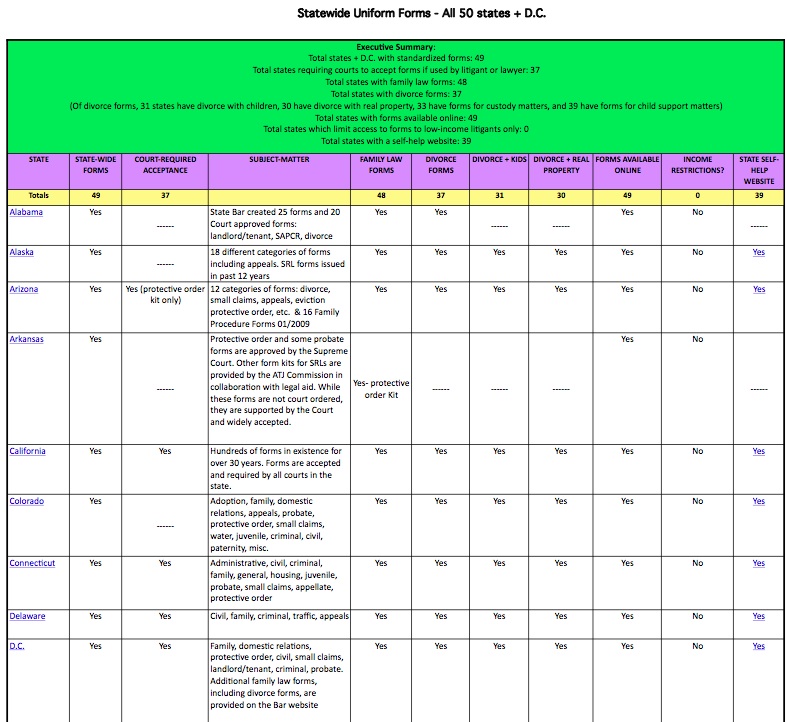
The Texas Access to Justice Commission, during their advocacy for forms in the face of bar opposition, did a wonderful job of surveying states for their availability of forms.  Here is a spreadsheet showing the results.  Here is a snapshot from the sheet:

Here is a link to a pdf version of the information gathered from interviews with 22 of these states.  Again, a sample (text blogged by Carl Reynolds):

Continue reading

Posted in Access to Justice Boards, Forms | Tagged | 1 Comment

Second Judges Journal Article: Towards Best Practices in Complex SRL Cases

I am happy to announce that the Winter 2012 issue of Judges Journal contains the second of my two post-Turner articles.  Here is a link to the full article.  It is titled:

A NEW DAY FOR JUDGES AND THE SELF-REPRESENTED:
Toward Best Practices in Complex Self-Represented Cases 

The new article includes discussion of how judges can handle cases with an attorney on one side, cases with angry or mentally disturbed litigants, as well as complex and jury trials.

The link to the first of the two articles, which deals with less complex situations, is here.

I very much hope that the two papers, particularly when taken together, will help judges deal with these situations in ways that enhance access to justice while maintaining neutrality.  Even more importantly, I hope it will encourage a robust sharing of ideas about how best to provide access in these situations.  I welcome thoughts and ideas, either in Comments, or by email to me.

Posted in Judicial Ethics, Self-Help Services | 1 Comment

Procedurally and Substantively Interesting Right to Counsel Case in Mass

It may be no surprise that the Massachusetts Supreme Judicial Court found a right to counsel in child adoption proceedings in which the adoption is sought by a private party, and the petition is opposed. (Follow this link, select SJC Opinions, and click on the number next to Adoption of Meahan.)

What is interesting is the procedural path that led to this resut, and the way the Mass statute defines the triggering of payment obligations of the state for counsel.

The trial judge appointed counsel (technically the Committee for Public Counsel Services is appointed).  The Committee then sought a Report to the appellate court as whether the appointment was proper, and argued in the state Supreme Court that it indeed was.

What is interesting about this is that the Massachusetts statute, General Laws, Chapter 211D,  Section 5, authorize the Committee to provide counsel when, “the laws of the commonwealth or the rules of the supreme judicial court require that a person in such proceeding be represented by counsel.”

What we are seeing here is the great wisdom of that law (enacted in 1984).  If there is a right, counsel is paid for, end of discussion.  So, if a judge ever ruled that under Turner there was a right to counsel in a particular case, the process of payment (and indeed the source of the payment) is already set up.

How much better a situation than those states in which the public defender is showing nervousness about paying for counsel in expanded situations.

States looking at their structures of entitlement to counsel should look at the Massachusetts model.

Posted in Access to Counsel | Tagged | Comments Off on Procedurally and Substantively Interesting Right to Counsel Case in Mass

Larry Tribe on Colbert Report Tonight

Is there any better an argument (is there any other argument?) for having cable than this.

Larry Tribe on the Colbert Report

From the Colbert News Hub:

To start the week, Stephen welcomes one of the country’s most esteemed legal scholars. Lawrence H. Tribe is the Carl M. Loeb University Professor and Professor of Constitutional Law at Harvard, as well as the recipient of 10 honorary degrees, including one from Hebrew University and another from the Government of Mexico. In addition to his work in the classroom, Tribe continues to practice in court, and to serve in government as the first Senior Counselor for Access to Justice and a member of President Obama’s Commission on White House Fellowships. Obama was Tribe’s student at Harvard, in fact, so the two have a long-time connection.

.  .  .

Tribe is notoriously liberal, so “Stephen” the character might take umbrage with some of his views, I suspect Tribe will be able to handle whatever Mr. Colbert dishes out. Oh yeah—he was also a national champion debater. I had thought he would come on the show to discuss SOPA, the Stop Online Piracy Act, which has dominated the news recently and which Tribe vehemently opposes as unconstitutional. However, the guest announcement on ColbertNation says he’ll talk SuperPac, so I’m hoping we’ll learn more about where Stephen will take his—once the hostage situation is over, of course, and that evil Jon Stewart releases whatever money is left!  *Fist shake*

Update: Now online at this link.

Is there any doubt about who will “win” this debate?

Posted in Dept. of Justice | Tagged | 1 Comment

FLASH: Politico Reporting DOJ Initiative Head Moves to White House as a Deputy Chief of Staff

Here is the Politico story.

It’s surely mixed news.  On the one hard, the DOJ Access Initiative, which has done so much to broaden the sense of possibility for access in Washington, loses a highly effective, well liked, and well connected leader.  On the other hand, access to justice gets a good and very well informed friend at a very high level in the White House.  He will be Deputy Chief of Staff for Planning, which, as I read it, puts him only two (metaphorical) steps from the President.

Lets hope for a speedy appointment of a worthy successor to Childress and Larry Tribe.

Posted in Dept. of Justice | Tagged | 2 Comments

Massachussets Pioneers Economic Benefit Statement

The Massachusetts Legal Assistance Corporation (state granting program) has released a 2011 Economic Benefit Statement.  Key language:

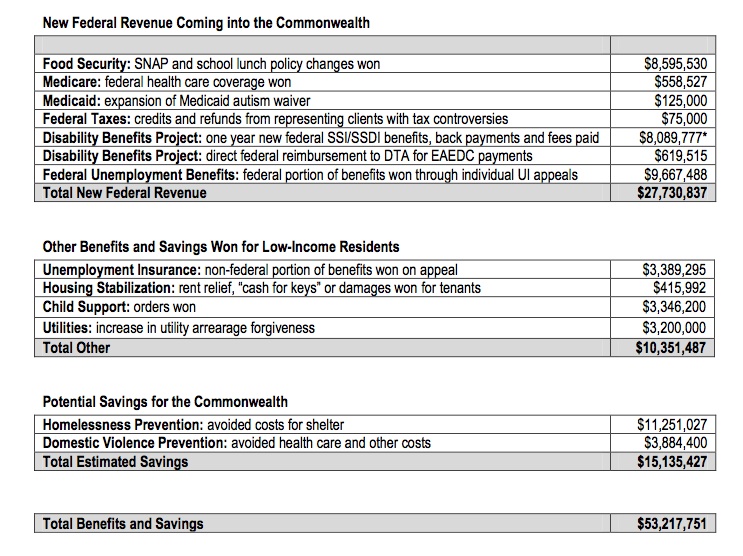
The work of MLAC-funded legal aid programs substantially boosts the Commonwealth’s economy each year by bringing in tens of millions of federal dollars, improving the economic condition of low-income clients and other residents and saving the state millions in avoided benefits and social services. MLAC estimates its grantees’ individual casework and leadership in systemic advocacy in FY11 resulted in at least $27,730,837 million in new federal revenue coming into the Commonwealth over the course of one year and credits its grantees with winning an additional $25,486,914 in income and savings for clients and the Commonwealth, for a total of $53,217,751 million.

Here is the breakdown:

Here are a paragraph giving a sense of the methodologies they used:

Through MLAC’s Medicare Advocacy Project (MAP), three programs, South Coastal Counties Legal Services, Community Legal Aid and Greater Boston Legal Services, represent Massachusetts elders and people with disabilities who have been wrongly denied Medicare coverage for medical services, equipment, hospitalizations, nursing home stays or prescription drugs. In FY11, MAP advocacy resulted in Massachusetts residents being approved for $558,527 of Medicare coverage for medical expenses.

The full paper also includes analyses of economic impact that is not quantifiable.

The important thing about this work is not such much the numbers (impressive as they are), but the sensitivity to documentation that they reveal.

I would encourage every state Commission to take the leadership in building an expanded database that shows the economic benefit of all access work.


Posted in Access to Justice Boards, Budget Issues, Funding, IOLTA | Tagged | 1 Comment

Tool for Translation of Websites Posted by Illinois Legal Online and

Illinois Legal Aid Online and Legal Assistance Foundation have done something very interesting.

Not only have they launched a new Spanish language website, which mirrors their main site, IllinoisLegalAid.org, but to do so, they have created a tool which links their content management site into the Google Translate API, making the process much simpler to manage.  (Obviously the accuracy of the translation is still dependent on that of Google Translate, and checking by an expert is very much in order.)

Ter Ross at Illinois Legalaid Online explains:

The first goal was to integrate the Google Translate API into the statewide website content management system (CMS) in order to develop comprehensive online Spanish legal resources, information, and referrals.  Integrating the free (at the time we started; now paid) Google Translate with the CMS allows content managers to automatically translate existing English legal content into Spanish and other foreign languages, while simultaneously copying all existing metadata, such as jurisdictions and problem codes. It also provides automatic translation of legal services program information in the online legal services directory. Illinois Legal Aid Online utilized a REST-based implementation of Google Translate’s API, to allow for easy expansion of the existing ColdFusion-based CMS with minimal programming. A simple form was added to the CMS that, when clicked by a content manager, sends English content text and all its metadata to Google Translate via the API for immediate machine translation. The translated text and metadata are returned instantaneously to the CMS, which then converts it to a new piece of content. (It appears simple and easy to the content managers, but really there’s a lot going on behind the scenes to parse the data and send it to Google, put it all back together and then feed it into the CMS as a new piece of content.)

They will be working on and issuing documentation for this tool, so that it can be integrated into other document management environments.

To inspire folks, here is their flier:  flier

Posted in LEP, Technology | Comments Off on Tool for Translation of Websites Posted by Illinois Legal Online and

Texas Supreme Court Moves Forward on Forms

Real leadership from the Texas Supreme Court.  Chief Justice Wallace Jefferson has responded to the State Bar’s position on forms with this letter to the President of the State Bar.  Here is the key language:

Continue reading

Posted in Access to Justice Boards, Access to Justice Generally, Forms | Tagged | 2 Comments

Texas Reports on 22 State Research Into Impact of Forms

The Texas forms mess, as so often with such situations, is yielding some useful byproducts.

This data, collected by the Texas Access to Justice Commission, and blogged about by Carl Reynolds, the Administrator of the State Administrate Office of the Courts, is a survey of states with forms, showing conclusively not only that that fears of lawyers about forms are wrong, but that in fact forms are helpful to practitioners as well as the self-represented.

The results of the survey are so important and helpful that I am reporting them in full:

Continue reading

Posted in Access to Justice Boards, Forms | Tagged , | 1 Comment

Carl Reynolds, Texas State Court Administrator, Blogs on Forms Issue

Carl Reynolds, the Administrator of the Texas Office of Court Administration, has posted a blog post on the state bar’s reaction to the forms issue.

It is well worth reading, not only for its substance, but for showing the value of ongoing transparency from court leadership.

Here is some key language, describing the points made in support of the forms proposal:

Continue reading

Posted in Forms, Self-Help Services | Tagged , | Comments Off on Carl Reynolds, Texas State Court Administrator, Blogs on Forms Issue