Judge Fern Fisher Testifies for Court Simplification as Access Solution

This is an important harbinger.  Judge Fern A. Fisher, Deputy Chief Administrative Judge, NYC Courts and Director of the NYS Courts Access to Justice Program, recently testified to a state Access Task Force Hearing about the importance of court simplification as part of the access solution.  New York thereby joins California, with its Elkins Report, (now in the implementation phase; Interim Report) in recognizing that simplifying the system is crucial to accessibility.  Here is the bulk of her testimony, explaining recent advances, and discussing the relevant recommendations of the Task Force on Access: Continue reading
Posted in Court Management, Forms, Systematic Change | Comments Off on Judge Fern Fisher Testifies for Court Simplification as Access Solution

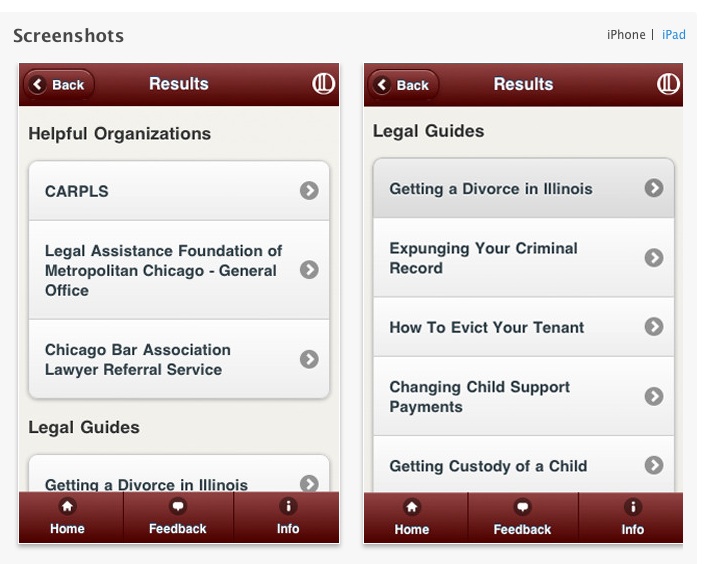
Illiinois LegalAid Online Launches iPhone App

No surprise here, Illinois LegalAid Online remains in the forefront with their iPhone App, downloadable here.

The description is as follows:

A field guide to Illinois law. Made for non-lawyers. Get easy to understand legal tools for issues like divorce, custody, criminal records, small claims, eviction, foreclosure, unemployment, name change, guardianship and more. Plain language legal information includes FAQs, step-by-step instructions and referrals to helpful organizations. This is a handy tool for Illinois families, consumers, workers, tenants, landlords, homeowners and more. Takes the fear out of going to court!

Here is the sample screen shot from the download site.

A challenge to other states — courts and legal aid.

Posted in Mobile Technology, Self-Help Services, Technology | Tagged | 4 Comments

Economist Magazine Joins the Chorus on Court Funding

The Economist magazine is highly respected in the business and conservative intellectual communities.  So it is perhaps an important milestone when it joins the chorus on the damage that underfunding of courts is doing to the social and economic fabric.

The article, in the October 1 issue, talks about backlogs and impact on the economy.  It cites to the recent ABA study, and in a publication more widely read outside the US, will have an additional impact on the way international business looks at the costs of doing business in the US.

Interestingly, for a publication that can focus on the failures of efficiency of government, it does not apply anti-governmental rhetoric to the courts.  This may be an important sign that the business community is coming to realize its stake in functioning courts.  Lets hope that, as in New York, they also realize their stake in access to justice.

Posted in Access to Justice Generally, Funding | 1 Comment

On Apologies — Lessons for Litigants and Administrators

The Washington Post has an interesting article on the success or failure of apologies. Peter H. Kim, associate professor at the Marshall School of Business at the University of Southern California, writes about his research which indicates that whether or not apologies are accepted depends on large part on whether the underlying acts are perceived as intentional or unintentional.  Thus apologies are more likely to be accepted if they can be cast as for acciental acts — including because the actor did not understand the norms that were being violated.  He writes:

Take Anthony Weiner’s apology, for example. It may have fallen on deaf ears because people attributed his sexting as intentional behavior. Meanwhile, Arnold Schwarzenegger’s actions could have been perceived the same way, but they weren’t. Why? Before apologizing, he reframed the offense from a moral deficiency to a matter of social incompetence. (Schwarzenegger said he thought he was just being rowdy and playful, and had no idea the women would be offended.) By claiming a faulty social barometer, he changed the perception of the offense in the eyes of voters, making his apology more successful—at least in 2003.

This may be helpful to litigants, showing both the value of apology and the pointlessness of apology that fails to show how repetition would be avoided.   Examples of those that at least appear to show lack of intent are:  “I did not understand the Court’s order.”  “I did not know that the kids had to be back by 5 PM.” (Interesting, this example underlines how important it is to explain the order in detail, including in all its implications, and to obtain confirmation of understanding, thereby making future “false” apologies less credible.)

For administrators, this distinction also underlines the value of transparency.  If you explain how a mistake happened, people are much more likely to believe that you have analyzed it, and taken steps to avoid its repetition.  After all, everyone makes mistakes, the search is not for people who never make mistakes, it is for people who fix them and go on to use the experience to prevent them.  (Actually, since so much of the legal system is about blame, it may be that our culture is least well prepared for this approach on an institutional basis.)

Posted in Court Management, Judicial Ethics, Science | Comments Off on On Apologies — Lessons for Litigants and Administrators

New York Continues Hearing Process for Access Funding — Lessons for Us All

As you know, this blog has previously drawn attention to the unusual  success of New York Chief Justice Jonathan Lippman in increasing access to civil legal services.  His approach, described in detail in our NewsMaker Interview, is to have groups not traditionally viewed as advocates for legal aid, such as banks and hospitals, take the lead and speak up at hearings throughout the state on the need for, and benefits of, access funding, particularly in the toughest times.  This is an usual approach, and highly successful.

Now New York is conducting a new round of hearings.  The link already includes video of the first two, already completed hearings.  The link will allow anyone to watch future hearings live.

Those testifying have been asked to address the following:

  • The particular types of situations or cases in which current civil legal services needs are unmet and their magnitude.
  • The categories of individuals whose unmet legal needs currently are especially critical.
  • Data on the impact of the economic downturn on sources of funding for civil legal services.
  • Impact on courts of increasing numbers of unrepresented litigants.
  • The economic and social harm to the community (direct and/or indirect) when critical legal needs are unmet.
  • The economic and social benefits to the community when such needs are met

More information on the Task Force to Expand Access is here.

UPDATE;

The witness lists for the first two hearings are below the fold. Continue reading

Posted in Access to Justice Boards, Access to Justice Generally, Funding | 1 Comment

British Columbia Leaflet on Preparing for an Interview with a Lawyer

This leaflet is an interesting model, prepared for litigants in the Supreme (i.e Superior) Court of BC.

Titled “A Guide to a Successful Interview with a Lawyer” the leaflet includes a step by step process for preparing for an efficient and productive meeting between lawyer and client.  It is designed for use in both paid and legal aid cases.

The leaflet includes:

Step 1: Fill out the Information  Sheet

Step 2: Prepare your Document List

Step 3: Prepare your written statement

Step 4: Going to the interview

I am particularly impressed with the suggestions of the preparation of a document list, nd of a written statement prepared prior to the interview.  The leaflet also makes excellent suggestions as to how a client can best explain his/her situation to an attorney.

The leaflet is copyright 2010 Community Legal Assistance Society.

Posted in Attorney-Client | Tagged | Comments Off on British Columbia Leaflet on Preparing for an Interview with a Lawyer

NewsMaker Interview — Fred Rooney on the CUNY Incubator

Today’s Newsmaker Interview is with Fred Rooney at CUNY Law School.  He directs CUNY’s Community Legal Resource Network (CLRN) and, along with Sue Bryant, created the Incubator for Justice program, which helps law gradates transition to economically viable solo and small practice.  The Incubator also has been home to two startup not-for-profits.  As you know, I think this is a very important model for the future, one of the very few that offers some real hope for change in the profession. Continue reading

Posted in Law Schools, Middle Income, Mixed Model, Newsmaker Interview | Tagged , | 2 Comments

Judge Kevin Burke, New President of American Judges Association, Now Blogging

Many of you have heard Judge Burke (Wikipedia entry) speak forcefully and movingly about the need for access to justice and the role of courts in making sure it is provided.  Judge Burke was one of the first judges in the nation to understand and communicate the relationship between access to justice and public trust and confidence.

So this is two great pieces of news in one.  As the new President of the American Judges Association, he will be able to encourage broad thinking in the judiciary and beyond.  Moreover, his new blog will be a focus of innovative and challenging thinking.

Most recently, for example, on the blog, he has shared the fascinating (and rejected) proposal by Wisconsin Chief Justice Shirley Abrahamson, another strong friend of access, that court conferences should be open to the public.

Judge Burke also shared my blog on the relationship of glucose and judging.  One judge commented delightfully: “I’ve got a 3-inch thick summary judgment motion sitting in front of me to the left. To the right is a thick slice of chocolate cake from one of my colleague’s birthday celebration today.  Sounds like I may have hit on a winning combination to ensure a just and wise decision this afternoon!

Posted in Access to Justice Generally, Judicial Ethics, This Blog | Tagged , | 1 Comment

California Courts Seek Comment on Draft Principles on Technology and Access to Justice

In an important development for the interaction of technology and access to justice, the California Court system is developing a document titled: Advancing Access to Justice Through Technology: Principles for Judicial Branch Initiatives.  It is intended for ultimate approval by the state’s Judicial Council.  A draft is now out for public comment at this link.

The Principles in the current draft proposed by the state’s Court Technology Advisory Committee are as follows:

1.    Ensure Access and Fairness. Use technologies that allow all court users to have impartial and effective access to justice.
2.    Include Self-Represented Litigants. Provide services to those representing themselves and those represented by attorneys.
3.    Preserve Traditional Access. Retain conventional means of access to courts for persons challenged by technology.
4.    Design for Ease of Use. Build services that are user-friendly and widely available. 5.    Provide Education and Support. Develop and roll out training and support for all
technology solutions, particularly those intended for use by the public.
6.    Secure Private Information. Design services to comply with privacy laws and to assure users that personal information is properly protected.
7.    Provide Reliable Information. Ensure the accurateness and timeliness of information provided to judges, parties, and others.
8.    Protect Legal Rights. Define remedies to guarantee that users do not forfeit legal rights when technologies fail or when users are unable to operate systems successfully.
9.    Improve Court Operations. Advance court operational practices to make full use of technology and, in turn, provide better service to court users.
10. Plan Ahead. Create technology solutions that are forward thinking and that enable courts to adapt to the changing expectations of the public and court users.

Each proposed principle is accompanied by extensive discussion.

That California is now considering such a step is an important evolution in making sure that technology is used to improve access to justice.  Some readers of this blog will recall that as far back as 2004 the Washington State Supreme Court, by Court Order, adopted that state’s own Access to Justice Technology Principles.  (Those seeking to comment might find the Washington Principles a stimulus to thought.)  Moreover, an issue of the Washington Law Review was dedicated to issues relating to those Principles.

Information on how to comment on the California draft, to be submitted by October 28, 2011, is here.

Posted in Access to Justice Generally, Self-Help Services, Systematic Change, Technology | Comments Off on California Courts Seek Comment on Draft Principles on Technology and Access to Justice

Martha Minow Talks About LSC Strategic Planning Process, TIG, etc.

This is encouraging.  Martha Minow, Vice-Chair of the LSC Board (as well as Dean of Harvard Law School), was recently interviewed by Spindle Law blog.  Some questions were about LSC.  Here is that exchange in full (look particularly at the bottom for a remark about TIG):

Spindle LAW: You are Vice Chair of the Legal Services Corporation. What does LSC do and what are some of the challenges it is currently facing?

Minow: The board members were appointed in 2009, by President Obama.  As board members, we walked into a situation of dire challenges for civil legal services across the country.  Legal services are facing not just cuts in federal funding, but decreasing IOLTA funds, as well as tight state and local budgets. At the same time, we see an exploding need among people for legal assistance: medical problems, foreclosures, employment and layoffs, violence, and more. State courts are in trouble as well given strained state budgets. Even for a pro se litigant, the question is whether there are clerks at the courthouse who can assist him or her through the process.

I’ve had the opportunity to work in places in the world coming through major political and governmental transitions.  One thing I’ve learned through that experience is that if you don’t have a functioning judicial system, and a legal system that’s perceived to be fair and running well, it can really jeopardize the stability of society.  Access to justice is fundamental, and obstacles to justice can undermine the people’s trust in the system in ways that threaten democratic stability.

Spindle Law: What is LSC doing to meet some of these challenges?

Minow: LSC is in a planning process as we speak. We’re looking to increase technology innovation grants, and ways for organizations to develop programs that can be duplicated by others, sharing limited resources. A good example is the Veterans’ law web resource developed by Pine Tree Legal Assistance in Maine.

Posted in Funding, LSC, Technology | 1 Comment

Comcast Offers Low Price Internet to Families That Get Free School Lunches

Comcast has launched a $9.95 a month broadband service (plus taxes) called Internet Essentials for families with a child who gets free school lunches (those who get partially subsidized lunches do NOT qualify).  Here is the PC World description of the program.

Those qualifying get the Internet access, without additional equipment charges, a coupon that gets them a computer for $150, and an Internet security package, as well as training options.  They promise no price increases (i.e. this is NOT a six month teaser.)  The FAQ promises that new enrollees will be allowed for three years.  As to speed: “Internet Essentials provides home Internet service with download speeds of up to 1.5 Mbps and upload speeds of up to 384 Kbps.

The number to call to get the application materials is 1-855-8-INTERNET (1-855-846-8376).  Outreach partners can connect here.

Thanks to Lisa Colpoys of Illinoislegalaid.org, for pointing this resource out.

Posted in Poverty, Technology | Comments Off on Comcast Offers Low Price Internet to Families That Get Free School Lunches

Esther Lardent Calls for Triage, Simplification and Trained Non-Lawyer Assistance

Ester Lardent is one the most thoughtful pro bono (and indeed access) leaders.

It is very encouraging to see her endorse triage and simplification in a recent opinion piece in the National Law Journal and available on Law.com.

 Triage and simplification. The growing trend toward self-representation in legal matters has created enormous burdens for the courts and may, absent quality-control measures, result in bad outcomes and bad law. We need an effective triage system — one that diagnoses clients’ legal problems and determines the best and least costly legal intervention. For some clients and matters, that will mean brief service and advice, education about legal issues and rights, pro se representation, mediation and negotiation, unbundled legal services or nonlegal assistance; for others, full representation with zealous advocacy by a lawyer. At present, we fail to distinguish the nature of the need and the optimal and practical legal process; given the crisis in resources, we cannot continue to do so. And, we must accept the fact that our justice system, as currently configured, is far too complex and adversarial. We need to simplify the law, delegalize those matters that are not best dealt with in a courtroom setting, and admit that, in appropriate matters, trained nonlawyers can provide effective assistance.

The bulk of the article deals with changes to pro bono, and is also very much worth a careful read.

Among her other reflective and innovative proposals:

  • Voluntary plus” pro bono
  • Law student pro bono.
  • Pro bono as a criterion for leadership.
  • Revise ABA Model Rule 6.1 (to narrow the definition of pro bono)
  • Bar association (financial) contributions
  • Make pro bono reporting meaningful

It may be that there are particular roles for pro bono in a triage system.  For example, retired judges might be involved in the approval of diagnostic triage decisions about who needs an attorney.

Various forms of unbundled services (as diagnosed in a triage system) may be particularly appropriate for pro bono attorneys unable to make large time commitments.

Law students (as generally suggested by Esther) may be well positioned to provide informational services, particularly when backed up by technology content.

So its particularly good for the pro bono community (and a highly respected leader in it) to be joining the triage discussion.

Posted in Pro Bono, Systematic Change, Triage | Comments Off on Esther Lardent Calls for Triage, Simplification and Trained Non-Lawyer Assistance

Can Courts be “Cosmopolitan Canopies?”

The Washington Post has a nice article today about the concept of “Cosmopolitan Canopies,” places where diverse people can come together and interact.  The idea is explored in a book by Yale Professor Elija Anderson, called The Cosmopolitan Canopy, Race and Civility in Everyday LifeThe Post quotes Anderson as follows: 

Anderson describes these locations as spaces that permit people from homogenous communities to observe and learn about people from different backgrounds. Such settings also offer people an oasis from the turf tensions in gentrifying neighborhoods and competitive workplaces.

The Post article describes one such place we have enjoyed with our grandson, near where some of our family lives, as follows:

On hot sunny days, small children of all hues splash and squeal in the fountain in the center of the Columbia Heights shopping complex [in DC], while watchful parents exchange smiles and small talk.

So, here is my thought:  what can we do to make courts “Cosmopolitan Canopies?”  I have certainly enjoyed watching self-help centers where there is a general feel of people helping each other, not just staff helping litigants.  On the other hand, people visiting courts are under tension — that may make some people more helpful, but others less open to helping or being helped.  (I was particularly struck by the Post article’s description of shoppers introducing each other to their foods in stores that serve as “Cosmopolitan Canopies.”  “Like the time [a woman] was picking over the avocados when a Jamaican man standing next to her offered advice on how to choose the best ones.

Maybe one simple start would be to make sure that court cafeterias offer foods from different cultures.  Maybe progress on LEP issues, including multi-lingual and cultural materials will expand the sense of friendliness to all cultures, and the sense that the courthouse is “home” to all races and ethnicities.  Maybe displays of culturally diverse community resources will help.  Maybe making sure that the design of the courthouse fosters interaction between litigants would help in this and other ways.

Anyway, please offer thoughts as to how the courthouse can be made a friendly and sharing place for all.

Posted in LEP | Tagged , | Comments Off on Can Courts be “Cosmopolitan Canopies?”

Questions and Answers About the Attorney Diagnosis Proposal

Recently, I blogged about what I called the “Attorney Diagnosis” approach to Triage for Access to Justice.  I believe that Turner may require not necessarily this, but at least some system that decides who needs what in terms of services to ensure a fair and accurate result.

The core idea in this approach is that following a preliminary review for financial eligibility and to determine if the matter is contested, a screening attorney would make a recommendation for or against appointment of counsel, taking into account the nature of the case, the merits and the stakes for the litigant.  An appropriate decision maker such as a retired judge would make a final decision.  In cases in which counsel is not provided, the attorney would provide unbundled services, or refer the person elsewhere for unbundled services or self help, thus ensuring that lower-cost forms of assistance would be provided.

At the time, I promised a more detailed development in Q and A format.  Here it is:

Continue reading

Posted in Access to Counsel, Access to Justice Generally, Legal Aid, Research and Evalation, Systematic Change | Tagged , | Comments Off on Questions and Answers About the Attorney Diagnosis Proposal

Jim McMillan Blogs on E-Filing and the Self-Represented

Jim McMillan of NCSC’s Court Technology Bulletin blogs today on his Rule 6 for e-filing.

E-Filing Must Support the Self-Represented

The whole post is very valuable, but here is some of the key language:

So how are states going to mandate E-filing when a majority of their cases include the self-represented?  The answer of course is to provide online capabilities that are designed for the self-represented.  These capabilities should include first guided forms for data capture (for example see www.a2jauthor.org and Minnesota’s I-CAN! court forms http://www.mncourts.gov/ican).  Many courts unfortunately currently only allow self-represented litigants to generate the paper forms with these systems.  However a few do “save” the data so that it can be automatically transferred and entered into their CMS/EDMS when the litigant appears at the court and submits their signed paper copies and/or fee payment.  An excellent example of a fully electronic online filer/response system has been built by the UK Courts in their Money (Small) Claim Online system.

Jim also discusses signature and verification issues in this post.

Posted in Forms, Technology | Tagged | Comments Off on Jim McMillan Blogs on E-Filing and the Self-Represented