Civil Justice Council of England and Wales Report and Recommendations on Self-Represented Litigants

As reported by Richard Moorhead, the Civil Justice Council has issued its report on how to respond to the increase in self-represented litigants expected in England and Wales as a result of the massive legal aid cutbacks.

The recommendations, as summarized in the press release, will be astonishingly familiar:

1. Improving the accessibility, currency and content of existing online resources;

2. Producing a ‘nutshell’ guide for self-represented litigants (SRPs);

3. Improving judicial and court services for SRPs;

 4. Advice for judges on the availability of legal pro bono services;

 5. Guidance for court staff when dealing with SRPs;

 6. Guidance for legal professionals, and what SRPs can expect from lawyers;

 7. Notice of McKenzie Friends; these are people who volunteer to assist unrepresented  parties. (Editor’s Note:  This concept, unknown in the US, will be the focus of a future post)

 8. Introducing a code of conduct for McKenzie Friends;

 9. Freeing up in-house lawyers to provide pro bono services; and

 10. A call for leadership from major advice and pro bono agencies across England and Wales to drive collaboration.

The report also makes medium term recommendations:

a) A systematic review should be undertaken of court leaflets, forms and information, involving consultation with experts in the field;

 b) Making a primary website available that pulls together and maintains the best independent guidance;

 c) Increasing the number of courts that offer Personal Support Units and information officers to assist SRPs;

 d) Producing a user-friendly guide to the Small Claims Court;

 e) Improving access to legal advice;

f) Developing Law works early electronic advice for SRPs and agencies;

 g) Finding new means of funding the administration of pro bono and other voluntary legal services;

 h) Offering surgeries and after-hours court information sessions for SRPs;

 i) Keeping records of numbers and circumstances of SRPs, and ensuring court user committees address their needs; and

 j) Reviewing the question of access to appeals after refusals by a judge on the ‘paper’ application.

Longer term recommendations were as follows:

 1. Developing arrangements for mediation and early neutral evaluation when SRPs are involved in a case;

2. Developing Public Legal Education;

3. Further developing pro bono advice and assistance;

4. Research-based improvements to the small claims process; and

5. A study of other forms of procedure for SRP cases e.g. holding hearings in community centres, capping costs.

Posted in International Models, Self-Help Services | Tagged | 2 Comments

Karen Lash of DOJ Access Initiative Keynote to Rothgerber Conference

Access beacon and energizer Karen Lash of DOJ gave the keynote last weekend at the wonderful Rothgerber Conference, TOWARD THE CONSTITUTIONAL RIGHT OF ACCESS TO JUSTICE: IMPLICATIONS AND IMPLEMENTATION organized by Melissa Hart for the University of Colorado Law School.  The keynote was so moving, powerful, and energizing that I asked permission to post it on this blog, and now here it is.  Please share, both as a moving reminder of what can be done, and as a guide to the DOJ Access Initiative’s focus, direction, and activities.

Continue reading

Posted in Access to Justice Boards, Access to Justice Generally, Dept. of Justice, Law Schools, Meetings | Tagged | 2 Comments

A Revolutionary Idea — Calculating Legal Aid Grants Based on Customer Satisfaction

The NY Times has a fascinating article about how Medicare reimbursement for hospitals is going to be in part calculated on patient satisfaction.  As explained in this government factsheet, this is part of a broader initiative to incentivize a range of measures of care, including objective ones.

The impact on hospital planning and operations is apparently significant.  As the article explains:

The ratings are based on Medicare-approved surveys, which hospitals hire companies to give to a random selection of patients after they are discharged. Some surveys are given by phone, others by mail. All ask the same questions: Did the doctors and nurses communicate well? Was pain well controlled? Was the room clean and the hospital quiet at night? The surveys go to younger patients as well as Medicare beneficiaries.

The article includes examples of both positive changes, such as improved staff training, but also attempts to improve perceptions, rather than the underlying performance:

In Connecticut, Bridgeport Hospital improved some of its lowest scores in its maternity unit after delivery nurses began telling patients how great the postpartum nurses are, said Eileen Callahan, the nurse manager for the maternity unit.

When the mothers and their babies are brought out of the delivery room, “the postpartum nurse greets them at the desk and starts the ‘oohs’ and ‘ahhs,’ and how lucky they were to have the nurse in the delivery,” Ms. Callahan said. She said initially there was “some hard swallowing going on” during exchanges for nurses who did not like each other. Ms. Callahan said she bases a portion of her nurses’ annual reviews on how well they followed these patient transfer practices.

Forgetting for a moment the questions that last practice might raise, just suppose that LSC and/or IOLTA programs found ways to use customer satisfaction surveys to allocate grants (there are ways that could be done even within a census formula driven system — funders could, for example, require for low scoring programs that portions of the budget be allocated to satisfaction-improving programs.

It could be a major cultural change.  The problem now is that with the need overload, there is just no incentive to worry about client satisfaction — in fact, today courts are far more likely to measure client satisfaction than legal aid programs.

Posted in Legal Aid, Medical System Comparision | Tagged | Comments Off on A Revolutionary Idea — Calculating Legal Aid Grants Based on Customer Satisfaction

Implications of Alternative Poverty Measure for Access to Justice

The Census Bureau has rolled out the results of applying its alternative measure of poverty to 2010.  This alternative measure, which will not be used to calculate benefits, is being offered as an aid to policy makers.

The results have obvious implications for access to justice programs and planning.  As reported by the New York Times:

The new assessment was developed primarily to give policy makers a sense of the effect that social safety-net programs are having, said Kathleen Short, a Census Bureau official who presented the measure on Monday at a conference at the Brookings Institution. It also includes costs like child care, out-of-pocket medical expenses and taxes, which erode income for those above the poverty line, greatly expanding the ranks of the near poor, whom the safety net does not reach.

More specifically:

  • A smaller number of children are reported in poverty (3.2 million reduction, not an insignificant number),
  • More seniors are reported in poverty because of medical costs,
  • The number of people in the 100% to 200% of poverty group is very high — it is now one third of Americans! (Adding the 16% in poverty, that means that almost half get less than 200% of the poverty level.)
  • The number of people who earn less than four times the poverty level rose — is is now 83% of the population (that would be $93,373 for a family of four).

While LSC regulations (Section 1611.5) provide some flexibility in taking into account unusual costs and circumstances, these numbers highlight the importance of programs having structures in place that take advantage of this flexibility.

The increasing numbers of low resourced middle income people similarly highlight the ever-growing need for programs that serve this population, either for free, or through innovations that reduce costs such as unbundling or law school incubators.  Indeed, I am coming to believe that the creation of market and modified market strategies for meeting middle income need is critical for access to justice, and that our failure to do any more than middle at the edges is at the core of the access failure.  We forget how many people move between poverty and middle income status.

I would particularly urge access commissions to look at the implications of these numbers for their overall state plans.

(Irrelevant proud parental disclosure — my stepson, Arloc Sherman, of the Center for Budget and Policy Priorities, is quoted in the NYT article.)

Updating Note:  Because of an editing and layout error, it was not necessarily fully clear in the initial version of this post (which was distributed automatically by e-mail) that the italicized material is a direct quote from the New York Times.  We apologize for the error.

Posted in Access to Justice Boards, Access to Justice Generally, Mixed Model, Poverty | 1 Comment

NewsMaker Interview: Prof. Jim Greiner on the Latest Offer-Outcomes Research and its Implications

This blog is proud to be interviewing Professor Jim Greiner of Harvard about his latest research, conducted with Cassandra Wolos Pattanayak and Jonathan Hennessey, into the impact of offers of representation on outcomes.  The research is summarized in a recent post, and I will not repeat the summary here, except to say at the grossest level that one study showed very dramatic impacts from offers of representation, and another, applying the same law, but in a different court, representation and client pool selection environment, showed little if any.

The research, as always, raises as many questions as it answers, so lets get going, starting with the obvious major potential conclusions.

Continue reading

Posted in Access to Counsel, Legal Aid, Research and Evalation, Triage, Unbundling | 3 Comments

Pro Bono Specialization — With Esther Lardent’s Comments

Here at the Rothgerber Symposium in Denver, Jim Greiner of Harvard, has made an interesting suggestion about pro bono.  He has suggested that larger firms, rather than just working to maximize pro bono hours, should specialize in certain pro bono substantive areas, making sure that the representation is of the highest quality, and has the greatest impact.

There are several obvious arguments in favor of such an approach. One is the emerging evidence that just providing representation is not necessarily enough.

Another is the argument that specialization would be consistent with the firms’ commitment to uniqueness and quality in their market-based practice.  (Maybe some firms would worry about being identified with certain types of issues or clients.)

Such a role for pro bono firms might help fill the still existing gap in the delivery system created by the defunding of the old legal services back-up centers, with the firms taking on leadership in creation of briefbanks, model pleadings, networking, advocacy theorizing, etc.

Note moreover, that this idea might be considered as part of the process of reconsidering pro bono that is taking place.

Update:  Esther Lardent Comments:

We developed the concept of “signature projects” for law firms more than a decade ago and have worked with countless large firms to develop, implement, and enhance these projects.  I’ve attached “Ten Elements of Signature Projects” as an example of what we have done to introduce the concept which is quite widespread among firms.  Also, I do not believe that it is feasible for larger firms to focus on only one area of law – attorney interest, local needs and availability of pro bono work, among other factors – make that approach far too limiting, but what we do encourage is firms going deep in one or two areas on a firm wide basis to develop expertise and secure better and systemic solutions.

Here is an extract from the article linked to above:

Benefits to law firms and legal departments

*Experience to date indicates that signature projects
generate substantially higher pro bono hours/percentages;
*They also typically result in broader pro bono partici- pation, particularly among harder-to-recruit lawyers, such as partners and transactional lawyers;
*They promote teamwork, across practice groups, levels of seniority and among offices;
*They increase the visibility of pro bono within the firm or department;
*They enhance morale and esprit de corps;
*They can be the source of wonderful publicity and media coverage;
*They offer an efficient vehicle for firms/departments to acquire pro bono expertise;
*They permit law firms/legal departments to more easily and effectively assess the impact of their pro bono work and the difference that work has made;
*They are highly attractive to legal departments and can form the basis of effective partnerships between law firms and these departments;
*For legal departments, signature projects that add a legal dimension to an already existing company charitable/ voluntarism focus permit greater interaction with other company leaders that demonstrates the added value of legal work;

Thanks to Esther Lardent.

Posted in Pro Bono | Comments Off on Pro Bono Specialization — With Esther Lardent’s Comments

Is San Franciso Thinking of a Right to Counsel, or a Right to Diagnostic Triage?

An interesting idea.  According to the SF Chronicle, the City Council will soon be considering a “right to counsel.”  The article starts this way:

San Francisco would offer eligible low-income litigants involved in custody battles, tenant-landlord disputes and other civil cases access to free legal counsel — a constitutional right now reserved for criminal defendants — under legislation that three supervisors will formally introduce today.

If the idea is approved by the Board of Supervisors, San Francisco would be the first city in the nation to become a “Right to Civil Counsel City.”

The debate over whether to establish a right to civil counsel already has been under way in several states.

The San Francisco proposal calls for for creating a one-year experiment in which private-sector attorneys would volunteer their time to represent clients in civil proceedings. The city’s involvement initially would be limited to funding one employee to serve as project coordinator.

Sure sounds like Civil Gideon — but then it turns out to be something much more practicable and potentially realistic.

The onus would be on the court to determine, on a case by case basis, whether pro bono legal services are warranted. Those involved in crafting the program still must set up a system to determine which cases would be eligible and get priority.

Not everyone who needs representation, or who could benefit from it, would be assigned an attorney. At least not at the beginning.

The proposal, if approved, would not enact a right to counsel in civil proceedings right away. “But rather it is a codification of the beginning of a firm commitment to this eventual goal,” said Supervisor David Chiu, chief sponsor of the proposed ordinance. Supervisors Jane Kim and Scott Wiener  signed on as co-sponsors.

The Lawyers Committee for Civil Rights and the Bar Association of San Francisco support the concept and will work to line up pro bono attorneys to participate.

In other words, people would be screened by the court for the urgency of representation needs, the newly funded staffer would coordinate the program, and the bar would help find free lawyers.  Now, SF has one of the very best resourced access to justice systems in the country, so the idea of sufficient services being provided through re-organization of those resources is not crazy.  And it would be a wonderful opportunity to test a court-based system of diagnostic triage.  See my prior proposal.

Posted in Access to Counsel, Systematic Change, Triage | Tagged , | 1 Comment

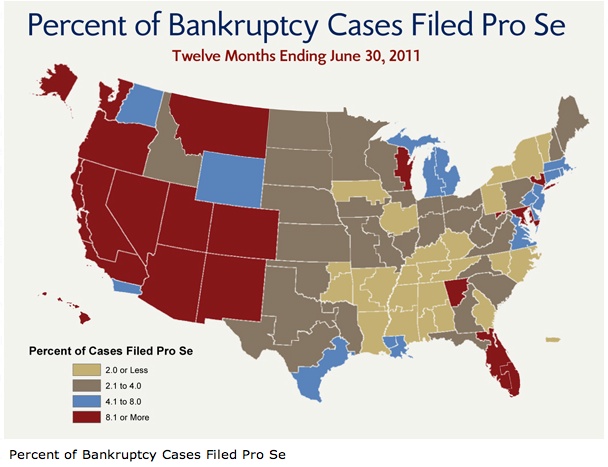
Distribution of, and Increase of, Self-Represented Bankruptcy Filings

The Third Branch — the blog of the Federal Courts, has published some statistics on where their self-represented bankruptcy filings are occurring.

Here is the key table:

The filings are heavily distributed towards the West:


It is an astonishing range, from 27% in the Central District of CA, to under 2% in some states.  It makes me think that the differnce is explained more by bar and court cultures than by economic differences.

Moreover, the self-represented percentage is up very significantly overall:

[W]hile non-pro se bankruptcy petitions increased 98 percent over the last fi ve years, pro se bankruptcy petitions grew 187 percent over the same time frame.

Posted in Research and Evalation, Self-Help Services, SRL Statistics | Comments Off on Distribution of, and Increase of, Self-Represented Bankruptcy Filings

General Study of Impact of Regulation Upon Occupations.

Richard Moorhead, perceptive as usual, has noticed a recent study conducted in the UK of the impact of regulations of occupations, done for the UK Commission on Employment and Skills, and titled A review of occupational regulation and its impact.  The authors are John Forth, NIESR; Alex Bryson, NIESR; Amy Humphris, LSE; Maria Koumenta, Oxford Brookes University; Morris Kleiner, University of Minnesota.  Richard Moorhead has pulled this quote — highly apposite to those of us in the US:

“The overall conclusions from the US studies on the impact of licensing are that, in general, occupational licensing increases the wage of licensed workers, reduces employment growth and raises the price of goods or services but without overall improvements in the quality of service or product offered. The magnitude of the effects vary by occupation and location.”

Here is the para on US studies of the impact of licensing upon price.

Price effects of occupational licensing in the US
Most studies of the influence of occupational licensing policies, on the price of the occupation‘s service in the US, find a positive relationship (see Cox and Foster, 1990; Kleiner 2006), albeit sometimes with no improvement in quality. These include recent studies by Kleiner and Todd for mortgage brokers, which indicate higher prices for mortgages with no influence on quality (Kleiner and Todd, 2009). The existing studies cover policies ranging from restrictions on interstate mobility, such as by limiting reciprocity, to restrictions on advertising and other commercial practices (Shepard, 1978; Bond et al., 1980; Kleiner et al., 1982). A review of empirical research on licensing found that licensing is associated with consumer prices that are four to 35 per cent higher, depending on the type of commercial practice and location (Kleiner, 2006). Kleiner and Kudrle (2000), for example, found that tougher state level restrictions and more rigorous pass rates for dentists were associated with hourly wage rates. These were 15 per cent higher than in states with fewer restrictions, with no measurable increase in observable quality. Similarly, Barker (2007) found that higher state educational standards for real estate brokers raise broker income without improving the quality of service. (Footnote omitted.)

I’d go with more than 35% for legal pricing myself.  Obviously this data does not conclude the debate about legal licensing by any means, but it is useful to have general confirmation of some areas of its impact.

I also find fascinating this table on percentages of workers at different educational levels are subject to licensing requirements.  It suggests, in support of licensing, that higher skill and knowledge occupations are much more subject to licensing, and that the bar is far from alone among the more highly educated occupations in requiring licensing.

Presumably, if such regulation has these impacts, then the “strong” monopoly of the bar in the US, and the high barriers to entry, should be combining to result in very significant increases in costs.  The question is whether a more nuanced regulatory system would provide the needed consumer protection without imposing such high consumer downsides, and such burdens on access.

Posted in Law Schools, Legal Ethics, Middle Income | Tagged | Comments Off on General Study of Impact of Regulation Upon Occupations.

Academic Paper on Turner v Rogers Issues Challenge to Advocates

This paper may be the first academic treatment of Tuner.  It is part of the University of Pennsylvania Law School Public Law and Legal Theory Research Paper Series, and of the University of Tennesse, Knoxville, College of Law Legal Studies Research Paper Seriesand titled Triaging Appointed-Counsel Funding and Pro Se Access to Justice.  It is by Professor Ben Barton and Professor Stephanos Bibas.

Its core thesis (on pages 3-4 of the paper as posted) is as follows:

Though Turner upset many civil-Gideon advocates, we should not lament the decision but (mostly) praise it.    In rejecting a broad new constitutional right, the Court steered toward more sustainable pro se reform. The Court’s solution is far more realistic than a grandiose new right to counsel would have been. Funding for counsel is scarce; existing lawyers are already overtaxed; and appointing civil lawyers would siphon time and resources from more important, more complex felony cases. In a world of scarcity, legislatures, courts, and legal-aid organizations need flexibility to triage cases. Both the Constitution and sensible policy thus reserve appointed counsel primarily for criminal cases. Any appointment of counsel in civil cases must be selective and discretionary, reserved for the most complex and most meritorious cases. Less-expensive pro se court reform is far more workable; giving everyone a lawyer is an impossible dream. Turner was not explicit about the importance of resource constraints, but its rule makes much more sense in a world of limited funds.

Properly handled, pro se court processes can be cheaper and fairer. Extraordinarily, the Court noted that appointing counsel in these cases could make the proceedings “less fair overall” and introduce unwarranted “formality or delay.” Though that observation is a matter of common sense, over the past eighty years the Court has always praised lawyers’ role in guaranteeing just procedures. Turner’s changed tune reflects a more mature, more nuanced view of lawyers and complexity in our adversary system. If Turner helps to spur new, simpler, and fairer pro se court processes, everyone will benefit (footnotes omitted).

Addressed mainly to the civil Gideon community, the paper urges an appreciation of the opportunity Turner offers to embrace a broad variety of access solutions.  Implicit in the analysis is the need for courts to meet sufficient due process standards of accuracy and fairness.  The paper also recognizes that civil Gideon advocates will find much in the decision to support the argument for a right to counsel in certain situations.  Urged throughout is the need for realistic triage of what situations are in need of the more costly full representation solution. It implicitly raises for the future the toughest question — how is that to be done at both the categorical and the individual level?

Posted in Access to Counsel, Supreme Court, Triage | 2 Comments

Tools to Create an Unbundled-Orriented Lawyer Referral Service

The time is long past for every jurisdiction that allows unbundling — and of course now most do, to have such services available through lawyer referral and information services, ideally through a panel of the existing lawyer referral system.  Lets face it, thats where the clients without lawyers enter into the system, and it is hard to understand why more LRIS do not offer this crucial affordability tool, particularly given the poll data on the public’s interest in exploring the option.

So it is important to draw attention to these LRIS Unbundling materials developed to assist in the creation of such a panel. (Remember, of course that state law governs as to who is allowed to operate such a lawyer referral service.)

The materials come to you courtesy of Sue Talia and the Contra Costa County Bar Association.

They include ideas for making the argument for limited scope LRS services, recruiting and training panelists, application form, additional resources for panelists, training intake staff, intake checklist, materials for clients, program marketing, program monitoring, sample client satisfaction survey, model client marketing handout, model attorney marketing handout.

Here is a link to more materials from the ABA Standing Committee on Lawyer Referral Information Service, including a link to the materials from Contra Costa.

Lets hope that more LRIS rise to this challenge, and  that more unbundling advocates urge them to do so.

Posted in Middle Income, Unbundling | Tagged | Comments Off on Tools to Create an Unbundled-Orriented Lawyer Referral Service

SJI Issues Grant Guideline — Suspends Priority Areas, Changes Scholarship Program

SJI has issued its new FY 2o12 Grant Guideline.

The important news, as summarized in the current SJI E-News is as follows:

Special Interest Categories: Project Grants, SJI has temporarily suspended, any prioritization on special areas of interest. The SJI Board will continue working to further encourage innovative ideas, as well as the exploration, adaptation, and improvement of policies impacting the state court community. Applicants should focus on how their project not only impacts their courts and stakeholders, but also addresses national court issues.

This seems like good news, suggesting that under the new Board both that SJI is systematically planning for the future and that they will continue to put a focus on national court issues.  It would seem an encouraging message for those innovating in a wide variety of areas.

The next practicable deadline (one is this week) is February 1, 2012.

Note also that the former scholarship program has been changed and is now called Education Support Program, described here.

Beginning October 1, 2011, SJI will support the enhancement of skills and knowledge through training and education by awarding funds to individuals through the Education Support Program (ESP). ESP differs from the scholarship program in several ways, most notably in the maximum amount of an award and approved use of the award.

ESP awards are for full-time judges of state, trial, and appellate courts; full-time professional state or local court personnel with management responsibilities; and supervisory and management probation officials in judicial branch probation offices, in the amount of $1,000 for tuition only. Conferences, mid-year or annual state/local association meetings, or symposia are not eligible educational programs for the ESP.

The ESP maximizes SJI investments with limited funding. Through ESP, SJI will encourage mechanisms that educate a greater number of judges and managers, respond more rapidly to the changing needs of those participating in educational programming, and support distance learning. Consistent with the scholarship program, ESP applications are due quarterly on the first day of November, February, May, and August. In addition, ESP awards on a “first-come, first considered” basis.

I think the effect will be to spread this money around to more folks, but in also to require a travel and hotel match.

Posted in Funding | Tagged , | Comments Off on SJI Issues Grant Guideline — Suspends Priority Areas, Changes Scholarship Program

NLADA Announces Important Appointment — Chuck Greenfield

This is very good news.  Chuck Greenfield is going to NLADA as their new Chief Counsel for Civil Programs.  That alone would be encouraging news about the direction of access to justice, because Chuck in all his positions, including at LSC, at Legal Services of Northern Virginia, and the Legal Aid Society of Hawaii, has brought an innovative and energetic perspective.

However the really good news is the way NLADA describes his role.  In addition to his counsel work: “Chuck will play a lead role in a new initiative at NLADA aimed at developing a research capacity for civil legal services as well as improving quality and program effectiveness.

This suggests that NLADA is making a strong commitment in these areas.  Maybe, adding this to the research coming out of the academic world, to the American Bar Foundation work mapping access, the encouragement of the DOJ, and Wayne Moore’s work on metrics, we are getting to a tipping point in which we have a real research commitment and capacity, and therefore in which our system will become evidence based, and can show the value of what we do.  If so, that would really be something to celebrate.

I am please to be able to say that Chuck has agreed to do a NewsMaker Interview for this blog.  Watch this space.

Posted in Research and Evalation | Tagged | 4 Comments

Noting an Untimely Death — Rob Stuart — He Created Tech Circuit Riding and We All Benefited

Most in the ATJ Community will never have heard of Rob Stuart, who has just died at the shocking age of 49.  But if you ever attended a meeting with a Pro Bono Net or OST circuit rider, or any other tech resource support system, or used materials they have developed or shared, you have benefited from his work.  Rob was probably the first tech circuit rider in the non-profit and advocacy sector, and he was certainly the person who brought impeccable community organizing skills to spreading the concept.

Rob used to talk about how everyone remembers Paul Revere, and few remember his co-riders.  The reason was that Revere had a network,  and so his warnings echoed, while the other riders’ reached few.  (Of course it helped to have a good PR poet).  Rob lived that philosophy.  Whenever you talked to him he had someone you needed to talk to, and the outcome was always a new project and yet more connections.  Thus he is the grandfather of the technical assistance system in technology and access to justice.

Often Rob brought together the energy, and then moved on.  Thus in 1997 he brought together a small group of about 15 of those doing such non-profit outreach in technology in a tiny meeting room in Chicago.  That led directly to the creation of NTEN, the most recent conference of which had 2,200 attendees.

Rob was one of those people who always gave so much more than he took.  I thought I would have time to balance the books with him, and now I never will.

As I hear more about efforts to memorialize Rob, I will update this post.

Update:

There is now a memories page for Rob.

Posted in Technology | 3 Comments

Legal Malpractice Insurance and Unbundling

Often one of the forces holding back the spread of unbundling is anxiety about the likely role of malpractice insurance companies.

So it is nice to see that Lawyers Mutual (of North Carolina) has actually posted unbundling risk management materials on their website.

Indeed: if you do a search on their website, using the word “unbundling” you get a lot of relevant materials.

Hopefully this is the start of a trend.

Posted in Unbundling | Tagged | Comments Off on Legal Malpractice Insurance and Unbundling