Wallace Jefferson to Retire As Texas Chief

As reported by the Dallas News – Business, Texas Chief Justice Wallace Jefferson plans to retire effective October 1.

As the website puts it:

But . . . legal insiders say Jefferson’s resignation is a significant blow to those who advocate for improvements in the administration of justice.

During the past four years, Jefferson has worked with state legislators to increase legal aid assistance for the poor and middle class. He has also advocated innovative juvenile justice reforms designed to keep at-risk children in school and out of jail.

He also dramatically improved transparency of the court system in Texas. He pushed to make most court documents available to the public through the Internet. He also moved to put cameras in the state Supreme Court so that people could watch every oral argument.

“The civil justice system is simply unaffordable for the poor and middle class today,” he said Monday. “We implemented real reforms that have a direct and positive impact on people’s lives. I’m very proud of the court for that.”

Jefferson’s achievements in administration of justice reforms gained him national acclaim. He was elected president of the Conference of Chief Justices. And he serves on the council for the influential American Law Institute, a century-old progressive legal organization that focuses on simplifying complex legal standards.

“He is one of the greatest chief justices in our state’s history,” said Harry Reasoner, a partner at Vinson & Elkins and chair of Texas Access to Justice, which administers legal aid programs throughout the state.

“Jefferson’s national prestige has no match in our state’s history,” he said.

All true.  Readers of this blog will particularly remember his role in ensuring, following appropriate procedures, that simple and easy to use court forms are available for those who need them in Texas.  They are also probably aware that he has played a major role in ensuring that the Texas Access Commission is one of the most innovative, energetic, and strategic in the country.  His philosophy is summed up by the following, from the letter written in response to the bar anxiety on the forms issue:

The Constitution requires the Court to administer justice.  This occurs not only by deciding cases but by establishing a judicial climate in which people who lack money to hire a lawyer have a reasonable chance to vindicate their rights in a court of law.  

The Chief Justice has been unfailingly helpful to people working for access on the national level.  He has been a beacon to other Chief Justices, and a clear strong, and principled voice.  While we will miss him dearly in his current role, I feel great confidence that he will continue to contribute his vision and energy to the creation of a better world.  Thanks again Chief.
Posted in Access to Justice Generally | 1 Comment

NCSC Issues Call To Action on Language Access

Following its Language Access Summit last year, NCSC has issued its Call to Action on the issue.

The Action Steps identified are:

Step 1: Identifying the Need for Language Assistance

Step 2: Establishing and Maintaining Oversight

Step 3: Implementing Monitoring Procedures

Step 4: Training and Educating Court Staff and Stakeholders

Step 5: Training and Certifying Interpreters

Step 6: Enhancing Collaboration and Information Sharing

Step 7: Utilizing Remote Interpreting Technology

Step 8: Ensuring Compliance with Legal Requirements

Step 9: Exploring Strategies to Obtain Funding

As well as describing these steps, the document includes a number of action example highlights for each step.

Lets hope that attention to this issue will focus in part on the particular problem of the self-represented who face language access barriers, from whom the challenge is surely the greatest.

Those interested in exploring the issues in their states may find the list of Summit attendees, starting on page 49, particularly helpful.

Posted in Access to Justice Generally | 1 Comment

Roger Smith Analysis of Best Access Websites

Roger Smith, a UK academic, presented at the recent ILAG on his review of websites as a potential alternative to human advice.  Here are his fascinating conclusions as to what is most important:

  1. Design is important.Too many websites are little more than digital leaflets: many legal advice websites are exactly that. Someone has put an existing leaflet on the web. They do not use the web’s interactive power: they just have pages of information. The best sites use the fewest words to the best effect – particularly important if you are using a phone to access them;
  2. The best sites take you on a journey, replicating what happens when you book an airline ticket – as you list places, dates, and times options are refined out and you are given only the core information relevant to you. Too few websites use interactivity, decision trees and what might be called an ‘app approach’.
  3. The best websites link to opportunities for assistance by other means. Websites are not a ‘fire and forget’ form of provision. The best websites are not ‘stand alone’ virtual resources.
  4. An advice website needs to work from the perspective of the person consulting it. Too many websites work from the advisers’ perspective;
  5. To get near to replacing a need for face to face interaction, the information on the website needs to be specific, relevant and useful. This is very hard to judge and really needs an expert from inside the jurisdiction to make a qualitative assessment.
  6. The very best websites raise the possibility of eliminating the advice from the dispute resolution process.

I highly recommend the whole piece.

Posted in Self-Help Services, Technology | 1 Comment

President’s Coming Out for Two Year Law School Underlines Need for New Access Head at DOJ

It is great to see the President coming out in favor of cutting law school to two years.

On Friday, he questioned the utility of a third year of classes and suggested that students use their final two semesters to gain work experience. “In the first two years, young people are learning in the classroom,” Mr. Obama said. “The third year, they’d be better off clerking or practicing in a firm even if they weren’t getting paid that much, but that step alone would reduce the costs for the student.

Obviously implicit in this approach could be the creation of all kinds of models in which the third year could include service in areas of need.  Possibilities, perhaps all controversial, might include forgiveness of loans to those who volunteer in access organizations for a full year, incubator programs in which those who have completed two years learn how to transition to middle income sustainable practice, court internships in which recent graduates provide informational or even advocacy help to the self-represented, making students pay an “access fee” if they did not spend the post graduate third year on access (surely cheaper than full tuition).

But the real point is that the exploration and advocacy that such ideas need if the initial leverage offered by the Presidents remarks is to be taken advantage of, need an in place head of the Access Initiative at DOJ.  This administration has done so much for access, and filling the position would leverage it even more.

Who knows, maybe there will be other similarly innovative ideas from the President.  As he said in getting into the topic:  “This is probably controversial to say, but what the heck. I am in my second term, so I can say it[.]”  Please Mr. President, go for it.

Posted in Law Schools, Self-Help Services, Systematic Change | Comments Off on President’s Coming Out for Two Year Law School Underlines Need for New Access Head at DOJ

Guest Blog on Australian Tribunal that Use Administrative Agency Approach In Many Traditionally Judicial Areas

After meeting Julie Grainger, a member of the Victorian (Australia) Civil and Administrative Tribunal (VCAT), I asked her to describe for this blog how the Tribunal works.  Its uses more of an administrative agency type approach in many substantive areas that most of us in the US tend to think can only handled by “traditional” courts.  I think we have a lot to learn from this.

Continue reading

Posted in Administative Proecdure, Simplification, Systematic Change | Tagged , | Comments Off on Guest Blog on Australian Tribunal that Use Administrative Agency Approach In Many Traditionally Judicial Areas

Illinois Access to Justice Bill Has Several Interesting Aspects

The recently passed and signed Illinois Access to Justice Act has received attention mainly as the second civil Gideon pilot, but this is only one of the things the bill does that are worth paying attention to.

The Bill does indeed set up civil Gideon pilots in several counties.  Beyond the funding provisions (not here quoted) the language is very general: Continue reading

Posted in Access to Counsel, Pro Bono, Research and Evalation | 1 Comment

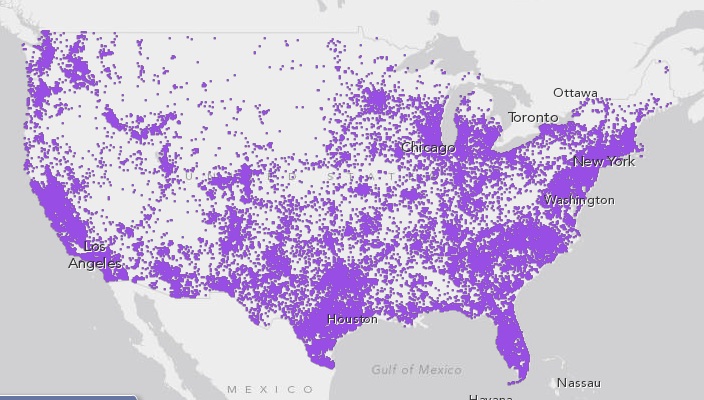
Census issues Language Mapper

That’s right, a tool that lets you plot languages by area.

Here is the national Spanish language graph (with each dot representing about 100 people.)

census

The overall message of course, is how fast Spanish and LEP folks are spreading throughout the country.  Almost every court and program is impacted.

The tool includes several languages and zoom capacity, so you can zoom in onto a very local area.  Here is the DC western suburbs at maximumzoom.

Census-dc copyEnjoy


Posted in LEP | Comments Off on Census issues Language Mapper

First Modules Of Updated Judicial Curriculum Launched and Posted

Yesterday at the meeting of the National Association of State Judicial Educators, we launched the first new modules of the updated Judicial Curriculum on Self-Represented Litigation.   These have been developed by the the NCSC Center on Court Access for All, with funding from the Public Welfare Foundation, and are based on the original curriculum launched by the Self-Represented Litigation Network at a conference at Harvard in 2007.  The first five new modules have been posted here.  These first five cover the following topics:

  • Module A. Judges, Ethics and the Self-Represented – The Law Today
  • Module B. Making the Courtroom Work – a Quick Techniques Overview
  • Module C. Starting the Self-Represented Case – Setting the Right Foundation
  • Module D. Getting Facts in Self-Represented Cases – Approaches and Techniques
  • Module E. The Decision and Beyond – Barriers, Decision and Preparation

Each module conisists of a PowerPoint and a Guide.  The Guide includes the objectives, the slides, teaching notes for the slides, activity suggestions, resources, and suggestions for which Best Practice video to use.

We hope that these modules will be easier to use than the original curriculum, and particularly that they can more easily be integrated into larger educational programs.

The modules have, of course, been updated to reflect changes in the law, inducing Turner, the CCJ resolution, and changes in state judicial conduct codes.

These modules will be updated, and we welcome feedback and ideas.  We also plan additional modules.

p.s.  Brief video report here.

Posted in Judicial Ethics | Comments Off on First Modules Of Updated Judicial Curriculum Launched and Posted

Law Student Pro Bono, The ABA, CCJ Resolution and the Moral Crisis of the Profession

This is an important week for the issue of mandatory law student pro bono, and also for the moral status of the bar.

As David Udell and Deborah Rhode explain in a National Law Journal article, The ABA body responsible for law school accreditation has to decide whether to include a requirement for law student pro bono in law school graduation requirements.  So far the omens are not good:

Back in November 2012, when we asked the ABA’s Standards Review Committee to include the 50-hour requirement in the revised accreditation standards that it was then developing for consideration by the Council of the ABA Section on Legal Education and Bar Admission, the Committee rejected the idea, noting in its minutes that it “did not agree that such a requirement was correctly placed in the accreditation standards.”

Years earlier, however, the dialogue had already moved beyond the baseline question of whether the ABA’s standards should cover pro bono service.

They do, at Section 302(b)(2), which directs law schools to provide “substantial opportunities” to students to perform pro bono service. The real problem is that “substantial” has never been defined. It’s that vagueness that requires correction, as was underscored in May 2012 when New York moved to create its own 50-hour pro bono service requirement as a condition of admission to the New York bar.

Perhaps the ABA will find it informative that the Conference of Chief Justices passed,on July 31, a Resolution encouraging the concept at the state level.  The key language:

NOW, THEREFORE, BE IT RESOLVED that the Conference of Chief Justices encourages the Chief Justice of each state to discuss with the Deans of their law schools a proposal that students perform pro bono service prior to law school graduation as a condition of admittance to the State bar.

The whereas clauses make the case really well:

WHEREAS, it is vital to the state courts that lawyers commencing their legal careers be qualified to engage in the practice of law; and

 WHEREAS, pro bono services performed by law students during law school are a form of essential training which provide students with a real opportunity to learn about the law,     the courts, and the students’ own professional responsibility for helping to assure access     to justice; and

 WHEREAS,  it is a matter of concern that not all law schools currently assure that all students participate in experiential learning opportunities that would enhance their education in the skills necessary to practice law; and

 WHEREAS, the American Bar Association Standards for Legal Education presently only state that law schools shall provide a substantial opportunity to students for experiential learning; and

 WHEREAS, in order to assure that new lawyers will emerge from law school with a real world understanding of litigants and courts, the New York Unified Court System has adopted a new fifty-hour pro bono service requirement for applicants seeking admission to the  New York bar; and

WHEREAS, courts and legislatures across the country will likely give serious consideration to the  adoption of statewide experiential learning requirements, the modification of the ABA Council of the Section of Legal Education and Admission to the Bar Standards for Legal Education offers an especially effective manner to achieve the goal of more capable  practitioners while also providing enormous value to the individuals in our justice system who will be the direct beneficiaries of these services[.]

What the opponents seem to forget is that this is about far more than getting a few more pro bono hours out of law students, or even impacting the long term views of young lawyers.  It is about whether the institutions of the bar recognize that they are organizations with a responsibility to support and facilitate access.

Unless they do so, the bar will be at increasing risk of loosing the moral authority that is the only ultimate justification for the highly privileged position as self-regulators that it enjoys in many states.  Moreover, at even greater risk will be the lawyers professional monopoly.  If a monopoly self-regulated bar puts self-protection first, then why keep it?

Posted in Law Schools, Legal Ethics, Non-Lawyer Practice | 3 Comments

Another Mobile App to Get us Thinking About Potential

The University of California at Irvine Center of Excellence on Elder Abuse and neglect has released an app that might get us thinking.

As described:

Based on input from multidisciplinary community partners, we’ve created these useful features for this mobile app:

Warning Signs of abuse, neglect and financial exploitation
What to look for in the home environment, caretaker behavior, elder/dependent adult behavior, medical markers
Elder and Dependent Adult Penal Code 368
Easy-to-reference summary of Penal Code 368
Other common crimes that can be used in conjunction with a PC 368 arrest
Quick tips on Memory Loss, People with Dementia as Witnesses, Caretaker Role, assessing common injuries like Bruises and Pressure Sores
Agency Contacts for cross-reporting and for providing assistance to the victim

This got me thinking about some tools that take fuller advantage of the sensors in mobile units.

  • Taking a photo that can analyze for whether a bruise is inflicted with an instrument or body part
  • Tool to gather the data for the reporting form – and send it electronically
  • Geolink to nearest medical and law enforcement
  • For victims — recording of attack triggered by sound patterns or movement patterns
  • Dialing law enforcement, similarly triggered.

Building such apps requires collaboration between advocates, scientists, medical people and techies.

Posted in Document Assembly, Domestic Violence, Mobile Technology, Technology | Comments Off on Another Mobile App to Get us Thinking About Potential

Tools for SRL Courtroom Observation Project

I am delighted to be able to post the excellent instruments used in the Brooklyn Family Court SRL observational study, which is part of the Justice Index Project of the National Center for Access to Justice.

As you may know, this project is observing and recording whether Judicial Officers are taking recommended steps to ensure access according to the “engaged” model for judging, and will assess whether the use of these techniques has an impact on satisfaction.

From the Courtroom Observation Form, below are some of the items that were looked for.

Did the Judicial Officer:

Frame the hearing by stating why the parties are in court
Explain the right to be represented by an attorney and get an explicit waiver (e.g., “I will speak for myself.”)
Explain the relevant legal context within which the matter will be decided
Give one or both parties the opportunity to consent to some part of the process
Explain the courtroom process to the litigants
Ask questions to draw out relevant information from litigant(s)
Use the hearing to attempt to get the parties to reach agreement
Rule from the bench
Explain the ruling
Use technical legal terms without explaining them in English
Explain the next steps in the process at the end of the hearing
 If one side was represented by counsel, [r]aise an issue on behalf of the unrepresented litigant
 If one side was represented by counsel, [a]llow counsel to frustrate the self-represented litigant’s attempts to present evidence through the use of evidentiary objections
 Lose her or his composure by raising her or his voice with a litigant or otherwise showing irritation or displeasure with a litigantIt should be noted that the form allows for comments, and collects other data about the case.

The Litigant Satisfaction interview includes the opportunity to agree or disagree with the statements below

1.  The judge had the information needed to make good decisions

2.  The judge cared about my case

3.  The judge did not treat me with courtesy and respect

4.  The judge listened to my side before deciding

5.  The court’s process required me to waste time today

6.  In my case, the judge treated all sides the same

7.  The way my case was handled was fair

8The judge allowed me to say what I needed to say about my case

9.  I understand what happened in my case today

10.  I did not understand some of the legal words used in court today

11.  The judge was well prepared for my case

12.  The judge explained the decision (if the judge made a decision)

13.  The outcome of the hearing was favorable to me

14.  As I leave the courthouse, I do not know what to do next

15.  My case has taken too long to get completed

16.  I needed language interpreter services that were not available

Even before we have research results, I believe that these instruuments will be a powerful tool to sensitive judges to the impact of their management of the courtroom.

I would love to see these same instruments used in other jurisdictions — combining would provide some powerful additional data.  It would be particularly powerful to use them when the impacts of other innovations are being researched

Rights to the Instruments are reserved, but authorization is granted for use by courts by languge on the linked attachments.  The contact is David Udell, Executive Director, NCAJ, udell(at)yu.edu.  The instruments were drafted by John Greacen.

Posted in Research and Evalation, Self-Help Services | 1 Comment

Follow-Up Guest Blog on Bronx Family Court Self-Help Center

Bronx Family Court Help Center
By Bronx County Family Court Clerk of Court Mike Williams

As Richard blogged yesterday, the Bronx County Family opened its new Help Center Complex this week.  Our initial goal was to relocate an extremely busy office to the first floor to allow easier access to services and improve the navigation of the building by all users.  Once underutilized space was designated, the New York State Office of Court Administration (OCA) provided funding to renovate the space for the Court Help Center.  Luckily, we were also able to obtain some new furniture from OCA funds set aside strictly for renovation projects.  There was no other funding or resources provided.  All computer and electronic equipment were redeployed or relocated from existing offices.  No additional staff were hired but many were reassigned.  The end result was an eight room complex consisting of a large waiting room, the Petition Room (which is the docketing office), the DIY (A2J terminals) room, a room to get records and court orders, a courtroom, a volunteer attorneys office, and two small offices for interviewing and conferencing.

This new space, designed with access to justice as a priority, also allowed us to expand upon our volunteer legal services partnerships.  These include:

– The NYC Volunteer Lawyer Project, which presently consists of 33 law firms and 250 court trained volunteer attorneys, staff the office twice a week and provide free legal advice with limited restrictions.
– Law students supervised by an attorney from Sanctuary For Families, a Domestic Violence Agency, are provided access to the court’s public access network computers to process Family Offense petitions utilizing the aforementioned DV application as part of their Court Advocate Project.
– Legal Information for Families Today (LIFT) a 501(c)(3), not for profit organization whose mission is “to enhance access to justice for children and families,” staffs a table and provides an array of interdisciplinary legal pamphlets for users.
– A volunteer lawyer from MFY Legal Services is provided office space one day per week for their Kinship Caregiver Project.  By utilizing a network of volunteer law firms and attorneys, this project provides persons seeking custody, guardianship or adoption, including Special Immigrant Juvenile proceedings, with full representation at no cost.

Additionally, we placed 10 DIY Form (Do-It-Yourself) public access terminals with headsets in the waiting room that host multiple types of NYS Family Court A2J interviews via the Law Help Interactive site.  This resulted in a record 40 DIY petitions being filed by court users on the first day the Help Center was opened.

While only opened a few days, the Center has already improved our court efficiency and overall operations.  By relocating different offices and personnel to a joint location, we were able to streamline our processes, lower employee workloads, increase our filings and overall productivity while reducing waiting times and improving services.  In fact, on the first day of being open, Monday July 29, 2013, the Bronx Family Court filed over 27% more petitions (262 total) on average than the first four Mondays of July.

Posted in Court Management, Self-Help Services | Comments Off on Follow-Up Guest Blog on Bronx Family Court Self-Help Center

Bronx Family Court Self-Help Center Pushes the Envelope

The Bronx County Family Court Help Center has been re-opened with a state-of-the-art integration of services.

The Help Center is conveniently located on the first floor of the courthouse, so unrepresented litigants can’t miss it and need not wait for the notoriously slow elevators in the building.  There is a huge welcoming Help Center sign above the opening.  Litigants are assisted on a first come first serve basis, no appointment is necessary.  There is no income screening.

This Center takes a comprehensive and multifaceted approach to serving the legal, procedural and informational needs of court users.

Without leaving the first floor Help Center or even moving to a different waiting area, a litigant can:

– File a petition, motion or order to show cause

– Appear before the Custody and Visitation Order Intake Judge/Referee in the Help Center courtroom

– Meet with a Volunteer Attorney for legal advice

– Request and/or receive a copy of a court order

– Select from an array of informational booklets.

In addition, the Help Center has:

– 10 public access A2J computers available for use complete with audio capabilities. (4o filings in the first day.)

– A dedicated court employee to act as a liaison for attorneys’ custody, visitation or family offense filings.

– A “Greeter” (who is also a Spanish Interpreter) to answer basic questions and navigate people to the right area expeditiously.

– A large screen TV playing court created informational videos.

– A LIFT (Legal Information for Families Today) table to assist litigants

I am told that a litigant can come into this Help Center seeking a domestic violence order of protection and can file a petition and meet with a Judge and get a temporary order and court date in a matter of 15 minutes, all in the Help Center.  As Judge Fern Fisher stated, the Bronx Family Court Help Center is, “a one stop shop access to justice dream.”

I particularity like the idea of an associated courtroom right in the Center.

When more information is available online, I will link to it.

Posted in Self-Help Services | 4 Comments

September Court Technology Conference to Feauture Self-Represented Track

The 2013 Court Technology Conference, to be held in Baltimore September 17-19, will feature a full track on the use of technology to assist in court access for the self-represented.

Session titles and descriptions are:

What do Litigants Expect?

Two national experts will describe what litigant portals do, and what other supporting technological strategies are needed. Most court websites now offer links to forms, answers to Frequently Asked Questions, and suggestions for additional resources. How do these offerings compare to pro se parties’ expectations?

What Do Self-Represented Litigants Need?

Current court portals for self-represented litigants are just a start, and they typically focus on case initiation. Learn what else litigants need from portals and what organizational strategies are necessary to run a litigant portal properly. How can technology help pro se parties manage their cases to a successful conclusion?

Successful SRL Portals

Explore three current litigant portals in California, Minnesota, and Massachusetts. See how they are both different and the same. How are they succeeding in providing on-demand support to pro se parties? Learn the plans these court leaders have for future improvements to their portals.

Risks, Challenges, and Benefits of SRL portals?

Litigant portals are not easy websites to build or maintain. Three experts will facilitate a peer-to-peer discussion about what technologies support these capabilities and how to solve typical problems. All are welcome to participate in this roundtable conversation: we want to hear about your experiences with your court’s portal.

Superb Self-Help in Other Countries

Other countries are leading the way when it comes to litigant portals. Learn about the innovative portal projects in the Netherlands, Great Britain, and Canada. Can they be models for ours? What features are relevant for America’s pro se litigants?

What’s the Implementation Roadmap?

The benchmark for great litigant portals is rising quickly. If courts are to build and maintain them successfully, many implementation issues must be identified and solved.

SRL 2023

Think beyond the current “art of the possible”: three thought leaders will discuss what self-represented litigants might need in ten years. How will their demands on the court evolve? What technological capabilities are required to meet those demands? The future may surprise and delight you (or dismay and alarm you).

For SRLs, What’s the Big Idea?

A national expert will facilitate a peer-to-peer discussion that reviews the entire track with the goal of culling the key, recurring ideas that courts should remember, consider priorities, and act upon. Participants will also discuss methods for continuing the conversation about litigant portals after the conference.

Speakers/faculty include Bonnie Hough (CA), Judge Dina Fine (MA), John Greacen (himself), Glenn Rawdon (LSC), Tom Clarke (NCSC), Susan Ledray (MN), Snorri Ogata (Orange county CA), Craig Burlingame (MA)  and myself.  We are working hard to turn this into a powerful and helpful series of sessions. 

Please do encourage your tech and leadership folks to come to learn more about access issues and the potential of technology.  Maybe this can be the launching of more national networking on technology for access to justice.

Posted in Court Management, Meetings, Self-Help Services, Technology | 2 Comments

Startup Health Insurer Model for Legal Insurance

I blogged recently about how research into randomized medicaid expansion might be making a case for broader use of the legal insurance concept.  How this interesting article in the Washington Post suggests how it might be done.  The article focuses on a startup that will soon be launching  new web-based health insurance provider — to be named Oscar.

As the article explains:

The idea behind Oscar is that using your insurance should be as easy and intuitive as using your Facebook account or your Tumblr page. As Nazemi puts it, “We have a responsibility to take the friction and pain of engagement out of the process.” The experience is familiar to anyone who uses today’s leading social networks (the former head of engineering at Tumblr now works for Oscar). But for anyone who has used the Web sites of Aetna or Cigna or Blue Cross Blue Shield, it’s something of a revelation.

Sign into your Oscar insurance account online, and you’ll see a few carefully chosen options on a page that’s otherwise white and clean. At the top, you can type in your symptoms and be taken immediately to a guided set of options, including a button that lets you talk to a doctor. Click it, and a doctor will call you, wherever you are, whatever time of day it is, within 20 minutes. If you need to see someone, the site will offer a list of nearby providers, tell you which ones are recommended for your condition and inform you how much each is likely to cost.

But it is not just about access, it also resonates with the data-driven triage concept we have been working on in the legal area.

Schlosser tells the story of an analysis his team ran on a database of six years’ worth of anonymous medical claims. The team looked only at episodes that began with a headache and ended on the same day they started, which means no follow-up care was needed.

“Five percent of those episodes accounted for 35 percent of the costs,” Schlosser marveled. “The people in that 5 percent all ended up at the emergency room. That was probably people who had a headache on Sunday night at 4 a.m. when the doctor wasn’t there. If you could just take that issue and move it to a different layer of care, a nurse coming to visit you or going online with a televisit, that’s win-win-win. It’s a win for the consumer. It’s a win for the providers. And it’s more cost-efficient.”

That’s the larger ambition of the founders: to change health care by building an insurance Web site that people trust to guide them through their care decisions.

So a legal version of this would be a great facilitator of early intervention, it would make it possible to use the least expensive intervention, and would ultimately reduce demand for court intervention — thus saving the state money.  Of course integrating this with non-lawyer practice would dramatically increase the options for cost savings.

I think most potential consumers of lawyer’ services are relectuant to be engage a lawyer unless that person is personally recommended by someone they trust.  A huge question in a legal insurance system would be whether people would be willing to make this jump.

Ogther huge questions are cost — and who would pay.  Most current legal insurance is part of union contacts.  Most people do not expect to need a lawyer — just like most young people do not expect to need medical care. It will be interesting to see if the educational programs associated with the Affordable Care Act figure out how to get “legally health” people to buy into the insurance concept.

The Oscar website might also teach us much about how legal portals might work.

Posted in Legal Insurance, Medical System Comparision | Comments Off on Startup Health Insurer Model for Legal Insurance